

AI email sequences are automated, multi-step email campaigns drafted with the help of AI tools, then reviewed and scheduled by a human before they go out. The main payoff is speed combined with relevance: you can produce a full welcome or nurture series in an afternoon instead of a week, and each email can be personalized without extra manual work. If you run marketing or sales outreach and want more sequences shipped without burning your week on drafts, this approach fits. If your list is small or your offers change daily, treat AI drafts as a starting point, not the finished product.
TL;DR:
- Generating full sequences in one pass ensures a consistent narrative arc and reduces the risk of contradictory or disjointed emails.
- Sequence emails should be reviewed carefully for tone, accuracy, correct merge field rendering, and functional links to maintain trust and deliverability.
- Using behavioral or engagement-based segments, such as purchase stage or recent activity, enhances personalization and reduces unnecessary editing post-generation.
- Ensuring technical compliance with laws like CAN-SPAM and GDPR, especially concerning identity, consent, and data use, is critical, regardless of AI assistance.
- Regularly testing and monitoring reply, click, and conversion rates over opens provides more reliable insights into sequence performance and ROI.
Table of Contents
- Sequence templates you can copy and adapt today
- The end-to-end AI workflow: brief, generate, review, export
- What an AI email builder actually needs to do
- Prompt templates that keep your brand voice intact
- Deliverability and inbox AI: what has changed and how to protect placement
- Measuring what matters once opens stop telling the truth
- A two-week pilot you can run before scaling anything
- Staying compliant when AI writes your emails
- Segmenting your list so AI sequences actually fit each reader
- Where AI tools fit in a modern email stack
- Where AI sequences go wrong and how to fix it
- What actually matters once the novelty wears off
- How Will’s playbooks help you run this without guessing
- Sources
- FAQ
Sequence templates you can copy and adapt today
Every sequence below follows the same logic: a brief goal, a cadence, and a purpose for each email. Paste these into your AI tool as a starting brief, and then adjust tone and offer to match your brand.
- Welcome series (5 emails, sent over 10 days): Email 1 confirms the signup and sets expectations. Email 2 shares your origin story or mission. Email 3 delivers a quick win or resource. Email 4 answers a common objection. Email 5 makes a soft offer. Brief example: “New newsletter subscribers, goal is trust and first purchase, offer is a starter bundle, tone is warm and direct.”
- Nurture sequence (4 emails, sent weekly): Each email teaches one concept and links to a deeper resource, building toward a pitch in the final email. Brief example: “Leads who downloaded a guide, goal is education before a demo request, tone is helpful and specific.”
- Cart recovery (3 emails, sent over 48 hours): Email 1 reminds and reassures, email 2 adds urgency or a small incentive, email 3 closes with a deadline. Brief example: “Shoppers who abandoned checkout, goal is completed purchase, offer is free shipping, tone is friendly and brief.”
- Re-engagement (3 emails, sent over a week): Email 1 asks if they still want to hear from you, email 2 offers a reason to stay, email 3 removes inactive contacts from future sends. This template performs best on lists older than six months.
- B2B outreach (4 emails, sent over two weeks): Email 1 opens with a specific observation about the prospect’s business, email 2 shares a relevant example, email 3 handles a likely objection, email 4 asks for a short call.
The end-to-end AI workflow: brief, generate, review, export
The fastest path to a usable sequence runs through five checkpoints, each with a clear owner.
- Write a one-paragraph brief. Name the audience, the goal, the offer, the tone, and the merge fields you have available (first name, company, last action taken).
- Choose your generation mode. Generating the whole sequence in one pass keeps the narrative arc consistent and avoids repeated openers. Generating email by email gives you more control but risks a disjointed flow across the series.
- Run the human review checklist. Check for consistent voice across emails, confirm every claim and offer detail is accurate, verify merge fields render correctly, and make sure links point to the right pages.
- Export and map fields. Match your AI tool’s merge tags to your ESP’s format before import, whether that is Mailchimp, Klaviyo, or ActiveCampaign, since native template exports save hours of manual rebuilding.
- Automate the send with a trigger. Set the entry condition (signup, cart abandonment, tag applied) and confirm timing before turning the sequence live.
Pro Tip: Run the planning pass as one prompt for the whole sequence, then edit individual emails afterward. This keeps the story consistent while still letting you fine-tune each message.
A practical rundown of AI writing tools and workflows can help you pick the right generator for this stage, and a deeper breakdown of pilot guidance for AI-generated campaigns walks through the review step in more detail.
What an AI email builder actually needs to do
Marketing claims aside, judge a tool by what it can produce and export, not by its landing page copy.
- Coherent multi-email generation: the tool should produce a full sequence that reads as one story, not five disconnected drafts.
- Brand memory: it should retain your tone, offer details, and past emails across a session so later emails do not contradict earlier ones.
- ESP export: native templates for common platforms save you from rebuilding every email by hand.
- Personalization tokens: merge fields should map cleanly without manual find-and-replace.
- Deliverability guardrails: built-in checks for spam-trigger phrasing and structure are worth more than a longer feature list.
- Clear pricing and quotas: know your generation limits before you commit a campaign to the tool.
- Data handling transparency: understand where your prompts and customer data are stored and for how long.
Red flags include vague claims about “AI-powered everything” with no example output, no export options beyond copy-paste, and no visible limits on generation volume.
Prompt templates that keep your brand voice intact
A good prompt is really just a good brief written in plain language. Use this shell as your starting point:
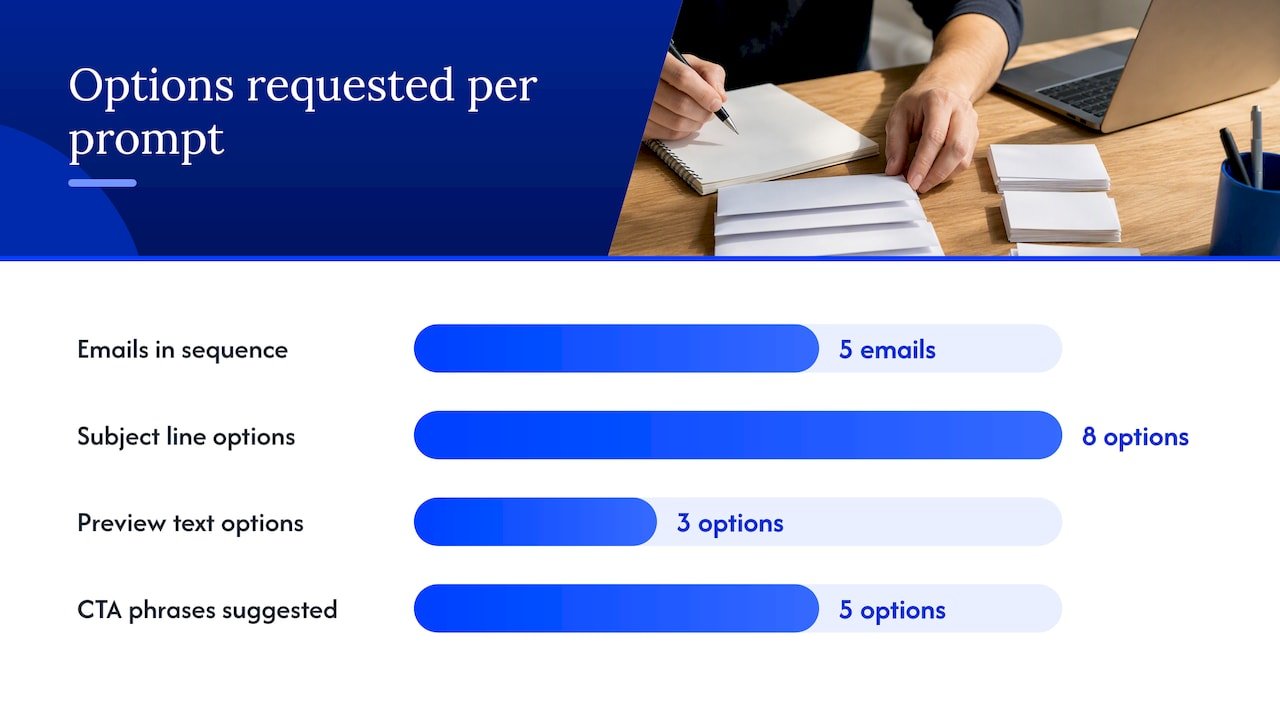
- Universal sequence brief: “Write a [number]-email [sequence type] for [audience], goal is [specific outcome], offer is [offer], tone is [three adjectives], merge fields available are [list]. Keep each email under [word count] words.”
- Subject line prompt: “Give me 8 subject line options for email [number] of this sequence, mixing curiosity and directness, under 50 characters each.”
- Preview text prompt: “Write 3 preview text options for this email that complement the subject line without repeating it.”
- CTA prompt: “Suggest 5 call-to-action phrases matching a [tone] voice for a reader who has already read two prior emails in this sequence.”
Pro Tip: Always ask for options in batches of five or more, then pick and mix rather than accepting the first draft. Volume gives you real choice.
Here is a full example brief for a five-email welcome series: “Write a 5-email welcome sequence for new email subscribers of a fitness coaching brand. Email 1 confirms signup and sets expectations, email 2 shares the coach’s background, email 3 delivers a quick workout tip, email 4 addresses the objection ‘I don’t have time to work out,’ and email 5 offers a discounted first session. Tone is encouraging and direct. Merge fields available: first name, signup source. Keep each email under 150 words.” For more prompt shells organized by campaign type, a set of ready-to-use AI brief templates covers subject lines, CTAs, and full sequences side by side.
Deliverability and inbox AI: what has changed and how to protect placement
Mailbox providers now lean on AI for summarizing and filtering incoming mail, which changes what a subscriber sees before they even open your email and can quietly reduce inbox placement if your content or structure looks off, according to the 2026 Benchmark Report from Validity. Deliverability now leans more on sustained engagement, meaning opens, clicks, replies, and forwards, than on content alone, per the Unspam.
- Lock down authentication: SPF, DKIM, and DMARC records should be current before you scale any AI-generated sequence.
- Control your annotations: implement schema markup so Gmail and other providers show your intended preview instead of a generic AI summary.
- Front-load clarity: put your key point and offer early in the email body so AI summarizers represent it accurately.
- Clean your list regularly: remove inactive contacts before launching a new sequence, since sustained engagement carries more weight than raw list size.
A single technical or engagement misstep can quietly cap your reach. Mailbox providers increasingly enforce bulk sender requirements and annotation standards, and falling out of compliance affects every sequence you send afterward, not just one campaign.
Stay mindful of consent and transparency too: collect only the data you need, disclose how it will be used, and give subscribers a visible way to manage their preferences.
Measuring what matters once opens stop telling the truth
Opens are a weaker signal than they used to be, since privacy features and AI-driven previews inflate or obscure real engagement. Track replies, conversions, and on-site behavior instead, alongside inbox placement checks, to see what a sequence is actually doing.
- Set your primary KPIs first. Reply rate and conversion rate tell you more than open rate ever will.
- Test one variable at a time. Start with subject lines, then move to cadence, then personalization depth.
- Watch for micro-moment triggers. A click on a specific link can justify a faster follow-up than your default cadence.
- Tie results to revenue. Connect sequence performance to actual sales or booked calls, not just clicks.
- Report on a fixed cadence. Weekly during a pilot, monthly once a sequence is stable.
A two-week pilot you can run before scaling anything
Pick one small, well-defined segment. Write the brief, generate the sequence, run the human review checklist, then send to that controlled cohort only. Watch reply rate and conversions over the two weeks, not just opens. A pilot that produces a handful of real replies and at least one conversion is worth scaling. One that produces neither means the brief, not the AI tool, needs a rewrite.
— Will
Staying compliant when AI writes your emails
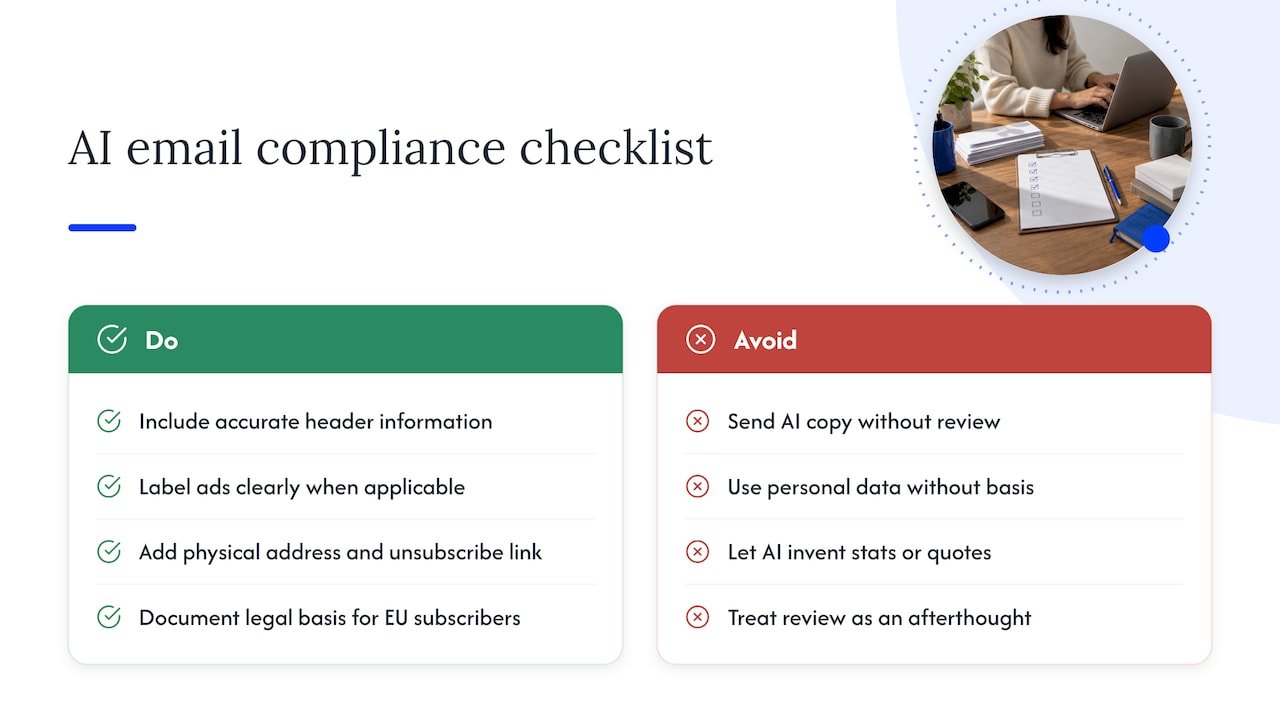
AI-generated copy does not change your legal obligations. Under CAN-SPAM, every commercial email still needs accurate header information, a clear identification that it is an advertisement where applicable, your physical address, and a working unsubscribe link that gets honored promptly. AI tools do not automatically include these, so your review checklist needs a line item for them every time.
GDPR adds another layer if you have subscribers in the European Union: you need a documented legal basis for emailing them, typically consent, and you must be able to show what data you collected and why. AI-assisted personalization that pulls from customer data (browsing history, purchase behavior, location) should only use fields you have a legitimate basis to process, and your privacy policy needs to reflect that AI tools are part of your workflow if they touch customer data.
There is also an honesty question that sits outside strict legal requirements. If an AI drafts a story, testimonial, or claim that sounds like a real customer experience but is not, that is a problem regardless of what the law technically requires. Keep AI-generated content factual, verify every claim before it ships, and never let a tool invent a statistic, quote, or case study to fill a gap in your draft. Treat the review step as your compliance checkpoint, not an afterthought, since a legal issue in email 3 of a five-email sequence still affects your whole list.
Segmenting your list so AI sequences actually fit each reader
AI personalization is only as good as the segments you feed it. Broad demographic splits (age, location) rarely produce meaningfully different emails. Behavioral segments do: what someone clicked, what they bought, how long since their last interaction, and where they entered your funnel.
Start with three practical splits: acquisition source (which lead magnet, ad, or referral brought them in), engagement level (active openers and clickers versus dormant contacts), and purchase stage (browsing, cart abandoned, past customer). Each of these changes what the AI brief should say. A dormant contact needs a re-engagement tone and a reason to come back, while a recent purchaser needs a follow-up that assumes context, not a cold introduction.
Feed these segment definitions directly into your brief as a merge field or a tone instruction, not just as a list filter. Telling your AI tool “this reader abandoned a cart three days ago and has never purchased before” produces a sharper email than a generic nurture prompt applied to everyone. The tighter the segment, the less editing your draft will need afterward, and the more the personalization will read as genuine rather than templated. A lead magnet strategy that feeds clean, well-tagged leads into your sequences makes this segmentation easier from the start, since the tag applied at signup becomes your first behavioral data point.
Where AI tools fit in a modern email stack
Most AI email tools fall into two categories: generators built into existing email service providers, and standalone drafting tools you use before importing copy elsewhere. Some sequence builders can generate a full multi-email flow from a single brief and export ESP-ready HTML or native templates, which speeds up setup considerably while keeping the sequence coherent from email to email.
The practical difference between tools shows up in three places: how well they hold context across a multi-email sequence, how cleanly they export to your specific ESP, and whether their subject-line and preview-text suggestions come as real alternatives rather than one option restated five ways. A tool that nails generation but exports as plain text will still cost you hours of manual formatting.
Rather than chasing the newest name on a landing page, evaluate any candidate against the feature checklist earlier in this guide, and pressure-test it with a real brief before committing. A roundup of AI writing tools built for marketers walks through several options side by side if you want a starting shortlist, and general context on what email marketing does for growth is worth a skim if you are new to the channel’s economics.
Where AI sequences go wrong and how to fix it
The most common failure is generic tone: AI drafts that sound like nobody in particular, which readers spot fast and stop trusting. Fix it by feeding the tool real examples of your past writing and specific tone instructions, then editing every draft by hand before it ships. A workflow for humanizing AI-drafted content covers this edit pass in detail.
The second failure is broken continuity: emails generated one at a time that repeat the same opener or contradict an earlier claim. Generating the full sequence in one planning pass, rather than email by email, largely solves this.
The third failure is factual drift: an AI tool inventing a detail, misstating an offer, or summarizing your product incorrectly. Every claim needs a human check against your actual offer terms before send, no exceptions.
Finally, broken links and bad merge fields do outsized damage. A dead link or a merge tag that renders as “Hi [First Name]” instead of a real name destroys trust immediately and produces a disproportionate hit to engagement signals on the emails that follow. Test every link and every merge field on a sample send before the sequence goes live to your full list.
What actually matters once the novelty wears off
The conventional advice treats AI email tools like a content faucet: brief in, sequence out, done. That undersells the real risk and the real opportunity. The risk is that generic, unreviewed AI copy erodes trust faster than no email at all, because readers now expect a certain baseline of relevance and spot a hollow draft immediately. The opportunity most marketers underuse is treating the AI as a drafting partner for structure and volume, while keeping every fact, offer detail, and brand voice decision in human hands.
Prioritize the planning pass and the review checklist before you touch subject-line variants or send-time optimization. A well-structured five-email sequence with a mediocre subject line will still outperform a brilliant subject line attached to a disjointed sequence. Get the arc right first, then polish the edges.
— Will
How Will’s playbooks help you run this without guessing
Building your first AI email sequence is straightforward once you have a brief template and a review checklist in hand. Scaling that into a reliable system across multiple campaigns is where most marketers stall, and that is exactly what our coaching and playbooks are built to solve.
A pilot structure like the one covered in this guide can be used in a step-by-step program: segment your list, write the brief, generate the sequence, run the review, and send to a controlled cohort before scaling further. If you want the guided version instead of piecing it together alone, here is where to start.
- Book a coaching call to map out your first pilot sequence with direct feedback on your brief and review process.
- Join the pilot program through our two-to-four-week automation pilot, which fixes links and merge fields before you ever hit send.
- Grab the workflow playbook at AI workflow automation for affiliate marketers for the templates and checklists behind everything in this guide.
Sources
FAQ
What are the best email sequence platforms?
The right platform depends on whether you need built-in AI drafting, strong ESP export, or both. Evaluate any candidate against a feature checklist covering multi-email coherence, personalization tokens, and native export before committing, rather than picking based on marketing claims alone.
What is the 30/30/50 rule for cold emails?
Definitions of this rule vary across practitioners, so treat any specific breakdown with caution unless it comes from a source you trust. The general principle behind most versions is to weight your effort toward list quality and personalization before worrying about the email copy itself.
Is there an AI to organize emails?
AI tools that help draft and structure email sequences exist, and some can generate a full multi-email flow from a single brief and export it in ESP-ready formats. For organizing an inbox itself rather than drafting outbound campaigns, that is a separate category of tool outside the scope of sequence building.
Can you give me an example of an email sequence?
A common example is a five-email welcome series: confirm signup, share your story, deliver a quick win, handle an objection, then make a soft offer, sent over about ten days. Cart recovery sequences typically run shorter, three emails over 48 hours, moving from a reminder to an incentive to a deadline.