

Run an analyzer first. Feed it a real product and see whether it surfaces themes with sources attached, not just a tidy paragraph. Only after that check should you trust a generator to draft copy or a summarizer to represent customer sentiment. AI product reviews are getting genuinely useful, but the quality gap between tools that link their evidence and tools that don’t is the whole story right now.
TL;DR:
- Verified source linking and recent reviews are essential for trustworthy AI review summaries, especially when handling products with mixed feedback.
- AI tools that analyze multiple platforms and provide clear source evidence outperform generative or superficial analysis systems.
- Detection of AI-generated fake reviews remains effective but can produce false positives, so manual review is always necessary.
- Using AI for drafts and summaries requires human verification, especially for negative themes and source transparency, to maintain authenticity and credibility.
- The most successful workflows combine AI analysis for identifying genuine issues, careful manual editing, and transparent source linking, as demonstrated by the Wayfair pipeline.
Table of Contents
- What Are AI Product Reviews, and Which Tools Actually Deliver?
- How Does AI Actually Read and Summarize Reviews?
- What Should You Check Before Trusting an AI Review Tool?
- Three Copyable Workflows for Generating and Verifying Reviews
- How Accurate Are AI Detectors at Spotting Fake Reviews?
- When Should You Use a Generator vs. an Analyzer?
- What Do AI Review Tools Actually Cost?
- Has AI Review Technology Actually Worked in Practice?
- Where Does AI Still Fall Short on Product Reviews?
- Balancing Automation With Authenticity
- Ready to Put This Into Practice?
- Sources
What Are AI Product Reviews, and Which Tools Actually Deliver?
AI product reviews come in two flavors that get lumped together constantly, and the confusion costs marketers time. One category generates review copy from scratch, drafting persuasive product write ups for affiliate content or landing pages. The other analyzes existing customer feedback and produces a summary, a verdict, or a trust score. Knowing which one you’re using changes how much you should trust the output.
Here’s how the current shortlist breaks down for real-world use.
Quillbot AI product review generator builds fast draft reviews and templates aimed squarely at content creators and affiliate marketers. It’s a generation tool, not an analysis tool, so treat its output as a first draft that needs editing, disclosure, and real product experience layered on top. ReviewAI (reviewai.pro) takes the opposite approach: it aggregates Amazon reviews alongside Reddit threads and YouTube commentary to produce a BUY, SKIP, or CAUTION verdict, which matters because cross-referencing multiple sources surfaces community signals that a single platform’s star rating hides. ReviewGen.ai targets brands rather than shoppers or affiliates, offering systematic review solicitation and AI-assisted response templates for companies managing their own reputation. Thryv folds review monitoring into a broader small-business software suite, useful if you already run other operations through it. Reviews.ai, Reviewly.ai, Mobal.io, and Magic Feedback round out the commercial field with varying mixes of collection, generation, and light analysis, though none publish the kind of methodology detail that lets you judge accuracy with confidence.
| Tool | Best for | Primary function | Standout feature | Pricing model |
|---|---|---|---|---|
| Quillbot | Fast affiliate/marketing draft copy | Generate | Editor controls, marketer templates | Free tier plus paid plans |
| ReviewAI (reviewai.pro) | Quick buy/skip verdicts | Analyze | Cross-platform evidence (Reddit, YouTube) | Freemium |
| ReviewGen.ai | Brands collecting and responding to reviews | Generate/collect | Business-facing review solicitation | Paid tiers |
| Thryv | Small businesses already using Thryv software | Analyze | Bundled with broader CRM suite | Paid subscription |
| Reviews.ai | Businesses wanting review widgets and monitoring | Collect/analyze | Review display integrations | Paid tiers |
For a purely academic look at what separates a reliable analysis from a plausible-sounding one, an open-source classification pipeline is worth understanding before you pick a commercial tool at all, which the next section covers.
How Does AI Actually Read and Summarize Reviews?
Most people assume AI review tools all work the same way. They don’t, and the distinction matters for what you should expect from the output. Generative tools like Quillbot’s write from a prompt and their own training patterns, essentially guessing at persuasive language. Extractive and aspect-guided systems work differently: they pull actual sentiment tied to specific product features, such as “battery life” or “sizing,” directly from real customer text.
The most detailed public example of the aspect-guided approach comes from a large-scale pipeline built for Wayfair. It extracts aspect-sentiment pairs, consolidates similar aspects so “runs small” and “too tight” count as the same signal, and samples a representative set of reviews before generating a summary. The system caps input reviews at a manageable limit per product and covered tens of thousands of products across millions of reviews in its released dataset. That cap isn’t arbitrary. Feeding a summarizer every review a popular product has ever received doesn’t improve accuracy, it just adds noise and cost.
Three failure points show up again and again in AI-generated summaries:
- Hallucination. The model states a feature or complaint that no reviewer actually mentioned.
- Sarcasm misreads. “Great, it broke on day one” gets scored as positive sentiment.
- Niche terminology gaps. Technical or hobbyist vocabulary gets flattened into generic praise or complaint language.
Salesforce’s guidance on AI summarization backs this up directly: tools still struggle with sarcasm, niche terminology, and nuanced human context, which is exactly why a human spot-check stays part of any serious workflow, not an optional extra.
What Should You Check Before Trusting an AI Review Tool?
Most AI review tools look polished in a demo. The real test happens when you feed one a product you already know well and see if it tells you the truth.
- Confirm it links to source reviews. If you can’t click through from a theme to the actual customer quotes behind it, the summary is unverifiable by design.
- Check whether negatives get exposed. A tool that only surfaces praise is marketing copy wearing an AI costume, not analysis.
- Ask about refresh cadence. Products change, batches vary, and a summary built from 18-month-old reviews can actively mislead.
- Test verified-purchase filtering. Unverified reviews skew results, especially for products with active fake-review problems.
- Look for published methodology. Vendors willing to show their dataset size, sampling rules, or test results are giving you something to evaluate against.
Spend 30 to 60 minutes running a real trial before committing. Pick a product you know has both fans and detractors, run it through the tool, and check whether the negative themes it surfaces match what you already know is true. Then try feeding it a handful of reviews you suspect are fake or AI-written and see if anything flags.
Pro Tip: Ask any vendor directly whether they’ve published A/B test results or a sample dataset. The aspect-guided pipeline built for Wayfair released both, and that kind of transparency is rare enough that its absence should make you cautious.
Three Copyable Workflows for Generating and Verifying Reviews
Reading about AI review tools is one thing. Actually using one without embarrassing yourself in front of an editor or an FTC complaint is another. Here are three workflows worth stealing.
- Draft affiliate copy without losing authenticity. Run your product notes through a generator like Quillbot for a first-pass structure, then rewrite every claim you haven’t personally verified. Add an explicit AI-assisted disclosure, pull in one or two verbatim customer quotes, and run a manual realism check against verified-purchase reviews before publishing. An affiliate review template walks through this structure in more depth.
- Build aspect-guided summaries for product pages. Sample a capped, representative set of reviews rather than all of them, consolidate similar aspects, and set a refresh trigger, a common production rule is rebuilding the summary once new reviews reach roughly 10% of the existing count. Always keep a visible link from each theme back to source review counts.
- Run a quick classifier and human audit pass. Pull a product’s most recent 100 reviews, run a TF–IDF style check for AI-generated language patterns, and flag anything scoring high for manual review rather than automatic removal.
Pro Tip: Never let a classifier auto-delete a review. Flag it, then check it yourself. Even strong models produce false positives on human-written reviews that simply read a little formal. For the product-selection side of this pipeline, A product research workflow covers how to pick what to review in the first place.
How Accurate Are AI Detectors at Spotting Fake Reviews?
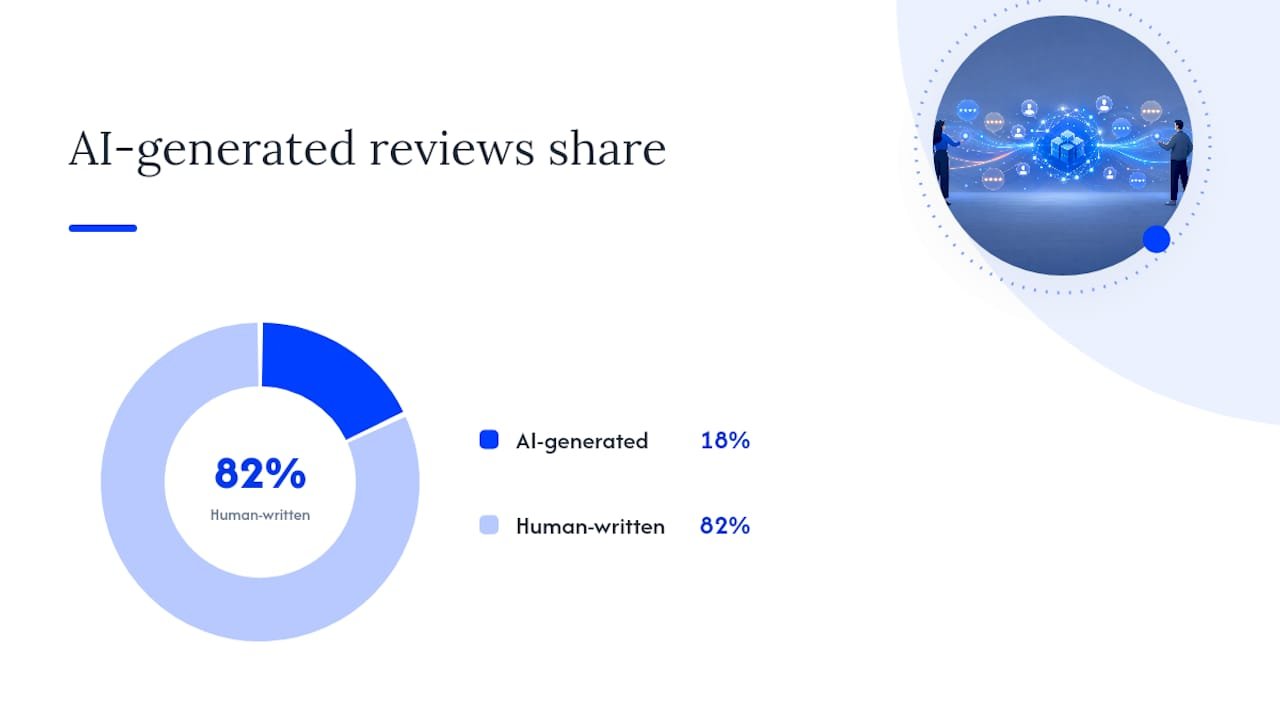
Detection technology is more mature than most marketers realize, and also narrower than most vendors admit. A study using TF–IDF features combined with a support vector classifier tested 6,217 Amazon reviews, of which 1,116 were labeled AI-generated, and reported an F1 score of 0.9925 on the test set. That’s a strong result within a focused, well-labeled dataset.
The catch is that focused datasets don’t always generalize. The same classification approach can produce false positives on reviews that are human-written but AI-edited, or written by a non-native English speaker in an unusually formal register. Treat a high detection score as a flag for human review, never as an automatic takedown trigger.
On the transparency side, Nielsen Norman Group’s guidance is blunt: AI review summaries build trust only when they surface both positive and negative themes and link back to source reviews with counts and quotes. A summary that hides the raw material behind it is asking for blind trust, and shoppers increasingly know better than to give it.
A few operational rules keep this honest:
- Set a minimum sample size before trusting any summary. Five reviews tell you nothing.
- Re-run summaries once new review volume grows by roughly 10%.
- Spot-check a small, random sample of flagged “likely AI” reviews by hand every cycle, not just when something looks obviously wrong.
For a deeper look at detection tooling beyond reviews specifically, an AI content detection guide covers the broader landscape.
When Should You Use a Generator vs. an Analyzer?
The job determines the tool, not the other way around. Drafting affiliate copy calls for a generator like Quillbot, edited hard and disclosed honestly. Researching whether a product is actually good calls for an analyzer, something closer to ReviewAI’s cross-source model, because a single platform’s star average hides too much. Fraud and authenticity checks call for a classifier plus a human, never a classifier alone.
Three defaults are worth adopting regardless of which tool you pick, especially when you want to optimize your ecommerce conversion on product pages like these: product pages that convert.
- Always link summarized themes back to their source reviews and counts.
- Always surface negative themes alongside positive ones, never just the flattering half.
- Always require human verification before a high-stakes recommendation goes live, especially one tied to a purchase decision or a paid partnership.
While you’re trialing tools, track three numbers: time saved per review cycle, any conversion lift on pages using AI-assisted summaries versus static ones, and how often your human spot-check disagrees with the AI’s verdict. That last number tells you more about a tool’s real reliability than any marketing page will.
What Do AI Review Tools Actually Cost?
Pricing across this category splits roughly three ways. Consumer-facing generators like Quillbot typically offer a free tier with limited output, then paid plans that unlock longer drafts, more templates, and editing controls, priced similarly to other AI writing subscriptions. Cross-source analyzers like ReviewAI tend to run freemium models, a basic verdict lookup at no cost with deeper cross-platform evidence gated behind a subscription.
Business-facing tools built for brands rather than individual marketers, ReviewGen.ai and Thryv among them, price differently again. These usually run on monthly subscription tiers scaled to review volume or business size, since the value proposition is ongoing reputation management rather than one-off content drafting. Reviews.ai and similar collection-and-display tools follow a comparable subscription structure tied to how many review widgets or integrations a business needs.
None of the vendors in this space publish enterprise-grade pricing transparency, so the honest advice is to treat published rates as a starting point and confirm current tiers directly before committing. What’s worth budgeting for either way is the human time a real workflow still requires: editing generated drafts, spot-checking flagged fake reviews, and verifying summaries against source material. Skipping that step to save a subscription fee tends to cost more in credibility than the tool ever saved in hours.
Has AI Review Technology Actually Worked in Practice?
The clearest documented example of AI review technology working at scale is the aspect-guided summarization pipeline built for Wayfair, which processed 92,000 products against 11.8 million reviews and moved into production with A/B testing that showed measurable engagement improvements. That’s a genuine success story, and it’s notable specifically because the team released their methodology and a large anonymized dataset instead of just claiming results.
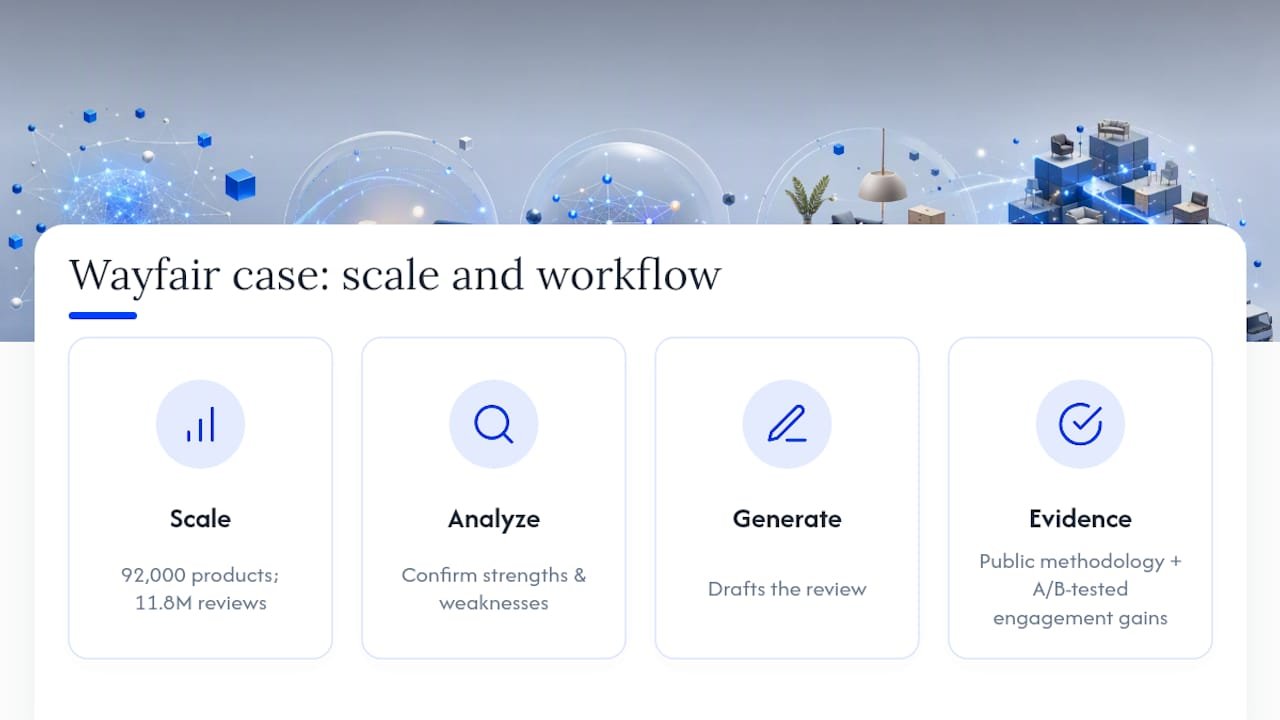
Smaller-scale wins show up constantly in affiliate marketing, though they’re harder to verify publicly since most creators don’t publish their process. The pattern that works reliably: use an analyzer to confirm a product’s real strengths and weaknesses before writing about it, then draft with a generator, then edit hard against verified-purchase language. Marketers who skip the analysis step and generate straight from a product description tend to produce reviews that read as generic.
The honest gap here is that most of the “success stories” circulating in marketing content are vendor case studies without independent verification. The Wayfair pipeline stands out precisely because its evidence is public and reproducible, which is a low bar that most of the industry hasn’t cleared yet.
Where Does AI Still Fall Short on Product Reviews?
The technology has real ceilings worth knowing before you build a workflow around it. Sarcasm detection remains weak across nearly every model on the market, and niche or technical vocabulary, the kind hobbyist and enthusiast communities use constantly, still gets flattened into generic sentiment far too often.
Hallucination is the bigger risk for anyone publishing AI-assisted content. A generator can state a feature or a complaint that no actual customer ever mentioned, and it will do so in confident, fluent language that reads exactly like a verified claim. Detection classifiers carry their own limitation: strong results within a labeled dataset don’t guarantee the same accuracy against reviews the model has never seen a pattern like before, and false positives on legitimate human writing are a real cost of running detection too aggressively.
There’s also a trust problem baked into the interface layer. Summaries that don’t link back to source reviews are functionally unverifiable, no matter how confident they sound, and NN/g’s research is direct about this: AI summaries should supplement raw customer reviews, never replace them. Any tool or workflow that hides its evidence is asking shoppers, and marketers, to trust it blindly. The tools worth using are the ones that make it easy to check their work, not the ones that make checking unnecessary.
Balancing Automation With Authenticity
I’ve watched marketers fall into two traps with AI reviews: automating everything and losing the voice that made their content trustworthy, or refusing AI entirely and burning hours a generator could save responsibly. Neither works. The KPIs I actually watch when testing a tool are simple: does it expose negatives unprompted, and does my manual spot-check ever disagree with its verdict. If either answer worries me, I don’t ship it. For readers who want a structured way to adopt this without guessing, An affiliate review template serves as a good starting point for new marketers.
— Will
Ready to Put This Into Practice?
This website isn’t a review generator or an analyzer. It provides workflow guidance that helps marketers use available tools to produce content they can publish under their own name. The templates and coaching guide marketers through drafting, disclosing, and verifying AI-assisted reviews to streamline the process.

Two useful resources include the 7 Part AI Assisted Affiliate Review Template, which outlines a detailed structure with disclosure language, and the AI affiliate workflow recipes, designed for managing review content across products or sites. Both are built for marketers who want AI doing the heavy lifting, not the thinking, on content that still has to hold up to a reader’s scrutiny. If you’re ready to see how these workflows fit into a full affiliate strategy, start with the case study data Willbuckley has published from real campaigns.
Sources
- Classification of Artificial Intelligence-Generated Product Reviews on Amazon
- AI summaries of reviews
- End-to-End Aspect-Guided Review Summarization at Scale