

You want prompts that produce affiliate content you can actually publish, not another generic list you have to rewrite from scratch. Below you will find template prompts grouped by task (reviews, comparisons, buying guides, email, SEO) and mapped to funnel stage, plus audit prompts that catch the mistakes AI tends to make and a real workflow from Will Buckley’s own process. Copy one, drop in your product and audience details, and run it.
TL;DR:
- Using structured prompts tailored to specific funnel stages significantly improves AI-generated affiliate content quality and relevance.
- Incorporating real product data, clear criteria, and detailed output schemas ensures unbiased, accurate, and trustworthy drafts suitable for publication.
- Regular audits for factual accuracy, missing viewpoints, and compliance are essential to prevent false claims and maintain ethical transparency.
- Performance tracking for organic rankings, click-through rates, and time on page guides prompt refinement and optimization over time.
- Embedding prompts into existing workflows and updating them based on results creates a sustainable, effective content engine for affiliate marketing.
Table of Contents
- Affiliate Marketing Prompts You Can Copy Right Now
- Matching Prompts to Funnel Stage and Reader Intent
- The Prompt Structure That Actually Works
- Audit Prompts That Catch Mistakes Before You Publish
- Adapting Prompts Across ChatGPT, Claude, and Other Models
- Will Buckley’s Real Workflow, Step by Step
- Prompts for SEO Titles, Snippets, and Social Distribution
- Prompts and Wording for Honest Affiliate Disclosures
- Tailoring Prompts to Your Specific Niche
- Measuring Whether Your Prompt-Generated Content Works
- Fitting AI Prompts Into Your Existing Marketing Workflow
- Updating Prompts Based on What Actually Performs
- Why I Push Affiliates Toward Structured Prompts, Not Shortcuts
- Want the Full Playbook Behind These Prompts?
- Sources
- FAQ
Affiliate Marketing Prompts You Can Copy Right Now
The fastest way to use AI for affiliate content isn’t to ask it to “write a blog post about X.” Instead, it’s feeding it a structured brief and letting it fill in a schema you control. Every prompt below follows that logic, and every one works whether you’re running it through ChatGPT, Claude, or another model.
1. Content strategy and 90-day plan
Use this when you’re starting a new site or niche and need a roadmap instead of a blank page.
Act as an affiliate content strategist. My niche is [niche], my target reader is [audience description], and I promote [product/program]. Build a 90-day content calendar with 12 article topics grouped into awareness, comparison, and buying-decision content. For each topic, give me the target keyword, the funnel stage, and one internal linking suggestion.
2. Long-form review template
This one leans on an explicit output schema, which is the single biggest lever for getting a review that doesn’t skip evaluation criteria a reader expects. Kinsta’s prompt framework recommends building long-form reviews section by section rather than in one pass.
Write a review of [product] for [audience]. Structure it with these sections in order: quick verdict, who it’s for, key features, pricing, pros, cons, comparison to one alternative, and final recommendation. Do not invent test results or personal experience I have not provided. Flag with anywhere first-hand testing detail would strengthen the section.
For a ready-made structure you can drop straight into this prompt, Will’s seven-part affiliate review template breaks down each section in more depth.
3. Comparison article template
Comparison content converts because readers arrive already deciding between two or three named options.
Write a comparison article between [Product A] and [Product B] for someone trying to decide which to buy. Use fair, consistent criteria across both: price, core features, support, and best use case. End with a clear verdict that states which reader profile fits each option, not a single “winner.”
4. Buying guide template
Write a buying guide for [category] aimed at [audience]. Open by identifying three common use cases for this category. Build a decision matrix comparing 4 to 6 options across price, best for, and standout feature. Close with a short recommendation for each use case, not one blanket pick.
5. SEO title and meta description generator
Generating three variants instead of one lets you test which angle actually pulls clicks, a pattern that shows up across most tested affiliate prompt lists.
Write 3 SEO titles (under 60 characters) and 3 meta descriptions (under 155 characters) for an article about [topic]. Include the primary keyword [keyword] naturally in each title. Make one variant curiosity-driven, one benefit-driven, and one direct.
6. Email nurture sequence and broadcast
Write a 5-email nurture sequence for someone who just downloaded [lead magnet] and might be interested in [affiliate product]. Email 1 delivers value with no pitch. Emails 2 through 4 build a case using one angle each (problem, social proof, objection handling). Email 5 is a direct offer with urgency that is honest, not manufactured. Then write one standalone broadcast email I could send to my full list announcing the same offer.
7. Social and Pinterest pin copy
Write 5 short social captions and 3 Pinterest pin descriptions for [article/product]. Each caption should be under 200 characters, include one specific benefit, and end with a question or curiosity hook. Pin descriptions should include the keyword [keyword] naturally and a soft call to action.
8. CTA and excerpt variations
Small copy tweaks move click-through rate more than most people expect, which is why testing variants matters more than picking one “perfect” line.
- Generate 5 button CTA variations for a review page, each under 5 words.
- Write 3 short excerpt versions (under 30 words) I can use as article previews on my homepage.
- Write 2 urgency-based CTA lines and 2 curiosity-based CTA lines for the same offer, so I can A/B test tone.
These eight templates cover most of what a working affiliate site needs in a given month, based on the pattern TopFreePrompts’s collection uses across strategy, review, comparison, SEO, and email prompts chained together.
Matching Prompts to Funnel Stage and Reader Intent
Not every reader is ready to buy, and using a bottom-funnel prompt on a top-funnel reader wastes both their time and your conversion rate. ToFu (top of funnel) readers are still learning about a problem. MoFu (middle of funnel) readers are comparing solutions. BoFu (bottom of funnel) readers are deciding between specific products.
- ToFu: “Explain why [problem] happens and what options exist to solve it, without recommending a specific product yet.” This builds trust before the pitch.
- MoFu: “Compare [Product A], [Product B], and [Product C] on the criteria that matter most for [use case].” Comparison prompts fit here because the reader already knows the category.
- BoFu: “Write a review focused on removing purchase hesitation for [product], addressing the three most common objections a buyer might have.” This is where your affiliate link does the heaviest lifting.
Once you have a MoFu comparison output, you can repurpose it fast: feed the same output back into the email prompt above and ask for a condensed 3-paragraph version, or ask for 3 social captions pulled directly from the comparison’s strongest point. One draft becomes four assets.
The Prompt Structure That Actually Works
A prompt engineering checklist beats a single clever sentence every time. Kinsta’s affiliate prompt framework breaks a reliable prompt into five parts, and skipping any one of them is usually why AI output feels generic.
- System instructions: tell the model what it is and what it must never do. Example: “You are an affiliate content writer. Never invent statistics, never claim first-hand testing, never omit cons.”
- Contextual grounding: feed it your actual product data, verified pricing, and any source links you want cited. Don’t ask it to guess pricing.
- Task instructions: state the exact deliverable and format, including word count and section order.
- Reasoning criteria: tell it how to decide, not just what to produce. “Recommend based on best fit per use case, not commission rate.”
- Output schema: give it the exact structure, as shown in the review template above.
Pro Tip: Keep a “master system prompt” saved as a document and paste it at the top of every new content prompt. It takes 30 seconds and stops you from re-explaining your editorial rules every single time.
Editorial rules matter as much as formatting. Instruct the model to disclose affiliate relationships, list genuine drawbacks even for products you’re promoting, and rank by fit for the reader rather than by which program pays the highest commission. A model with no reasoning criteria will default to flattering copy, and flattering copy erodes trust faster than a mediocre product does.
Audit Prompts That Catch Mistakes Before You Publish
AI drafts read confidently even when they’re wrong, which is exactly why an audit pass matters more than a longer first prompt. Run these six after any draft:
- Fact-checker: “List every factual claim in this draft that needs a source, and flag any that sound invented.”
- Missing viewpoints: “What objections or alternative perspectives does this draft leave out that a skeptical reader would raise?”
- Source filler check: “Identify any sentence that sounds authoritative but cites no real source.”
- Pricing check: “Flag every price or numeric claim in this draft so I can manually verify it against the current listing.”
- Affiliate compliance: “Does this draft clearly disclose the affiliate relationship, and does it list at least one genuine con?”
- SEO gap finder: “Compare this draft’s headings against the target keyword [keyword] and list any missing subtopics a reader would expect.”
An audit stage that asks the model to surface missing viewpoints and required citations cuts down the fact-checking load you’d otherwise do line by line after the fact.
Before hitting publish, run through a short checklist: every claim has a source or is marked as opinion, first-hand experience claims are flagged and either verified or removed, pricing and availability are checked against the live page, and screenshots or product images are current. Then iterate: edit the weak section, re-run just that prompt, and compare the new output side by side with the old one rather than regenerating the whole piece.
Adapting Prompts Across ChatGPT, Claude, and Other Models
Most of the prompts above are model-agnostic, but small adjustments improve reliability depending on which model you’re running.
- Use a dedicated system message for editorial rules in ChatGPT and Claude; for models without a distinct system field, put those rules in the first paragraph of your prompt instead.
- Claude tends to hold structure well across very long outputs, which makes it a solid pick for long-form SEO comparison articles that run past 2,000 words.
- For short-form outputs (social captions, meta descriptions), trim few-shot examples to one or two; long examples can push the model toward matching length instead of matching tone.
- For long-form outputs, one full few-shot example of your ideal section structure beats three short fragments, since the model has more pattern to anchor to.
Will Buckley’s Real Workflow, Step by Step
Here’s the actual sequence Will runs for a new affiliate article, from research to distribution:
- Research: Run a keyword and audience research prompt, pulling from Will’s affiliate keyword research approach to confirm buyer intent, not just search volume.
- Outline: Generate a section-by-section outline using the output schema from the review or comparison template above.
- Draft: Run the full content prompt against that outline, feeding in verified product data.
- Audit: Run all six audit prompts from the previous section before touching the draft manually.
- SEO pass: Generate title, meta, and FAQ schema variants.
- Email: Repurpose the draft’s strongest angle into a nurture email.
- Repurpose: Pull social captions and pin copy straight from the finished draft.
Pro Tip: Insert placeholder tags like anywhere you plan to add real performance data later. It keeps drafts honest instead of filled with invented numbers.
Adapt the order to your niche: a physical-product review site might run the SEO pass before the audit, while a software affiliate site often needs pricing verification first since SaaS pricing changes often. For the full breakdown of this chain, see Will’s ChatGPT workflow guide for affiliate marketing.
Prompts for SEO Titles, Snippets, and Social Distribution
Getting an article written is half the job. Getting it found and shared is the other half, and these three prompt types cover most of that work.
- Title and meta generator: “Write 3 SEO titles under 60 characters and 3 meta descriptions under 155 characters for [topic], each optimized for a different angle: curiosity, benefit, and direct.”
- Featured-snippet FAQ prompt: “Write 4 FAQ questions and answers about [topic]. Each answer must be 1 to 2 sentences, direct, and written to match how Google displays featured snippets.” Applying proven AI SEO methods to on-page structure like this tends to lift both crawlability and answer-box eligibility.
- Social and pin copy: “Write 3 Pinterest pin descriptions and 3 Twitter/X posts for [article], each with a distinct hook, under the platform’s character limit, ending in a soft call to action.”
Run all three against the finished draft in one sitting so your distribution assets match the article’s final claims, not an earlier version.
Prompts and Wording for Honest Affiliate Disclosures
Disclosure isn’t optional, and vague wording buried in a footer doesn’t meet the standard regulators and platforms expect. Use these two prompt patterns:
- Post-level disclosure: “Add a one-sentence disclosure near the top of this article stating that it contains affiliate links and that I may earn a commission, in plain language.”
- Site-level disclosure: “Write a short disclosure page explaining how affiliate links work on this site, without legal jargon.”
Instruct the model directly: “List at least one genuine drawback for every product recommended, even if the drawback is minor.” Never let a draft imply first-hand testing you didn’t do. For exact wording you can adapt today, Will’s affiliate disclosure examples cover both formats above.
Tailoring Prompts to Your Specific Niche
A prompt written for a supplement review site will produce weak output if you run it unchanged on a SaaS comparison site. The fix is swapping out the context block, not rewriting the whole prompt.
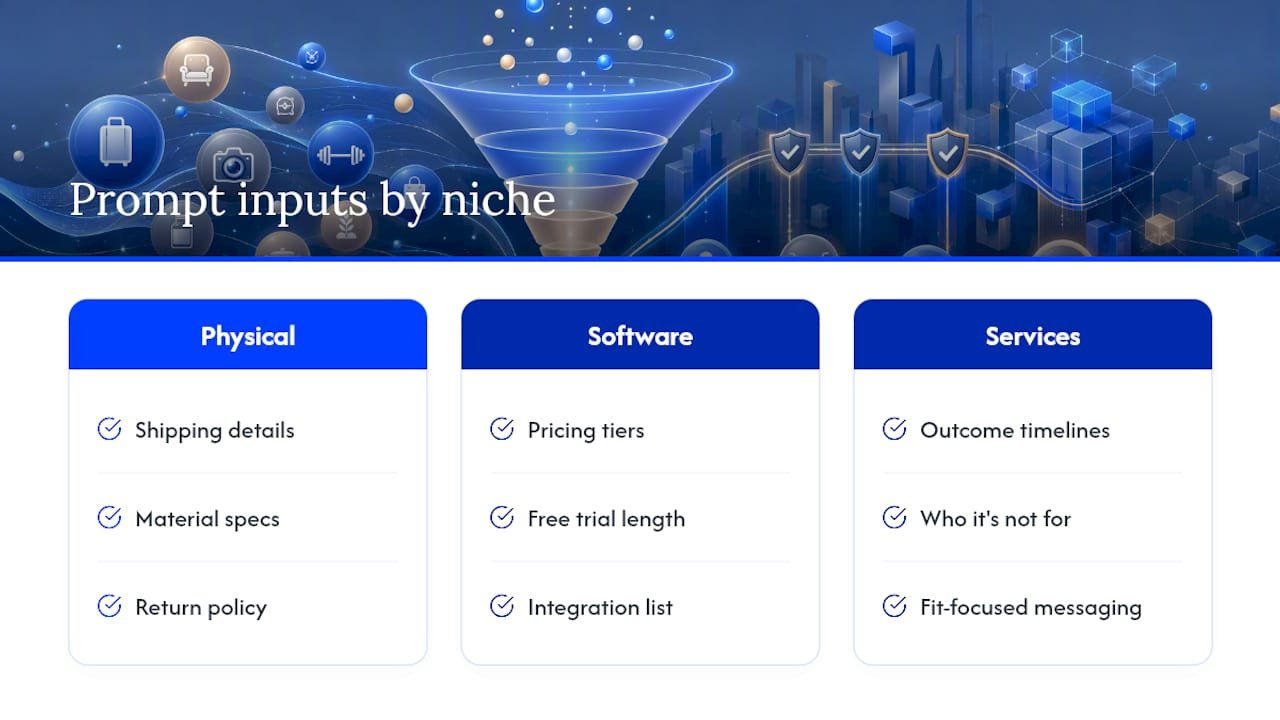
For physical products, feed the model shipping details, material specs, and return policy so it can address real buyer objections. For software and SaaS, feed it pricing tiers, free trial length, and integration list, since those details drive most buying decisions in that category. For services (coaching, courses, consulting), feed it outcome timelines and who the service is not a fit for, since service buyers weigh fit more heavily than spec sheets.
Audience tone matters just as much as product type. A prompt aimed at busy parents should ask for shorter sentences and time-saving framing. A prompt aimed at technical buyers can include jargon the model would otherwise need to avoid. Add one line to your system instructions: “Write for [specific audience], adjusting vocabulary and sentence length to match how this reader actually talks.”
Niche-specific keyword research also changes which funnel-stage prompt you lead with. A saturated niche like personal finance needs sharper MoFu comparison angles to stand out, while a newer niche might still have room for broad ToFu educational content. Pulling from niche-specific keyword workflows before you prompt for content, rather than after, saves you from writing a strong article around the wrong search intent.
Measuring Whether Your Prompt-Generated Content Works
Publishing AI-assisted content without tracking performance is how marketers end up with a site full of pages nobody reads. Three metrics matter more than the rest: organic ranking movement, click-through rate on affiliate links, and time on page compared to your site average.
Watch ranking for your target keyword over the first 30 to 60 days after publishing. If a page stalls outside the first two search results pages, the SEO gap finder audit prompt from earlier can flag missing subtopics competitors cover. Click-through rate on affiliate links tells you whether the content actually persuades, separate from whether it ranks. A page that ranks well but converts poorly usually has a weak verdict section or buried CTA, both fixable with the CTA variation prompts covered earlier.
Compare prompt-generated drafts against your historical average time on page. A steep drop usually means the draft reads generically, a common tell when the system instructions skipped audience-specific tone. Run an A/B test using two title variants from the same title-generator prompt, and track which one holds a better click-through rate over at least two weeks before declaring a winner. Treat every metric drop as a prompt problem to fix, not a reason to abandon AI-assisted drafting altogether.
Fitting AI Prompts Into Your Existing Marketing Workflow
Prompts work best slotted into workflow stages you already run, not as a separate process bolted on top. If you already use a content calendar, add a column for “prompt used” and “audit passed” so your team can see which stage a draft sits in without asking.
For solo affiliate marketers, the simplest integration is a shared prompt document organized by funnel stage, matching the ToFu, MoFu, and BoFu breakdown covered earlier. Pull the relevant prompt, fill in product and audience context, and move straight to drafting. For teams, assign the audit stage to a second person; a fresh set of eyes catches fabricated claims and missing disclosures far more reliably than the same person who wrote the prompt.
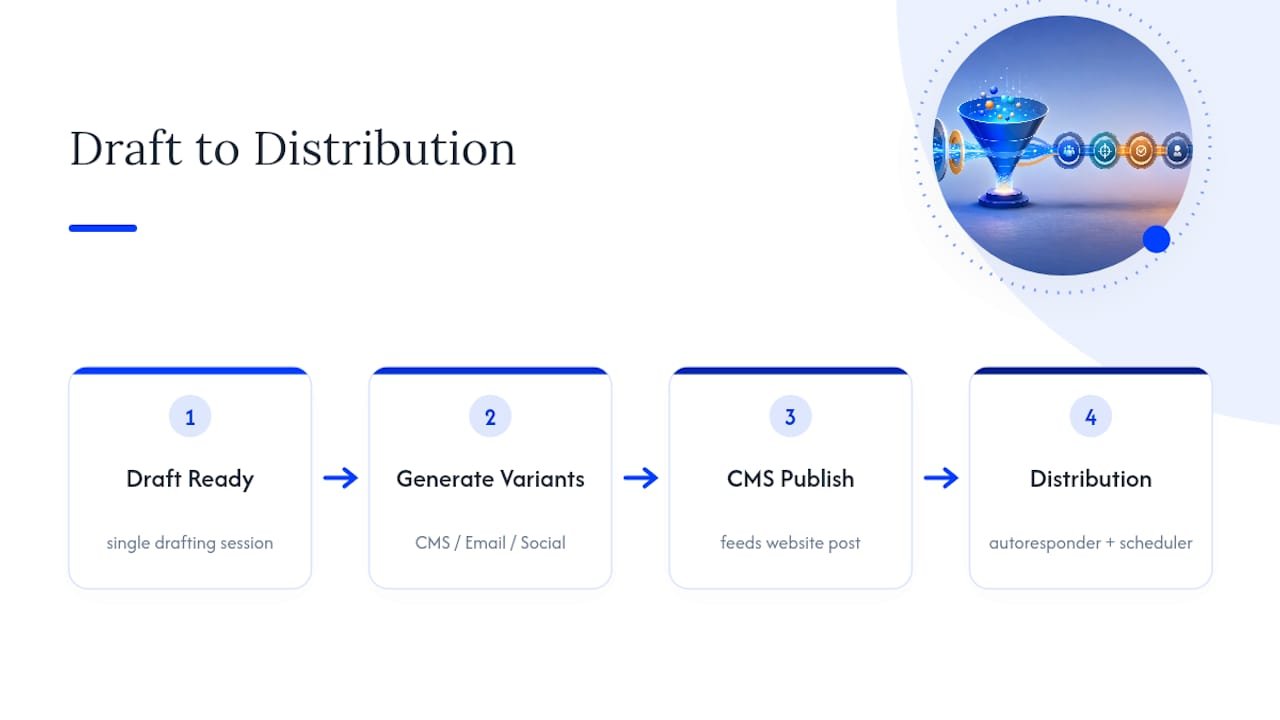
Connect the output side to whatever publishing and email tools you already run. A finished draft feeds your CMS, the email variant feeds your autoresponder sequence, and the social captions feed your scheduling tool, all from one drafting session instead of three separate writing sessions. Tools built for marketing workflow automation can chain these steps so a finished draft automatically triggers the next stage instead of sitting in a folder waiting for someone to remember it.
Updating Prompts Based on What Actually Performs
A prompt that worked well six months ago can quietly stop working as your niche, algorithm, or audience shifts. Treat your best-performing prompts as living documents, not finished assets.
Start with the pages that underperform on the metrics from the measurement section above. If a review consistently gets weak click-through on its affiliate link, go back to the prompt and tighten the reasoning criteria: maybe it needs a stronger objection-handling section, or the verdict is too hedged. Small tweaks work better than full rewrites; adjust one variable, republish, and compare again over a similar time window.
Keep a simple log of prompt versions next to your content calendar. Note the date, what changed, and how the resulting content performed against your baseline. Over several months, this turns into your own private playbook of what your specific audience responds to, which generic prompt lists can never give you since they’re built for no one’s audience in particular.
Revisit your system instructions quarterly, especially the editorial rules section. If FTC guidance shifts or a platform tightens its affiliate policy, that change belongs in your master system prompt immediately, not the next time you happen to notice.
Why I Push Affiliates Toward Structured Prompts, Not Shortcuts
Most affiliate marketers I talk to want AI to replace the thinking, not just the typing. That’s backwards, and it’s why so much AI-generated affiliate content reads hollow. The prompt structure in this article works because it forces you to make editorial decisions upfront: what criteria matter, what the reader actually needs to decide, what you’re willing to say no to. AI fills in the sentences. You still own the judgment.
The mistake I see most often isn’t using AI. It’s skipping the audit stage because the draft looks finished. A confident, well-formatted paragraph with an invented statistic is still an invented statistic, and it’s your name and your affiliate disclosure on the page when a reader catches it.
— Will
Want the Full Playbook Behind These Prompts?
These templates get you most of the way there, but building a full content engine around them takes more than a prompt list. Paid playbooks package workflows, prompt chains, and case-study data behind campaigns aimed at conversion, not just publishing.

The AI affiliate workflows playbook walks through ready-to-run recipes for chaining research, drafting, auditing, and distribution prompts into a repeatable system, with real performance data from campaigns run this way. If your content leans toward video, the YouTube automation affiliate marketing playbook applies the same prompt-first approach to script writing and video repurposing. Pick the playbook that matches your content format and start applying the workflow to your next article today.
Sources
- How to create effective AI prompts for affiliate publishers — Kinsta
- Affiliate marketing: how it works and how to start — Coursera
- Best ChatGPT for Affiliate Marketing: Prompts to Grow Commissions and Traffic — TopFreePrompts
- 20+ ChatGPT prompts for affiliate marketing — DesignRush
FAQ
What are some effective prompts for affiliate marketing?
The most effective prompts include a system instruction, real product context, a clear task, reasoning criteria, and an output schema, such as the long-form review and comparison templates covered earlier in this article.
Can you make $10,000 a month with affiliate marketing?
Income varies enormously by niche, traffic, and program commission rates, and no legitimate source guarantees a specific figure; consistent content production and honest, well-tested prompts improve your odds, but they don’t set a ceiling or a floor.
What are the 5 P’s of effective prompting?
There’s no single agreed-upon “5 P’s” framework for prompting; the structure that reliably works, per Kinsta’s prompt framework, is system instructions, context, task, reasoning criteria, and output schema, five parts worth remembering even without a catchy acronym.
Can I use ChatGPT for affiliate marketing?
Yes. ChatGPT and Claude both work well for affiliate content when given structured prompts with real product data, clear output schemas, and an audit pass before publishing, exactly the approach outlined throughout this article.