

Topical authority with AI means owning a clearly bounded subject area and packaging modular, extractable evidence so generative engines can select and absorb your pages. It works because AI systems reward content that reads like a fact, not just content that ranks like an answer. If you want a place to start, map one commercial topic today and build a pillar page with clearly linked spokes underneath it.
TL;DR:
- Building topical authority requires creating comprehensive, evidence-rich content that covers a subject from multiple angles with consistent terminology and structured internal linking.
- AI-driven search favors pages that contain self-contained, well-formatted facts such as definitions, statistics, comparisons, and procedures, rather than just ranking high.
- Content should be designed as modular evidence containers, formatted with clear headings, short paragraphs, and specific claims to maximize AI absorption and citation likelihood.
- Effective topical clusters depend on assessing demand through search signals, linking page structure logically, and updating regularly based on performance and gaps analysis.
- Measuring AI citation influence involves tracking exposure, support link mentions, and whether your wording impacts the final answer, beyond traditional ranking metrics.
Table of Contents
- What topical authority is and how it differs from domain authority
- Why topical authority matters more in AI-driven search
- How AI changes content design: the evidence-container approach
- A practical framework for building topical coverage
- AI-assisted content workflows and tools
- Measuring whether your topical authority is actually working
- Templates and case studies you can reuse
- Three mistakes teams make chasing topical authority with AI
- Get hands-on help building your first cluster
- Sources
- FAQ
What topical authority is and how it differs from domain authority
Topical authority is the depth and clarity of your coverage on one subject, not the overall weight of your website. You earn it by publishing enough connected, specific content that both readers and machines can see you understand a topic from every angle, not just the angle that ranks for one keyword.
Domain authority, by contrast, is a blunt measure of your site’s overall link strength and trust across every subject you touch. A site can have strong domain authority and weak topical authority at the same time, which happens often when a general blog publishes one article on a niche subject and expects it to compete with a dedicated resource.
The distinction matters because generative engines do not read domain authority the way old-school SEO tools did. They look for patterns of coverage: does this site treat the subject as a passing mention or as a body of work? Several signals help an AI system infer topical coverage:
- Consistent terminology and entity usage across multiple pages on the same subject.
- Internal links that connect a pillar page to related subtopics in both directions.
- Depth signals like definitions, comparisons, and procedures repeated in context, not just once.
- Freshness and update patterns that show the coverage is maintained, not abandoned.
Building topical authority with AI starts with treating your site’s structure as a map of expertise, not a list of separate articles competing for the same few keywords.
Why topical authority matters more in AI-driven search
Generative search does not work in one step. According to a measurement framework for generative engine optimization, citation selection and citation absorption are distinct stages: a page first has to be retrieved as a candidate source, then it has to be judged useful enough to be absorbed into the generated answer itself. Ranking well is only the first hurdle.
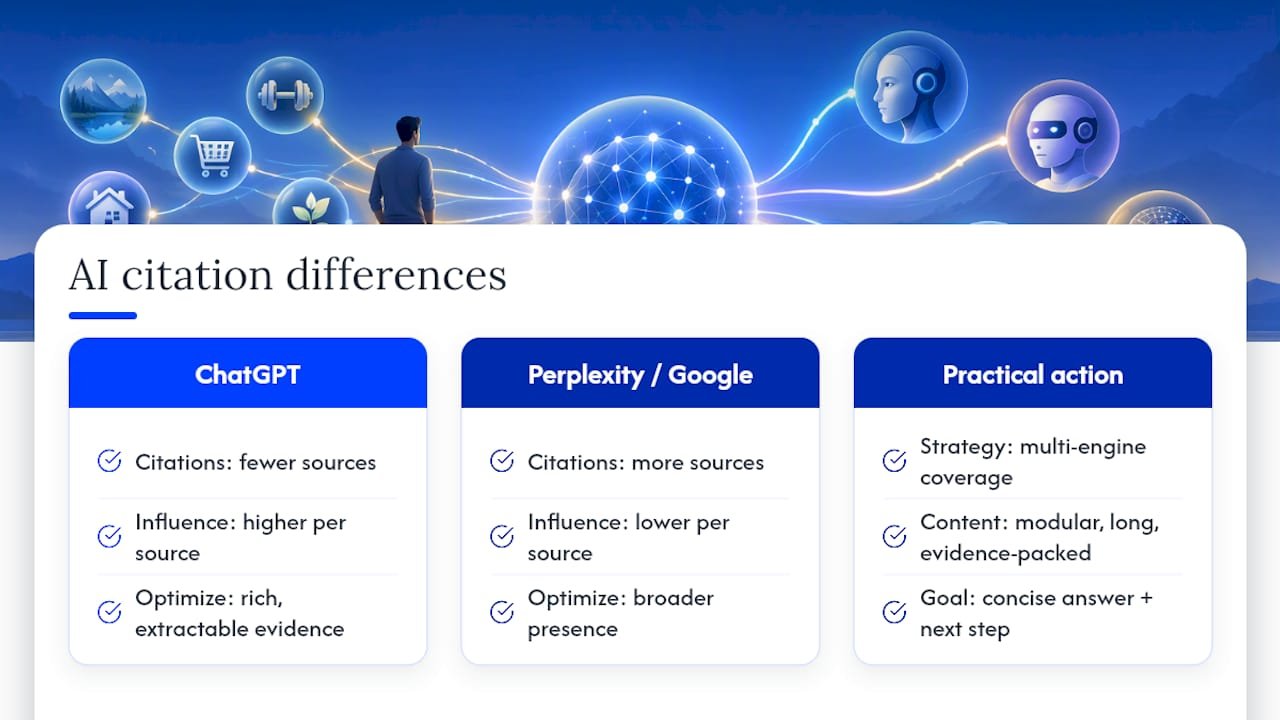
That same research found that pages with higher influence on the final answer tend to be more modular, longer, and packed with extractable evidence such as definitions, numbers, comparisons, and procedures. Getting selected is necessary but not sufficient. If your page is chosen but written as a wall of undifferentiated prose, an engine may pull from a competitor’s tighter paragraph instead.
The two-stage nature of AI citation changes how exposure is distributed. Selection and absorption are separate hurdles, according to a GEO measurement framework, which means ranking in the top results no longer guarantees you show up in the generated answer.
This has real consequences for traffic and brand visibility. When answers are generated rather than linked, a smaller number of well-structured pages end up carrying the citation weight for an entire topic. Practitioners auditing engine behavior have also found that different platforms cite differently: one controlled benchmark found that ChatGPT tends to cite fewer sources with higher influence per source, while Perplexity and Google cite more sources with lower influence each. That argues for a multi-engine strategy rather than optimizing for a single AI platform’s habits.
The click implications are not as grim as they sound, either. A Search Engine Journal analysis of an AI Overviews study found that clicks lost to AI summaries were not lower quality, and that AI Overviews can produce higher-quality clicks when your content gives the engine a concise answer paired with a compelling next step.
How AI changes content design: the evidence-container approach
The most useful concept to borrow from GEO research is the evidence container: a self-contained block of text, usually a paragraph or a short section, that holds one complete, extractable fact. It has a clear subject, a clear claim, and enough context that an AI system can lift it without needing the rest of the page to make sense of it.
Not every kind of writing works equally well as an evidence container. The research behind the GEO framework points to four genres that generative engines absorb most readily:
- Definitions that state what something is in one or two sentences, without hedging.
- Numbers and statistics tied to a specific source and a specific claim.
- Comparisons that lay out two or more options against the same criteria.
- Procedures that break a process into ordered, repeatable steps.
Formatting choices either expose these units or bury them. A heading that matches the question a reader (or an AI system) is likely to ask makes the paragraph beneath it easier to isolate. Short paragraphs, one claim per sentence, and specific numbers instead of vague ranges all raise the odds that a chunk of your page reads as a complete fact rather than a fragment of an argument.
It is worth being honest about what does not work. The same framework found that formatting a page as a series of question-and-answer blocks does not reliably increase absorption on its own. Semantic alignment, evidence density, and section modularity matter more than the cosmetic structure of your headings.
Pro Tip: Write the paragraph so it would still make sense as a stand-alone quote in someone else’s answer.
A practical framework for building topical coverage
Building a topical cluster is not about publishing more, it is about publishing in a shape that maps to how people actually search and how engines actually retrieve. Start with the topic itself, not the content calendar.
- Choose a topic space with a commercial filter: pick a subject where search demand overlaps with a product, service, or affiliate offer you can credibly recommend.
- Confirm demand signals using Search Console queries, People Also Ask boxes, and related searches, rather than guessing at what readers want to know.
- Build one pillar page that defines the topic broadly and links out to every major subtopic you plan to cover.
- Write spoke pages for each subtopic, each one narrow enough to be the best single answer to its specific question.
- Link every spoke back to the pillar and sideways to related spokes, using anchor text that describes the destination rather than generic phrases like “click here.”
- Map content gaps by comparing what you already rank for against what your competitors and the wider SERP cover, then prioritize the gaps with the highest commercial intent.
- Revisit the cluster quarterly to update statistics, add new spokes for emerging subtopics, and prune pages that never earned traffic or citations.
The commercial filter in step one deserves emphasis. It is tempting to chase every subtopic that shows search volume, but a cluster only pays off if it eventually points a reader toward a decision you can help them make. An AI keyword research workflow can speed up the discovery and clustering stage considerably, turning a manual brainstorm into a structured list of pillar and spoke candidates within an afternoon.
Linking conventions matter more in a topical cluster than in a standard blog. A pillar page that links to ten spokes but receives no links back from them signals a weak cluster to both readers and crawlers. Reciprocal linking, done with descriptive anchor text, is what turns a folder of related articles into a structure an AI system can traverse and trust.
Gap analysis should lean on data you already have. Search Console shows you which queries you are already getting impressions for but not clicks, which is often the fastest sign of a missing spoke. People Also Ask boxes reveal the exact phrasing readers use for adjacent questions. Analytics tools show you which existing pages get the most engagement, which tells you where your next spoke should link from.
AI-assisted content workflows and tools
Scaling a topical cluster by hand is slow, but scaling it carelessly with AI produces the kind of thin, repetitive content that hurts more than it helps. The workflow that works treats AI as a drafting and research accelerant, with a human checkpoint before anything publishes.

A practical sequence looks like this: start with topic discovery using clustering tools to group keywords by intent, build a cluster outline that assigns each subtopic to a pillar or spoke, extract the evidence you will need (definitions, figures, comparisons, steps) before you draft a single sentence, generate an AI-assisted first draft against that evidence, and finish with a human review pass that checks accuracy, tone, and originality.
Tool categories map cleanly to each stage:
- Clustering and keyword tools group related queries so you can see the shape of a topic before you write anything.
- Extractable-evidence tools help you pull verified statistics, definitions, and procedures rather than inventing them.
- Repurposing tools turn one well-researched pillar into spokes, social posts, and video scripts without duplicating the same paragraph everywhere.
A 90-day AI content strategy rollout walks through this sequence at a pace most small teams can sustain without burning out on production. For drafting itself, a roundup of AI writing tools for marketers covers which tools are actually built for long-form structure versus which are better suited to short repurposed snippets.
Google’s own guidance is worth following closely here. Its documentation on generative AI content warns against publishing large volumes of near-identical AI-generated pages and recommends disclosure and human verification wherever automation plays a role in production. That is not a suggestion to avoid AI, it is a reminder that unreviewed AI output at scale is the fastest way to undo the topical authority you are trying to build.
Pro Tip: Run every AI-assisted draft through a fact check against your own evidence list before it ever reaches an editor.
Measuring whether your topical authority is actually working
Ranking reports alone will not tell you whether AI systems are citing you, so the measurement layer needs its own metrics. The GEO measurement framework proposes splitting these into observed exposure, selection frequency, and absorption proxies, and that split is worth building into your own dashboard.
Selection metrics answer whether you are even in the running: AI impressions, how often your domain appears as a supporting link, and how frequently your brand gets mentioned across AI answers for your target queries. Absorption proxies go a step further and ask whether your specific wording made it into the answer: paragraph overlap between your content and the generated response, repeat citations across multiple queries on the same topic, and how often your exact phrasing gets quoted rather than paraphrased.
Cluster-level KPIs should still tie back to revenue, not vanity visibility. Pages per session within a cluster, assisted conversions from spoke pages, and the conversion rate of pillar-page traffic all tell you whether the authority you are building actually moves people toward a decision.
| Metric type | What it measures | Example signal |
|---|---|---|
| Selection | Whether you appear as a candidate source | AI impressions, brand mentions in AI answers |
| Absorption | Whether your wording shapes the final answer | Paragraph overlap, repeat citation across queries |
| Business outcome | Whether the cluster drives revenue | Pages per session, assisted conversions |
A simple experimental design works well for testing changes: pick a spoke page, rewrite one section as a tighter evidence container, and track its citation frequency across two or three AI platforms over a fixed period before and after the change. A GEO playbook covers how to connect this kind of test back to traditional SEO reporting so you are not running two disconnected measurement systems.
Templates and case studies you can reuse
A case study on affiliate topical clusters shows the pillar-and-spoke model applied to a real niche, including how the internal linking was structured to support both readers and AI retrieval. The topical authority case study for affiliates breaks down the cluster from initial topic selection through the linking pattern that connected every spoke back to the pillar.
These assets map directly onto the framework above:
- The affiliate case study demonstrates the commercial-filter and gap-mapping steps in a live example.
- The 90-day rollout plan gives a production schedule for teams following the AI-assisted workflow.
- The AI writing tools roundup supports the extraction and drafting stages without requiring a large team.
Every workflow described here assumes human review before publication and clear disclosure where AI assisted the draft, which matches the practical stance in this piece and the caution in Google’s own guidance on generative AI content.
Three mistakes teams make chasing topical authority with AI
The biggest mistake is hunting for a mythical GEO schema markup that will make AI systems favor your pages. No such tag exists. Google’s own documentation confirms there are no special technical requirements to appear in AI Overviews beyond standard crawlability and indexability.
The second mistake is scale for its own sake: publishing dozens of thin spokes instead of a handful of genuinely evidence-dense pages. Absorption research consistently favors density over volume.
The third is skipping measurement entirely and assuming rankings tell the whole story. They do not anymore.
The teams that win are the ones who treat every paragraph as something an engine might quote word for word, not as filler between headings.
— Will
Get hands-on help building your first cluster
Everything above is a roadmap, and the fastest way through it is having someone who has already built the clusters walk you through your first one. Coaching and content resources are available for affiliate marketers who need to turn this kind of framework into a working site, not just a plan on a whiteboard.

If you are just getting your workflow off the ground, the AI content strategy rollout walks through a structured 90-day path from topic mapping to a published cluster, with the coaching support to keep it from stalling. If you are further along and want to see the pillar-and-spoke model applied to a real affiliate niche before you commit your own resources, the affiliate topical authority case study shows exactly how one cluster was built and linked.
Start with whichever page matches where you are today, and use it as your first concrete step toward a cluster that AI systems can actually cite.
Sources
This article draws on primary research and official guidance rather than secondhand summaries, including the GEO measurement framework on citation selection and absorption, Google’s own documentation on AI features and generative AI optimization, and independent reporting on AI Overview click quality.
- From Citation Selection to Citation Absorption: A Measurement Framework for Generative Engine Optimization Across AI Search Platforms
- Google AI Overviews study finds lost clicks weren’t lower quality | Search Engine Journal
FAQ
What does “topical authority” mean?
Topical authority means a website has published deep, connected coverage of one subject rather than a single article competing on a keyword. It is judged by breadth and consistency across a cluster of pages, not by any single ranking.
Is SEO dead now with AI?
SEO is not dead, it has added a second layer. Traditional ranking factors like crawlability and structured data still govern whether a page gets selected as a candidate source, according to Google’s generative AI optimization guidance, while evidence density and modularity govern whether that page gets absorbed into the final answer.
What are the 3 C’s of SEO?
Definitions of the “3 C’s” vary across practitioners, and no single authoritative source fixes the term. A common version refers to content, code, and credibility, but the phrase is not standardized the way “E-E-A-T” is.
What is the 80/20 rule in SEO?
The common SEO prioritization principle involves focusing the bulk of your effort on the small share of pages or keywords that drive most of your traffic and conversions. It is a general prioritization principle borrowed from the Pareto principle rather than a fixed SEO metric.
How do I know if AI engines are actually citing my content?
You can track this through selection metrics like AI impressions and supporting-link mentions, paired with absorption proxies like paragraph overlap and repeat citation across queries, as outlined in the GEO measurement framework. Standard rank tracking alone will not show you this.