

Ask for a 90-day pilot with a performance-tied rate bump, structured as a base rate plus a kicker once you hit an agreed target. Attach your strongest recent number, usually your conversion rate or revenue-per-click, on a single page. Set a clear review date and a reversion clause so the merchant knows exactly what happens if the target is missed. This framing lowers the merchant’s risk and gets approved far more often than an open-ended request for more money.
TL;DR:
- Present a clearly defined 90-day pilot with specific KPIs, a review date, and a reversion clause to minimize merchant risk and increase approval chances.
- Back your rate request with recent conversion data, customer quality metrics, and supporting export files, packaged into a concise one-page summary.
- Propose result-based commission structures like tiered rates, hybrid bonuses, or recurrences, depending on your product type and proven performance.
- Reach out directly to an affiliate manager with a short, result-focused message, providing evidence and clear terms to avoid generic requests or escalation delays.
- Use exclusivity and audience data to strengthen your bargaining position, emphasizing unique placements and demographic alignment to justify higher rates.
Table of Contents
- What evidence and metrics to prepare before you ask
- Concrete commission structures to propose
- How to make an offer merchants accept
- Outreach and negotiation process
- Common negotiation pitfalls and fallback strategies
- A copyable 90-day pilot template you can send today
- Industry benchmarks for commission rates across different niches
- Using exclusivity and audience data as leverage
- Common objections from brands and how to address them
- Legal and contractual considerations when formalizing commission agreements
- Negotiation as a relationship, not a one-time ask
- Get help building your pilot faster with The Mindset Motivator
- Sources
- FAQ
What evidence and metrics to prepare before you ask
Before you write a single word to a partner manager, pull your own numbers together. Merchants approve rate changes based on proof, not persuasion, so your job is to make the proof easy to trust and easy to skim.
Start with a three to six month window of performance: conversions, conversion rate, average order value, and conversion rate optimization tips. These four numbers tell a partner manager whether you drive volume, quality, or both, and flexible commission structures work best when they’re tied to measurable outcomes like these. Then layer in customer-quality indicators: refund rate, any retention signals you can see (repeat purchase links, subscription renewals you’re credited for), and lifetime value proxies if your platform tracks them. A merchant who sees low refunds and strong repeat behavior from your traffic will pay more to keep it.
- Pull conversion count, conversion rate, AOV, and revenue-per-click for the last three to six months.
- Note refund rate and any retention or repeat-purchase signal tied to your links.
- Export raw click-to-conversion logs, cookie window settings, and cross-device data if your dashboard tracks it.
- Package everything into a one-page summary with a CSV or dashboard screenshots attached.
Keep the write-up short. A one-page executive summary with a spreadsheet or dashboard screenshot attached reads as credible. Ten pages of charts reads as a stall tactic.
Concrete commission structures to propose
Do not just ask for a flat percentage increase. Merchants respond better to structures that reward results they can measure, and five common commission structures give you a menu to choose from depending on what you can prove and what the merchant can afford.
- Tiered models: propose thresholds like 8% up to 50 sales a month, 10% from 51 to 100, and 12% above that, so your rate climbs automatically as volume grows.
- Hybrid base plus kicker: keep your current base rate and add a bonus percentage once you clear a target, which limits the merchant’s downside while giving you real upside.
- Pay bumps and time-limited boosts: ask for a temporary lift tied to a launch, seasonal push, or content refresh, then let it expire or convert to a permanent rate if it performs.
- Recurring versus one-off payouts: for subscription products, request recurring commission on renewals; for single-purchase items, a one-off bump tied to volume usually fits better.
The choice depends on the product. Payout duration should match the business model: recurring commissions make sense for subscriptions, time-limited boosts fit product launches, and one-off increases suit predictable, single-purchase offers. Hybrid models tend to be the easiest sell because they give the merchant a ceiling on cost while still rewarding you for outperforming your baseline.
How to make an offer merchants accept
The pitch matters as much as the numbers. A request framed as a permanent raise puts the merchant on the defensive. A request framed as a time-boxed pilot with clear conditions puts you both on the same side of the table, and negotiation frameworks built around pilots consistently get better acceptance rates than open-ended asks.
- Propose a pilot with two or three KPIs (conversion rate floor, minimum monthly revenue, refund rate ceiling) and a stated reversion clause if you miss them.
- Offer a non-cash alternative alongside the cash ask: faster payout cycles, exclusive creative assets, or a co-marketing slot in the merchant’s newsletter.
- Walk in with three numbers already decided: your ideal rate, your walkaway rate, and a creative alternative you’d accept instead of cash.
- Once agreed, get the deal documented in writing and configured directly inside the affiliate platform so payouts calculate automatically.
Pro Tip: Never let a custom rate live only in an email thread. Ask the partner manager to confirm the exact rule inside the platform dashboard before your next payout cycle runs.
Non-cash concessions often close deals that a straight percentage bump can’t. A merchant who can’t move on rate this quarter might happily move your payout schedule from net-60 to net-30, and that alone changes your cash flow more than a point or two of commission would.
Outreach and negotiation process
Skip the general support inbox. Custom rate approvals come from an affiliate or partner manager with actual authority, and reaching them directly, rather than a shared support address, is the difference between a fast answer and a form-letter reply.
Run a short three-step cadence instead of one long email. First, a warm intro that references your account and recent performance. Second, the proposal itself: your pilot terms, your KPIs, and what you’re offering in return. Third, a follow-up with your evidence attached, sent a few days later if you haven’t heard back.
- Lead every message with your results, not your request, so the manager sees value before they see the ask.
- Propose the trial explicitly and ask what metrics they’d need to see to approve it.
- Request written confirmation of any verbal yes, including the review date and reversion terms.
- If a manager goes quiet for more than a week, escalate politely to their supervisor or account lead rather than resending the same email.
Common negotiation pitfalls and fallback strategies
The most common mistake is emailing generic support and asking for “a better rate” with no framework attached. That message gets ignored or auto-declined because it gives the merchant nothing to evaluate.
The second mistake is asking for a permanent increase with no trial period. Merchants are far more cautious about open-ended commitments than about time-boxed pilots, since a documented pilot with a reversion clause removes the risk of a permanent cost increase that underperforms.
- Avoid vague requests: always attach a specific rate, structure, and review date.
- Insist the pilot terms get written down and configured in the platform, not just agreed verbally.
- Keep raw exports and conversion-level reports on hand in case the merchant asks for an audit before renewal.
- If a full rate increase gets declined, fall back to a short campaign boost, a creative bonus, or a one-time KPI bonus instead.
A copyable 90-day pilot template you can send today
Here’s a template built from the pilot structure that tends to get approved: a base rate, a kicker tied to one or two KPIs, weekly reporting, a 90-day review date, and a reversion clause if targets are missed. Documented pilot structures with clear review periods reduce merchant risk and speed up approval, which is exactly why this format works better than an open-ended ask.
- KPIs: conversion rate floor, minimum monthly revenue, or refund rate ceiling, pick one or two, not five.
- Cadence: weekly performance snapshot, formal review at day 90.
- Reversion clause: rate returns to baseline automatically if KPIs aren’t hit, no renegotiation needed.
- Reporting sample: a one-page summary with conversions, revenue-per-click, and refund rate side by side.
You can see this kind of evidence packaging in action in a real affiliate marketing case study, and pull ready-to-adapt outreach language from funnel map and audit prompts built for exactly this kind of email. AI dashboards can also cut the time it takes to pull weekly reports down to minutes instead of hours.
Industry benchmarks for commission rates across different niches
Commission rates vary widely by niche, and no single number applies across categories. Physical product affiliate programs often sit at the lower end of the range because margins are thin, while software and subscription programs tend to pay more because customer lifetime value is higher and renewals compound.
Digital information products and online courses frequently sit at the higher end of typical ranges because there’s no manufacturing cost to protect. High-ticket B2B software and finance-adjacent programs sometimes negotiate custom rates well above their public rate card for affiliates who bring consistent, qualified volume. The exact numbers a program advertises publicly are rarely the ceiling. Most programs keep a published baseline rate for new affiliates and a separate, higher custom rate reserved for partners who ask and can prove their value, which is exactly the gap this negotiation process is built to close.
Rather than anchoring to a single industry average, benchmark yourself against what a program’s own tiered structure suggests. If a merchant already runs a tiered public rate card, their top tier tells you what they’re willing to pay for volume, and that number is a far more useful anchor than a generic niche average pulled from a blog post.
Using exclusivity and audience data as leverage
If you can offer something the merchant can’t get from another affiliate, that’s worth more in negotiation than your traffic volume alone. Exclusivity is the clearest form of this: offering a merchant your only spot in a resource roundup, your newsletter’s lead placement, or a dedicated video review that no competitor’s program gets from you.
Audience insight is the second lever. If you know your audience skews toward repeat buyers, higher AOV purchases, or a specific demographic the merchant is trying to reach, say so explicitly and back it with the data you already pulled together. A merchant negotiating blind treats every affiliate as interchangeable. A merchant who sees your audience is unusually valuable for their specific goals has a reason to pay above their standard rate.
Bring both to the table at once when you can. An affiliate who says “I’ll give you exclusive top placement, and my audience converts at a higher rate than typical traffic because of X” gives the partner manager two separate reasons to say yes instead of one.
Common objections from brands and how to address them
Expect pushback, and prepare for it rather than treating it as a rejection. The most common objection is margin: the merchant says the current rate already reflects their margin ceiling. Respond by offering a hybrid structure where the base stays the same and the kicker only pays out once you clear a target that itself expands their revenue.
The second common objection is precedent: merchants worry that raising your rate sets an expectation for every other affiliate in the program. Counter this by asking for the increase to apply specifically to the pilot’s defined KPIs rather than as a blanket program change, which keeps it framed as performance-based rather than a policy shift.
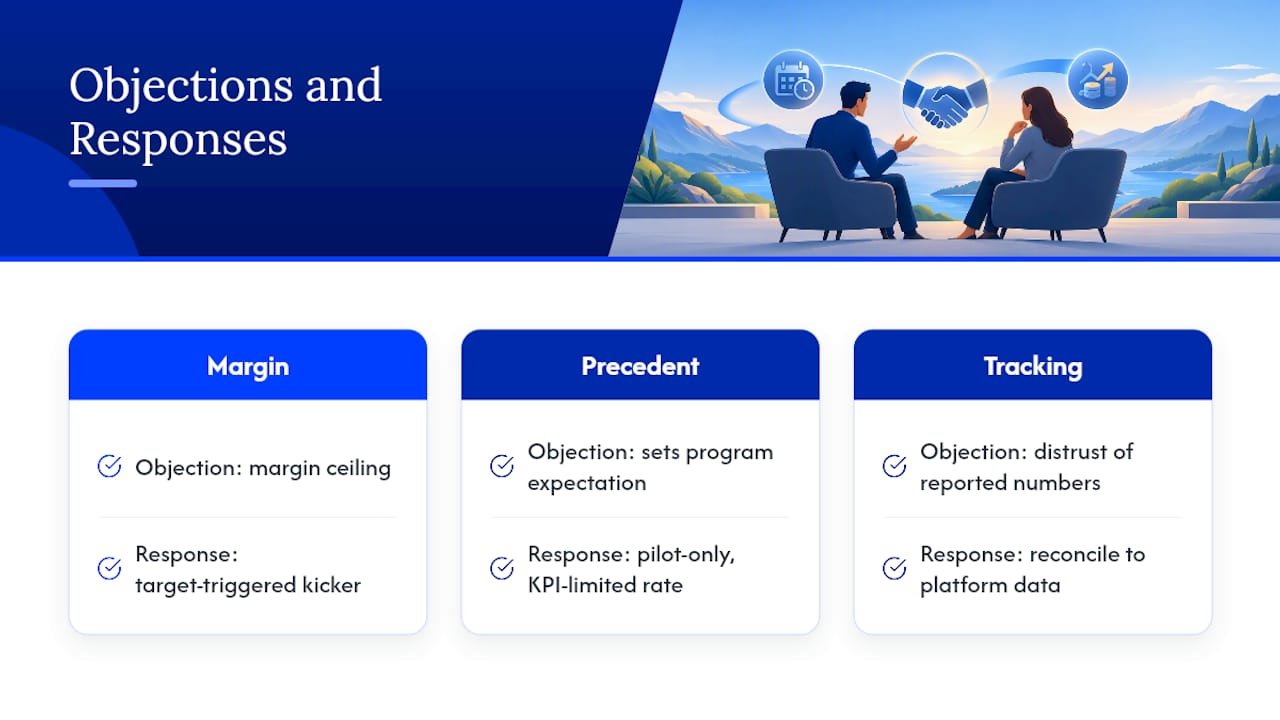
A third objection is tracking trust: some merchants hesitate because they’re unsure your reported numbers match their own dashboard. Preempt this by offering to reconcile against their platform data directly and by proposing the deal get configured inside the affiliate platform itself, removing any ambiguity about what triggers the higher rate.
Legal and contractual considerations when formalizing commission agreements
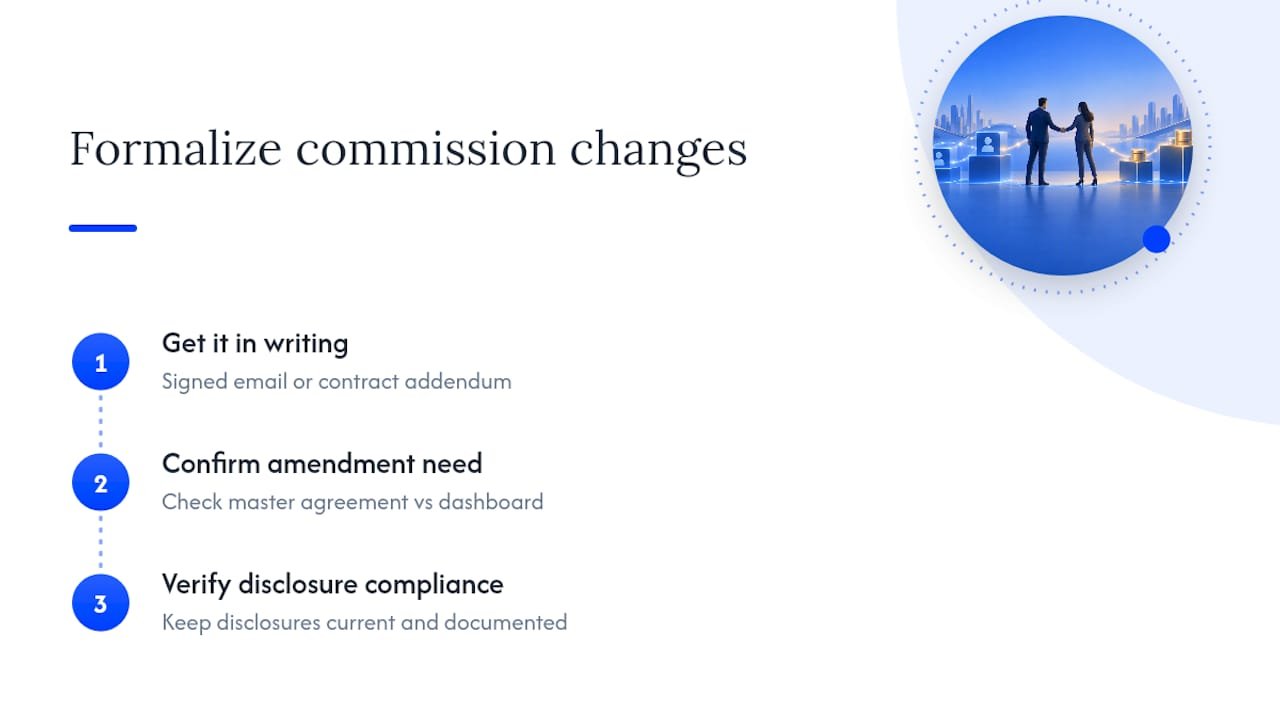
Once a merchant agrees to new terms, get them in writing before you change any promotional behavior based on the new rate. A verbal yes from a partner manager isn’t enforceable if a dispute comes up later, and reconciliation problems are far easier to resolve when the agreed KPIs, review date, and reversion clause exist in an email or contract addendum both sides signed off on.
Pay attention to how the new rate interacts with your existing affiliate agreement. Some programs require a formal amendment to the master agreement for any custom rate above a certain threshold, while smaller adjustments can run through the platform’s dashboard settings alone. Confirm which applies before you assume the deal is final.
If your promotion touches a regulated space (finance, health, or anything where endorsements carry compliance weight), your disclosure setup can matter as much as your numbers. Regulatory changes around AI-shaped endorsements are already changing how some merchants qualify affiliates, and publishers with reliable, documented disclosure practices are reportedly seeing that used as a factor in payout decisions. Keep your disclosure language current and easy to point to, since it can double as reassurance during a sensitive negotiation.
Negotiation as a relationship, not a one-time ask
Negotiating your affiliate commission isn’t a single conversation you win or lose. Revisit terms every time your performance improves, because the rate that made sense six months ago may be underpaying you now.
The partnerships that grow fastest are the ones built on trust between you and a specific partner manager, not the ones chasing the biggest one-time bump. Treat every pilot as the start of an ongoing conversation, not the end of one.
— Will
Get help building your pilot faster with The Mindset Motivator
Pulling together conversion data, drafting outreach, and configuring a pilot inside an affiliate platform takes real time, especially if you’re doing it manually every quarter. Coaching and templates are built to shorten that process: negotiation templates you can adapt directly, AI dashboards that pull your performance numbers automatically, and one-on-one coaching if you want a second set of eyes before you send an offer.

If you want to see the kind of evidence packaging and automation this guide describes in practice, check the YouTube automation affiliate marketing playbook for a walkthrough you can start using this week.
Sources
- 5 Affiliate Commission Structures: Models & Benefits — Impact
- Affiliate commission models: How to choose the right structure — Tapfiliate
- Negotiating custom affiliate deals — Track360
- FTC’s new AI-disclosure mandate is reshaping affiliate compliance stacks — Affiliate Times
FAQ
What is the 80/20 rule in affiliate marketing?
A small share of your affiliate partnerships or content typically drives most of your revenue, so it pays to identify your top performers and focus your negotiation efforts there first. Applied to commission negotiation, it means prioritizing the merchant relationships where your traffic already converts well rather than spreading requests thin across every program you’re in.
What is a good affiliate commission rate?
There’s no single rate that applies across every niche, since software and subscription programs tend to pay more than physical product programs due to higher lifetime value. The most useful benchmark is a merchant’s own published tier structure: their top tier shows what they’re willing to pay affiliates who prove strong performance.
Can I use ChatGPT for affiliate marketing?
Yes, tools like ChatGPT can help draft outreach emails, summarize performance data into a one-page format, and speed up the evidence-gathering work described in this guide. For prompt examples built specifically for affiliate workflows, see this ChatGPT for affiliate marketing guide.
Is affiliate marketing still profitable in 2026?
Affiliate marketing remains a viable revenue model in 2026 for publishers who actively manage their commission structures rather than accepting default rates. Programs increasingly reward affiliates who can prove conversion quality and compliance readiness, which makes active negotiation more valuable now than a passive, set-and-forget approach.
How do I know if a merchant will negotiate commission rates?
Most affiliate programs with a dedicated partner manager and a tiered public rate structure are open to custom deals for affiliates who bring proven, consistent performance. The clearest signal is whether the program already publishes tiers, since that shows they’re set up to reward performance above a baseline rate.