

The fastest path to affiliate revenue is skipping search volume entirely at first and building your keyword list from the offer outward. Pick a product, list every buyer question that leads to a purchase, expand those into long-tail phrases, and run a 60-second SERP check before you write a single word. If page one shows comparison posts and review roundups instead of forums or thin blog spam, you’ve found a winnable keyword. Everything below walks you through that process in detail.
TL;DR:
- Focusing on commercial-investigation and transactional keywords yields higher revenue than search volume alone, as these queries show buyer readiness.
- Starting keyword research from the offer and buyer questions ensures alignment with actual purchase intent and helps identify low-competition, high-conversion phrases.
- Manually checking the SERP is crucial to verify competition and format cues, revealing real-time opportunities that keyword tools may oversimplify or miss.
- Building content clusters around high-intent pillar pages supported by relevant long-tail posts improves topical authority and conversion rates.
- Opting for low-volume, high-intent keywords and patience with rankings typically results in better affiliate income than chasing high-volume but informational search terms.
Table of Contents
- What Is Affiliate Keyword Research and Why Intent Beats Everything Else
- How Do You Research Affiliate Keywords Step by Step?
- What Tools Should Affiliates Use for Keyword Research?
- How Do You Read a SERP for Buyer Intent in Under a Minute?
- Building a Content Cluster That Actually Makes Money
- What Makes an Affiliate Page Actually Convert Readers Into Clicks?
- How Do You Track Whether Your Keywords Are Actually Working?
- Understanding Affiliate Program Structures Before You Chase a Keyword
- Turning Keyword Data Into a Repeatable Revenue Habit
- Practical AI Shortcuts I Use for Faster Keyword Clustering
- Will Buckley: Why Small, Consistent Wins Beat Chasing Traffic
- Get Hands-On Help Building Your Keyword Cluster
- Sources
What Is Affiliate Keyword Research and Why Intent Beats Everything Else
Affiliate keyword research is the practice of finding search terms that not only get traffic but attract people ready to click a link and buy something. That distinction separates it from standard SEO keyword research, where the goal is usually just visibility. You’re not chasing eyeballs. You’re chasing wallets.
Most keyword tools sort terms by search intent into four buckets: informational (someone learning), navigational (someone looking for a specific brand or site), commercial investigation (someone comparing options before buying), and transactional (someone ready to purchase right now). For affiliates, the second and fourth categories do the heavy lifting. Informational content builds authority and can eventually convert, but its a slow burn. Commercial-investigation and transactional queries are where the money sits.
The evidence backs this up. Commercial-intent searches make up a smaller slice of total search volume than informational queries, but they carry a disproportionate share of the actual revenue opportunity because the people typing them are closer to a purchase decision. A thousand people searching “what is a VPN” convert at a fraction of the rate of a hundred people searching “best VPN for streaming Netflix abroad.”
You can spot buyer intent without a tool, just by reading the words in the query. Watch for these modifiers:
- “Best,” “top,” and “review” signal someone comparing options
- “Vs” and “alternative” signal head-to-head decision making
- “Pricing,” “cost,” and “worth it” signal someone close to buying
- “For [specific use case]” (like “for beginners” or “for small business”) signals a narrowing decision, which usually means higher purchase readiness
Statistic to know: commercial intent accounts for roughly 14.5% of all searches, yet it drives the majority of revenue for content-based businesses, according to AiseoJournal’s analysis of buyer journey data. That gap between volume and value is the entire reason intent-first research beats volume-first research for affiliates.
How Do You Research Affiliate Keywords Step by Step?
This is the workflow. It runs in five stages: seed, expand, filter, check, prioritize. Skip a stage and you’ll end up with a list that looks impressive in a spreadsheet and produces nothing in your bank account.
Step 1: Start with the offer, not a keyword tool
Open a blank document and answer three questions about the product or program you’re promoting. What problem does it solve? Who buys it? What do those buyers type into Google right before they buy?
If you’re promoting a project management tool, don’t start by typing “project management” into Keyword Planner. Start by listing the actual buyer types: freelancers juggling client work, small agency owners managing teams, remote startups coordinating across time zones. Each buyer type has different language and different pain points, which means different keywords.
Matt McWilliams makes a case that keyword research should start from the offer’s economics, not from a volume chart. A $200 one-time commission product and a $20/month recurring subscription justify pursuing very different keyword difficulty levels. If the commission is generous and recurring, you can afford to fight for a harder keyword. If it’s a one-off $5 payout, you need low-competition, high-conviction terms or the math never works.

Write down five to ten seed phrases per buyer type. Keep them rough. This stage is about breadth, not precision.
Step 2: Expand seeds into long-tail phrases
Take each seed and run it through a set of commercial modifiers. This is mechanical, and that’s the point. Attach “best,” “review,” “vs,” “alternative,” “pricing,” “worth it,” and “for [use case]” to every seed phrase you wrote down.
“Project management tool” becomes:
- Best project management tool for freelancers
- [Tool name] review for small agencies
- [Tool name] vs [Competitor] for remote teams
- Is [Tool name] worth it for a solo consultant
- [Tool name] pricing for startups
Long-tail keywords built this way tend to convert better than short, generic terms because the searcher has already narrowed down what they want. They’re not browsing anymore. They’re deciding.
Don’t stop at obvious modifiers. Check autocomplete by typing your seed into Google’s search bar and noting what it suggests. Check the “People Also Ask” boxes on the results page. Both surface real phrasing that real buyers use, which beats guessing every time.
Step 3: Run seeds through a keyword tool and apply filters
Now bring in software. Whether you’re using Google Keyword Planner, Semrush, or Ahrefs, the goal at this stage is attaching metrics to your long-tail list so you can compare options.
Filter for:
- Intent label, if the tool provides one (Semrush tags keywords by intent directly)
- Keyword difficulty (KD) under 30 for a new site, under 45 for an established one with existing authority
- CPC, which acts as a proxy for commercial value even when you’re not running ads. High CPC usually means advertisers are paying to appear there, which means someone is converting
- Volume, but treat this as the last filter, not the first
This is also where you hunt for what Gelato’s research on affiliate keyword strategy for 2026 calls “zero-volume” keywords: phrases that show 0 to 10 monthly searches in a tool but still pull consistent traffic because they’re so specific and so numerous in variation. A tool will underreport these because search volume estimates are noisy at the long tail. Don’t discard a keyword just because the tool says “not enough data.”
Step 4: Manually check the SERP before committing
This step gets skipped constantly, and it’s the one that separates people who waste months from people who rank in weeks. Metrics are estimates. The live search results page is reality.
Open an incognito browser window and search your candidate keyword. Look at what’s actually ranking:
- Are the top five results comparison articles, review posts, or product pages? That confirms commercial intent
- Are any of the top results forum threads, outdated posts (check the date), or thin 500-word pages with no real depth? That’s a competitiveness gap you can exploit
- Does the page have shopping ads, a “People Also Ask” box, or a comparison table snippet? These SERP features tell you what format Google wants to reward
- Are three or more results from massive, high-authority domains? If so, and your site is new, move that keyword down your list
Pro Tip: Bookmark five keywords a week where the SERP shows at least one weak link in the chain, whether that’s a 2019 blog post with no updates or a forum thread outranking actual content. Those are the keywords a new site can realistically take in under six months.
Step 5: Prioritize with intent first, difficulty second, volume last
Once you’ve got a filtered, SERP-checked list, rank it. The order matters more than most people realize.
Intent comes first because a low-volume, high-intent keyword will always out-earn a high-volume, low-intent one for affiliate content. Difficulty comes second because there’s no point building around a keyword you can’t realistically rank for in a reasonable timeframe. Volume comes dead last, because volume without buying intent is just an ego number.
A workable prioritization formula: score = (intent weight × business value) ÷ (difficulty + 1). Give commercial-investigation and transactional keywords a higher intent weight than informational ones. Estimate business value from the commission amount and a realistic conversion rate for that kind of content. Divide by difficulty plus one so a keyword with zero difficulty doesn’t produce a divide-by-zero error, and so harder keywords get automatically discounted.
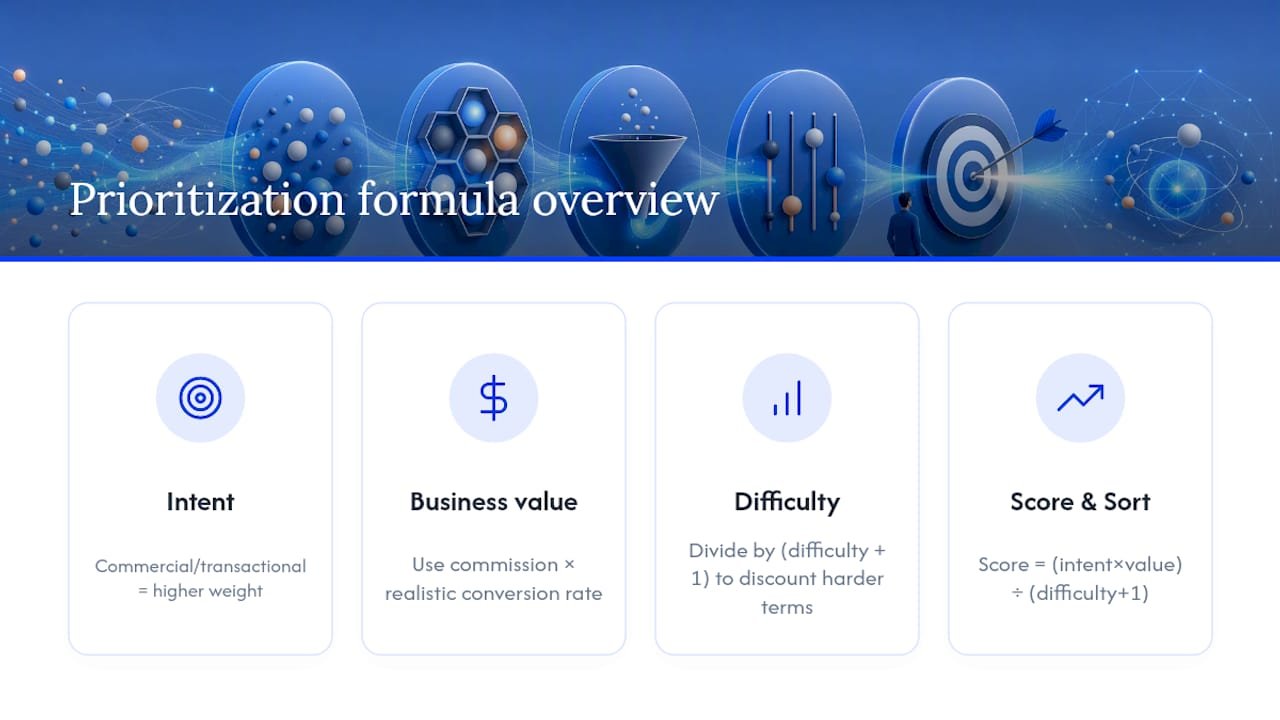
Run your list through that formula, sort descending, and you’ve got your content calendar for the next quarter.
What Tools Should Affiliates Use for Keyword Research?
You don’t need an expensive stack to do this well. What you need is the right tool for the right question, and a habit of checking free sources before paying for anything.
Google Keyword Planner is free with a Google Ads account (no ad spend required to use the tool) and gives you real volume ranges plus related keyword suggestions. Its intent labeling is weak, but its volume data is about as accurate as you’ll get for free.
Semrush and Ahrefs are the paid workhorses. Both label keyword intent directly in their keyword tools, which saves you the manual guesswork described above. Both also show the ranking difficulty score and, critically, let you see exactly which pages currently rank so you can size up the competition before committing hours to a draft.
Keyword Surfer is a free browser extension that overlays estimated volume and CPC directly onto Google search results as you browse. It’s the fastest way to sanity-check a keyword while you’re already reading the SERP manually.
AnswerThePublic visualizes question-based and preposition-based query variations around a seed term. It’s particularly good for informational-to-commercial bridge content, the kind of post that answers a question but naturally sets up a product recommendation.
Here’s the free-tool workflow that replicates most of what a paid subscription gives you:
- Type your seed keyword into Google and screenshot the autocomplete suggestions
- Scroll to the bottom of the results page for the “related searches” box
- Open every “People Also Ask” dropdown and note the follow-up questions that appear
- Search “[keyword] Reddit” to surface forum discussions, which often reveal the exact phrasing real buyers use and expose low-competition angles the gelato guide on affiliate research flags as a growing 2026 opportunity
- Note any keyword returning near-zero volume in a paid tool but showing consistent forum and Reddit chatter. That mismatch is often a hidden opportunity, not a dead end
Run the free version first. Upgrade to a paid tool only once you’ve validated that the workflow itself is producing content that ranks and converts.
How Do You Read a SERP for Buyer Intent in Under a Minute?
Metrics can mislead you. A keyword tool might show a “medium” difficulty score for a keyword that’s actually dominated by three unbeatable domains, or “easy” for a keyword the tool hasn’t recalculated since a Google update reshuffled the results. The SERP itself never lies, because it’s showing you what’s ranking right now.
Here’s what to look for in your 60 seconds:
- Shopping carousels or product ads at the top mean Google reads the query as transactional. Build a direct comparison or “best of” page, not a long educational post
- Comparison and “vs” articles dominating page one confirm commercial-investigation intent. This is your sweet spot as an affiliate
- Forum threads (Reddit, Quora) ranking in the top five usually signal weak competition. If a forum thread with no formatting and no images is beating out actual content, a well-built page can often take that spot
- Posts with visible publish dates older than two years and no updates are vulnerable, especially if pricing or product details in the post look stale
- A “People Also Ask” box stacked with basic definitional questions suggests the query still leans informational, which means it’s better suited to a supporting post than a pillar page chasing conversions
Pro Tip: Before you trust a difficulty score, open the top three ranking pages and check their word count, publish date, and backlink profile in whatever tool you’re using. If all three are recent, comprehensive, and well-linked, the “medium difficulty” label is lying to you.
Metrics tell you what a keyword tool’s algorithm estimated weeks or months ago. The SERP tells you what Google is rewarding today, which is a meaningfully different and more useful signal, echoing the SE Ranking finding that live intent analysis outperforms static keyword data.
Building a Content Cluster That Actually Makes Money
Individual keywords don’t build authority. Clusters do. The standard structure that works for affiliate sites: one commercial pillar page (think “Best [Category] Tools for [Audience]”) supported by three to eight narrower posts covering individual reviews, head-to-head comparisons, and adjacent informational questions.
The pillar page captures the broad commercial-investigation searcher. The supporting posts capture narrower long-tail variants and funnel their internal links back up to the pillar, concentrating topical authority the way content strategy guides on blog structure recommend for building topical depth.
A simple spreadsheet does the scoring work. Track these columns for every candidate keyword:
| Column | What it captures |
|---|---|
| Keyword | The exact long-tail phrase |
| Intent | Informational, commercial-investigation, or transactional |
| Difficulty (KD) | Score from your tool of choice |
| CPC | Proxy for commercial value |
| Estimated business value | Commission amount × realistic conversion rate |
| Priority score | (Intent weight × business value) ÷ (difficulty + 1) |
| Cluster | Which pillar page this keyword supports |
| Status | Not started, drafted, published, needs update |
Sort by priority score, group by cluster, and you’ve got a publishing sequence instead of a random pile of blog post ideas. Link every supporting post back to its pillar using anchor text that describes the pillar’s topic, not generic phrases like “click here.” That anchor consistency is part of how search engines understand which page in your cluster is the authority for that broader topic.
What Makes an Affiliate Page Actually Convert Readers Into Clicks?
The keyword tells you what the reader wants. The page has to deliver that exact format, or you lose them at the scroll.
If the keyword is a “vs” comparison, build a comparison page with a table, not a 2,000-word narrative essay. If the keyword is transactional (“buy,” “pricing,” “deal”), the reader wants a fast answer and a clear link, not three paragraphs of backstory before the recommendation shows up. Matching format to intent is one of the clearest levers you have, and it’s exactly what AiseoJournal’s buyer journey research recommends: comparison articles for comparison SERPs, product-style pages for transactional ones.
A few non-negotiables for conversion hygiene:
- Write headings from the buyer’s decision point, not from a generic feature list (“Which plan fits a solo freelancer?” beats “Plan Comparison”)
- Put your primary recommendation and its link above the fold, or at minimum within the first two screens
- Never hide pricing behind a “contact us” wall on a page targeting a pricing-intent keyword. Research on transactional intent pages shows that hiding pricing on pages built for exactly that query kills conversions, because the reader searched for a number and you gave them a form instead
- Disclose the affiliate relationship clearly and early. Trust converts better than concealment ever will
Pro Tip: Run a five-second test on your own page: if a stranger landed on it, could they tell within five seconds what you’re recommending and why? If not, your format doesn’t match your keyword’s intent.
How Do You Track Whether Your Keywords Are Actually Working?
Rankings alone are vanity if nothing downstream moves. The metrics that matter for affiliate content, in order of how directly they connect to revenue: impressions, click-through rate, actual clicks, conversion rate, and revenue per visitor.
Google Search Console is where this starts. It shows you which queries are generating impressions for a page even before that page ranks well, which tells you whether your targeting is even in the right neighborhood. A page with rising impressions but flat clicks usually has a title and meta description problem, not a keyword problem. A page with decent clicks but no conversions usually has a format or offer-fit problem, not a traffic problem.
Cross-reference Search Console data with your affiliate network’s dashboard or your own link-tracking setup to connect specific keywords to actual commission revenue, not just clicks. This is the step most affiliates skip, and it’s the one that tells you which of your “winning” keywords are actually paying rent.
A workable cadence: check performance every two weeks for new content, and give any page at least six to eight weeks before deciding it’s underperforming; Google needs time to fully index and settle rankings. If a page has decent impressions but weak CTR after that window, rewrite the title. If it has good CTR but no conversions, the problem sits with format or offer fit, not the keyword.
Statistic to know: long-tail keyword targeting tends to produce higher conversion rates than short, generic terms precisely because the searcher has already narrowed their own intent. Track conversion rate by keyword length as a segment, and you’ll usually see this pattern in your own data within a few months.
Understanding Affiliate Program Structures Before You Chase a Keyword
Not every affiliate program pays the same way, and that difference should shape which keywords you even bother pursuing. A flat one-time commission program (common with software tools and physical products) rewards keywords that convert fast, since you get paid once regardless of how long the customer sticks around. A recurring commission program, common with SaaS subscriptions, rewards patience: even a modest keyword can compound in value over months as customers renew.
Tiered commission structures, where your payout percentage increases as you refer more customers, change the math again. Early on, a lower-difficulty keyword that generates steady volume might be worth more than a harder keyword with bigger single-sale value, because it helps you climb the tier faster. Cost-per-lead (CPL) programs, common in finance and insurance, pay out on a form submission rather than a full purchase, which usually means you can target slightly less bought-in commercial-investigation keywords, since the conversion bar is lower.
Before building a keyword list, check the program’s cookie duration too. A 24-hour cookie punishes informational content that doesn’t convert same-day, pushing you harder toward transactional keywords. A 60 or 90-day cookie gives commercial-investigation content more room to work, since a reader who compares options today might buy two weeks later and you still get credit.
Match your keyword difficulty tolerance to the payout structure. Chasing a hard keyword for a low, one-time commission rarely pencils out. The same difficulty level for a high-value recurring program usually does.
Turning Keyword Data Into a Repeatable Revenue Habit
The mistakes that sink most affiliate keyword lists aren’t complicated. They’re the same handful, repeated:
- Chasing volume over intent. A 10,000-search informational keyword with no buying signal will almost always underperform a 200-search commercial-investigation phrase
- Skipping the manual SERP check. Trusting a difficulty score without ever opening the actual results page
- Ignoring offer economics. Building content around a keyword that doesn’t match the commission structure or cookie length of the program
- Hiding pricing or the recommendation below multiple paragraphs of unnecessary preamble
- Publishing without a cluster plan, leaving supporting posts with no pillar to link to and no topical authority to draw from
Red flags that should knock a keyword off your list entirely: three or more massive, high-authority domains occupying the top five spots with fresh, comprehensive content; zero commercial modifiers appearing anywhere on page one; or a program with a payout structure that doesn’t justify the difficulty you’d need to overcome.
Practical AI Shortcuts I Use for Faster Keyword Clustering
The manual version of this workflow works fine. The AI-assisted version just does it faster, and I lean on it constantly when I’m building out a new niche.
Feed a large language model your seed list and ask it to generate fifty long-tail expansions using the commercial modifiers covered earlier, then run that raw output through your keyword tool to attach real metrics. From there, ask the model to group the surviving keywords into clusters based on shared buyer intent and topic overlap, which turns a flat spreadsheet into a pillar-and-support structure in minutes instead of hours. I break this exact process down with real examples on my blog, including the prompt structures that produce usable clusters instead of generic noise.
The mistake I see most often isn’t laziness. It’s trusting the AI output without checking it against a live SERP. A model can suggest a keyword that sounds perfect and has zero real search behavior behind it.
Pro Tip: Never publish an AI-suggested keyword without running it through the manual SERP check from earlier. AI is excellent at pattern generation and terrible at knowing what’s ranking on Google this afternoon.
Treat AI as a speed multiplier for the expand and cluster stages, not a replacement for the filter and check stages. Those still need your eyes.
Will Buckley: Why Small, Consistent Wins Beat Chasing Traffic
Most people treat keyword research like a numbers game: bigger volume, bigger win. I’d argue the opposite is true for affiliates. A stack of ten low-volume, high-intent keywords that each convert at a healthy rate will outearn one big informational post that ranks well and converts almost nobody.
Start smaller than you think you should. Pick one offer you already promote, and spend a single afternoon finding five commercial-investigation long-tail keywords using the offer-first method above. Not fifty. Five. Run the SERP check on each one before you write anything.
Realistically, expect your first conversion from a new keyword to take somewhere between six and twelve weeks, depending on your site’s existing authority and how competitive that first SERP check turned out to be. That’s not a failure if it happens on week ten instead of week four. It’s the normal timeline for content that has to get indexed, evaluated, and trusted by Google before it earns a ranking worth clicking.
If you want to go deeper on the AI-assisted side of this process, including how I structure prompts for expansion and clustering, I cover it in more detail on the blog.
— Will
Get Hands-On Help Building Your Keyword Cluster
Reading a workflow and executing it under deadline pressure are two different things, especially when you’re also writing the content, managing the affiliate relationships, and trying to keep a publishing schedule. Willbuckley’s coaching exists for exactly that gap: hands-on implementation of the intent-first process above, applied to your actual offer instead of a hypothetical one.

Coaching sessions walk through your specific niche and produce a prioritized keyword cluster built around your real offer economics, plus a conversion-optimized outline for your first pillar page, so you’re not staring at a blank spreadsheet wondering where to start. If you’d rather have someone check your SERP analysis and cluster structure than guess whether you got it right, book a session through the landing page and bring one offer you’re already promoting. That’s the fastest way to turn this article into an actual published cluster.
Sources
For deeper reading on the concepts covered above, SE Ranking’s breakdown of search intent types and Semrush’s keyword intent guide are strong starting points on classification. For affiliate-specific tactics, Matt McWilliams’ offer-first keyword workflow and Gelato’s 2026 affiliate keyword guide go deeper on long-tail and zero-volume tactics. On the content side, insave.hosting’s SEO practices guide and GrowthPlugins’ conversion research pair well with the on-page section above.
Pingback: Programmatic SEO for Affiliates: Build a 50–200 Page Pilot in 2–4 Weeks – The Mindset Motivator