

Prompt engineering for marketing turns raw AI output into on-brand, testable assets that cut drafting time and sharpen campaign results. It works for anyone producing content at volume: solo affiliate marketers, in-house content leads, performance teams running paid campaigns. By the end of this guide, you’ll have frameworks, copy-paste templates, and a workflow you can actually run on Monday morning.
TL;DR:
- Reusable prompt frameworks like TRIM and the five-part structure improve content relevance, consistency, and voice fidelity in marketing outputs.
- Including specific role descriptions, context, constraints, and examples in prompts significantly reduces the need for multiple re-prompts and manual edits.
- Creating a shared prompt library with versioning and ownership ensures team-wide consistency and efficient scaling of AI-assisted content workflows.
- Regular testing, measuring, and fact-checking prompts are essential to prevent the publication of unverified claims and maintain brand integrity.
- Choosing the appropriate AI model based on the task, data privacy, and integration needs maximizes efficiency and aligns AI tools with marketing objectives.
Table of Contents
- What Prompt Engineering for Marketing Actually Means
- Core Prompt Frameworks Every Marketer Should Know
- Ready-to-Use Prompt Templates for Common Marketing Tasks
- Building a Prompt Library Your Team Will Actually Use
- How to Test and Govern Your Prompts
- Choosing the Right AI Tool for the Job
- A Practitioner’s Prompt Playbook for Affiliate Marketing
- Where This Is Headed
- Turn These Prompts Into a Repeatable Income System
- Sources
- FAQ
What Prompt Engineering for Marketing Actually Means
Prompt engineering for marketing is the practice of structuring your instructions to an AI model so it produces usable, on-brand copy instead of generic filler. It’s not about magic words. It’s about giving a model the same clarity you’d give a new freelance writer: who they’re writing as, what the piece needs to do, and what “good” looks like.
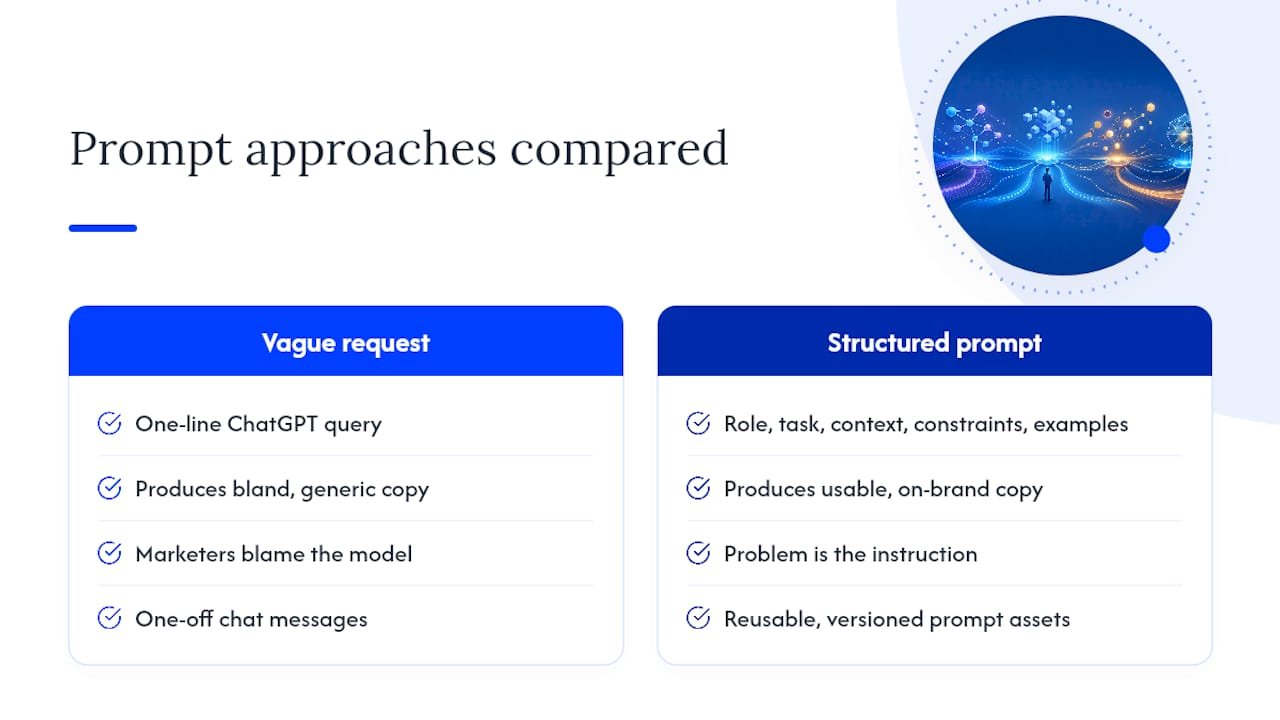
That distinction matters because most marketers still type a one-line request into ChatGPT, get a bland draft back, and conclude AI “doesn’t get their voice.” The problem usually isn’t the model. It’s the instruction. Structured prompts built around role, task, context, constraints, and examples reliably produce more usable, on-brand outputs than vague requests, because the model isn’t guessing at what you actually want.
The payoff shows up in workflow speed, not just copy quality. Marketing teams that treat prompts as reusable, versioned assets, rather than one-off chat messages, report faster campaign iteration and more consistent creative output, according to Harvard Business Review’s coverage of gen-AI strategy. Short, hands-on practice with real briefs also builds this skill faster than reading about it, which is why guided project formats built around actual campaign tasks tend to stick better than generic tutorials.
Core Prompt Frameworks Every Marketer Should Know
Two structures do most of the heavy lifting for marketing prompts, and you don’t need more than that to start.
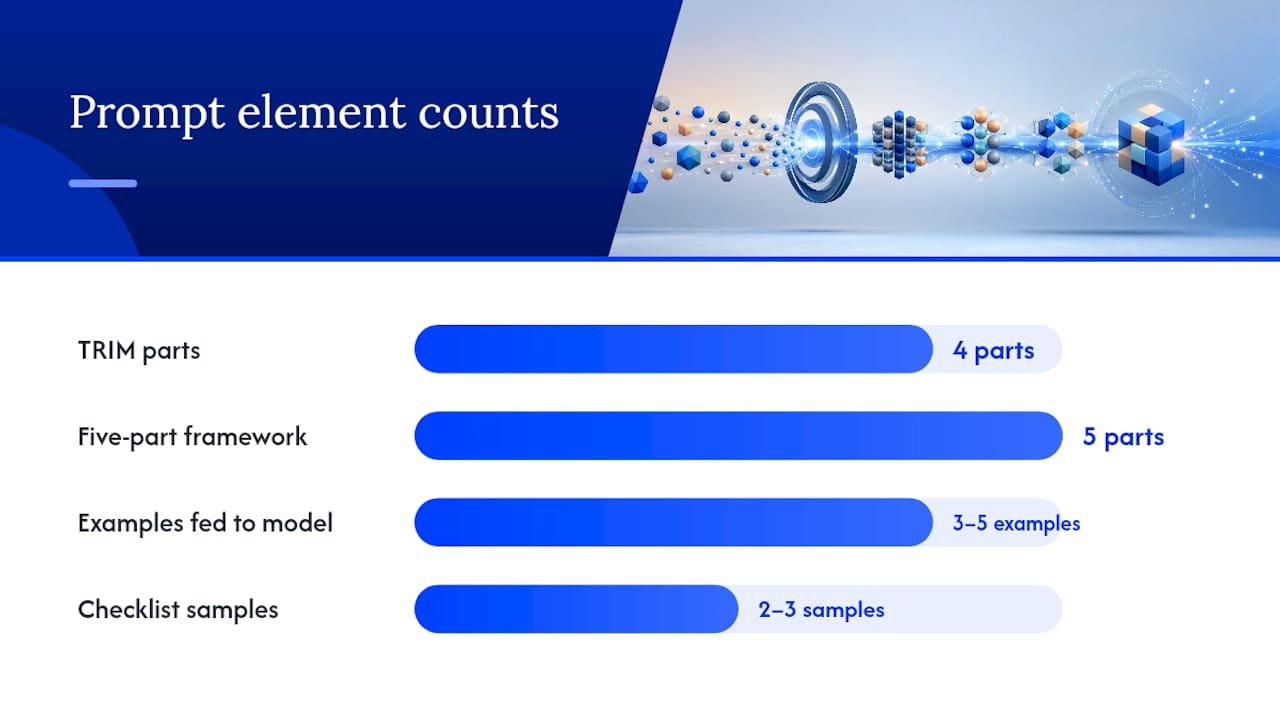
TRIM stands for Task, Role, Instructions, Model context. You tell the AI what you need done, who it’s acting as, how to do it, and what background it needs about your brand or product. It’s a fast, lightweight structure for quick asks like subject lines or social captions.
The five-part framework, Role, Task, Context, Constraints, Examples, is the workhorse for anything longer: blog posts, ad copy, email sequences. Here’s what happens when you skip parts of it:
- Skip the Role, and you get generic corporate tone with no personality.
- Skip the Context, and the model invents details about your product or audience.
- Skip the Constraints, and you get 800 words when you needed 150.
- Skip the Examples, and brand voice fidelity drops sharply. Feeding a model three to five real examples of your actual writing beats describing your tone with adjectives like “friendly” or “bold” every time.
Paste this checklist into your prompt template and fill in each line before you hit send: Role (who’s writing), Task (what output, in what format), Context (product, audience, offer), Constraints (length, tone, banned words), Examples (2 to 3 samples of your voice).
Pro Tip: Save your five-part checklist as a text snippet in whatever tool you use daily. Filling in five blanks takes 90 seconds and saves you three rounds of frustrated re-prompting.
Ready-to-Use Prompt Templates for Common Marketing Tasks
These templates map to the tasks marketers run every week. Swap the bracketed sections for your own details and treat the first output as a draft, not a final asset.
- Content brief. “Act as a content strategist for [brand/niche]. Write a content brief for a blog post targeting [keyword]. Audience: [description]. Include a working title, three H2 sections, target word count of [X], and one call-to-action idea.” Google Workspace’s marketing prompt library shows this same job-first structure for turning a bare topic into a workable outline inside Docs.
- Ad copy variations. “Act as a direct-response copywriter. Write five short-form ad variations for [product] targeting [audience pain point]. Constraints: under 30 words each, one variation should lead with a question, one should lead with a statistic, tone is [urgent/friendly/authoritative].”
- Email sequence. “Act as an email marketer. Write a three-email welcome sequence for new subscribers to [offer]. Email 1: welcome and expectation-setting. Email 2: social proof and objection-handling. Email 3: soft pitch with deadline. Keep each email under 150 words.”
- Content repurposing. “Turn this blog post [paste text] into: one LinkedIn post under 200 words, three tweet-length hooks, and a 60-second video script outline.”
- Analytics summary. “Act as a marketing analyst. Summarize this campaign data [paste data] in plain language for a non-technical stakeholder. Highlight the single biggest win, the single biggest concern, and one recommended next step.” HubSpot’s prompt collection uses this same plain-language reframe for turning raw numbers into a digestible update.
When a draft misses, don’t start over. Iterate with follow-ups: “Make this 30% shorter,” “Rewrite in a more conversational tone,” or “Replace the second paragraph with a specific example instead of a general claim.” Iteration prompts almost always get you further, faster, than a fresh attempt from scratch.
Building a Prompt Library Your Team Will Actually Use
A prompt that works once and then disappears into a chat history isn’t a system. It’s a fluke. Treat your best prompts like creative assets: name them, version them, and store them somewhere your whole team can find.
A workable structure looks like this:
- Naming convention: task_channel_version (example: “ad-copy_facebook_v3”).
- Tags: by funnel stage, format, and campaign so anyone can filter fast.
- Home base: a shared Notion doc, a Google Doc, or a dedicated tool like Prompt Builder works fine. What matters is one source of truth, not the specific app.
- Ownership: assign one person to update and retire prompts as your brand voice or offers change.
Practitioner guidance on this consistently points the same direction: treat prompts like versioned assets with clear ownership, not disposable chat messages.
From there, the mini-process is simple: brief goes in, prompt gets pulled from the library and customized, draft comes out, a human edits for accuracy and voice, then it publishes. That fifth step, editing, never gets skipped. It’s the difference between AI-assisted content and AI-generated liability.
How to Test and Govern Your Prompts
Treat prompt performance the way you’d treat any other marketing variable: measure it, then improve it.
Track edit time (how long a human spends fixing the draft), click-through rate on AI-assisted versus human-written variants, conversion lift where you can isolate it, and a qualitative brand-fit score from whoever owns your voice guidelines. Run A/B tests the same way you’d test subject lines: same audience, one prompt variable changed at a time, whether that’s tone, structure, or example count.
Governance matters just as much as testing, and this is the part teams skip until something goes wrong. LLMs can state incorrect figures or sources with total confidence, so practitioner guides consistently recommend a mandatory fact-check step before anything AI-drafted goes live, especially for statistics, claims, and anything that touches compliance.
Your governance checklist should cover:
- Every statistic or factual claim gets verified against a primary source before publishing.
- A list of prohibited claims (health claims, guaranteed results, competitor comparisons) sits in the prompt library itself.
- One named person signs off before publish, no exceptions for “small” pieces like social captions.
Choosing the Right AI Tool for the Job
Not every model fits every marketing task, and picking the wrong one wastes more time than a bad prompt does. Conversational, creative models tend to handle ad copy, social captions, and first-draft blog content well. Reasoning-focused models do better with campaign analysis, competitive research summaries, and structured data interpretation. Image models are their own category entirely, suited to visual assets, not text. Vendor guidance on marketing use cases generally maps model type to task rather than treating one model as universally best.
Before adopting a tool, check:
- Where your data goes and whether it’s used for further model training.
- Whether the tool integrates with your CMS, ad builder, or analytics dashboard, or requires copy-pasting everywhere.
- Whether pricing scales with your actual usage or locks you into a flat tier you’ll outgrow.
For a deeper breakdown of specific tools worth testing, A guide to AI writing tools for marketers covers the trade-offs in more detail.
A Practitioner’s Prompt Playbook for Affiliate Marketing
Affiliate marketing content lives and dies on volume and specificity, so prompts built for it need tight constraints from the start: exact product names, real commission structures, and disclosure language baked into the template rather than added after the fact. A structured brief-to-draft process, paired with a maintained prompt library, routinely cuts editing time on repetitive formats like product roundups and comparison posts. The output isn’t perfect copy. It’s a strong first draft, every time, instead of a blank page.
Where This Is Headed
Prompt skills are becoming table stakes for marketing teams, not a specialty. The real risk isn’t AI writing badly. It’s teams publishing confident, unverified claims. Invest in governance and a shared prompt library before you scale output.
— Will
Turn These Prompts Into a Repeatable Income System
Templates get you better drafts, and agencies offering SEO content production, vertical-aware services can help scale your output efficiently. What actually moves the needle for affiliate marketers is turning those drafts into a repeatable content and promotion system, and that’s the gap Playbooks are built to close. If you’re producing content at volume and want a structured path rather than more scattered experiments, the YouTube automation affiliate marketing playbook walks through the workflow end to end: prompt-driven scripting, production, and promotion built around real affiliate offers.
You’ll get concrete workflows instead of theory, templates you can adapt to your niche, and a structure for scaling content without scaling your hours. Start with the playbook, plug in your own offers, and run your first prompt-assisted batch this week.
Sources
- AI Prompts for Marketers: The Complete Guide (With Copy-Paste Templates)
- How should gen-AI fit into your marketing strategy (HBR)
- Prompts for marketing (Google Workspace)
- 33 ChatGPT prompts I keep in my toolkit
FAQ
Can ChatGPT Help With Marketing?
Yes, ChatGPT can draft ad copy, emails, content briefs, and analytics summaries when given structured prompts with role, context, and examples. It still requires human editing for accuracy and brand voice before anything publishes.
Which AI Tool Is Best for Marketers?
There’s no single best tool. Conversational models suit creative copy, reasoning-focused models suit analysis and research, and image models handle visual assets, so the right choice depends on the task in front of you.
Is Prompt Engineering Still in Demand?
Yes. As marketing teams embed AI deeper into content and campaign workflows, structuring effective prompts has become a core skill rather than a niche specialty, and teams that treat prompts as reusable assets report faster iteration cycles.
Pingback: Marketers: Build a Prompt Library in 30 Days with 10–15 Copy Ready Prompts – The Mindset Motivator