

A winback email with AI is a short sequence aimed at people who used to read or buy from you and have gone quiet. AI does the slow parts: it finds the lapsed segment, drafts copy that refers to what each person actually did, and suggests timing. You still decide who gets a message, what you promise and whether it worked. Done well, it is one of the least stressful ways to get more from a list you already built.
If you have ever looked at a subscriber count that keeps climbing while clicks keep sliding, this is for you. Let’s walk through it step by step, with example subject lines and a sequence you can adapt today.
TL;DR
- Define “lapsed” for your own audience first. Ninety days is a common starting point, but your repeat curve decides.
- Use AI for segmenting, drafting and auditing, and keep a human approval step before anything sends.
- Run a short sequence of two to four emails, with a personal hook and a simple offer, then stop.
- Keep a holdout group so you can see what the campaign recovered rather than what would have happened anyway.
- Respect unsubscribes, cap frequency and let unresponsive contacts go to protect deliverability.
Table of Contents
- What an AI-assisted winback campaign really is
- Decide who counts as lapsed
- Write emails that sound like you noticed them
- Build the sequence: how many emails and when
- Our perspective: keep the human in the loop
- Stay on the right side of consent and deliverability
- Measure what you actually won back
- A simple two-week plan to try this week
- Want a hand putting this into practice?
- FAQ
- Sources
What an AI-assisted winback campaign really is
A winback campaign is not a blast to your whole list with “we miss you” on top. It is a targeted effort to re-engage people who showed interest earlier and then stopped responding. In an AI-assisted version, the assistant helps with the groundwork. One practical guide describes the workflow as finding customers who bought before but have not ordered in 90 days, drafting an email with an offer and scheduling it after human approval.
For affiliate marketers, “customer” can mean a few things. It might be a subscriber who used to click your recommendations, a reader who once bought through your link, or a buyer of your own digital product. The mechanics are the same: you have a signal that they were once engaged, and a signal that they are not now.
There is a limit worth knowing about. Platform guidance notes that winback efforts work less well on people who have not interacted with your emails in more than 180 days. The sooner you reach out after someone cools off, the better your odds. Waiting a year and hoping is the most common mistake we see.
Decide who counts as lapsed
Before any AI touches your list, answer one question: how long is too long for your audience? There is no universal number. Adobe’s deliverability guidance calls 90 days a rule of thumb for inactive subscribers, while reminding you to account for things like seasonal sending patterns.
Think about how often your readers naturally act. If you recommend a monthly software subscription, 90 days of silence is a real signal. If you cover tax software or holiday gear, a quiet summer is normal. Another help-center guide suggests that 90 days suits high-frequency categories, while luxury or B2B audiences may need 180 or 365 days to match their repeat purchase curve.
Next, find the people. Most email platforms can do this without AI. One major platform lets you identify inactive contacts by a low contact rating or by campaign interaction, such as not opening or clicking your last five emails. That gives you a clean starting list.
Then go a step further. Segmenting only by last open date treats very different people the same. Constant Contact advises including engagement level and past value, such as separating silent VIP buyers from one-time browsers. Someone who bought three tools through your links deserves a different note from someone who downloaded a checklist once.
This is where AI earns its keep. You can hand an assistant an export of your list with last click date, number of past clicks and categories of interest, and ask it to propose segments you would not have thought of. Klaviyo’s team notes that CRM-embedded AI agents can surface revenue opportunities in existing data by suggesting segments beyond manual setups. If you want a deeper look at how this works, this guide to AI customer segments covers the approach in detail.
A quick caution on data: only paste what you are allowed to share with an AI tool, and strip anything you do not need, like full names or addresses, if a first name and behavior will do.
Write emails that sound like you noticed them
The biggest complaint about AI email copy is that it reads like AI email copy. The fix is specificity. Spojit’s documentation highlights that generic output is a common pitfall and that prompts should be constrained to reference specific data points, such as a customer’s first orders.
AI can personalize using past purchases, browsing history or wishlisted products, and predictive analytics can use customer lifetime value and churn risk to tailor the incentive. For a small affiliate list, you will not have all of that. You will have something simpler: which topics someone clicked, which tools they looked at, and when they last showed up. That is plenty.
Here is a prompt shape that works well. Tell the assistant who the reader is, what they last did, what you have published since, and what you want them to do next. Then give it limits: under 120 words, one link, no invented discounts, no fake urgency, plain tone. Ask for three subject line options and pick the one that sounds like something you would say out loud.
A few example subject lines to adapt (these are illustrations, not tested results):
- “Still comparing email tools? I updated my notes”
- “You clicked on this back in spring, so I thought of you”
- “We miss you. Here’s what changed”
That last one is not random. Adobe cites Return Path research indicating that phrasing like “We miss you” gets higher response than “We want you back”. It makes sense: one sounds like a friend, the other sounds like a demand.
If you promote a product with a discount or bonus, the same guidance says that re-engagement emails using dollar-amount discounts often get higher response than percentage offers. Only offer what the program actually permits, and disclose affiliate relationships the way you normally do.
Not every winback needs a discount, either. For B2B-minded readers, one analysis of AI-driven re-engagement points out that the best next action may be content such as a case study instead of a price cut. If your audience cares about results, a link to a real walkthrough, like our affiliate marketing case study data, may do more than a coupon.
Whatever the assistant writes, read it aloud. If you would never say a sentence to a reader, cut it. Our guide to humanizing AI content has a quick workflow for exactly that edit.
Build the sequence: how many emails and when
Short and kind beats long and pushy. Timing guidance varies by platform, so treat these as starting points rather than laws.
One platform’s built-in winback journey triggers after 45 days without a purchase and sends two messages separated by a 15-day wait. That is a useful floor: two messages is a legitimate sequence. Scandiweb, in a case write-up, proposes a four-touch, 14-day re-engagement sequence with personalized hooks and direct links, closing with an experimental conversational AI touch. You do not need that last piece to benefit from the structure.
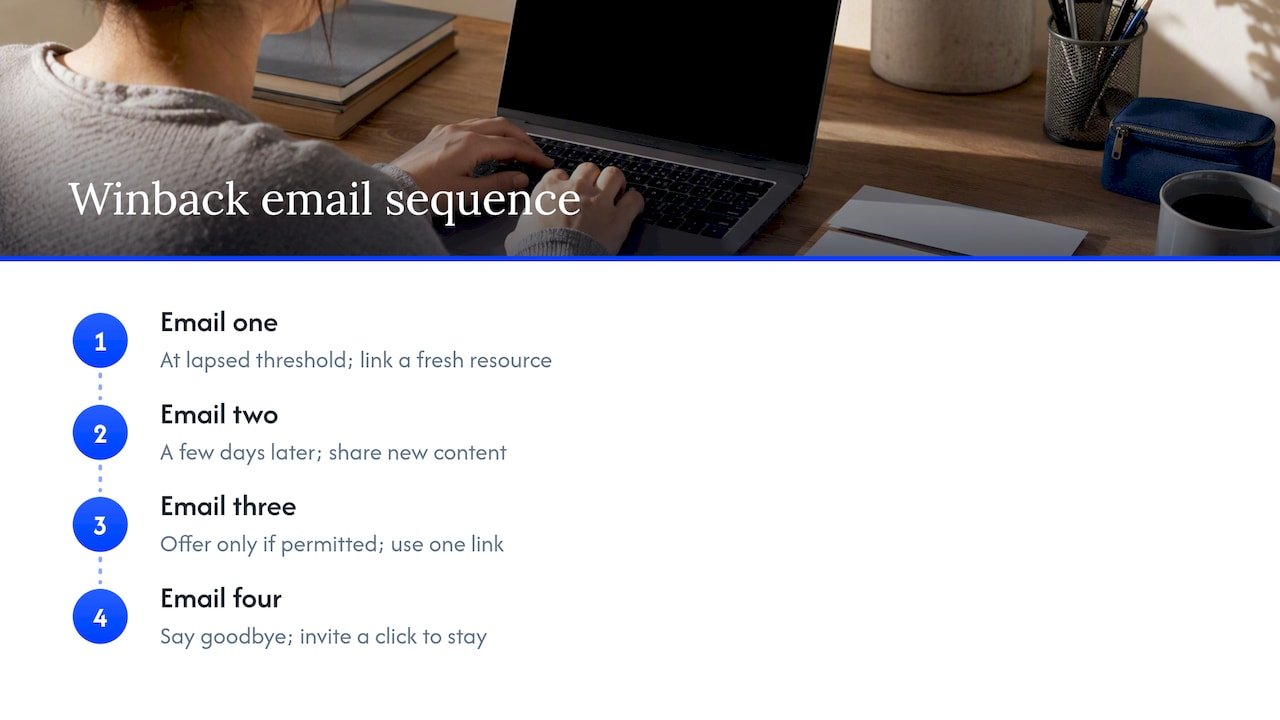
Here is a simple four-email version for an affiliate list, written in prose so you can adapt it:
Email one goes out as soon as someone hits your lapsed threshold. It is short and warm, references the last thing they engaged with and links to one useful, fresh resource. No offer yet.
Email two follows a few days later and takes a different angle. Maybe it is your best new tutorial or a comparison you updated. Think of it as proof that staying subscribed is worth it.
Email three carries the offer, if you have one: a bonus, a dollar-amount saving where the program allows it, or a free template. Keep the call to action to a single link.
Email four is the honest goodbye. Tell them you will stop sending unless they click, and make that click easy. People respond to a clear choice, and the ones who do not respond leave your active list, which is healthy for you.
If you want the nuts and bolts for building sequences quickly, our guide on running AI email sequences with plug and play briefs walks through the briefs we use. And if you are still growing the list itself, building a high converting affiliate email list comes first.
Once the sequence is live, AI can help you improve it. Klaviyo notes that AI agents can run flow audits to find drop-off points and suggest changes to the number of emails and their timing. On a small list, you can do a poor man’s version: paste your open and click numbers per email into an assistant and ask where people fell away. For ideas on how many touches and how to space them, these customer retention strategies are worth skimming too.
Our perspective: keep the human in the loop
We teach affiliate marketers to use AI as a fast, tireless assistant, not as the face of the business. Winback is a perfect example. The assistant can sort a list in minutes and give you five drafts before your coffee cools. What it cannot do is know why someone drifted away, or feel the difference between a note that sounds like a friend and one that sounds like a sales funnel.
That is why we lean on a simple rule: AI proposes, you approve. The guides we looked at build that step in, and we think it matters even more for small lists, where every reader is a real person who might reply to you directly. Many of our readers find that the emails that get replies are the plain ones, with a first name and one honest sentence about why you are writing.
The second part of our view is about time. Many affiliates come to us overwhelmed, with tools and tabs everywhere. Winback is a way to get more from work you already did. You already earned those subscribers. A thoughtful two-week sequence, drafted with AI and polished by you, can be a calm and practical project rather than another thing on the pile. Our approach is built around exactly that: practical, time-saving steps that you can run without needing a big team. If you want the broader picture, see our guide to AI workflow automation for affiliate marketers.
— Will
Stay on the right side of consent and deliverability
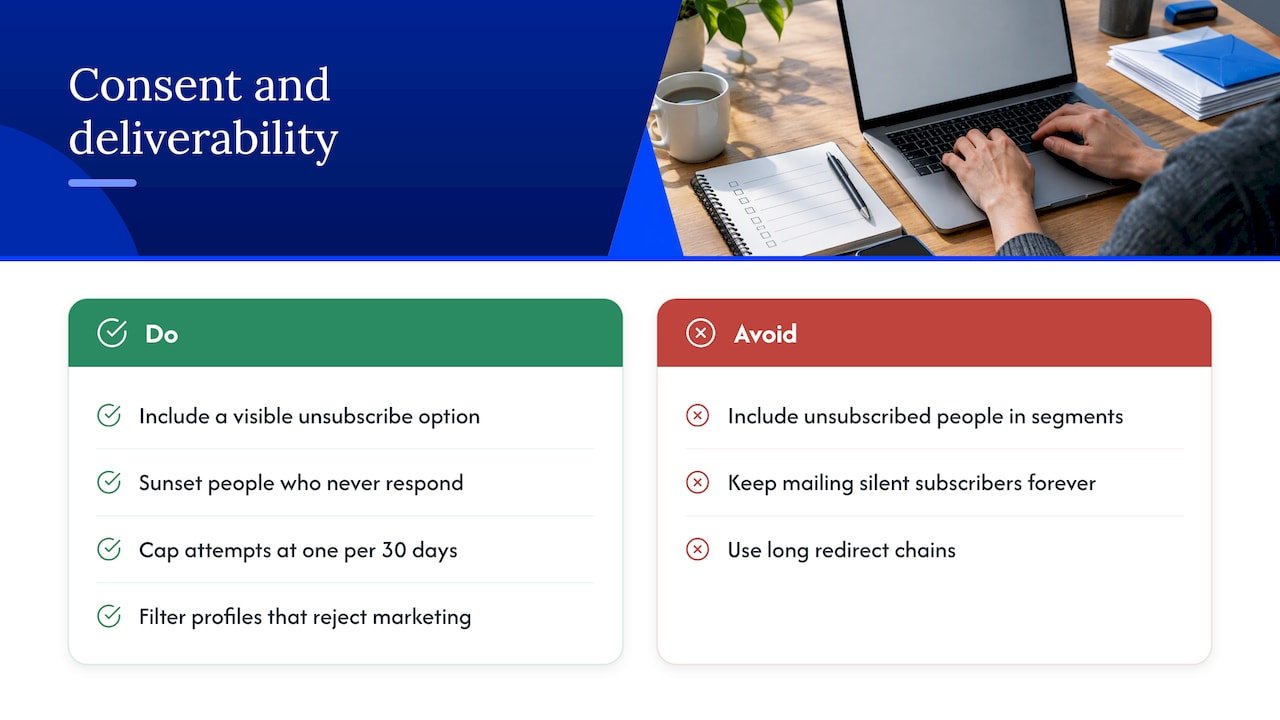
Winback emails go to people who have stopped engaging, which is exactly the group most likely to hit “spam.” A few habits protect you.
First, always include a visible unsubscribe option and consider sunsetting people who never respond. Klaviyo’s guidance lists both as core practices for protecting deliverability.
Second, limit frequency. Spojit’s documentation advises capping winback attempts at one per customer every 30 days and filtering out profiles that do not accept marketing. If someone unsubscribed, they are out of every segment, no exceptions, no matter how well the AI thinks they would convert.
Third, do not keep mailing the silent forever. Adobe notes that mailbox providers and denylist operators consider engagement over roughly 1.5 to 1.8 years and recommends gradually reducing sends to continually inactive subscribers. Winback is a last good attempt, not a lifelong subscription to their inbox.
If your emails carry affiliate links, the links themselves matter too. Long redirect chains can hurt inboxing, which we cover in affiliate email deliverability: fix redirect chains, not links. And if you are using AI on subscriber data, our piece on mapping ethical AI marketing to NIST, IAB and UNESCO is a good guardrail. Rules on consent differ by country, so check the requirements for where your subscribers live and ask a qualified professional if you are unsure.
Measure what you actually won back
It is tempting to count the people who clicked after your sequence and call it a win. But some of them would have come back anyway. Bloomreach suggests tracking repurchase rate in the targeted segment, revenue within a defined window and time to second purchase, then using a holdout group to see whether you recovered revenue or just accelerated purchases that would have happened regardless.
A holdout is simply a random slice of your lapsed segment that gets no winback emails. Set it aside before you send. When the observation window ends, compare the two groups. If the emailed group came back at a meaningfully higher rate, you have real lift. If not, you have learned something valuable cheaply.
The same logic applies to the broader list of metrics. Bastelia lists reactivation rate, incremental lift against a holdout, recovered revenue, time to reactivation and quality signals like unsubscribes and spam complaints. For affiliates, “recovered revenue” is your commission from those clicks, so tie it to your tracking. Our guide to affiliate attribution models shows how to credit the right touch, and AI marketing analytics helps you read the numbers without drowning in dashboards.
One more practical point: count what you spent. If you offered a bonus or paid for a tool, subtract it before you celebrate.
A simple two-week plan to try this week
Day one, define your lapsed threshold and export the segment. Day two, ask an assistant to propose two or three sub-segments, such as past clickers on a specific topic versus long-time quiet readers, and set your holdout aside. Days three and four, draft the four emails with specific prompts and edit each in your own voice. Day five, check that unsubscribed and non-marketing contacts are excluded, then schedule.
Then let it run for the sequence length, review replies personally, and check results against your holdout once the window closes. Resist the urge to tweak halfway. If the numbers disappoint, adjust the offer or the angle and try a fresh segment next month.
If you need help turning a draft into something good, our Claude for marketing guide and prompt engineering workflows for affiliates cover the prompts we use.
Want a hand putting this into practice?
We built our coaching, tutorials and newsletters for affiliate marketers who want to use AI without losing their own voice. If you would like workflows you can copy rather than theory, start with our guide to Claude for marketing, or look around at willbuckley.com for the latest videos and tips.
You do not need to do everything at once. One small, well-run winback sequence is a good first experiment.
FAQ
How long should a subscriber be inactive before a winback email?
It depends on how often your audience normally acts. Ninety days is a common rule of thumb, but seasonal patterns and your own repeat curve should decide. Slower categories, such as B2B or high-ticket products, may justify 180 days or more.
How many emails should a winback sequence have?
Two to four is a sensible range. One platform’s built-in journey uses two messages with a 15-day gap, and a published case proposal uses four touches over 14 days. Start small, measure against a holdout and add emails only if the data supports it.
Do I need to offer a discount?
No. A fresh resource, a useful update or a simple check-in can work, especially for readers who care about results more than price. If you do offer something, make sure the affiliate program allows it, keep it specific and be honest about any limits.
Can AI write the whole winback email for me?
It can draft it, but you should edit and approve every send. Prompts that reference real data, like what the reader last clicked, produce far better copy than generic requests. Read each email aloud and cut anything that does not sound like you.
Sources
- Run a Win-Back Email Campaign with AI
- Winback journeys with triggered emails
- Re-engagement best practices, Adobe Marketo Engage
- How to Build a Win-Back Email Campaign with AI
- Identify Inactive Subscribers
- Win-Back Emails: How to Re-Engage Inactive Customers
- 5 win-back email examples and strategies
- Re-engaging inactive customers with AI recommendations
- FAQs: Winback journeys
- Email marketing re-engagement case study
- Win-Back Emails Guide
- AI customer segments guide
- Customer retention strategies