

Coupon affiliate marketing means you promote a merchant with a discount code, and you earn a commission whenever a shopper redeems that code at checkout. The big difference from a standard affiliate link is that the sale can be credited to you even if nobody clicked anything. That makes codes a strong fit for videos, podcasts, newsletters and social posts. It also means you need to understand attribution, tracking and disclosure before you build a strategy around them.
If you have ever wondered why one affiliate gets paid for a sale that another affiliate seems to have started, this guide is for you. We will walk through how codes work, how to set up a coupon program or pitch one, how to measure it, and how to keep it clean.
TL;DR
- A coupon code can credit an affiliate with a sale without a referral-link click, so it works where links are awkward, such as podcasts and video.
- When a code and a link compete, the platform’s rules decide who gets paid, and many systems favor the code. Read the merchant’s terms first.
- Treat the customer discount and your commission as one acquisition cost, and set both together.
- Protect codes with expiry dates, usage caps, partner-specific codes and regular checks for leaks.
- Disclose your affiliate relationship clearly, near the code or link, wherever people see it.
Table of Contents
- What coupon affiliate marketing actually is
- Coupon codes versus referral links
- What happens when a code and a link collide
- How to set up a coupon affiliate strategy
- How to track coupon performance
- Do coupons add sales or just collect credit?
- Keeping codes clean: leaks, abuse and brand bidding
- Disclosure and advertising rules in the US
- Where to go from here
- Our perspective on coupons
- FAQ
- Sources
What coupon affiliate marketing actually is
In a normal affiliate setup, a reader clicks your tracked link, a cookie is stored in their browser, and a later purchase is matched to that cookie. Coupon affiliate marketing swaps the cookie for a code. The merchant gives you a code, shoppers type it in at checkout, and the redemption tells the system which affiliate earned the sale.
One network’s help center describes this as linkless code tracking: an exclusive code can identify an affiliate sale without the shopper clicking an affiliate link, subject to the advertiser’s commissioning rules and window. That last part matters. Whether and how long a code earns you money is always the merchant’s choice.
There are really two kinds of coupon affiliates, and it helps to know which one you are. The first is the coupon or deal site, which collects offers from many brands and gets paid when visitors redeem them. The second is the creator or publisher with a personal code: a reviewer, a YouTuber, a newsletter writer who gets an exclusive code for their audience. This article covers both, but if you are just starting out, the second is usually the easier door to open.
Coupon codes versus referral links
The cleanest way to understand codes is to put them next to links.
| Referral link | Coupon code | |
|---|---|---|
| How credit is earned | Shopper clicks, a cookie is set | Shopper enters the code at checkout |
| Needs a click? | Yes | No |
| Best channels | Blogs, email, social posts with clickable links | Podcasts, video, print, live events, anywhere links are awkward |
| Main weakness | Cookies can be lost or blocked | Codes can leak onto public deal pages |
| Customer sees a discount? | Not necessarily | Usually yes, though not always |
Store-platform documentation makes the key point plainly: a referral link has to be followed, while an affiliate-owned coupon can credit its owner even when the customer never used a referral link. That same documentation notes why this suits podcasts, printed materials and videos, places where asking someone to click is unrealistic. Another vendor’s conversion-tracking documentation describes the same split: attribution comes from either a browser cookie after a link click or redemption of the distributed code.
If you want a deeper look at how credit is assigned across touchpoints, our guide to affiliate attribution models shows how to match each model to the role your content plays. And if you are still working out the link side of the equation, the cookieless link tracking setup is a good companion.
What happens when a code and a link collide
This is the question that trips up most newcomers. A shopper clicks your link, then leaves, finds another affiliate’s code on a deal page, and uses it. Who gets paid?
There is no universal answer, because each platform sets its own priority. One store plugin’s documentation says that if a customer uses another affiliate’s coupon after clicking a link, the coupon owner is credited. One Shopify referral tool’s guidance, dated July 21, 2026, says that in its system an affiliate discount code takes priority over link tracking, and that when no code is used, the most recently clicked affiliate link gets the credit within the configured cookie duration.
So the practical rule is simple. Before you invest in a program, ask the merchant two things: what wins when a code and a link both appear, and how long the window lasts. Then plan around the answer. If codes beat links, your personal code needs protection from leaks. If links win on last click, a coupon page that shows up late in the journey may not earn what you expect.
How to set up a coupon affiliate strategy
Whether you are a publisher pitching a merchant or a merchant building a program, the setup runs through the same few decisions. We will go in the order they come up.
Decide whether you want a discount at all
A code does not have to mean a price cut. Programs can use codes purely as identifiers, and some give fixed rewards or links with no customer discount. If you create content for an audience that already trusts you, an exclusive code with a modest perk can work as a thank-you rather than a bargain. If your audience is deal-driven, the discount is the product.
The point is to choose on purpose. Many creators accept whatever code a brand hands over, then find the discount is too thin to excite anyone or too deep to be sustainable for the merchant.
Set the discount and the commission together
This is where beginners get tripped up, because it feels like two separate numbers. It is one. Every redeemed code costs the merchant the discount plus your commission, and a smart merchant counts both as a single customer acquisition cost.
A quick worked example, using round numbers only to show the logic. Say a product sells for $100, the code takes 10% off, and your commission is 20% of the sale. The shopper pays $90. If commission is calculated on the amount paid, you earn $18, and the merchant has given up $10 plus $18, or $28, to land one sale. If you were negotiating for a higher rate, you now know that a merchant’s real constraint is that $28, not your 20%. A slightly smaller discount can leave room for a better commission, and vice versa.
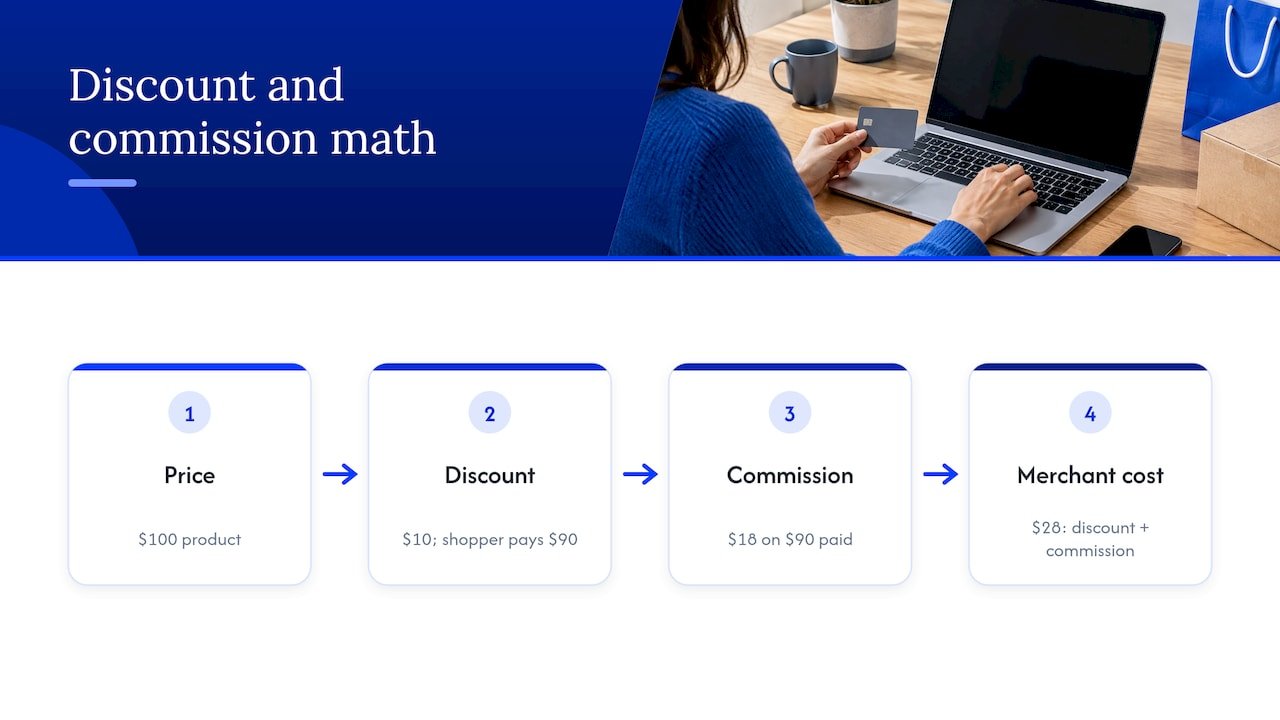
That is exactly the kind of framing that helps in a negotiation. If you are heading into that conversation, our 90 day pilot approach to negotiating commission gives you a copyable structure. For merchants weighing the same math from the other side, reviews of discount codes in tools like writing and SEO software show how stacked discounts and deals look from the shopper’s side of the screen.
Agree on clear program terms
Write down what is allowed before the first code goes live. The terms should say which kinds of sites may use codes, whether coupon aggregators are welcome, what the code applies to, whether it works for new customers only, how long commissions last, and what happens when a code is shared publicly. A merchant who skips this step usually spends the following months cleaning up.
As a publisher, ask for those terms in writing. You are not being difficult. You are protecting your income.
Pick the channels where codes shine
Because codes do not need a click, put them where links are weak. A spoken code in a YouTube video, a code on a slide, a code in a podcast outro, a code in a printed handout. If you are building on video, the YouTube affiliate marketing step-by-step guide covers how to structure content so a code feels natural rather than tacked on.
How to track coupon performance
A code that you cannot measure is just a hope. The good news is that tracking is usually built into the platform you are already using, so most of the work is deciding what to look at.
Start with the basics: redemptions per code, revenue per code and refund or return rate. Coupon tracking ties each redeemed code to its authorized partner, which lets you review results by customer status, new versus returning, and by return rate. A code that drives lots of orders but also lots of returns is not the win it looks like.
Then look at the type of customer. A code that mainly gets used by existing customers is probably claiming credit for sales that were going to happen anyway. That is why some merchants pay different commissions for first-time buyers than for repeat orders, and why you may want to ask for a new-customer rate if your audience is genuinely new to the brand.
If the product is a subscription, check how renewals are handled. Some systems create a fresh commission entry for every later payment that uses the coupon, which turns one code into a recurring income stream. You can see the same logic in recurring commission programs for software subscriptions, where each renewal can produce a new entry. Ask whether a given merchant works the same way, because it changes what a code is worth over a year.
Finally, build a habit of checking your own tracking, not just the merchant’s dashboard. A tag-based setup lets you see where code-related clicks and page views come from. Our Google Tag Manager walkthrough for affiliates shows how to do this step by step.
Do coupons add sales or just collect credit?
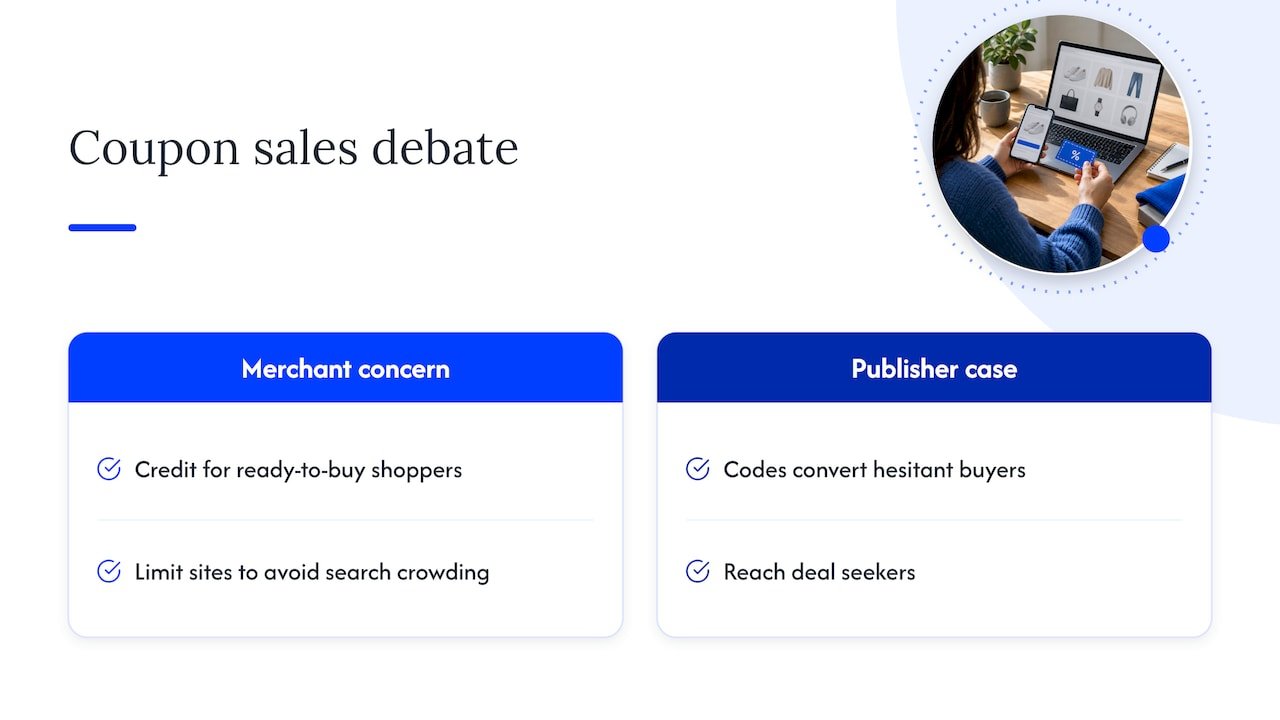
This is the central debate in coupon affiliate marketing, and an honest guide has to name it. Merchants worry that coupon sites get credit for shoppers who were already about to buy. Coupon publishers answer that codes convert hesitant buyers and reach deal seekers the merchant would never have met.
Both things can be true in the same program. Industry research from a major affiliate network, using its own measured sample, found that messages shown before checkout raised revenue per session, and that a pre-checkout message without a discount also raised the likelihood of conversion. The same report cautions that last-click credit can over-credit the final touch. In plain terms, the final click is not always the one that did the persuading.
What does that mean for you? If you are a creator whose audience discovers products through your content, you are on solid ground. You introduced the brand, and the code simply closes the sale. Say so in your pitch, with numbers if you have them. If you run a deal page that mostly catches people at checkout, expect more scrutiny, and expect merchants to ask about incremental value. Some even limit how many coupon sites can promote them, to avoid crowding branded search results.
Keeping codes clean: leaks, abuse and brand bidding
The most common problem in coupon programs is leakage. A code intended for one partner or channel shows up on a public coupon site, and suddenly anyone can claim it. For merchants the cost is an unnecessary discount plus a commission paid to someone who did nothing. For the original partner it means the code stops reflecting their audience.
The usual defenses are straightforward:
- Give each partner their own code, so a leak can be traced.
- Add expiry dates and usage caps.
- Limit codes to new customers or make them single-use where it fits.
- Watch for sudden spikes from unfamiliar customers and retire any code that has gone public.
- Review partners on a regular schedule.
Brand bidding is the second issue. If a partner buys ads on the merchant’s own brand name, they can intercept shoppers who were already looking for the brand and collect a commission on a sale that was never in doubt. Merchants can ban brand-term bidding in the program terms and then monitor branded search results to enforce the rule. If you manage paid search yourself, an outside team that handles Google and Meta ads can help spot who is showing up on your brand terms.
Coupon sites also use aggregators that update promotions automatically inside a network’s interface, so a merchant should check what is actually live, not just what they approved. Expired codes that stay published frustrate shoppers and weaken trust in everyone involved, including you.
Disclosure and advertising rules in the US
If you earn money from a code or link, readers need to know. In the United States the Federal Trade Commission’s Endorsement Guides apply to affiliate relationships, and the agency says an affiliate relationship should be disclosed in the video and in the description near the links. Its guidance also explains that a disclosure works when it is clear and conspicuous and the reader sees it together with the link. The guides were revised in 2023, including a new definition of clearly and conspicuously.
For codes, apply the same logic. Put the disclosure next to the code, whether it is in a caption, a video, a newsletter or a slide, and say it in the medium people are using. If a video mentions a code, say the disclosure out loud and show it on screen.
Readers outside the US should check their own country’s advertising authority, because requirements differ by market. Our guide to EEAT for affiliate sites includes copyable disclosure wording and the FTC steps in plain language, which saves you from reinventing it.
Where to go from here
Coupon affiliate marketing is simple to describe and surprisingly easy to get wrong. The strongest results come from knowing the attribution rules, pricing the discount and commission as one cost, tracking by customer type and keeping codes tightly controlled.
If you want to move faster, we have put together ready-to-run AI affiliate workflows that help you plan content, organize your promotions and save time on repetitive tasks, so you can spend more energy on the part only you can do: building trust with your audience.

If you are just getting started and want a roadmap, our 30-day beginner plan for AI affiliate marketing walks you through your first month.
Our perspective on coupons
We teach affiliate marketers to think about a code as a relationship, not a trick. The affiliates who do well with codes tend to be the ones whose audience already trusts them, and who tell that audience plainly what they earn.
Our practical, AI-driven approach is built around saving you time. Tracking redemptions, organizing offers, checking which codes are live and drafting disclosure language are exactly the repetitive jobs that smart workflows can take off your plate, so your attention goes to the content and the conversations.
If you feel overwhelmed by attribution rules, you are in good company. Start with one merchant, one code and one channel, read the terms carefully and measure for a few weeks. That small, steady pilot will teach you more than any theory, and we are here to help you build it.
Will
FAQ
Do I need a website to do coupon affiliate marketing?
Not necessarily. Because codes can credit a sale without a click, creators can use them in videos, podcasts, newsletters and social posts. A site still helps, since it gives your code a home that you control and that people can find later.
Is a coupon code better than a referral link?
They do different jobs. Links suit clickable content, while codes suit spoken, printed or video content where a click is unlikely. Many programs let you use both, so check the merchant’s terms for which one takes priority when they overlap.
How do merchants stop coupon codes from leaking?
Common steps include partner-specific codes, expiry dates, usage caps, new-customer limits, single-use codes and regular audits. Merchants also watch for sudden spikes from unfamiliar customers and retire any code that has become public.
Do I have to disclose coupon affiliate links and codes?
In the US, the FTC expects you to disclose a material connection, such as earning a commission. The disclosure should be clear, placed near the link or code, and made in the same medium, for example both spoken and on screen in a video.
Can I run coupon affiliate marketing without offering a discount?
Yes. Programs can use codes or links only as identifiers, or pay fixed rewards with no customer discount. Ask the merchant what is available, and decide whether a discount actually helps your audience.
Sources
- Coupon Code Tracking, Publisher Help Center
- How to Track Affiliate Sales with Coupon Codes
- How are Conversions Tracked in Friendbuy?
- How Shopify Referral Tracking & Attribution Works
- Quantifying the Business Value of Shopping Browser Extensions
- FTC’s Endorsement Guides: What People Are Asking
- Recurring commission affiliate program
- Google and Meta ads
- Discount code and deals review