

Have you ever sat down to choose an affiliate niche and ended up with forty browser tabs and no decision? You are not alone, and the fix is simpler than it looks. Choose a niche by running it through four checks (demand, competition, offers and fit with you), then prove it with a small batch of real content before you commit. AI can speed up the research, and our AI affiliate workflows show how to put that into practice.
TL;DR
- A good niche has people with a real problem, products that solve it, and room for you to rank or reach them.
- Experience matters more than the niche itself: in one large survey, affiliates with 3+ years earned 9.45 times what beginners did.
- Judge offers on commission, cookie window, product quality and how well they fit your audience.
- Treat research numbers as estimates, then test with a few pieces of content for two to four weeks.
- Pick a narrow sub-niche you can stay interested in for a year.
Table of Contents
- What makes a niche worth choosing
- Does the niche matter, or do you?
- A four-step way to choose
- How to choose affiliate offers
- Niche ideas to start from
- Don’t trust the numbers blindly
- Build depth once you have picked
- Our perspective
- Take the next step
- FAQ
- Sources
What makes a niche worth choosing
A niche is a defined group of people with a shared problem or interest, plus the products that help them. “Fitness” is a category. “Home workouts for people over 50” is a niche.
A research framework from Noloii treats niche choice as a multi-variable investigation: demand, competition, commercial intent, product availability, monetization, differentiation and sustainability. That sounds like a lot, so here is the short version. You need people who want something, a way to reach them, and something to sell them that pays you fairly.
The same source offers a rough revenue formula worth keeping in your head: qualified visitors, times the share who click your affiliate link, times the share who buy, times the average commission. If any one of those is close to zero, the niche is close to zero for you. Real programs add refunds, caps and attribution windows, so treat the result as a ceiling, not a promise.
Does the niche matter, or do you?
Both, but probably you more than you expect. A late-2023 survey of more than 2,270 professional affiliates, reported by PartnerKin, found education/e-learning averaging over $10,000 a month, travel over $9,000 and beauty/skincare over $8,000. Eleven of 19 niches averaged over $4,000 a month, and even pets and animals averaged $2,200.
The more useful finding is that affiliates with 3+ years of experience earned 9.45 times as much as beginners ($20,166 versus $2,134 a month). Experience tracked earnings more closely than niche did.
That should be reassuring. You do not need to find the one magic niche. You need a reasonable one that you can stick with long enough to get good. Pick something you can see yourself writing and talking about in year three.
A four-step way to choose
Step 1: List what you know and care about
Start with your own interests, jobs, hobbies and problems you have solved. Shopify suggests listing your interests and expertise, then mapping each to niches and sub-categories. Looking at what other creators do on Instagram, Reddit and YouTube shows you where audiences already gather.
Your list will include things that sound boring to you but valuable to others. Keep them. Boring-to-you and urgent-to-someone-else is often where the money sits.
Step 2: Check that people want it, and that it lasts
Use free keyword tools such as Google Keyword Planner and Google Trends. Shopify’s guide recommends looking at core keywords, then homing in on sub-categories, and preferring evergreen niches with long-term trend durability over quick fads.
Search demand is not buying demand, though. Searches for “best standing desk” signal a buyer. Searches for “history of desks” do not. Our guide on buyer intent keywords walks through how to tell the difference, and our AI keyword research workflow shows how to speed up the sorting.
Step 3: Size up the competition
Search Engine Land’s affiliate guide says to look at which sites already rank for your target keywords and judge by their type whether you can compete. If page one is full of huge publishers with deep budgets, go narrower. If it has a few thin blog posts and forum threads, you have an opening.
It also gives a useful reality check on forecasting: its example is a page targeting a keyword with 1,000 monthly searches that earns around $50 a month. Run that kind of math before you fall in love with a niche. Looking at how rivals structure their content also helps, and a competitor content analysis can show you the gaps you could fill. If video is your angle, a YouTube competitor analysis does the same job for channels.
Step 4: Confirm there are good offers
A niche with traffic and no decent programs is a hobby. Browse affiliate networks and individual brand programs in your niche and see what exists, how it pays and whether you would honestly recommend it. The next section covers how to compare them.
How to choose affiliate offers
Once a niche passes the first checks, the offer decides whether it pays. Compare these five things.
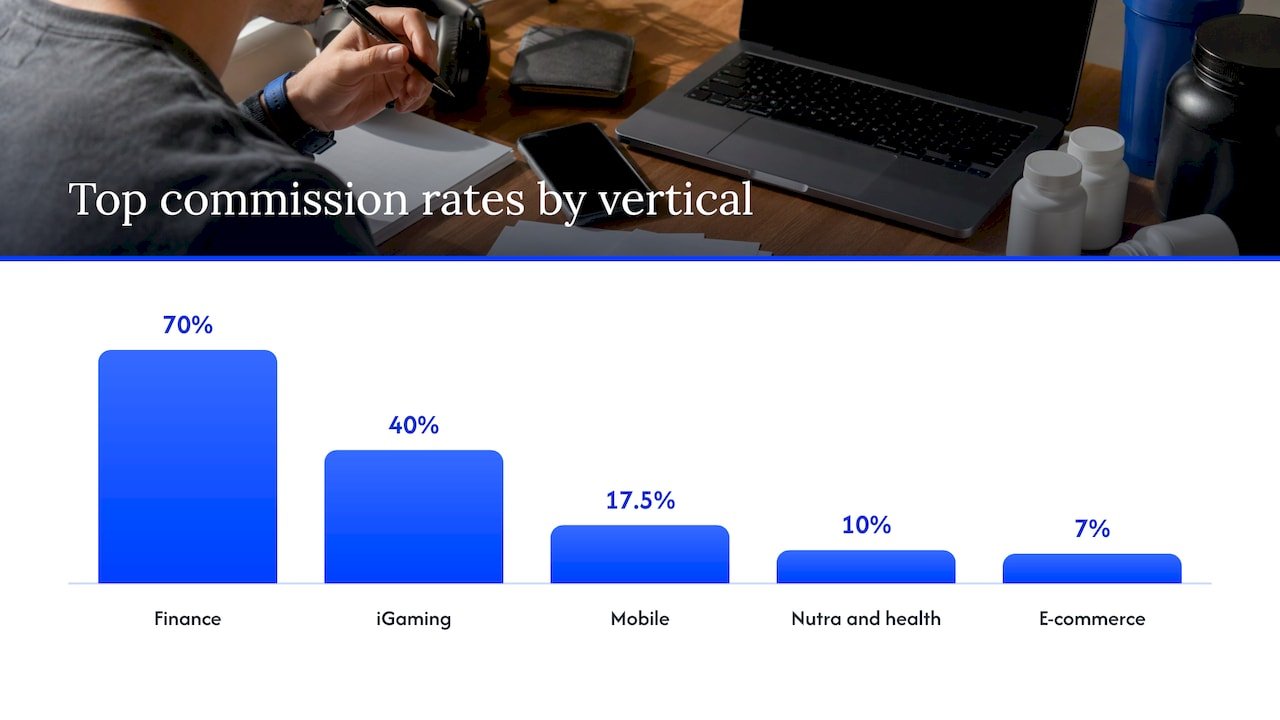
Commission. Rates vary hugely by vertical. The Affiliate Registry dataset (October 2026) reports median top commission rates of 70% for finance, 40% for iGaming, 17.5% for mobile, 10% for nutra and health, and 7% for e-commerce. Median cookie windows were 30 days across those categories, and median flat payouts ranged from $0.20 for mobile to $90 for iGaming.
Order value. Shopify points out that higher average order values earn more per sale at the same commission rate. A 5% cut of a $2,000 purchase beats 20% of a $15 one.
Recurring pay. Software subscriptions can pay month after month. Shopify lists recurring software subscriptions and replenishable products as strong monetization angles.
Terms and tracking. Check the cookie window, payout threshold, refund handling and exclusions. If the terms are thin, our guide to how to negotiate a higher commission with a 90-day pilot gives you a way to ask once you have results.
Fit. Would your reader actually want this, and can they afford it? Mark Mason’s guide at Ahrefs says to check that people spend money in the niche, that you can get traffic, and that quality offers exist, and to promote only what you would genuinely recommend. That last point protects your trust, which is your real asset. Disclose your links clearly, too; our affiliate disclosure examples show how.
Niche ideas to start from
Shopify’s list of ideas includes personal finance, travel, technology and software, pets, health and wellness, fitness, beauty, home décor, food and drink, and gaming. Software and AI tools are a natural fit if you like explaining how things work, because the products are digital and the payouts can recur.
Some published commission ranges can help you compare. Whop’s affiliate statistics put SaaS commissions at 20% to 70%, and its 2024 figures list education and e-learning, travel, beauty and finance among the highest-earning niches. Treat averages like these as a map of where money moves, not a forecast of your income, because they come from self-reported or aggregated samples.
The market behind them is large. AffiliateBooster’s 2026 report, drawing on several industry data sets, puts US affiliate spend at $13.20 billion for 2025. Plenty of room for a focused newcomer.
Don’t trust the numbers blindly
Research indicators are proxies. As the Noloii framework puts it, search demand is not purchasing demand, clicks are not conversions, and commission rates are not profit. A score that squeezes all of that into one number can hide real differences between niches.
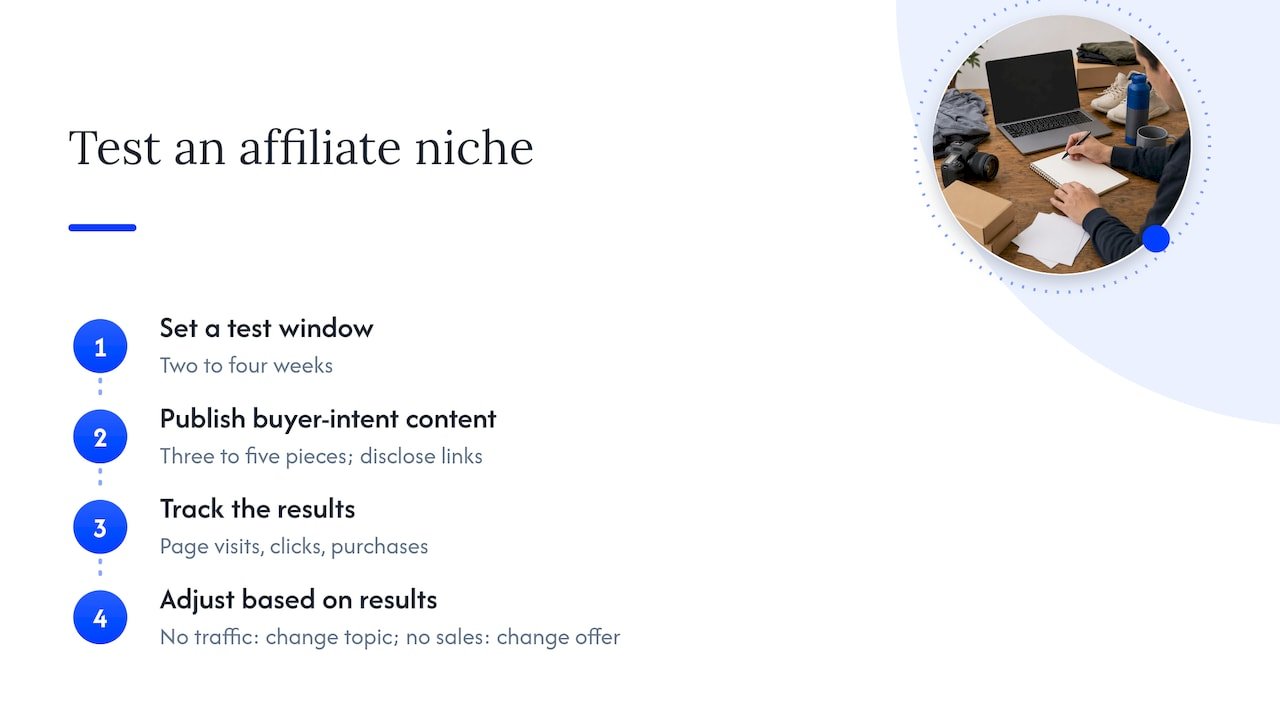
So finish your research with a test. Pipedrive’s guide suggests creating a few pieces of content and promoting them through social media or paid ads to gauge engagement before you commit. We like a similar two-to-four-week window, and our piece on an AI SEO revenue test lays out how to run it.
A simple version: publish three to five pieces aimed at buyer-intent searches, add your affiliate links with a clear disclosure, and watch three things. Are people finding the pages? Are they clicking? Does anyone buy? If the answer to the first is no, change the topic. If clicks happen but sales do not, change the offer.
Build depth once you have picked
A niche pays when your site covers it thoroughly. That is the idea behind topical authority for affiliates: many connected pages on one subject beat scattered posts on many. If you want volume, a programmatic SEO pilot can help you build 50 to 200 pages in a few weeks.
And if search feels crowded, other channels can open a niche up. Video is one, and our YouTube affiliate marketing guide is a beginner-friendly start.
Our perspective
We have watched a lot of people stall at niche selection, and the pattern is almost always the same: they are looking for certainty before they have started. There is no spreadsheet that gives it to you.
What we teach is a practical, AI-assisted approach. Let AI do the slow parts, such as clustering keywords, summarizing competitor pages and drafting test content, so you spend your time on the judgment calls only you can make. That is how you save hours without handing over your voice.
Choose a narrow niche you can talk about, run the four checks, publish a small test, and let real results make the decision. Then keep going. The affiliates who earn the most are, by the numbers, the ones who stayed long enough to get good.
Will
Take the next step
If you would like help turning your niche shortlist into a working routine, start with our AI affiliate workflows: ready-to-run recipes for research, content and testing that save time at every stage.

You can also see how it all comes together on willbuckley.com, where we share tips, videos and a newsletter for affiliate marketers learning to use AI.
FAQ
What is the most profitable affiliate niche?
Surveys often put education/e-learning, travel and beauty at the top, with averages above $8,000 to $10,000 a month in the Authority Hacker survey. Still, experience correlated more strongly with income than niche did, so the best niche is one you can stay in.
How narrow should my niche be?
Narrow enough that you can name the reader and their problem in one sentence. Start with a sub-category, such as home workouts for beginners instead of fitness, and widen later once you have traffic and trust.
How long should I test a niche before deciding?
Two to four weeks is enough to see whether pages get found, clicked and bought from. Publish a handful of buyer-intent pieces, track results, and then double down, adjust the offer or switch.
How do I choose affiliate products for my niche?
Start with what your audience is already searching for and trying to fix. Then compare commission, cookie window, order value and product quality, and promote only what you would honestly recommend.
Sources
- Affiliate marketing: Tips, tricks, and best practices (Search Engine Land)
- Affiliate Niche Research: How to Research and Evaluate (Noloii)
- 13 Best Affiliate Marketing Niches (Shopify)
- The SMB guide to choosing a profitable affiliate marketing niche (Pipedrive)
- 3 Ways to Find a Great Affiliate Niche (Ahrefs)
- How Much Do Affiliate Marketers Earn (PartnerKin)
- Affiliate commission benchmarks (Affiliate Registry)
- 2026 State of Affiliate Marketing Report (AffiliateBooster)
- Affiliate marketing statistics (Whop)
- Analyzing competitor content for SEO
- YouTube competitor analysis