

Yes, you can start affiliate marketing with AI today. Pick one niche, shortlist three affiliate programs, and run a focused 30-day plan instead of buying tools first. That single sequence, tested by beginners who follow a staged roadmap, is what separates people who launch from people who research forever.
TL;DR:
- A focused 30-day plan, including niche selection, program shortlisting, and content publication, is crucial to launch affiliate marketing successfully.
- Prioritize tools that support specific tasks like research, drafting, SEO, and tracking, starting with inexpensive options that address your biggest bottleneck.
- Always verify AI-generated claims, such as commission rates and product features, against source details before publishing to avoid compliance issues.
- Building a repeatable, layered system of research, drafting, SEO, traffic, and email marketing yields better results than random tool usage or diversification.
- Success depends on consistent execution of the workflow, not on buying the latest tools or chasing viral content.
Table of Contents
- Your 30 to 90 Day Roadmap for AI Affiliate Marketing
- How Do You Choose a Niche and Affiliate Programs?
- What AI Tools Do You Actually Need to Start?
- What’s the AI Workflow for Writing a Converting Post?
- Where Should Your First Traffic and Emails Come From?
- Your Day-by-Day Launch Checklist for the First 30 Days
- What Mistakes Kill Affiliate Returns the Fastest?
- What Will Buckley’s AI Workflows Actually Look Like
- Where Does AI Fall Short in Affiliate Marketing?
- How Do You Know if Your AI Tools Are Actually Working?
- Who Is Actually Making This Work Right Now?
- Why the Tool-First Approach to AI Affiliate Marketing Is Backwards
- Want the Workflows Instead of Building Them From Scratch?
- Sources
Your 30 to 90 Day Roadmap for AI Affiliate Marketing
You don’t need a year to find out if this works. You need about 90 days, broken into three honest stages.
- Days 1 to 7: Pick your niche, shortlist three affiliate programs, and get your site and analytics running. No content yet, just the skeleton.
- Weeks 2 to 6: Publish three to six AI-assisted posts and build one lead magnet. This is where most beginners quit too early, right before momentum shows up.
- Months 2 to 3: Run traffic tests, turn on your email funnel, and measure what’s actually converting instead of guessing.
Affiliates who follow a staged sequence like this one commonly reach $1,000 a month within six to eight months of consistent execution. That’s not a promise, it’s a pattern. The people who hit that mark rarely skip stage one to jump straight into paid ads.
How Do You Choose a Niche and Affiliate Programs?
Your niche needs to pass three tests: you know something about it, people are actively searching for solutions in it, and affiliate programs actually exist to monetize it. Missing any one of those three usually means months of wasted effort.
Before you write a single post, verify these on every program’s page:
- Commission structure: recurring (monthly payouts for as long as the customer stays), bounty (one flat payment), or tiered (payout increases with volume)
- Cookie length, meaning how many days after a click you still get credit for a sale
- Prohibited claims list, especially around health, income, or guaranteed results
- Payment threshold and schedule, since some programs hold payouts until $100
Pro Tip: Don’t chase the highest commission rate first. A 20% recurring commission on a $30/month tool often beats a 50% bounty on a $20 one-time sale, once you do the math over twelve months.
What AI Tools Do You Actually Need to Start?
Most beginners buy tools backward, grabbing whatever’s trending before they know what’s actually slowing them down. The smarter move is to match tools to jobs, not the other way around. A practical affiliate workflow covers five job categories: research, drafting, SEO optimization, creative, and tracking, since no single tool handles all five well.
Here’s how those jobs map to a realistic starter budget:
| Job category | What it solves | Starter cost band |
|---|---|---|
| Research | Finding buyer-intent keywords and content gaps | Free tools to start |
| Drafting | Turning outlines into publishable drafts | Free to $20/month |
| SEO optimization | On-page checks, meta data, internal linking | up to $30 per month |
| Creative (images/video) | Thumbnails, social clips, ad variants | up to $30 per month |
| Tracking/email | Click tracking and a basic email funnel | Free tier available |
A conservative minimum viable stack, covering hosting, one research tool, one drafting tool, and a free email tier, runs $138 to $162 a month. The decision rule is simple: buy for the bottleneck you actually have. If you can’t generate ideas, fix research first. If ideas pile up but nothing gets published, fix drafting first.
What’s the AI Workflow for Writing a Converting Post?
A repeatable process beats a one-off masterpiece. Here’s the sequence that turns a blank page into a published, earning post:
- Research the target keyword and pull the top five ranking pages to see what questions they’re missing.
- Outline the post around those gaps, not around what you assume readers want.
- Draft each section with AI, feeding it specific product details instead of vague prompts, since specificity is what separates useful drafts from generic filler.
- Edit for accuracy. This is the step people skip. Every vendor claim in the draft needs verification against actual documentation before it goes live.
- Optimize for SEO: check headings, meta description, and internal links.
- Publish with your disclosure placed above the first affiliate link, plus real screenshots if you’re reviewing software.
Pro Tip: Never let AI write a claim you haven’t personally verified. “This tool increases conversions by 40%” needs a source, not a guess dressed up as confidence.
Where Should Your First Traffic and Emails Come From?
Beginners waste money chasing paid traffic before organic content has proven anything converts. A better split for the first 90 days: roughly 70% organic content, 20% one small paid creative test, and 10% held in reserve for whatever channel starts working.
Your email funnel doesn’t need to be complicated. Four emails do the job:
- Email 1: Deliver the lead magnet immediately, no delay.
- Email 2: Welcome email with one genuinely useful tip, no pitch.
- Email 3: A case example or use case that shows the product solving a real problem.
- Email 4: Soft promotion, framed as a recommendation, not a hard sell.
Track three numbers weekly: click-through rate to your affiliate links, email capture rate on the lead magnet, and total earnings in the first 30 days. AI-personalized campaigns have pushed click-through rates up by as much as 40% in some case studies, which is exactly why the CTR number deserves weekly attention, not a glance at month’s end.
Your Day-by-Day Launch Checklist for the First 30 Days
Break the roadmap into weeks and the whole thing stops feeling abstract.
- Days 1 to 7: Register your domain, set up analytics, finalize your niche, and confirm your three affiliate programs.
- Days 8 to 21: Publish three to six posts using your AI workflow, and build one lead magnet tied directly to your niche’s biggest pain point.
- Days 22 to 30: Turn on your four-email funnel, launch one small paid creative test, and log your three core metrics every week.
By day 30 you’ll have real data instead of guesses, and that data tells you exactly what to scale next.
What Mistakes Kill Affiliate Returns the Fastest?
Five mistakes account for most failed affiliate attempts: picking a niche with no genuine demand, buying five tools before publishing a single post, skipping disclosure, letting AI draft claims nobody verified, and quitting at day 20 right before content starts compounding.
Your disclosure belongs above the first affiliate link on every page, not buried in a footer nobody scrolls to. A simple line works: “This post contains affiliate links. If you purchase through them, we may earn a commission at no extra cost to you.”
Pro Tip: If a page underperforms after 60 days, check the obvious things first: is the affiliate link even clickable, does the CTA match search intent, and is the page actually indexed by Google.
What Will Buckley’s AI Workflows Actually Look Like
I built my own YouTube automation and short-form ad testing around one rule: AI drafts, I decide. My YouTube automation playbook and ready-to-run affiliate workflows map to the exact process above. The lesson students misapply most: they let AI pick the niche instead of narrowing it themselves first.
Where Does AI Fall Short in Affiliate Marketing?
AI is a strong drafting and research partner, not a fact checker or a compliance officer. It will confidently state a commission rate, a feature, or a statistic that’s outdated or simply wrong, because it’s generating plausible text, not verifying claims against a vendor’s current terms page.
The fix is a verification habit, not a better tool. Before publishing anything AI drafted, cross check every specific claim, especially pricing, commission structure, and product features, against the actual program page. This is exactly the discipline Coursiv recommends: treat AI output as a first draft that needs a human pass, never as a finished, publishable fact sheet.

A second limitation shows up in tone. AI-generated content can read generic when every affiliate in your niche is prompting the same tool with similar instructions. The way around it is feeding AI your own specific experience, screenshots, and observations rather than asking it to write “a review of X software” from scratch. Specificity is the one thing AI can’t invent on its own.
There’s also a compliance risk worth naming directly: AI doesn’t know your program’s prohibited claims list. It might write “guaranteed results” into a health or income-related post without any awareness that phrase could get your account terminated. That’s a manual check every single time, not a one-time setup task.
None of this means avoid AI. It means treat it like a fast, occasionally overconfident intern: useful for volume, unreliable for accuracy, and always in need of a second set of eyes before anything goes live.
How Do You Know if Your AI Tools Are Actually Working?
Buying a tool and using a tool are two different things. The affiliates pulling ahead are the ones checking performance weekly, not the ones who set up a stack once and assume it’s working.
Start with output quality. If your drafting tool consistently needs heavy rewrites, it’s either the wrong tool or your prompts lack specificity. Track how much editing time each draft actually requires. If that number isn’t shrinking after a few weeks of practice, the tool or the prompt approach needs to change, not just the output.
Next, track the metrics that matter more than vanity numbers: click-through rate on affiliate links, email capture rate, and conversion rate on your top three posts. More than 60% of affiliate professionals now use AI daily, and the ones seeing real advantage are the ones who built AI into every layer of the workflow, not just content drafting. That means checking your SEO tool’s recommendations against actual ranking movement, and your creative tool’s output against actual click rates, not just gut feeling.
Set a monthly review, not a daily one. Daily checks create noise and tempt you to change things before they’ve had time to work. A monthly pass, comparing this month’s numbers against last month’s, tells you honestly whether a tool is earning its cost or just sitting in your stack out of habit. Cut anything that isn’t paying for itself within 60 to 90 days.
Who Is Actually Making This Work Right Now?
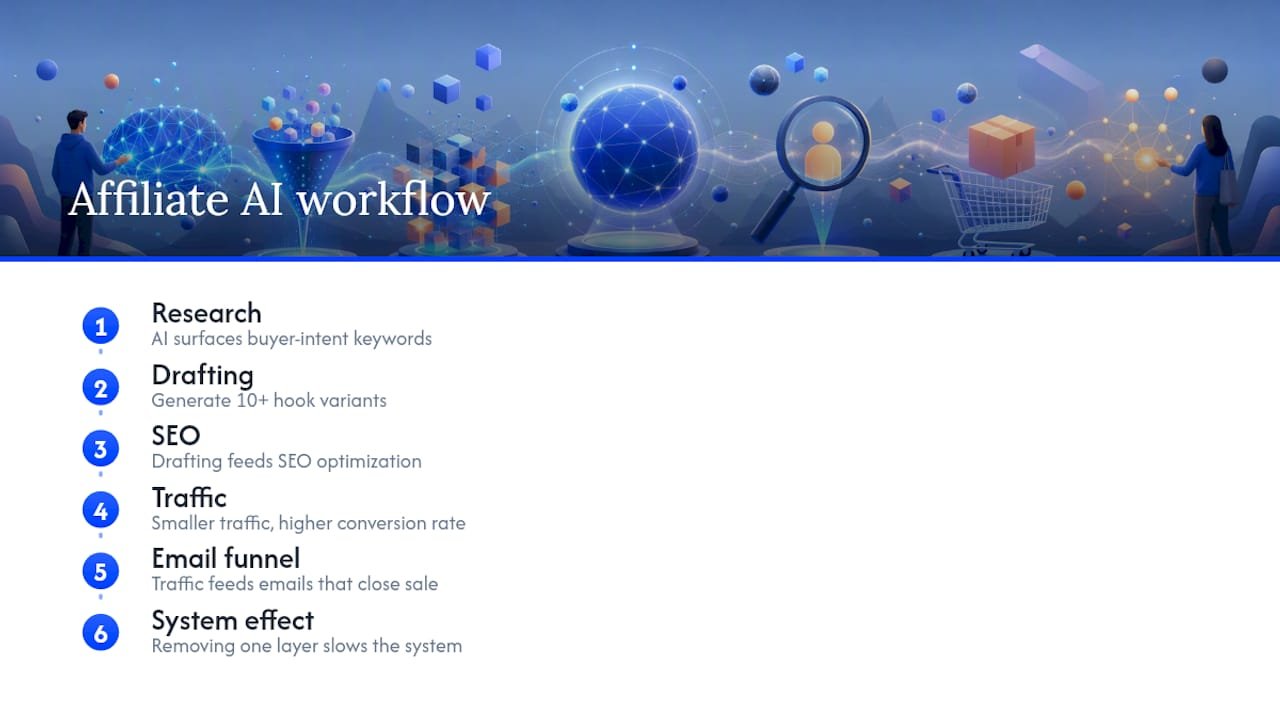
The pattern among affiliates succeeding with AI isn’t exotic, it’s consistency applied to a narrow niche. Affiliates who build AI into research, drafting, SEO, and tracking simultaneously, rather than using it for one isolated task, report the strongest gains, and that layered approach is exactly what separates top performers from beginners who use AI for drafting alone and nothing else.
Short-form video offers a clear example of the pattern. Instead of producing one polished ad and hoping it performs, affiliates using AI creative tools generate ten or more hook variants for the same offer and test them against each other. Most hooks fail. One or two outperform the rest by a wide margin, and that’s the one that gets the ad budget. This only works because AI makes producing ten variants cheap enough to be worth doing.
The keyword research side tells a similar story. Affiliates who let AI surface buyer-intent keywords, phrases that signal someone is close to purchasing rather than just researching, tend to convert traffic faster than those chasing high-volume, low-intent terms. It’s a smaller traffic number that converts at a noticeably higher rate.
None of these examples involve a lucky viral post. They involve a repeatable system: research feeds drafting, drafting feeds SEO, SEO feeds traffic, and traffic feeds the email funnel that closes the sale. Remove any one layer and the system slows down considerably.
Why the Tool-First Approach to AI Affiliate Marketing Is Backwards
Most advice on this topic leads with a list of ten AI tools and lets the beginner figure out the sequence themselves. That’s backwards, and it’s why so many people buy a stack and never publish anything. The tool doesn’t create momentum. The plan does.
What the evidence actually supports is starting narrow: one niche, three programs, one workflow, repeated until it produces data. The temptation is to diversify early, more niches, more tools, more traffic sources, because it feels like progress. It’s usually the opposite. Diversifying before you’ve proven one thing works just splits your attention across several unproven bets instead of one tested one.
If I had to prioritize one thing for a beginner reading this, it wouldn’t be a tool recommendation. It would be the verification habit: never publish an AI-drafted claim you haven’t personally checked against the source. That single habit prevents the compliance mistakes and credibility damage that quietly kill more affiliate sites than bad SEO ever does.
Conventional wisdom treats AI as a shortcut around the work. The more accurate framing is that AI removes the slow parts, drafting, keyword research, creative variants, so you can spend your actual time on the parts AI can’t do: verification, strategy, and judgment calls about what your specific audience actually needs.
— Will
Want the Workflows Instead of Building Them From Scratch?
Everything in this plan works without buying anything beyond the minimum stack. But if you’d rather run proven workflows than build your own from a blank page, that’s exactly what my playbooks are for. Willbuckley’s ready-to-run AI affiliate workflows hand you the exact prompt sequences and templates referenced in this guide, so drafting, SEO passes, and creative testing take minutes instead of a full afternoon of trial and error.
The YouTube automation launch playbook is the best fit if you want a channel-specific route mapped out step by step, including the exact sequence I use for short-form testing. Both resources include the templates, not just the theory, so you’re implementing on day one instead of still planning by week three. Check out the workflow recipes and pick the one that matches where you are right now.
Sources
For deeper reference as you build your stack, Partnero’s breakdown of AI performance gains covers the CTR and conversion data behind AI-personalized campaigns. Eesel AI’s tool roundup organizes tools by job category rather than by hype. For program signups, Summit Studio’s affiliate program is worth checking if AI SaaS fits your niche.