

If you write affiliate reviews for a living, the schema that works in 2026 is a structured, verdict-first template built around honest testing and specific drawbacks, not a spec dump. It’s built for affiliate marketers and content creators who want one repeatable format they can trust to convert, and it’s not for anyone who’d rather write flowing narrative reviews with no fixed structure. Templates and ChatGPT workflows have been built around exactly this format, which is what the rest of this piece walks through.
TL;DR:
- Structured, verdict-first review templates with clear testing and specific drawbacks outperform long narrative reviews in conversions.
- Consistent testing of products for at least 14 days with detailed, timestamped screenshots and notes is essential for credibility.
- Address common objections with concrete facts about price, complexity, and trust, based on actual testing experiences.
- Place affiliate links strategically: in the summary, after the target audience paragraph, and in the verdict, for maximum engagement.
- Regularly update pricing, features, and screenshots every three months to maintain review accuracy and trust.
Table of Contents
- What Is the Schema for Product Reviews That Converts?
- The Copyable Review Schema: Section-by-Section
- Building a Testing Checklist Readers Can Actually Verify
- Writing Pros, Cons, and CTAs That Actually Convert
- Keeping Disclosure Honest and Reviews Current
- How Templates Put This Schema Into Practice
- The Template Matters Less Than What You Put Inside It
- Get the Templates Instead of Building From Scratch
- Sources
- FAQ
What Is the Schema for Product Reviews That Converts?
A product review schema, in the sense that matters here, is the article template itself. The headings, the order they appear in, the word counts you’re aiming for, and where the affiliate links go. It’s not the technical markup that puts stars under a Google result. Think of it as the blueprint you paste into every new review post so the reader (and you) always know exactly what’s coming next.
That distinction matters because a lot of guides on “review schema” drift into search engine markup and leave writers with nothing they can actually use. What you need is a content framework: summary box, who it’s for, testing notes, pros and cons, objections, alternatives, verdict. Every review you publish follows the same skeleton, which speeds up your writing and gives readers a format they learn to trust after the second or third post.
A verdict-first summary box placed near the top is the single highest-leverage element in that structure. It captures impatient buyers and AI answer extractors before they scroll past your page, which is exactly why it opens the template below.
The Copyable Review Schema: Section-by-Section
Paste this order into your CMS as a starting draft for every new review. Each part has a job, a suggested length, and a rule for where affiliate links belong.
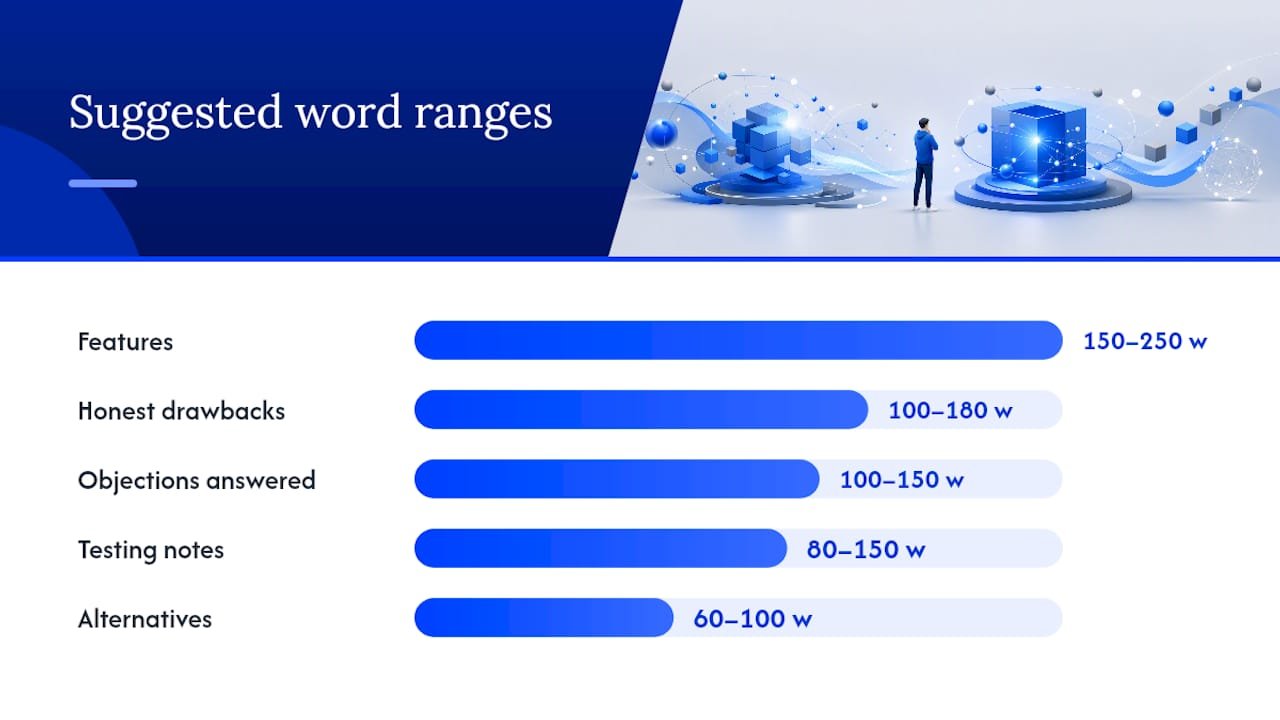
- Summary/verdict box (40 to 80 words). State the recommendation and the rating in the first two sentences. This is the block AI tools and skimmers pull from first.
- Who it’s for / who should skip it (30 to 60 words). A compact fit-check here reduces bounce and qualifies the reader before they invest time in the rest of the post. Put your strongest CTA immediately after this paragraph for high-intent skimmers.
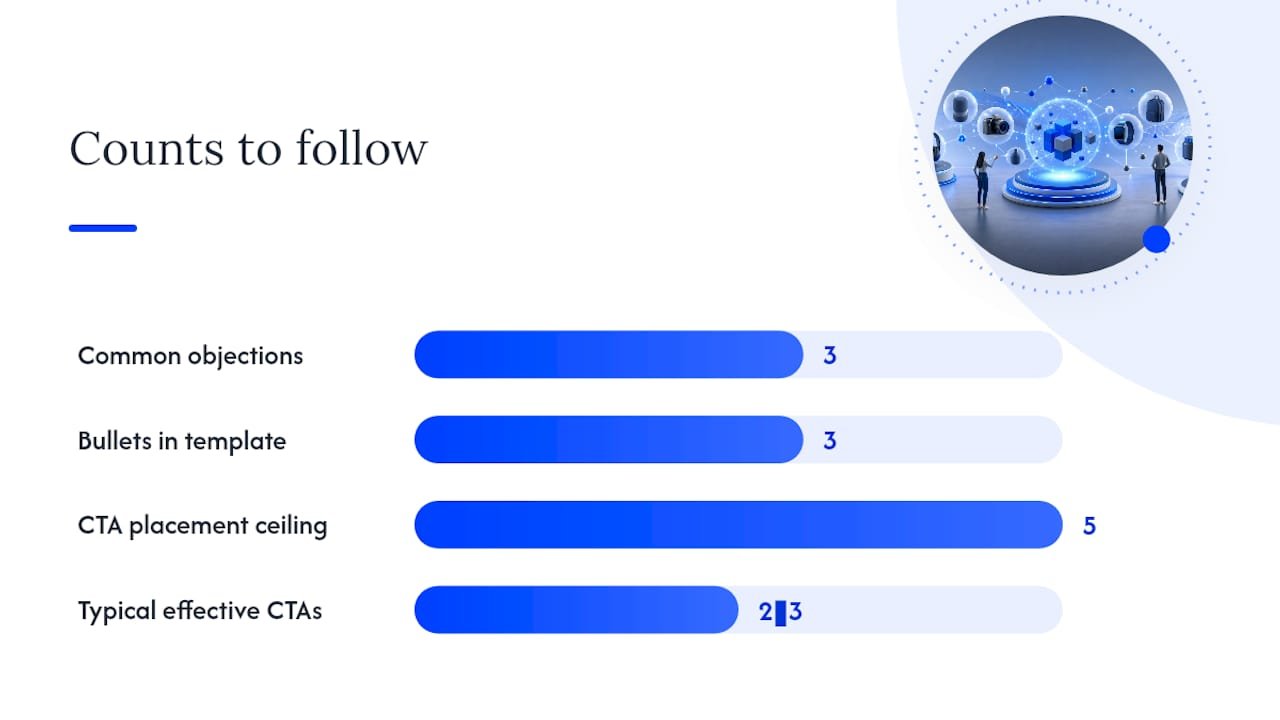
- 3-bullet breakdown (one line each). Three short bullets covering the core value proposition. Structured, bullet-first breakdowns like this consistently outperform long narrative openers in A/B tests.
- Testing notes (80 to 150 words). Dates, setup time, the scenario you ran. Screenshots go here.
- Features framed as benefits (150 to 250 words). Short paragraphs or bullets, each tied to a specific outcome rather than a spec.
- Honest drawbacks (100 to 180 words). Specific, comparative cons, not vague hedging.
- Objections answered (100 to 150 words). Price, complexity, and trust, addressed directly.
- Alternatives, described by category (60 to 100 words). No vendor comparison tables, just what a different type of solution offers.
- Verdict and CTA (40 to 60 words). Restate the recommendation and close with your primary link.
Keep your primary affiliate link in the summary box, again after the who’s-it-for paragraph, and once more in the closing verdict. That’s three placements before you’ve even hit the drawbacks section.
Pro Tip: Build this as an actual CMS content block or Google Docs template with the headings pre-filled. You’ll cut drafting time roughly in half once the skeleton is muscle memory.
Keep the total review length in the 1,200 to 1,800 word range. Long enough to prove testing happened, short enough that nobody bails halfway through.
Building a Testing Checklist Readers Can Actually Verify
Search engines and readers alike now favor reviews with visible testing evidence over spec-only writeups, and thin reviews without proof are losing ground fast. That means your test notes need to read like a lab log, not a marketing summary.
Run every product for a minimum of 14 days or one full use cycle before publishing, and log a short dated entry each time you touch it. That short-format test log is what separates a credible review from a rewritten spec sheet.
Capture and keep:
- A dated screenshot of the setup or onboarding screen, timestamped in the corner.
- A screenshot of the dashboard or output after your test period, annotated with an arrow or circle on the specific result you’re citing.
- Any support ticket or chat reply you received, with the response time noted.
- A one-line note recording exact setup minutes (“Setup took 11 minutes, no support needed” beats “easy to set up”).
Write test notes in the same format every time: what you tested, how long it took, and the single measurable result. “Ran a 20-email sequence over 14 days, open rate held steady, no deliverability warnings” tells a reader something a glowing adjective never will.
Pro Tip: Store one dated line per test, structured as test date, minutes used, key result. It turns into a ready-made testing notes excerpt you can drop straight into the review without rewriting it from scratch.
Writing Pros, Cons, and CTAs That Actually Convert
Vague cons kill trust faster than no cons at all. “Occasional learning curve” tells a reader nothing. “Took me three tries to connect the Zapier integration on the first setup” tells them you actually used the product. Structured pros and cons sections with specific, comparative drawbacks build credibility that generic bullet lists never manage.
Three objections show up in nearly every review’s comments section, so answer them before readers can ask:
- Price or value. State plainly what the reader gets for the cost relative to the closest alternative category, not a competitor by name.
- Complexity. Name the exact step that trips up new users and how long it actually takes to get past it.
- Trust. Point directly to your testing notes and disclosure rather than asserting “this really works.”
The pattern that holds up: reviews built on structured templates with concrete test notes report stronger engagement than long-form narrative reviews with no fixed shape, based on 12 months of A/B testing on the 3-bullet format.
Place your CTA three to five times: once in the verdict box, once after the who’s-it-for paragraph, once mid-pros/cons, once after objections, and once in the closing verdict. Five is a ceiling, not a target. Two or three well-placed links usually beat five scattered ones.
Keeping Disclosure Honest and Reviews Current
Put your affiliate disclosure at the top of the page, in plain language readers won’t skim past: “This post contains affiliate links. If you buy through them, I may earn a commission at no extra cost to you.” Repeat a shorter version right next to your first affiliate link. Early, visible disclosure builds trust instead of eroding it, and it satisfies most disclosure expectations in one sentence.
Audit every review on a fixed schedule, not whenever you happen to remember:
- Check pricing and plan names every three months.
- Reverify integrations and features that vendors change without notice.
- Retake screenshots if the interface has visibly changed.
- Confirm every affiliate link still points to a live, correct offer.
Show a visible “Last updated” date near the top. It’s a small line that quietly signals the review is still worth trusting.
How Templates Put This Schema Into Practice
You don’t have to build this schema from a blank page. Will Buckley’s 7-part AI-assisted affiliate review template maps directly onto the structure above, section by section.
Pair it with:
- ChatGPT prompts and workflows for drafting the features-to-benefits and objection sections faster.
- AI-assisted workflows for organizing testing notes and proof into publish-ready copy.
- A 30-day Reddit playbook for driving early traffic to a new review before it ranks.
Drop your own bio, case study links, testimonials, and proprietary test data directly into the marked placeholders as you go, so the template stays yours, not generic.
The Template Matters Less Than What You Put Inside It
Here’s what the conventional advice gets backwards: it treats structure as the whole solution. A perfect summary box, a tidy 3-bullet breakdown, five well-placed CTAs, none of it converts if the testing notes underneath are fabricated or thin. The schema is scaffolding. The proof is the building.
What’s overrated is polish. What’s underrated is specificity you can’t fake, an exact setup time, a support reply timestamp, a screenshot with today’s date visible in the corner. Readers and AI extractors alike have gotten better at spotting reviews that skipped the actual testing, and generic superlatives are the tell.
Prioritize this in order: run the test first, log it while it’s fresh, then build the review around what you found rather than writing the review first and hunting for evidence to support it. AI tools like ChatGPT are genuinely useful for structuring and polishing those notes once they exist. They’re not a substitute for having tested anything at all.
— Will
Get the Templates Instead of Building From Scratch
If the schema above sounds right but rebuilding it section by section for every new review sounds like a time sink, a template pack solves this. It’s built for affiliate marketers who want the structure, AI prompts, and traffic playbook bundled together instead of assembled piecemeal from many open tabs.

The pack includes a downloadable review template mapped to the schema in this article, a set of prompts for drafting benefit copy and objection sections, and a Reddit playbook for getting early traffic to a review before it ranks organically. Use the Product Comparison Generator to quickly create comparison copy and structured feature lists that complement your review templates. For marketers publishing multiple reviews per month, that combination saves significant drafting time.
Start with the YouTube Automation Affiliate Marketing launch playbook to see how the templates translate into a full content pipeline, then grab the review template and prompt set to put this schema to work on your next post.
Sources
- How to Write an Affiliate Product Review – Majestic Affiliates
- The 3-Bullet Product Review Template That Ranks and Converts – The Referral Realm
- How to Write Affiliate Product Reviews That Convert in 2026 – Sk Hasan
- How to Write a Product Review for Affiliate Marketing That People Believe – Lilach Bullock
FAQ
What Is a Product Review Schema in Affiliate Marketing?
It’s a content template, the section order, word counts, and CTA placement for a review post, not technical markup for search snippets. It’s what lets you publish consistent, high-converting reviews without rebuilding the structure every time.
How Long Should an Affiliate Product Review Be?
Aim for 1,200 to 1,800 words total, following a fixed section order from summary box through verdict. Length matters less than whether every section, especially the drawbacks and testing notes, is specific.
Where Should Affiliate Links Go in a Review?
Place your primary link in the summary box, once after the who’s-it-for paragraph, and again in the closing verdict, for three to five total placements. Anchor at least one link near your affiliate disclosure so readers see both together.
How Often Should I Update an Affiliate Review?
Audit pricing, integrations, and screenshots every three months, and show a visible last-updated date near the top. A refresh cadence keeps both readers and search engines confident the review is still accurate.
Can AI Write My Testing Notes for Me?
AI tools like ChatGPT should structure and polish notes you’ve already gathered, not invent testing that didn’t happen. The hybrid approach, human testing plus AI editing, keeps the review credible while speeding up drafting.