

Programmatic SEO works for affiliate sites, but only when two conditions line up: a dataset with genuinely unique per-entity information, and monetization math that pencils out at scale. If either is missing, don’t build. Before writing a single template, pull 5 to 10 sample entities from your target dataset and check their EPC and how different their data actually is from each other.
TL;DR:
- Programmatic SEO only succeeds when datasets contain genuinely unique data points that are regularly updated and add real value for each entity.
- Before building, affiliates must verify that the average EPC and estimated revenue per indexed page (RPIP) justify the cost, especially at scale.
- A pilot of 50 to 200 pages helps identify search engine indexing patterns and the actual revenue potential, preventing months of wasted effort.
- Proper data sourcing, template design, and scaling strategies are crucial to maintain crawl efficiency and avoid search engine penalties for low-quality content.
- Continuous monitoring of key metrics like EPC and RPIP, along with regular data updates and internal linking, ensures the long-term viability of large-scale programmatic sites.
Table of Contents
- What Is Programmatic SEO for Affiliates, and Why Does It Matter?
- Why Should Affiliates Consider Programmatic SEO?
- Data Pipelines, Templates, and Stack Choices: What Actually Works
- How to Build a Programmatic SEO Pilot in 2 to 4 Weeks
- Scaling Without Breaking Your Crawl Budget
- Avoiding the Scaled-Content Penalty: Quality and Freshness Controls
- The Metrics That Decide Whether a Template Cluster Survives
- Who’s Behind This Playbook
- Engineering Discipline Beats Content Volume
- Ready to Pilot Your First Programmatic Cluster?
- Sources
- FAQ
What Is Programmatic SEO for Affiliates, and Why Does It Matter?
Programmatic SEO for affiliates means generating hundreds or thousands of pages from a template populated by a structured dataset, where each page targets a specific long-tail search and links to a specific offer. It differs from templated spam in exactly one way: the data layer. Zapier’s guide on programmatic SEO puts it plainly. It succeeds only when each page delivers unique, useful information, not a reshuffled paragraph with a new city name swapped in.
You’ve probably seen the format even if you didn’t know the term. Comparison templates (“Best [tool] for [use case]”) pull spec data and pricing into a repeatable page shell. Geo or service pages (“[Service] in [city]”) combine location data with local pricing or availability. Spec pages (“[Product] specs and alternatives”) pull attributes from a manufacturer feed or API. All three follow the same rule: the template is a shell, and the data determines whether the page has a reason to exist.
Why does uniqueness matter more now than it did five years ago? Search engines have gotten better at pattern matching mass-produced pages, and AI Overviews increasingly summarize the “obvious” answer, leaving less room for thin content to earn a click. The pages that survive are the ones with a data point Google hasn’t already synthesized elsewhere: current pricing, a real availability window, a regional rule, an aggregated rating nobody else computed the same way.
What actually separates a defensible programmatic page from spam:
- A unique data field pulled from a primary source, not scraped competitor copy
- Contextual narrative that interprets the data instead of just displaying it
- Internal links that route authority from a hub page down to the leaf page
- A refresh cadence that keeps the unique field current
That last point gets ignored constantly. A page that was unique on launch day and never updated again decays into the same thin content you were trying to avoid.
Why Should Affiliates Consider Programmatic SEO?
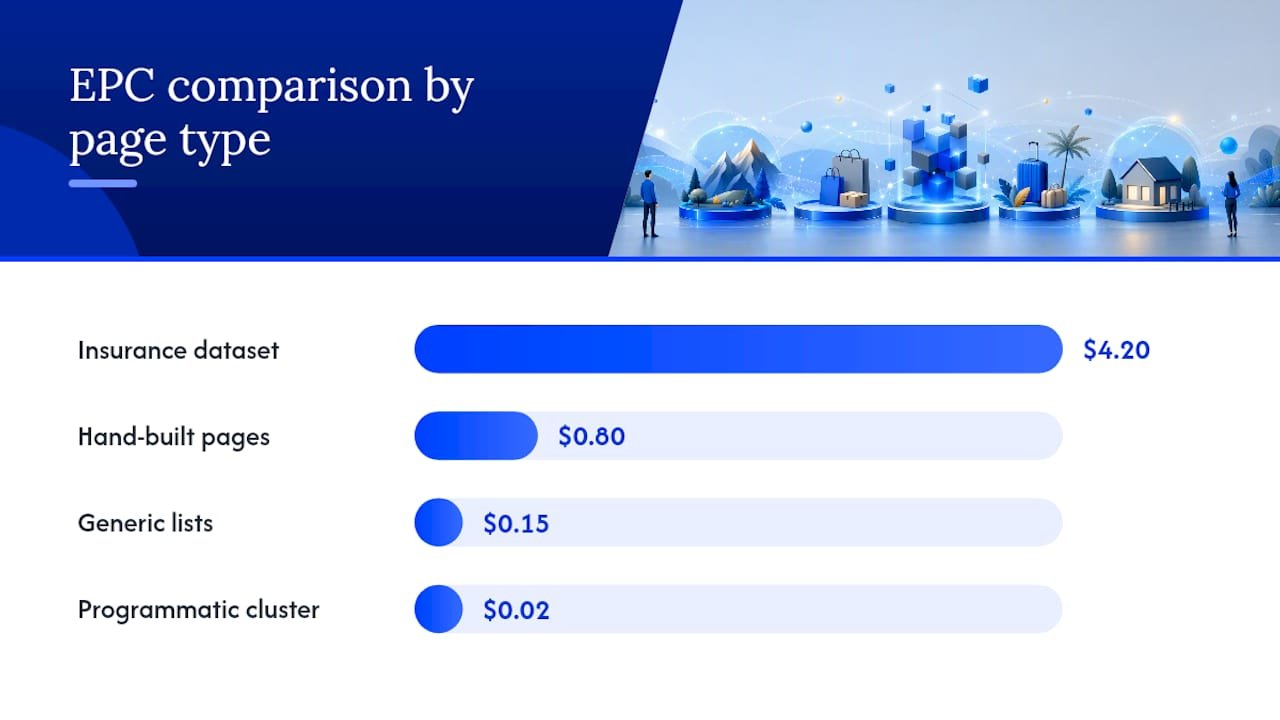
The honest answer is economics, not traffic volume. A programmatic cluster of 2,000 pages generating $0.02 EPC (earnings per click) is a worse business than 50 hand-built pages converting at $0.80 EPC. Before you build anything, you need to understand two numbers.
EPC tells you how much a click on your affiliate link is worth on average, blending clicks that convert and clicks that don’t. RPIP (revenue per indexed page) tells you what an indexed page is actually contributing once it’s live, factoring in impressions and click-through rate along with EPC. A vertical with high EPC but a brutal, unwinnable SERP will still lose to a vertical with modest EPC and low competition, because RPIP accounts for how many of your pages can realistically rank.
Run this programmatic SEO planning strategy sequence before committing engineering time:
- Pull the affiliate program’s EPC for your target vertical (check the network dashboard or ask your affiliate manager directly).
- Check SERP difficulty for 10 to 15 sample long-tail queries the templates would target.
- Confirm a dataset exists with enough unique, per-entity fields to fill 50+ pages without repeating the same three sentences.
- Estimate RPIP by modeling expected indexing rate times expected CTR times EPC.
Pro Tip: Run the math on a spreadsheet before you write a line of template code. If your projected RPIP is below what it costs you to host and refresh the page over a year, the vertical isn’t worth building yet, no matter how good the keyword volume looks.
Say you find a dataset of 400 insurance providers by state, EPC of $4.20, and moderate SERP difficulty. Fifty pilot pages at a 60% index rate and 2% CTR could plausibly generate meaningful monthly revenue within a quarter, according to affiliate programmatic playbooks tracking pilot-to-scale economics. Compare that to a dataset of 400 generic “best of” list pages with $0.15 EPC, where even perfect indexing won’t cover your time.
Data Pipelines, Templates, and Stack Choices: What Actually Works
Three technical decisions determine whether your programmatic build survives contact with Google: where your data comes from, how your template is structured, and what stack renders it.
Sourcing and cleaning your dataset
Four realistic sources exist, each with trade-offs. Public datasets from portals like Data work well for location-based or regulated-entity pages, since government data is authoritative and free, though it needs editorial context layered on top to pass uniqueness checks. Licensed APIs (pricing feeds, product catalogs, review aggregators) cost money but arrive structured and current. Scrapes, gathered with tools like Scrapy, fill gaps when no clean API exists, but they require ongoing maintenance as source sites change their markup. Proprietary data, like your own conversion tracking or a survey you ran, is the strongest differentiator because nobody else has it.
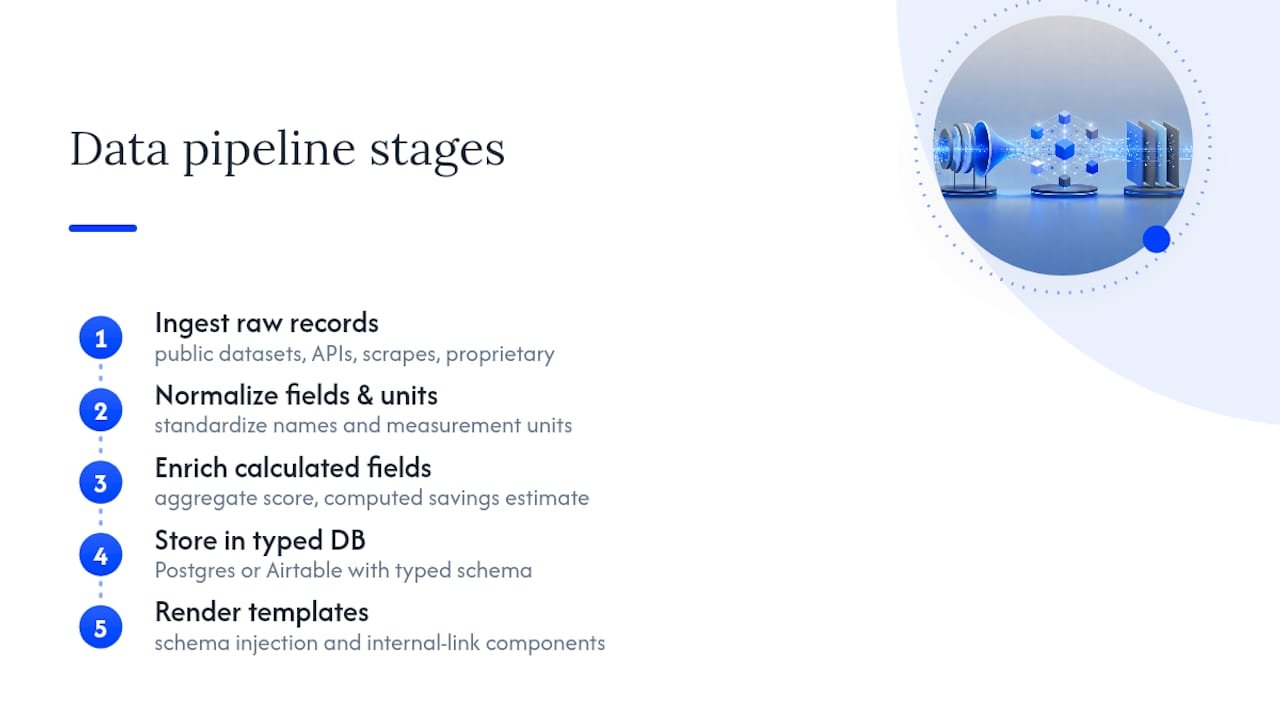
Whichever source you use, the practical pipeline pattern looks like this: ingest raw records, normalize field names and units, enrich with calculated fields (an aggregate score, a computed savings estimate), store the result in a typed database like Postgres or Airtable, then render through the template with schema injection and internal-link components attached automatically.
Template anatomy that holds up
A durable affiliate template has four parts:
- A verdict card giving the reader the answer in the first screen
- A unique data table pulling from your enriched dataset, not boilerplate
- Contextual narrative explaining what the data means for this specific entity
- An FAQ block seeded from real search queries, not generic filler questions
Every one of those sections needs at least one field that changes meaningfully from page to page. If your verdict card reads the same on 200 pages except for a swapped noun, you’ve built spam with a template wrapper.
Choosing your stack
| Scale | Recommended stack | Why |
|---|---|---|
| Under 500 pages | WordPress with a custom post type | Fast to launch, familiar CMS, adequate for smaller datasets |
| 500 pages | Headless CMS with Next.js or similar SSG | Handles incremental static regeneration, better Core Web Vitals at volume |
| thousands of pages | Fully headless with edge rendering and prerendering | Build times stay manageable, crawl efficiency improves |
WordPress with Advanced Custom Fields is fine for a pilot. Once you’re past a few thousand pages, static site generation with incremental builds becomes worth the migration cost, because rebuilding your entire site every time a price updates isn’t sustainable. Automation pieces you’ll want regardless of stack: a script that injects schema markup at build time, a component that auto-populates internal links between related entities, and a submission script that pushes new URLs to Google Search Console and Bing’s IndexNow API as soon as they go live. Real-world template examples and data-to-page code patterns are documented in Zapier’s GitHub repository, useful reference points when you’re deciding how much logic belongs in the template versus the data layer.
How to Build a Programmatic SEO Pilot in 2 to 4 Weeks
The playbook below runs in three phases: validate, pilot, scale. Skipping straight to scale is the single most common way affiliates burn months building a template nobody clicks.
-
Cluster your keywords by intent, not just volume. Group long-tail queries by what the searcher wants to do next: compare, buy, check eligibility, find a local option. Templates built for buyer-intent keyword clusters convert dramatically better than templates chasing informational volume.
-
Build your dataset with per-entity uniqueness fields baked in. For each entity, store at minimum: a current price or rate, a regional or category-specific attribute, an aggregate or computed score, and one field that updates on a predictable schedule. If two entities in your dataset would produce identical pages, merge them or cut one.
-
Design your template against a uniqueness checklist. The verdict, the data table values, the narrative’s opening sentence, and the FAQ answers should all be capable of varying meaningfully across at least a sample of 20 rows. Test this before writing production code by manually filling the template for five wildly different entities and reading them back to back.
-
Launch a pilot of 50 to 200 pages. This range shows up consistently in affiliate programmatic case work because it’s large enough to show a real indexing pattern and small enough to fix quickly if something’s wrong, a threshold backed by industry pilot-first playbooks. Submit the batch through Search Console and monitor indexing over the following three to four weeks.
-
Measure EPC and RPIP on the pilot before touching anything else. If your indexed pages aren’t earning close to your pre-build estimate, the problem is usually one of three things: the SERP is harder than your sample check suggested, the dataset fields aren’t differentiated enough, or the conversion placement on the page is wrong.
-
Iterate your quality filters before scaling. Tighten the minimum uniqueness bar, cut any entity category that underperformed, and adjust the template’s data table if certain fields consistently go unread (check scroll depth if you have the analytics for it).
-
Scale only once thresholds are met. A reasonable gate: 70%+ of pilot pages indexed within four weeks, EPC tracking within range of your validation estimate, and a working internal linking plan connecting leaf pages to a small number of hub pages that receive your actual link-building attention.
Pro Tip: Build your hub pages first, even though they’re a small fraction of total page count. A hub-and-spoke internal linking model means your editorial link building efforts concentrate on a handful of pillar pages, and the programmatic leaf pages inherit authority through internal links instead of needing their own backlinks.
Case data from smaller affiliate pilots tends to back this sequencing. Reviewing documented pilot results before you build your own dataset schema can save you from replicating a field structure that didn’t hold up.
Scaling Without Breaking Your Crawl Budget
Indexing problems, not writing problems, are what kill most programmatic builds once they cross a few thousand pages. Google allocates a finite crawl budget to your site, and every low-value page you let it discover is crawl budget not spent on a page that could actually rank.
Rendering choice matters here. Static prerendering works well when your dataset changes on a predictable schedule, since you can rebuild incrementally rather than regenerating the entire site. Server-side rendering makes more sense when data changes per-request, like live pricing, but it costs more in server load at scale. Most large affiliate builds land on a hybrid: static generation for the bulk of pages with incremental rebuilds triggered when specific data fields change, and edge caching to keep response times fast globally.
Practical crawl and indexing tactics:
- Submit new and updated URLs through the Bing/IndexNow API and Google Search Console’s URL inspection API rather than waiting for organic discovery
- Keep your sitemap segmented by template type and update timestamp so crawlers can prioritize freshly changed sections
- Set
robots.txtrules to block low-value parameter combinations (filtered or sorted views of the same data) from ever being crawled - Noindex or prune pages that show zero impressions after 90 days rather than letting them sit and dilute your site’s average quality signal
- Use a CDN and lazy-load non-critical assets to protect Core Web Vitals as page count climbs into the thousands
That pruning step is the one affiliates skip most often, usually out of reluctance to “throw away” pages they built. But a large tail of zero-impression pages actively drags down how search engines assess the rest of your site.
Avoiding the Scaled-Content Penalty: Quality and Freshness Controls
The single biggest risk in programmatic SEO isn’t getting caught by a manual action. It’s building thousands of pages that quietly never rank because they never cleared a minimum quality bar. Empire325’s implementation guide frames the fix correctly: successful builds focus on per-page unique data, comprehensive schema, and internal linking density rather than chasing raw page count.
Set a hard rule before launch: no page ships unless it has at least one genuinely unique data point that didn’t exist on the previous 10 pages generated from the same template.
Freshness needs a schedule, not a vague intention:
- Pricing or availability fields: refresh weekly
- Specs, ratings, or feature comparisons: refresh monthly
- Static reference data (regulations, historical facts): refresh quarterly
Pro Tip: If you can’t commit to refreshing a data field on any schedule, don’t make it your page’s uniqueness hook. A stale “unique” field ages into a liability faster than generic content does, because readers and algorithms both notice when a number stopped updating two years ago.
On schema, include Product or Service schema where applicable, FAQPage schema for your FAQ block, and BreadcrumbList to reinforce your internal hierarchy. These help entity extraction systems understand what each page is actually about, which matters more as AI-driven answer engines summarize search results directly.
The Metrics That Decide Whether a Template Cluster Survives
Two numbers should drive every scale-or-kill decision on a programmatic template: EPC and RPIP.
EPC is your average affiliate earnings per hundred clicks, divided by 100 to get a per-click figure, blended across every click regardless of whether it converted. If your network reports $180 earned per 1,000 clicks, your EPC is $0.18. RPIP takes that further by modeling revenue per indexed page: multiply expected monthly impressions by expected click-through rate by EPC.
Affiliate operators evaluating a vertical should check EPC and RPIP before building, since not every entity in a dataset deserves its own page.
Track these alongside your revenue math:
- AI Overview and featured snippet citation rate, since increasing answer-engine summarization changes how much organic click volume even converts
- Indexing rate within 30 and 60 days of publish
- CTA placement performance, testing verdict-first layouts against data-table-first layouts
- Verdict phrasing variants (direct recommendation versus comparative framing) run as an A/B split on a sample of the cluster
Set your decision thresholds before you look at the data, not after. Prune any cluster falling meaningfully below that after a full quarter of data, and take the entity categories that underperformed out of future dataset expansions entirely.
Who’s Behind This Playbook
This guide draws on Will Buckley’s coaching work helping affiliate marketers apply AI and structured workflows to their marketing, rather than treating programmatic SEO as a set-and-forget traffic hack. If you’re building your first cluster, start with the topical authority framework that explains how hub pages earn trust that leaf pages inherit, then work through the keyword research process that determines which templates are worth building at all.
Additional credentials, case results, and reader testimonials will be added here as they become available.
Engineering Discipline Beats Content Volume
Treat programmatic SEO as an engineering problem first, an editorial problem second. The template is infrastructure; the dataset is the product. Most failed builds I’ve seen fail because someone wrote a beautiful template and fed it a mediocre dataset, not the other way around.
A four-week pilot is realistic if your dataset already exists. If you’re still negotiating API access in week three, that’s your signal to stop and find a smaller dataset first.
— Will
Ready to Pilot Your First Programmatic Cluster?
Most affiliates trying to piece together programmatic SEO on their own spend weeks reinventing a pipeline that a structured walkthrough could shortcut in days. A practical, AI-driven coaching approach exists specifically to help you skip that trial-and-error phase and get a real pilot live faster.

If you’re ready to test the framework above on your own vertical, the YouTube Automation Affiliate Marketing playbook walks through building and scaling automated affiliate content step by step. Prefer to fix your foundation first? A short automation pilot focused on getting your internal linking and first template batch right in two to four weeks is the fastest way to know whether your dataset and vertical actually clear the bar this article laid out. Start there, then decide whether to scale.
Sources
- Programmatic SEO: How to do it & if you should
- How to Build a Programmatic SEO Machine for Affiliate Sites in 2026 – Affiliate Times
- Data
FAQ
Is Programmatic SEO Worth It for Small Affiliate Sites?
It can be, but only if you validate EPC and dataset uniqueness before building, since a small site can’t absorb the cost of an unprofitable pilot as easily as a larger operation. Start with 50 pages in a single vertical rather than spreading thin across several.
How Many Pages Should a Programmatic SEO Pilot Include?
Most affiliate playbooks recommend 50 to 200 pages for an initial pilot, enough to reveal a real indexing pattern without risking months of wasted build time. Scale only after that batch clears your indexing and EPC thresholds.
What’s the Difference Between Programmatic SEO and Templated Spam?
Programmatic SEO relies on per-page unique data that gives each page a real reason to exist, while templated spam reuses the same content shell with minor variable swaps. Zapier’s guide frames unique, useful information as the deciding factor between the two.
Which CMS Is Best for Programmatic SEO on an Affiliate Site?
WordPress with a custom post type works fine under roughly 500 pages, while headless setups using Next.js or similar static site generators handle larger builds better because of incremental rebuilds and stronger Core Web Vitals. The right choice depends on your page count and technical comfort level, not a universal best answer.
Does Willbuckley Offer Help Setting Up a Programmatic SEO Pilot?
Coaching, playbooks, and workflow guidance for affiliate marketers building AI-assisted marketing systems are available, including automation-focused resources relevant to a first pilot. Current program details and pricing are listed on the site.