

AI personalization uses customer signals and machine learning to serve each user experiences that increase relevance and conversion. The payoff is measurable: higher click-through rates, better retention, and creative teams that scale without burning out. The rest of this guide shows you how it works, where it pays off fastest, and how to run your first pilot without overhauling your stack.
TL;DR:
- AI personalization models rely on real-time signals such as recency, frequency, and intent to deliver highly relevant experiences for each user.
- The most effective use cases typically focus on site recommendations, email content, landing pages, chatbots, and dynamic ads or pricing.
- Starting a pilot involves selecting one objective and channel, ensuring data readiness, and gradually scaling while maintaining control groups and measuring performance.
- Platforms like Amazon Personalize and Azure AI Personalizer offer quick setup with automated training, suitable for teams without extensive ML expertise.
- Managing privacy, bias, and transparency proactively is essential to sustain trust and achieve long-term ROI in personalization programs.
Table of Contents
- What Is AI Personalization and How Does It Work?
- Why Does AI Personalization Matter for Marketing and CX?
- What Are the Best Channel-Specific Use Cases?
- Which AI Techniques Should Marketers Actually Understand?
- How Do You Manage Privacy, Bias, and Governance Risk?
- How Do You Build a Personalization Pilot Step by Step?
- What KPIs Should You Track for Personalization Programs?
- Which Platforms Should You Evaluate First?
- What Trends Should Marketers Watch Next?
- Practical Workflows and Templates from Will Buckley
- Author Perspective: Priorities and Common Pitfalls
- Get the Playbooks That Make These Pilots Faster
- Where to Learn More
- Sources
- FAQ
What Is AI Personalization and How Does It Work?
Rule-based personalization uses static logic: if a shopper viewed hiking boots, show more hiking boots. AI personalization replaces those fixed rules with models that learn from behavior and adjust in real time. Push it far enough and you get hyper-personalization, where content, offers, and even send times adapt per individual rather than per segment.
The models feed on several signal types: recency (what someone did in the last hour), frequency (how often they return), and intent signals (search terms, cart abandonment, dwell time). Academic reviews of the field confirm this shift away from static rules toward adaptive frameworks that learn preferences and predict future behavior, which is a meaningful jump from the “if this, then that” logic most marketers grew up on.
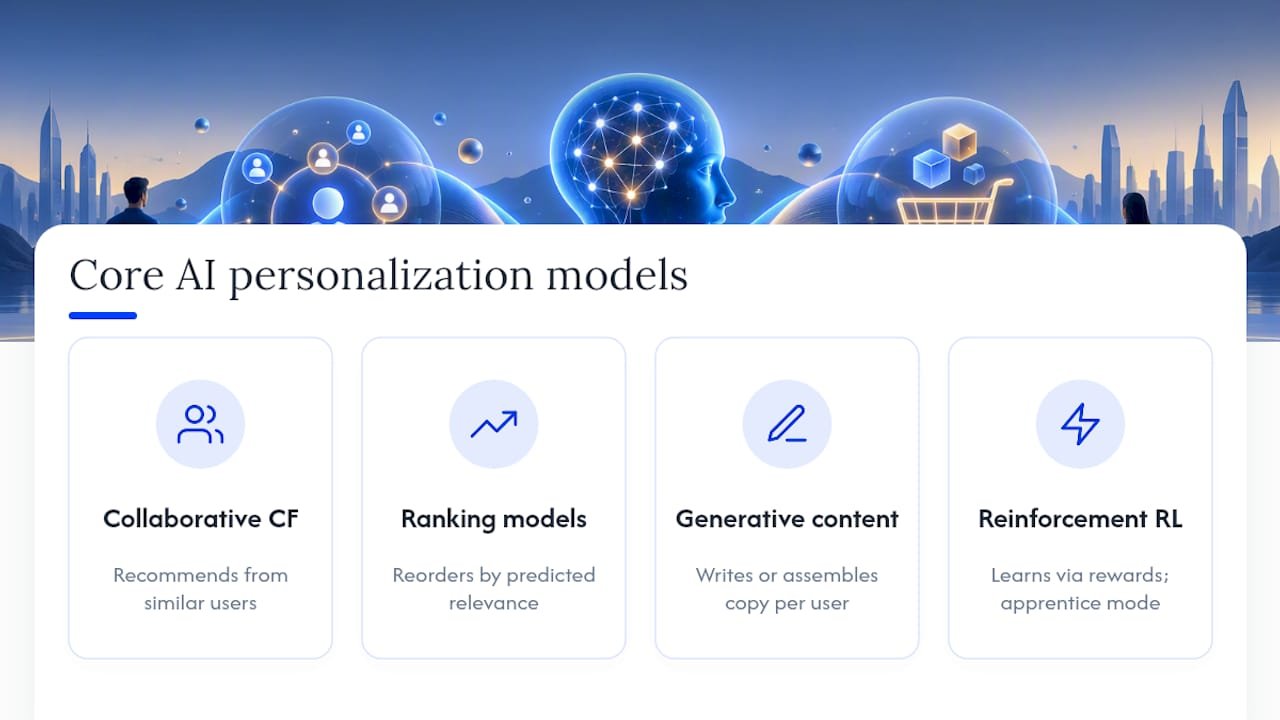
Four model families do most of the work: collaborative filtering (recommends based on similar users), ranking models (reorders a list by predicted relevance), generative conditional content (writes or assembles copy per user), and reinforcement learning, sometimes deployed in a safe “apprentice mode” that learns alongside your existing system before it ever touches live traffic.
Real-time personalization updates within milliseconds of a click, useful for on-site recommendations. Batch personalization runs on a schedule, often nightly, and suits email segmentation where instant reaction isn’t the priority. Most mature programs use both.
Why Does AI Personalization Matter for Marketing and CX?
More than half of customers, 52%, now expect offers tailored to their specific interests and behaviors. That’s not a preference anymore. It’s the baseline experience shoppers walk in expecting, and generic blasts read as an afterthought by comparison.
The business case is straightforward once you look at where the lift shows up. Conversion rate improves because the offer matches intent instead of guessing at it. Average order value climbs when recommendation engines surface a genuinely relevant upsell instead of a random “customers also bought” filler. Retention improves because a personalized experience feels like it was built for the customer, not sold to them, which keeps them coming back.
There’s an operational win too, one marketers underestimate. Personalization tools that draft creative variations or assist support agents cut the manual workload of running dozens of campaign versions. Industry benchmarking on AI’s marketing benefits shows this pattern holding across engagement and revenue metrics alike, not just isolated wins in one channel.
What Are the Best Channel-Specific Use Cases?
Personalization pays off differently depending on where it shows up. Here’s where marketers see traction fastest, mapped to channel:
- Site recommendations: Re-ranking product lists based on browsing behavior, and streaming-style “recommended for you” rails that update as intent shifts.
- Email: Subject-line and content-block variations generated per segment or per individual, tested against a control group before full rollout.
- Landing pages: Generative models assemble page variations by traffic source or referral intent, letting you A/B test creative at a scale manual editing can’t match.
- Chatbots and support: Sentiment-aware responses that shift tone when a customer sounds frustrated, plus agent-assist tools that surface the next-best answer.
- Ads and pricing: Dynamic ad creative matched to audience segment, and dynamic pricing that adjusts offers based on predicted price sensitivity.
Qualtrics frames this well: AI personalization draws on browsing, purchase history, social interactions, service interactions, and feedback to tailor the experience across every one of those touchpoints. The generative layer is genuinely new territory. Research from Harvard Business Review notes that generative models let marketers produce tailored landing pages and creative fast, but every output needs a factual-accuracy and brand-voice check before it goes live at scale. Skip that step and you’ll ship something off-brand to thousands of people before anyone notices.
Which AI Techniques Should Marketers Actually Understand?
You don’t need to build models from scratch, but knowing what’s under the hood helps you pick the right tool and ask vendors better questions.
Ranking APIs take a list you already generated and reorder it by predicted relevance to that user. Recommender systems go further, generating the candidate list itself from purchase and browsing history. Ranking APIs are lighter to implement and easier to explain; recommender systems produce better discovery but need more data to train well.
Reinforcement learning is the model family behind apprentice mode, a rollout pattern worth understanding even if you never touch the math. The system watches how your existing logic performs and learns alongside it, without changing anything users see, until it clears a performance threshold. It’s a low-risk way to test a smarter system without betting the quarter on it, and Azure’s own documentation on apprentice mode frames it explicitly as a safety pattern for exactly this reason.
Generative models handle creative variation: subject lines, page copy, ad text. Structured recommendation models handle “what to show,” not “what to say.” The signals that move the needle most consistently are recency and explicit intent (search terms, cart activity) over broad demographic data, which tends to be a weaker predictor than teams expect.
How Do You Manage Privacy, Bias, and Governance Risk?
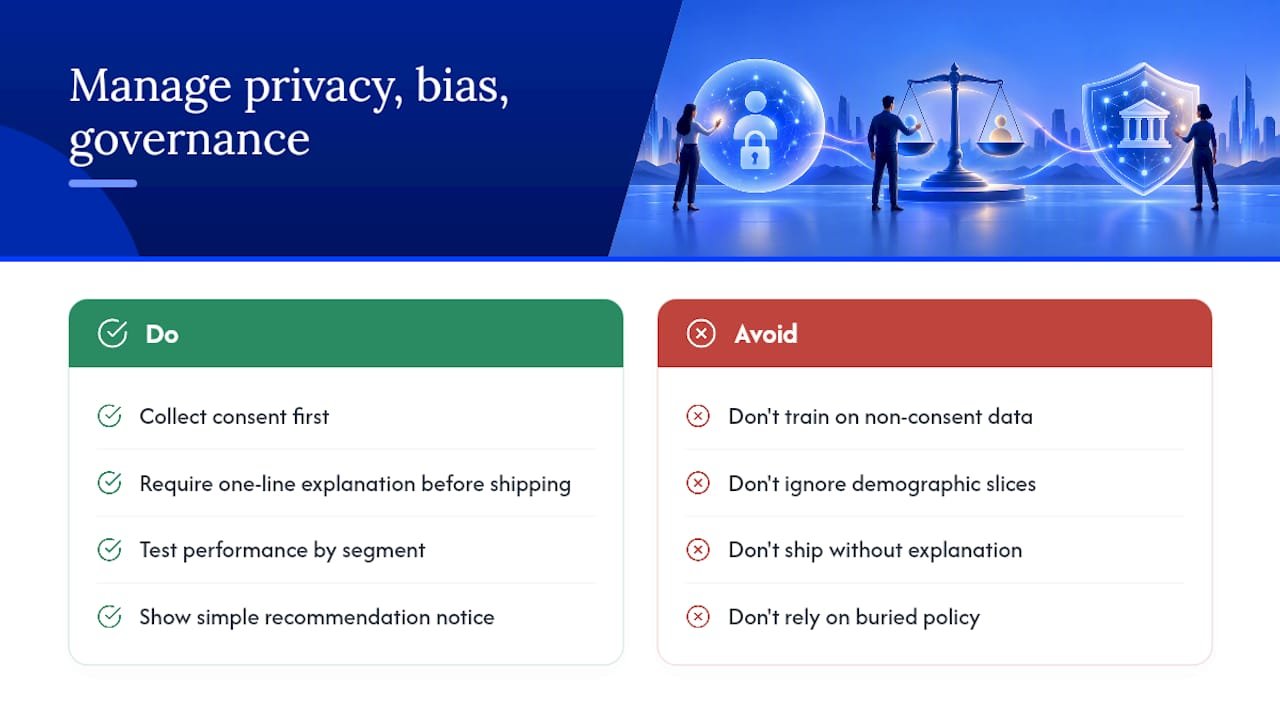
Consent-first collection isn’t just compliance box-checking. It’s the foundation the whole model depends on, because models trained on data customers didn’t knowingly provide tend to produce recommendations that feel invasive rather than helpful, and customers notice the difference even when they can’t articulate why.
Bias creeps in quietly. A recommendation model trained on historical purchase data will replicate historical skew, favoring segments that converted well in the past over segments the business hasn’t served well yet. Held-out testing and slice analysis, checking model performance separately across demographic or behavioral segments, catches this before it compounds.
Transparency matters more than most teams budget for. A simple notice (“recommended based on your recent activity”) does more for trust than a buried privacy policy update. Analysts who study this space consistently point to managing privacy, bias, and transparency proactively as the difference between programs that sustain trust and ROI long-term and ones that erode both quietly over time.
Pro Tip: Set a hard rule that no personalization tactic ships without a one-line explanation a customer could read and nod along to. If you can’t write that sentence honestly, don’t ship the tactic.
How Do You Build a Personalization Pilot Step by Step?
Start small, measure honestly, and scale only what proves itself.
- Pick one objective and one channel. Email open rate or site conversion, not both at once. Define your success threshold before you start, not after you see the numbers.
- Run a data readiness check. Confirm event tracking works, customer IDs are consistent across systems, CRM sync is live, and consent flags are captured correctly.
- Build a pilot with a small catalog. Limit scope to one product category or one email flow. Use apprentice mode if your platform offers it, so the model learns without customer-facing risk.
- Keep a holdout control group. Without one, you can’t prove the lift is real rather than seasonal noise.
- Scale gradually. Set a retraining cadence, automate the creative variation templates that worked, and expand catalog scope only after the pilot clears its threshold.
Managed platforms shrink this timeline considerably. Amazon Personalize’s automatic training feature can get a functional recommendation engine running in a few hours when you’re training on data you already have, which changes the calculus on whether a small team should build in house. For a deeper look at structuring the experiment itself, these conversion optimization workflows walk through test design marketers can adapt directly.
What KPIs Should You Track for Personalization Programs?
Track conversion lift, click-through rate, average order value, and retention or lifetime value as your primary business metrics. Underneath those, watch operational health: latency (is the recommendation loading fast enough to matter), coverage (what percentage of users get a personalized experience versus a fallback), model accuracy, and drift alerts that flag when performance degrades.
For experiment design, a holdout group is non-negotiable, sequential testing lets you stop early when results are clear, and multi-armed bandits can allocate traffic dynamically toward the better-performing variant during the test itself. Attribution ties revenue back to the personalization layer specifically, not the campaign as a whole, which analytics frameworks built for this purpose help isolate.
Which Platforms Should You Evaluate First?
Judge any platform on five axes: time-to-value, real-time support, integration effort, explainability, and pricing.
Amazon Personalize handles recommendation engines with automated training, and its integration with generative foundation models extends personalized content across channels without a separate creative pipeline. Azure AI Personalizer is built around reinforcement learning and ranking, with a free S0 tier offering 50,000 transactions per month for the first 12 months, a genuinely low-risk entry point for teams testing the waters. IBM offers AI personalization capabilities aimed at enterprise-scale customer experience deployments, typically for teams with existing IBM infrastructure. Qualtrics approaches personalization from the experience-management side, pulling survey and feedback data into the same profile as behavioral data.
Managed services make sense when your team lacks dedicated ML engineers or needs a working pilot in weeks, not quarters. Build-your-own makes sense when personalization is core to your product and you need control over every signal and model choice.
What Trends Should Marketers Watch Next?
Generative personalization is moving from novelty to default, letting small teams produce creative variation at a volume that used to require an entire production team. Longitudinal identity graphs, stitching a customer’s behavior across sessions and devices, are closing the gap that session-bound systems still struggle with today.
Privacy-preserving techniques, on-device processing and federated learning, are gaining ground as regulation tightens and customers grow warier of centralized data pools. Expect better tooling for bias monitoring too. Explainability is shifting from a compliance afterthought to a feature vendors compete on.
Practical Workflows and Templates from Will Buckley
Affiliate marketers don’t need enterprise ML teams to get results. You need a tight pilot and a few repeatable recipes.
- Pilot checklist: Pick two or three evergreen pages, confirm event tracking fires on clicks and scroll depth, set a baseline conversion rate, and run for a fixed window (two to four weeks minimum) before judging results.
- Recipe A: Add an on-page recommendation widget to your top evergreen affiliate posts, surfacing related products based on what similar readers clicked.
- Recipe B: Generate three subject-line variations per email using a structured prompt, roll out to a 20% sample first, and measure open rate before sending to the full list.
- Recipe C: Build a simple FAQ or chat agent that recommends affiliate products based on the visitor’s stated need, then surface time-sensitive offers in the response.
For a fuller build-out of these ideas, the ready-to-run affiliate workflows walk through each recipe with more detail.
Author Perspective: Priorities and Common Pitfalls
Fix your data hygiene and measurement before touching a fancy model. Most personalization failures trace back to bad tracking, not bad algorithms. Resist the urge to over-personalize. Utility beats cleverness every time, and small tooling wins early if you measure honestly.
— Will
Get the Playbooks That Make These Pilots Faster
This guide is designed as a practical shortcut for affiliate marketers without a data science team who want to achieve the benefits described. The flagship YouTube automation playbook walks through workflow templates for launching automated content and recommendation systems without reinventing the pilot process from scratch.
Every template inside is built for rapid testing, not months of setup, so you can run the pilot checklist above against real traffic within weeks. If you want proof this works before committing, the affiliate marketing case study data shows measured results from marketers who ran these exact plays. Start with the playbook, pick one channel from this guide, and launch your first pilot this month.
Where to Learn More
- Azure AI Personalizer docs: pricing tiers and apprentice mode details.
- Amazon Personalize: setup and generative integration specifics.
- Qualtrics 2025 consumer trends: the personalization expectation data behind this guide.
Sources
- Qualtrics announces 2025 consumer experience trends (PR Newswire)
- AI and customer experience — Qualtrics
- A Comprehensive Review of AI-Driven Personalization (2025)
FAQ
What Is AI Personalization in Simple Terms?
AI personalization uses machine learning models to tailor content, offers, and messaging to each individual based on their behavior, rather than applying one static rule to everyone. It draws on signals like browsing history, purchase data, and service interactions to decide what each person sees.
How Is Hyper-Personalization Different From Regular Personalization?
Regular personalization often works at the segment level, grouping similar users together. Hyper-personalization pushes further, adapting content, timing, and offers to the individual using real-time signals rather than a fixed group profile.
How Long Does It Take to Launch a Personalization Pilot?
With a managed platform and existing interaction data, a basic recommendation engine can be running in a few hours. A full pilot with proper measurement, though, typically runs two to four weeks to produce a reliable result.
What’s the Safest Way to Roll Out a New Personalization Model?
Apprentice mode, available in platforms like Azure AI Personalizer, lets a new model learn alongside your existing system without affecting live users until it clears a performance threshold. It’s the lowest-risk way to validate a model before full deployment.
Do I Need a Data Science Team to Use AI Personalization?
No. Managed platforms handle the infrastructure and training automatically, and Willbuckley’s affiliate workflow templates are built specifically for marketers without dedicated technical teams to run these pilots on their own.