

Yes, ChatGPT is a practical, revenue-driving tool for affiliate marketers — when you pair it with human verification, owned distribution, and a repeatable testing habit. Here’s where to start right now:
- Use ChatGPT to write first drafts and generate A/B headline variants for your top-performing pages.
- Optimize your highest-traffic, bottom-funnel pages for real buyer intent, not just volume keywords.
- Capture every click into an owned channel — your email list — so you’re not at the mercy of zero-click search behavior.
Your core starting stack: OpenAI ChatGPT for content generation, SurferSEO for on-page optimization, Mailchimp for email, Hootsuite for social scheduling, and ClickUp for workflow management.
Key Takeaways
ChatGPT is most effective for affiliate marketers when it handles first drafts, prompt-driven creative variants, and email scaffolding, while a human verification step catches errors before anything goes live.
| Point | Details |
|---|---|
| Start with existing pages | Apply ChatGPT prompts to your highest-traffic affiliate pages first for the fastest conversion lift. |
| Use the 6-step workflow | Ideate, outline, draft, optimize with SurferSEO, publish via Hootsuite/Mailchimp, then measure affiliate-tag conversions. |
| Disclose every time | FTC requires a clear, prominent affiliate disclosure on every page — build it into your publishing checklist. |
| Guard against AI traffic loss | Shopping-adjacent categories saw an estimated 15–25% organic traffic reduction; build your email list to own your audience. |
| Willbuckley’s system | Structured prompts, workflows, and accountability coaching to help you implement ChatGPT profitably in your affiliate business. |
Table of Contents
- How ChatGPT for affiliate marketing actually works across your funnel
- Ready-to-use ChatGPT prompts and templates for affiliate tasks
- How to build an end-to-end ChatGPT workflow from idea to published asset
- What are the biggest risks of using ChatGPT for affiliate content.
- A real ChatGPT workflow Will used on a product review
- What Will would try first if you’re starting today
- Willbuckley’s coaching gives you the workflow, not just the theory
- Sources
How ChatGPT for affiliate marketing actually works across your funnel
ChatGPT handles five affiliate tasks better than almost any other tool: drafting long-form product reviews, generating ad headline variants, writing email sequences, creating social captions, and brainstorming keyword angles you hadn’t considered. ClickBank confirms these five use cases are the most practical entry points for affiliates, with a clear caution: every output needs a fact-check pass before it goes live.
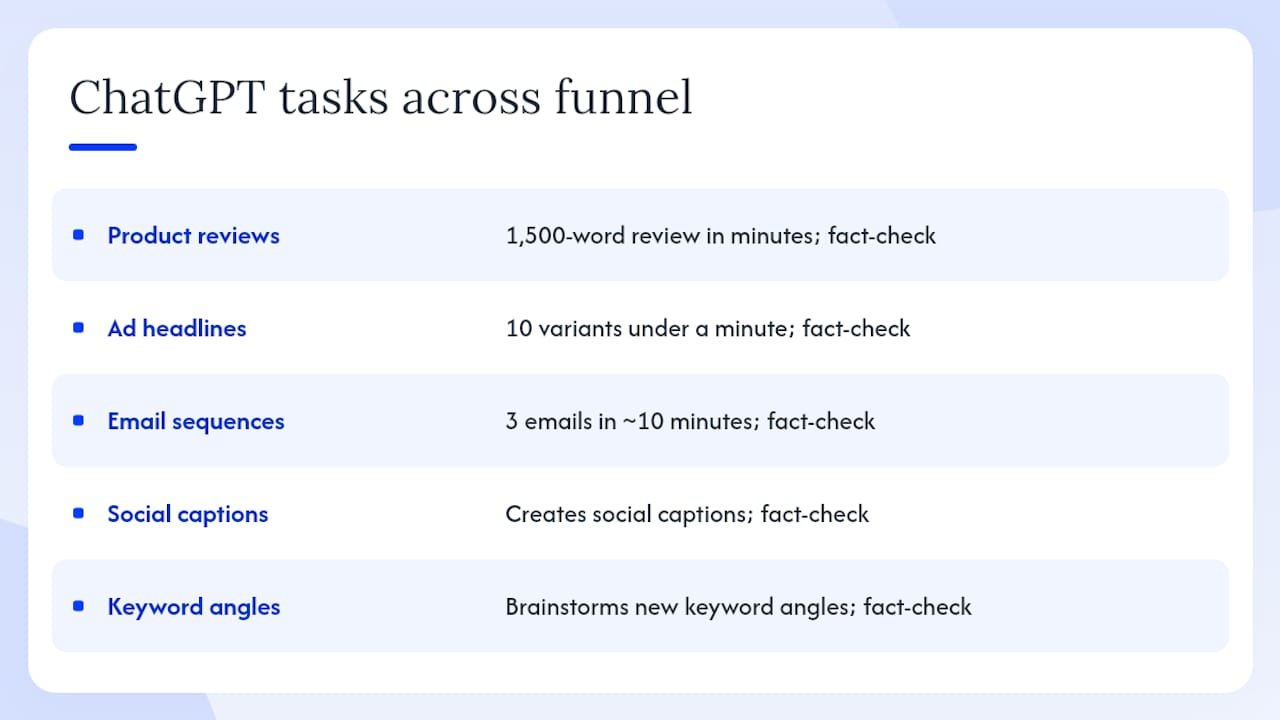
Product reviews and comparisons. ChatGPT can scaffold a 1,500-word review in minutes. Give it the product name, three key features, your target reader’s main objection, and the tone you want. The output won’t be publish-ready, but it gives you a structured skeleton that cuts your writing time significantly. A typical intro it might produce: “If you’ve been comparing project management tools and keep hitting the same wall — too many features, not enough simplicity — here’s what actually separates the contenders.” You edit that into your voice; you don’t write it from scratch.
Email sequences. A three-part welcome sequence for a new subscriber takes about ten minutes with ChatGPT. Email 1 sets expectations, Email 2 delivers a quick win, Email 3 introduces your affiliate recommendation with context. The model handles the structure; you inject the specific product details and your personal framing.
Ad headlines and CTAs. For paid traffic, ChatGPT generates 10 headline variants in under a minute. You test them, kill the losers, and scale the winner. ROIads notes that this rapid creative ideation is especially valuable for push and pop ad formats, where creative fatigue sets in fast and you need fresh angles constantly.
Localization. If you’re running geo-targeted campaigns, ChatGPT can adapt copy for regional tone, idiom, and cultural context. It’s not a certified translator, so always have a native speaker review anything going to a non-English market.
What to avoid automating. Never let ChatGPT publish unverified pricing, product specs, or health claims without a human check. The model can hallucinate specific figures with complete confidence. Anything touching medical, financial, or legal claims needs a subject-matter expert review, full stop.
Ready-to-use ChatGPT prompts and templates for affiliate tasks
A high-performing affiliate prompt has four components: context (who you are and what you’re promoting), audience (who’s reading and what they care about), constraints (word count, tone, format), and a clear desired output. ClickUp’s library of many marketing prompts reinforces this: sharing brand guidelines, persona details, and tone instructions consistently improves output quality.
Here are 12 ready-to-use templates, organized by task. Replace the bracketed placeholders with your specifics.
- Niche brainstorming: “List 10 underserved sub-niches within [broad niche] where buyers have high purchase intent and limited quality content exists. For each, suggest one affiliate product category.”
- SEO keyword expansion: “Given the seed keyword [keyword], generate 15 long-tail variants targeting buyers in the consideration or decision stage. Include question-format keywords.”
- Review skeleton: “Write a 600-word product review intro for [product name] targeting [persona]. Lead with the reader’s main pain point, introduce the product as a solution, and end with a transition to features.”
- Comparison scaffold: “Create a comparison outline for [Product A] vs [Product B] targeting [persona]. Include sections for pricing, ease of use, best-fit use case, and a verdict.”
- A/B ad headlines: “Write 10 ad headlines for [product] targeting [audience segment]. Vary the angle: use curiosity, urgency, social proof, and direct benefit. Keep each under 30 characters.”
- 4-part email sequence: “Write a 4-email welcome sequence for new subscribers interested in [niche]. Email 1: welcome and expectation-setting. Email 2: quick win tip. Email 3: case study or story. Email 4: soft pitch for [affiliate product].”
- Pre-lander script: “Write a 200-word pre-lander for [offer type] targeting [audience]. Open with a relatable problem, build curiosity, and close with a single CTA to learn more.”
- Localization prompt: “Adapt the following copy for a [country/region] audience. Adjust idioms, cultural references, and tone while keeping the core message intact: [paste copy].”
- Objection-handling FAQ: “Write 5 FAQ entries for [product] that address the most common buyer objections: price, trust, ease of use, results timeline, and refund policy.”
- CTA variants: “Generate 8 CTA button label options for [product/offer]. Mix action-oriented, benefit-led, and curiosity-driven options.”
- Microcopy: “Write 5 tooltip or microcopy options for a checkout page selling [product]. Keep each under 12 words and focus on reducing friction.”
- Analytics summary prompt: “Summarize the following campaign data in plain language and identify the top two optimization opportunities: [paste data].”
Prompt engineering tips. Use a system message or opening persona line to prime the model: “You are an experienced affiliate marketer writing for [persona].” Keep prompts under 300 words — longer prompts often produce bloated outputs. Add a constraint like “avoid generic advice” or “use second-person, conversational tone” to tighten the output.
Adsterra’s prompt-based campaign examples show that niche-specific pre-lander prompts with explicit audience details outperform generic ones by a wide margin in creative quality.
Pro Tip: Instead of rewriting a bad output from scratch, add one refinement instruction: “Make the opening more specific and cut the last paragraph.” Iterating in small steps produces better results than one long prompt.
How to build an end-to-end ChatGPT workflow from idea to published asset
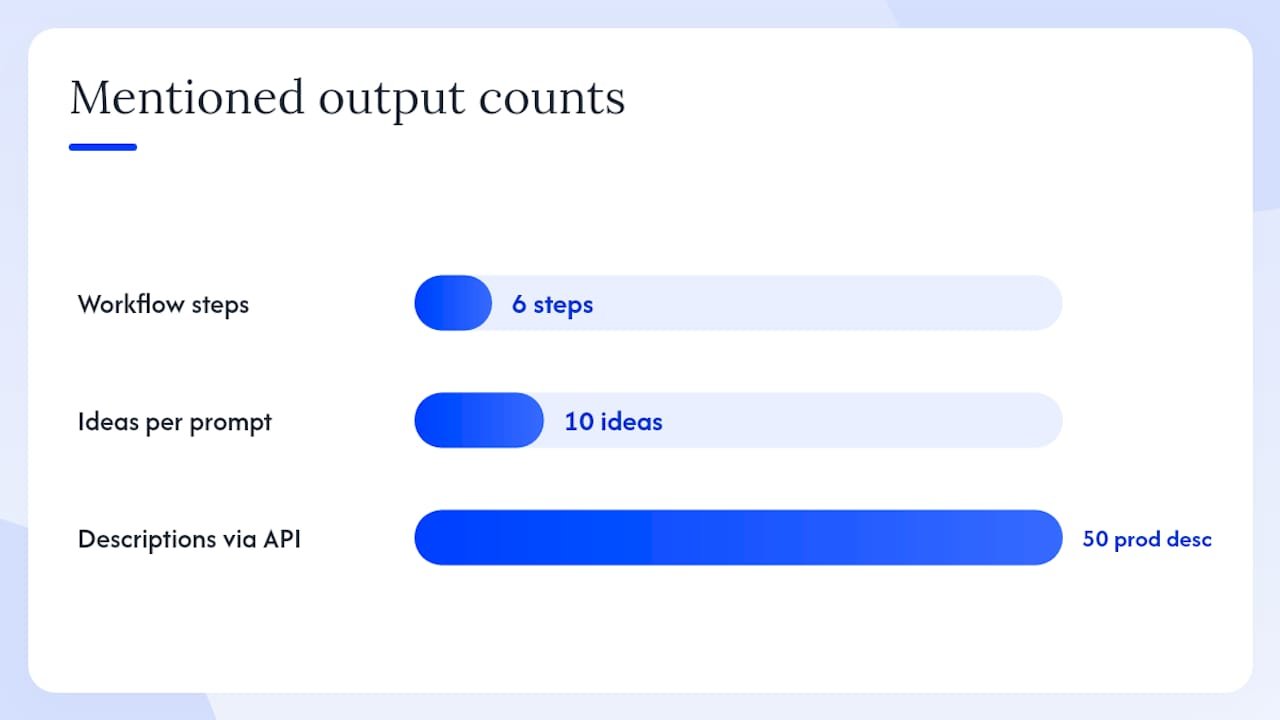
A repeatable workflow is what separates affiliates who dabble in AI from those who scale with it. Here’s a six-step process you can run for every piece of affiliate content:
- Ideate. Use ChatGPT to brainstorm topic angles and keyword clusters around your niche. Feed it your seed keyword and ask for 10 content ideas targeting buyers at different funnel stages.
- Outline. Prompt ChatGPT to build a structured outline for your chosen topic, including H2 sections, key points per section, and a suggested CTA placement.
- Draft. Generate a first draft section by section, not all at once. Shorter, focused prompts produce cleaner outputs than one massive request.
- Optimize for SEO. Run the draft through SurferSEO to check keyword density, heading structure, and content score against top-ranking pages. Adjust accordingly.
- Publish and distribute. Schedule social promotion through Hootsuite, send a teaser to your Mailchimp list, and assign the publish task in ClickUp so nothing falls through the cracks.
- Measure and iterate. Track affiliate-tag-verified conversions, not just raw traffic. If a page drives clicks but no conversions, revisit the CTA and offer fit.
ChatGPT UI vs. API. For most affiliates, the ChatGPT interface is enough. The API makes sense when you’re automating at volume — generating 50 product descriptions, running batch keyword research, or building a template email pipeline. The API requires basic technical setup but unlocks automation via tools like Zapier or Make.
Pro Tip: Connect ChatGPT outputs to ClickUp via a Zapier workflow: when a new content brief is created in ClickUp, trigger a ChatGPT API call to generate a draft outline and paste it into the task description. This cuts brief-to-draft time to minutes.
What are the biggest risks of using ChatGPT for affiliate content.
The single most important compliance rule is this: disclose your affiliate relationships clearly, every time, on every page. The FTC requires that affiliate relationships be disclosed in plain language that a reader can’t miss. “This post contains affiliate links” buried in a footer doesn’t meet that standard.
Beyond disclosure, watch for these red flags in every ChatGPT output:
- Hallucinated product facts: ChatGPT may invent specs, features, or awards that don’t exist. Cross-check every factual claim against the product’s official page.
- Inaccurate pricing: Prices change. Never publish a price from a ChatGPT output without verifying it live on the merchant’s site.
- Missing affiliate disclosure: ChatGPT won’t add your disclosure automatically. Build it into your publishing checklist.
- Unverified testing claims: If you haven’t personally tested a product, don’t let ChatGPT write as if you have. That’s a trust and legal risk.
- Localization errors: A phrase that works in American English can carry a different or offensive meaning in another market. Always have a native speaker review localized copy.
The AI traffic shift you need to plan for. Affiliyo’s reporting shows that shopping queries on ChatGPT grew faster than any other query type between December 2024 and June 2025, with some shopping-adjacent content categories seeing an estimated 15–25% reduction in organic traffic. The upside: conversion-per-click tends to rise for the traffic that remains, because AI-assisted searchers arrive more informed. Monitor your affiliate-tag-verified conversions closely, not just your session counts.
Some AI platforms pass referrer data when users click citations, giving you a measurable, if small, referral signal from chatbot platforms. Set up UTM tracking on every affiliate link so you can see this traffic in your analytics.
The practical response to zero-click risk is straightforward: build your email list aggressively, keep your bottom-funnel pages updated with real-time pricing and stock status, and audit every AI-generated claim before publishing.
A real ChatGPT workflow Will used on a product review
The goal was simple: publish a product review for a software tool in the productivity niche, rank it for a mid-volume buyer-intent keyword, and drive affiliate conversions through the blog and a newsletter segment.
The workflow:
- Context and prompt: The opening prompt was: “You are an affiliate marketer writing a product review for [software tool] targeting solopreneurs who struggle with task overload. Write a 200-word intro that leads with their pain point, introduces the product as a practical fix, and ends with a transition to the features section. Tone: conversational, direct, no hype.”
- Human review layer: Every factual claim — pricing, integration list, trial length — was verified against the product’s live pricing page before publishing. Two claims ChatGPT generated were inaccurate and were removed.
- SEO pass: The draft went through SurferSEO before publishing. Heading structure was adjusted and two secondary keywords were added naturally to the body.
- Distribution: The published post was emailed to a segmented newsletter list (subscribers who had previously clicked on productivity tool content). A short teaser was scheduled via Hootsuite for Twitter and LinkedIn.
What the process revealed:
- The AI-generated intro needed a complete rewrite for voice. The structure was right; the personality was flat.
- The FAQ section ChatGPT produced was the strongest part — objection-handling copy that would have taken an hour to write manually came out in two minutes.
- Iterating on the CTA (three rounds of prompt refinement) produced a version that felt natural rather than salesy.
You can find more workflow breakdowns and case study write-ups on the Willbuckley blog, where Will documents the exact prompts and results from his affiliate experiments.
What Will would try first if you’re starting today
Start with your single highest-traffic affiliate page and run this prompt against it:
“You are a conversion copywriter. Read the following product review [paste your content]. Identify the three weakest sections for buyer confidence and rewrite each with a stronger hook, a specific benefit statement, and a clear CTA. Target persona: [describe your reader]. Tone: [your brand voice].”
That one prompt, applied to a page already getting traffic, gives you the fastest path to a measurable conversion lift. You’re not building from zero; you’re sharpening what’s already working. Run it, publish the revised version, and check your affiliate-tag-verified conversions over the next two weeks. That’s your first real data point.
The reason this beats starting with a brand-new piece of content: you already know the page has an audience. Improving conversion on existing traffic is faster than waiting for a new article to rank.
Willbuckley’s coaching gives you the workflow, not just the theory
Most affiliates who try ChatGPT hit the same wall: the outputs feel generic, the workflow isn’t repeatable, and there’s no accountability to actually ship and test. Willbuckley’s coaching and educational content are built specifically to close that gap.

Working with Willbuckley means you get structured workflows, ready-to-use prompt templates calibrated to your niche, and a clear system for testing and measuring what’s actually moving your affiliate revenue. It’s not a course you consume and forget — it’s a practical framework you implement with guidance. If you’re ready to put a real AI-driven affiliate system in place, start here and see exactly what the program covers.
Sources
These are the primary sources behind this guide. Each one is worth reading in full if you want to go deeper on a specific area.
- What ChatGPT shopping queries are doing to affiliate creators. | Affiliyo
- ChatGPT prompts for marketing — ClickUp
- How to Make Money With ChatGPT: 5 Ideas for Affiliate Marketers | ClickBank
- How to Use ChatGPT for Affiliate Marketing: 11 proven tips – ROIAds
- How To Use ChatGPT For Affiliate Marketing? FREE Prompts | Adsterra