

Generative engine optimization (GEO) is the practice of structuring your content so AI-powered engines like ChatGPT, Google AI Overviews, Perplexity.ai, and Bing’s AI assistant cite it directly inside their generated answers. The single most important action you can take today: publish a self-contained, answer-first capsule under a question heading on every page you want cited. That one change makes your content easy to fetch, easy to parse, and easy to quote, which are the three conditions that determine whether a model grounds on your content or skips it.
Here is where to start right now:
- Open crawler access by allowing GPTBot, PerplexityBot, and ClaudeBot in your robots.txt file.
- Publish answer-first capsules of moderate length directly under question-style H2 headings on your highest-traffic pages.
- Add sourced statistics or attributed quotations to answer capsules where possible to provide verifiable claims for extraction.
- Check that your key content renders in raw HTML, not only via client-side JavaScript.
Controlled GEO experiments reported visibility improvements up to 40% when content included citations, quotations, and statistics. That is not a marginal gain. It is the difference between being part of the answer and being invisible to it.
Key Takeaways
Generative engine optimization requires answer-first capsules, sourced statistics, open crawler access, and engine-by-engine measurement to produce measurable citation share gains.
| Point | Details |
|---|---|
| Answer-first capsules drive citations | Write 120–150 word self-contained answers under question headings; this is the highest-leverage single edit. |
| Citations and statistics lift visibility up to 40% | Adding sourced statistics and attributed quotations produced the largest gains in controlled GEO experiments. |
| Rank no longer guarantees citation | Google AI Overview citations from top-10 pages fell from 76% to 38%; track citation share separately from rank. |
| Measure each engine separately | ChatGPT, Perplexity.ai, Google AI Overviews, and Bing behave differently; blended metrics hide what is actually working. |
| Open crawler access first | Allow GPTBot, PerplexityBot, ClaudeBot, and Bingbot in robots.txt before any content work; no access means no citation. |
Table of Contents
- What is generative engine optimization and how does it differ from SEO?
- Why GEO matters for your traffic, brand visibility, and conversions
- What to keep from SEO and what to add for GEO
- Your prioritized GEO playbook: ranked tactics with how-to steps
- Developer and CMS checklist for reliable GEO rendering
- How to measure GEO performance and run valid experiments
- Risks, limitations, and ethical considerations you need to know
- A 2–4 week GEO sprint for your content or affiliate team
- One-page GEO implementation checklist with priorities and owners
- The part most GEO advice gets wrong
- Sources
What is generative engine optimization and how does it differ from SEO?
To understand where your controls lie, picture a four-stage pipeline. First, an AI crawler ingests your page and adds it to an index or knowledge store. Second, when a user submits a query, a retrieval layer pulls the most relevant passages from that store. Third, a large language model (LLM) synthesizes those passages into a composed answer. Fourth, the model grounds its answer by citing or quoting specific sources. GEO is the discipline of making your content win at every stage of that pipeline, not just the first one.
The technical architecture behind most modern AI search engines is called retrieval-augmented generation, or RAG. A RAG system retrieves candidate passages and feeds them to the LLM as context. The model then writes an answer using those passages as its source material. Your goal is to be in the retrieved set and to be the passage the model quotes.
Controlled GEO experiments found that adding citations, quotations, and statistics produced visibility improvements of up to 40% on position-adjusted metrics. (arXiv, GEO research)
GEO builds on SEO foundations like crawlability, page speed, and structured data, but the unit of success is completely different. In SEO, you are chasing a rank position on a results page. In GEO, you are chasing a citation or mention inside a composed answer. That shift changes almost every content decision you make.
SEO vs. GEO at a glance:
- Goal: SEO targets a rank position; GEO targets a citation or mention in an AI-generated answer.
- Unit of success: SEO measures position and click-through rate; GEO measures citation share and presence in composed answers.
- Content shape: SEO rewards comprehensive, keyword-rich pages; GEO rewards short, extractable, self-contained answer capsules.
- Overlapping foundations: Both depend on crawlability, HTTPS, page speed, and structured data.
ChatGPT (OpenAI) and Perplexity.ai rely heavily on retrieval and tend to cite sources explicitly. Google’s AI Overviews blend its existing index with generative synthesis, so ranking still matters but no longer guarantees a citation. Bing’s AI assistant, powered by Microsoft, integrates closely with its organic index and ad ecosystem. Each surface behaves differently, which is exactly why you need to measure them separately.
Why GEO matters for your traffic, brand visibility, and conversions
Here is the uncomfortable truth: ranking well no longer guarantees you appear in the answer. One analysis found that only 38% of Google AI Overview citations came from top-10 ranking pages, down from 76% the year before. That is a dramatic shift. Pages that were invisible in organic results started appearing in AI answers, and pages that ranked first started disappearing from them.
The business implication is real. AI-generated answers reduce the number of clicks a user needs to make before getting information. That can hurt referral traffic for informational queries. But it also creates a new form of influence: if your brand is cited in the answer, you are shaping the user’s decision before they visit any page. For affiliate marketers and content creators, that means your product recommendations, comparisons, and how-to guidance can influence a purchase even when the user never clicks through to your site.
The trade-off is manageable if you plan for it deliberately.
- Lead every page with an extractable answer capsule so AI engines can cite you for informational queries.
- Keep your calls to action, comparison tables, and affiliate links lower on the page where human visitors who do click through will find them.
- Track citation share and click-through rate as separate metrics so you can see both effects clearly.
Pro Tip: Build two conversion paths: one for users who arrive via a direct click, and one for users who arrive already primed by an AI answer that cited you. The second group often converts faster because the AI has already done part of the persuasion work.
What to keep from SEO and what to add for GEO
You do not need to throw out your existing SEO work. Most of it still applies. What you need to do is layer GEO-specific practices on top of a solid technical foundation.
Technical tasks to keep
Your crawlability setup needs one update: explicitly allow AI crawlers. Add rules for GPTBot (OpenAI/ChatGPT), PerplexityBot, ClaudeBot (Anthropic), and Bingbot (Microsoft) in your robots.txt. Beyond that, the technical checklist looks familiar: HTTPS everywhere, fast server response times, server-side rendering or pre-rendered HTML so crawlers see your content without executing JavaScript, and a reliable caching strategy so the page looks the same on every crawl.
Content actions to add or reprioritize
This is where GEO diverges from traditional SEO. Keyword density does not help you get cited. Clarity and extractability do. Write one claim per sentence. Put the answer in the first sentence under the heading, not the third paragraph. Keep each answer capsule between 120 and 150 words so it fits cleanly inside a model’s context window without needing to be truncated.
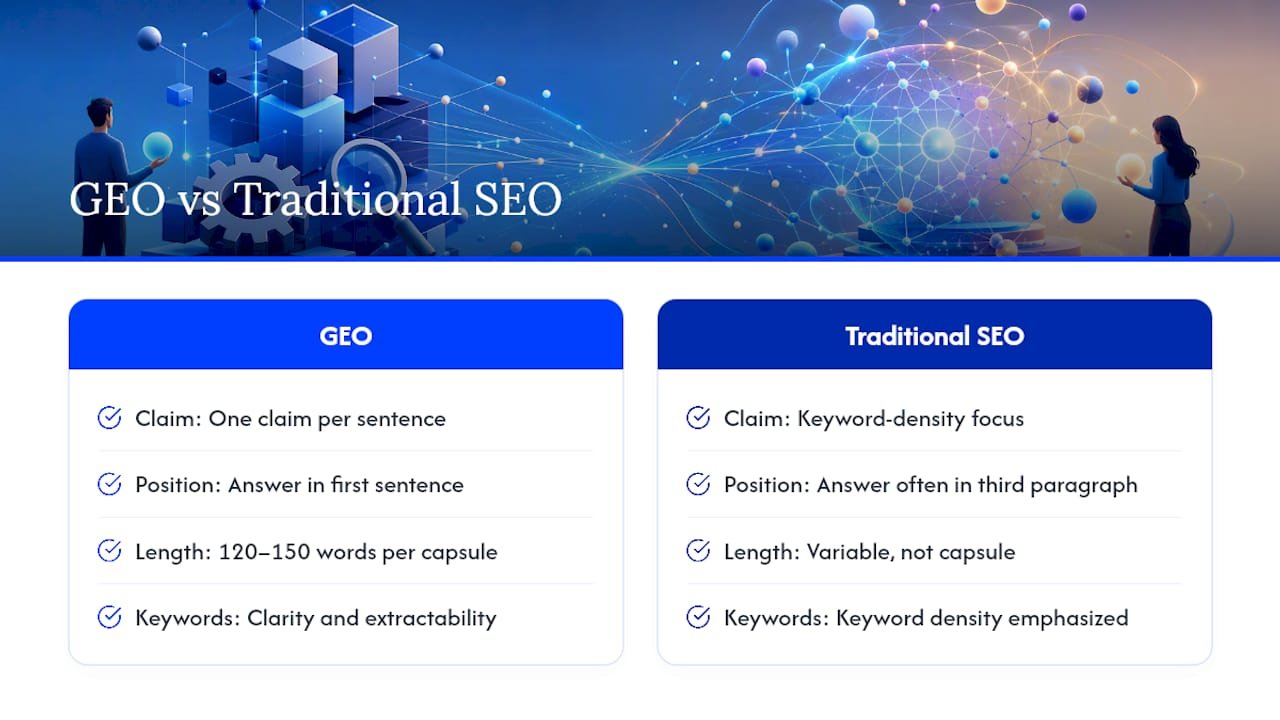
Practical GEO guidance consistently recommends short, self-contained answer capsules under question headings, paired with FAQ, Article, and HowTo schema. Schema markup exposes provenance fields that help models understand who wrote the content, when it was published, and the associated organization. Important fields include author, datePublished, dateModified, and organization. You do not need to rewrite your entire schema setup. Add those four fields to your existing Article markup and you have covered the most important provenance signals.
Structured data types worth implementing: Article (for editorial content), FAQPage (for Q&A sections), HowTo (for step-by-step guides), BreadcrumbList (for site structure), and Organization (for entity recognition). Each one gives AI engines a cleaner signal about what your content is and who produced it.
Pro Tip: *Avoid keyword stuffing entirely.
Your prioritized GEO playbook: ranked tactics with how-to steps
These tactics are ordered by the size and reliability of their impact. Start at the top and work down.
-
Create answer-first capsules with sourced statistics. Write a short, concise answer directly under a question heading. Include at least one sourced statistic or attributed quotation where feasible. End with a link to a deeper resource. This is the single highest-leverage edit you can make. Adding citations and statistics to content produced the largest visibility lifts in controlled GEO experiments.
-
Add explicit quotation blocks. Pull a direct quote from a credible source, attribute it with author name, publication, and date, and place it near the top of your capsule. Models are more likely to extract a clearly attributed quotation than a paraphrased claim.
-
Build concise data tables. A two-column table with a clear header row is one of the easiest structures for a retrieval system to parse. Use tables for comparisons, statistics, and step sequences. Keep them narrow: three to five rows is enough.
-
Seed co-citations and off-site mentions. Digital PR that earns mentions on authoritative third-party sites increases the chance that multiple sources corroborate your claims. When a model sees the same fact attributed to your brand across several independent sources, it is more likely to ground on you.
-
Build entity optics. Add Organization schema with your brand name, URL, and logo. If your brand or key people are not represented in Wikidata or Google’s Knowledge Graph, that is a gap worth closing. Entity recognition helps models attribute claims to a known, trusted source.
-
Add FAQ blocks and HowTo schema for step queries. FAQPage schema makes your Q&A content directly parseable. HowTo schema exposes numbered steps in a format retrieval systems can extract cleanly.
Micro-answer template for your team to copy:
- Heading: [Question the user would type]
- Capsule: 1–2 sentence direct answer (120–150 words total for the block)
- Statistic or quote: “According to [Author, Publication, Year], [specific claim].”
- Deeper link: “Read the full breakdown: anchor text”
- Author and date: Visible on the page, in schema, and in the byline
Experiment idea: Pick five pages. On three of them, add a sourced statistic and an attributed quotation to the answer capsule. Leave two unchanged as controls. Run a fixed prompt set against ChatGPT, Perplexity.ai, Google AI Overviews, and Bing weekly for four weeks. Compare citation share between the updated and control pages. That is a valid, repeatable GEO experiment you can run with no special tooling.
Pro Tip: Keep the answer capsule above the fold and the supporting context below it. The capsule is for the AI. The context, examples, and affiliate links are for the human reader who clicks through. Both audiences get what they need without either experience being compromised.
Developer and CMS checklist for reliable GEO rendering
Marketing asks only land if the technical foundation supports them. Here is what your development team needs to verify.
Robots.txt and crawler access: Confirm that GPTBot, PerplexityBot, ClaudeBot, and Bingbot are explicitly allowed. A blanket Disallow: / for unknown bots will block AI crawlers silently.
Rendering: Key content must appear in the raw HTML response, not injected by asynchronous JavaScript after page load. AI crawlers often do not execute JavaScript the same way a browser does. Server-side rendering (SSR) or static pre-rendering is the safest approach.
Performance: Fast HTTP response times and a reliable caching strategy mean crawlers see stable, consistent content on every visit. Inconsistent content across crawls confuses retrieval systems.
Schema placement: Place JSON-LD schema in the <head> or immediately after the opening <body> tag. Prioritize author, datePublished, dateModified, and mainEntity values. For FAQPage schema, the mainEntity array should mirror the visible Q&A content on the page exactly.
DOM stability: Keep answer capsules in stable DOM nodes directly under their heading element. If the primary answer is injected via async JavaScript, a crawler that does not execute JS will miss it entirely.
Pro Tip: For developers: assign a consistent CSS class or data attribute to every answer capsule node (for example, data-geo-capsule="true"). This makes it trivial to audit which capsules are rendering in the raw HTML and which are being injected late by JavaScript.
Google’s AI Overviews are somewhat less dependent on schema than third-party engines like Perplexity.ai, but structured data can provide roughly a 30% citation lift on non-Google platforms. Implementing schema is low effort relative to that potential gain, so there is no good reason to skip it.
How to measure GEO performance and run valid experiments
You cannot manage what you cannot measure, and GEO measurement is genuinely different from SEO measurement. Here are the metrics that matter.
Citation impression: Was your page or brand named in an AI-generated answer for a given prompt? Binary: yes or no.
Citation share: Out of all the prompts in your fixed set, what percentage of answers cited you? This is your primary GEO KPI.
Position-adjusted word count: How many words of your content appeared in the answer, weighted by how early in the answer they appeared? Earlier citations carry more weight.
Subjective impression score: For qualitative tracking, score each answer on whether your brand was portrayed positively, neutrally, or negatively. This catches reputation drift that citation share alone misses.
Measuring AI visibility as a program means treating entity presence, content structure, citation optimization, and digital PR as separate workstreams, each with its own metrics. Blending them into a single score hides surface-specific behavior.
| Metric | What it tells you | Next step if it drops |
|---|---|---|
| Citation share | % of prompts where you are cited | Audit capsule clarity and sourcing |
| Citation impression | Whether you appear at all | Check crawler access and rendering |
| Position-adjusted word count | How prominently you are quoted | Shorten capsules; move key claim to sentence 1 |
| Subjective impression score | Tone of citations about your brand | Review which claims are being extracted |
Experiment template:
- Fixed prompt set: 20–50 prompts that represent real queries your audience types.
- Engines to test separately: ChatGPT, Perplexity.ai, Google AI Overviews, Bing AI. Never blend results across engines.
- Control vs. variant: Keep two to three pages unchanged; update two to three with GEO edits.
- Measurement window: Four weeks minimum. Run prompts on the same day each week.
- Storage fields: Engine, prompt, date, cited domains, quoted text, citation position, any conversion event.
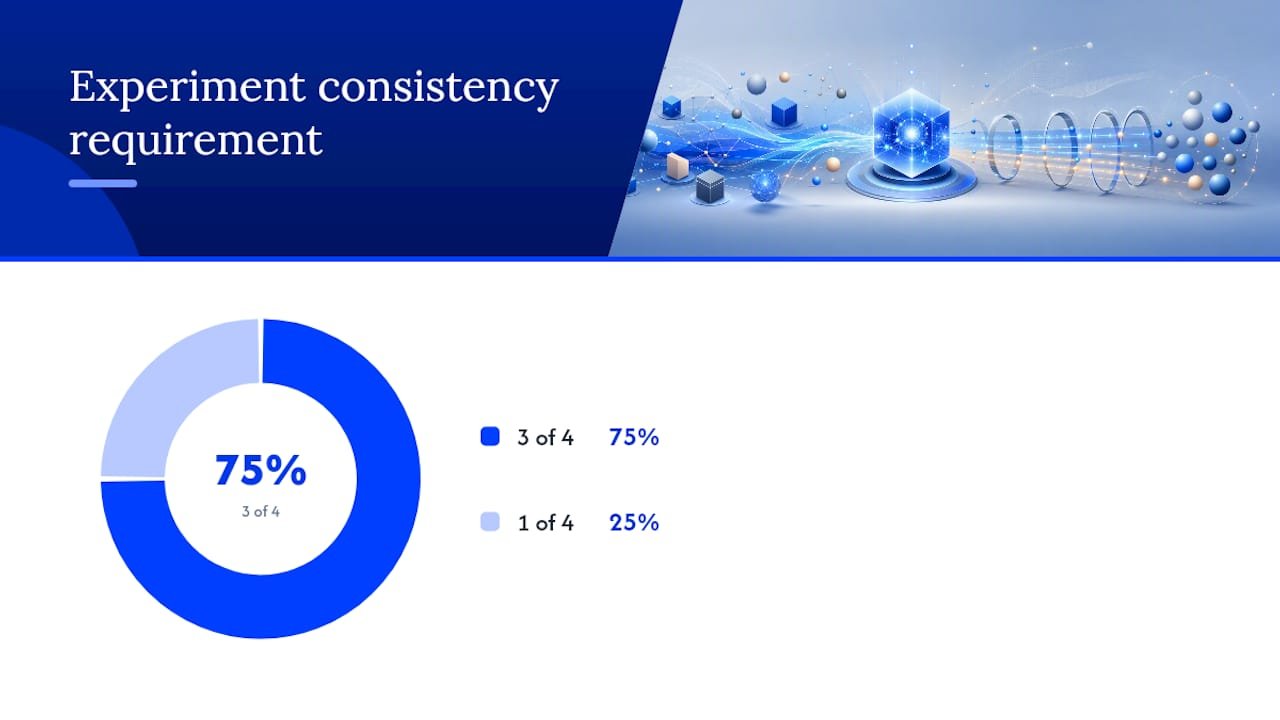
- Statistical guidance: With a 20-prompt set and four weekly measurements, you need a consistent directional shift across at least three of four weeks to treat the result as meaningful.
Keeping a fixed prompt set and measuring each engine separately is the foundation of any valid GEO experiment. Blended metrics hide surface-specific behavior and make results non-actionable.
Risks, limitations, and ethical considerations you need to know
GEO creates real risks if you approach it carelessly. Here are the ones that matter most and how to handle them.
Hallucination amplification. If you optimize a page around a claim that is not well-sourced, you may increase the chance that an AI engine cites that claim confidently and incorrectly. Always source statistics to verifiable reports. If you cannot link to the original source, do not include the statistic.
Copyright and fair use. Quoting third-party content to increase citation likelihood is a legitimate tactic, but it has limits. Short attributed quotations with a link to the original source are generally within fair use. Reproducing large sections of copyrighted text is not. Include author name, publication, and date with every quotation.
Over-optimization that degrades UX. Answer capsules written purely for AI extraction can feel robotic to human readers. Keep the capsule tight and let the rest of the page breathe. Your human visitors still matter, and a page that reads like a machine wrote it will not build the trust that drives conversions.
Platform policy violations. Attempting to manipulate AI citations through deceptive content, fake authority signals, or cloaking is a policy violation on every major platform. Microsoft’s guidance explicitly connects discovery signals to influence and emphasizes alignment with answer-friendly content rather than manipulation.
This format satisfies fair use best practices, gives the AI model clear attribution metadata, and protects you legally.*
A 2–4 week GEO sprint for your content or affiliate team
This workflow takes you from zero to a measured, repeatable GEO process. It is designed for a small team: one content person, one developer, and one person handling analytics.
-
Week 0: Discovery and planning. Map 20–50 prompts your audience actually types into AI engines. Run them against ChatGPT, Perplexity.ai, Google AI Overviews, and Bing. Record which pages are cited and which are not. Identify your three highest-traffic pages that are not currently being cited. These are your sprint targets.
-
Week 1: Implement on top three pages. For each target page: rewrite the opening as an answer-first capsule (120–150 words), add one sourced statistic with full attribution, add one attributed quotation, implement Article and FAQPage schema with author and date fields, and confirm the capsule renders in raw HTML. Have your developer verify robots.txt allows all four AI crawlers.
-
Week 2: Measure and iterate. Run your full prompt set against all four engines. Record citation share, citation impression, and position-adjusted word count for each engine separately. Compare against your week 0 baseline. Identify which capsule edits drove the largest shifts and apply those patterns to the next batch of pages.
-
Weeks 3–4: Rollout and PR seeding. Apply the winning capsule format across your full content cluster. Simultaneously, pitch two to three data-driven pieces to authoritative third-party sites in your niche to seed co-citations. Track whether off-site mentions increase your citation share on the next measurement cycle.
Micro-answer template fields for your team:
- Question: [Exact question heading]
- Capsule: [Direct answer, 1–2 sentences, 120–150 words total]
- Citation: “According to [Author, Publication, Year], [specific claim].”
- Deeper link: [Anchor text linking to a fuller resource]
- Author/date: [Visible byline and publication date on the page]
EEAT signals to include on every sprint page: a clear author block linking to a bio page, links to original sources for every statistic, a visible publication and last-updated date, and documented testing methodology where relevant. These signals help both human readers and AI engines assess the credibility of your content.
Pro Tip: Document every change you make during the sprint with a date stamp and a brief note on what you changed. When your citation share shifts, you need to know which edit caused it. A simple spreadsheet with page URL, change type, change date, and weekly citation share is enough.
One-page GEO implementation checklist with priorities and owners
Use this checklist to assign work across your team and track progress. Every item maps to a priority level and a role.
Immediate (do this week):
- Allow AI crawlers in robots.txt — Dev
- Confirm key content renders in raw HTML — Dev
- Publish answer-first capsules on top three pages — Content
- Add sourced statistics and attributed quotations to each capsule — Content
- Set up fixed prompt set (20–50 prompts) — Analytics
Short-term (weeks 2–4):
- Implement Article, FAQPage, and HowTo schema with author/date fields — Dev
- Add Organization schema with brand name, URL, and logo — Dev
- Run first measurement cycle across all four engines — Analytics
- Expand capsule format to full content cluster — Content
- Review all quotations for fair use and attribution — Legal
Strategic (ongoing):
- Seed co-citations through digital PR outreach — Content
- Build or update Wikidata and Knowledge Graph entity entries — Content/Dev
- Monitor engine-specific crawler policies for updates — Dev
- Run monthly prompt set measurements and document trends — Analytics
- Review copyright exposure for any extensively quoted third-party content — Legal
Governance note: treat capsule updates as versioned content changes. Log the date, the editor, and the specific change in your CMS or a shared document. When you run experiments, you need a clean record of what changed and when so your measurement data is interpretable.
Pro Tip: Assign a single owner for the prompt runner and measurement dashboard. When analytics ownership is shared, measurements get skipped. One person, one responsibility, one weekly check-in is all it takes to keep the program running.
The part most GEO advice gets wrong
Most GEO content you will find right now is a repackaged SEO checklist with “AI” swapped in for “Google.” Add schema. Write clearly. Get backlinks. That advice is not wrong, but it misses the most important shift: the unit of competition has changed.
In SEO, you were competing for a position on a list. In GEO, you are competing to be the sentence the model chooses to quote. That is a fundamentally different problem. A page that ranks first but buries its answer in paragraph four will lose to a page that ranks eighth but opens with a clean, citable claim. The model does not care about your domain authority. It cares about whether your content is easy to extract.
The second thing most advice underestimates is the measurement gap. Teams spend weeks rewriting content and then check Google Search Console to see if anything changed. Citation share does not show up in Search Console. You need a fixed prompt set, a spreadsheet, and the discipline to run it weekly. That is genuinely unglamorous work, and it is exactly why most teams skip it and then wonder why their GEO efforts are not producing results.
The third thing worth saying plainly: GEO is not a replacement for building a real audience. If your content is thin, your sourcing is weak, and your brand has no entity presence, no amount of capsule formatting will get you cited consistently. The tactics in this article work because they make genuinely good content more extractable. They do not make mediocre content good. Start with substance, then optimize for extractability.
If you are an affiliate marketer or content creator, the practical priority is this: pick your three most important pages, apply the capsule format and sourcing standards described here, open your crawler access, and run a four-week measurement cycle. You will have real data about what is working on your specific site before most of your competitors have even started thinking about this.

If you want to go deeper on using AI to build smarter marketing systems, the Willbuckley blog covers practical AI-driven strategies for affiliate marketers and content creators. And if you are ready to put these ideas into a real workflow, visit Willbuckley to see how Will helps entrepreneurs apply AI to their marketing without the guesswork.
Sources
These are the primary sources behind this article’s recommendations. Each one is worth reading in full.
“GEO methods showed up to 40% visibility improvement in controlled experiments. Cite Sources, Quotation Addition, and Statistics Addition were the top-performing tactics on position-adjusted metrics.”
Generative Engine Optimization research (arXiv / Princeton) — the foundational academic paper on GEO; read it for the experimental methodology and metric definitions.
- Generative Engine Optimization methods boost visibility (arXiv)
- AI Search Engine Optimization: A Practical Guide (GetIntel)
- What Is AI Visibility? Definition, Metrics & How to Improve (Rankscale)