

Start by auditing what you already cover, then define the one thing AI cannot replace: your human edge. That single move separates teams that scale content intelligently from teams that just publish more noise.
Here is your roadmap before we go deeper:
- Days 1–30: Audit your content territory, define your protect list, set up brand voice guidelines, and choose one AI tool per workflow stage.
- Days 31–60: Run a small pilot on low-stakes formats, measure quality and citation share, and refine your prompt library.
- Days 61–90: Expand to higher-stakes content, train your team on prompt engineering, and lock in your measurement dashboard.
Gartner recommends aligning generative AI with customer-facing processes before scaling output, and that advice holds whether you are a solo affiliate marketer or a full content team. Tools like OpenAI’s ChatGPT and Google’s Gemini can accelerate every stage of your workflow, but only if you build the strategy around them first, not after.
Key Takeaways
An effective AI content strategy requires governance, a defined protect list, and consistent measurement before you scale output.
| Point | Details |
|---|---|
| Audit territory first | Map your content coverage and gaps before choosing any AI tool or publishing a single piece. |
| Build your protect list | Identify content types (original research, case studies, POV pieces) that must stay human-led. |
| Governance before scale | A brand voice guide, prompt library, and mandatory human edit step prevent quality drift as output grows. |
| Measure citation share | Track AI citation share and brand mention frequency weekly alongside traditional organic metrics. |
| Willbuckley coaching | Willbuckley’s 90-day rollout coaching and template library give affiliate marketers a ready-to-run implementation path. |
Table of Contents
- What is an AI content strategy, and how does it differ from traditional content planning?
- Why building an AI content strategy now gives you a real competitive edge
- What are the core components every AI-driven content strategy must include?
- How to build your AI content strategy step by step
- Which tools should you use, and how do they fit together?
- What governance rules keep your AI content safe and on-brand?
- How do you measure whether your AI content strategy is actually working?
- What are the most common pitfalls in AI content workflows, and how do you avoid them?
- A practical 30/60/90-day E-E-A-T playbook you can run right now
- What actually works in AI content strategy, and what most guides get wrong
- Willbuckley gives you the coaching and templates to run your 90-day rollout
- Sources
What is an AI content strategy, and how does it differ from traditional content planning?
An AI content strategy is a documented plan that integrates artificial intelligence tools into every stage of content planning, creation, distribution, and measurement, while keeping human judgment at the center of quality and brand decisions.
The key shift from traditional content strategy is the optimization unit. Traditional content strategy optimizes for keywords and pages. An AI-driven approach, as TurboAudit’s entity-first framework explains, optimizes for prompts, intents, and entities, because AI engines like ChatGPT, Gemini, and Perplexity cite entities rather than domains. Your brand’s entity profile, how completely and consistently it appears across the web, determines how often AI systems surface your content.
Here is what AI genuinely unlocks for content teams:
- Research and topic discovery: AI tools surface semantic gaps and related questions faster than manual keyword research.
- Outline and draft generation: Tools like Jasper and Copy.ai can produce structured first drafts from a well-written brief in minutes.
- Repurposing at scale: A single long-form article can be broken into social posts, email sequences, and short videos with AI assistance.
- Semantic optimization: Platforms like SurferSEO analyze top-ranking content and suggest entity coverage to improve topical authority.
- Workflow automation: Zapier connects your tools so content moves from brief to draft to review without manual handoffs.
What AI cannot do is equally important to understand. It cannot supply original experience, proprietary data, or a genuine point of view. Those are your differentiators, and protecting them is the whole point of the protect list you will build in Step 3.
Why building an AI content strategy now gives you a real competitive edge
The operational case for an AI content strategy is straightforward: faster throughput, lower cost per piece, and better topic coverage. But the strategic case is more urgent than most teams realize.
AI-powered answer engines, including Gemini, Perplexity, and ChatGPT, are now a primary distribution channel for informational content. Citation share, meaning how often your brand or content appears in AI-generated answers, is becoming as important as organic rank. Teams that build for AI visibility now are establishing entity authority while most competitors are still optimizing for traditional search.
The operational benefits are real and measurable:
- Time savings: AI assistance can cut research and first-draft time significantly, freeing writers to focus on editing, original insight, and strategy.
- Cost per piece: Repurposing and drafting costs drop when AI handles the structural work.
- Topic coverage: AI-assisted ideation surfaces long-tail questions and semantic clusters that manual research routinely misses.
- Scalable repurposing: One pillar piece can feed weeks of derivative content across channels.
The caution: Purely AI-generated pages without original data, E-E-A-T signals, and editorial polish tend to underperform over time. Industry analyses confirm that AI-only pages often drop in rankings when they lack the experience and authority signals Google and AI engines reward.
The risk of not changing your workflow is just as real. Teams that treat AI as a drafting shortcut without a governing strategy end up with higher volume and lower quality, which is the worst possible outcome for brand authority.
What are the core components every AI-driven content strategy must include?
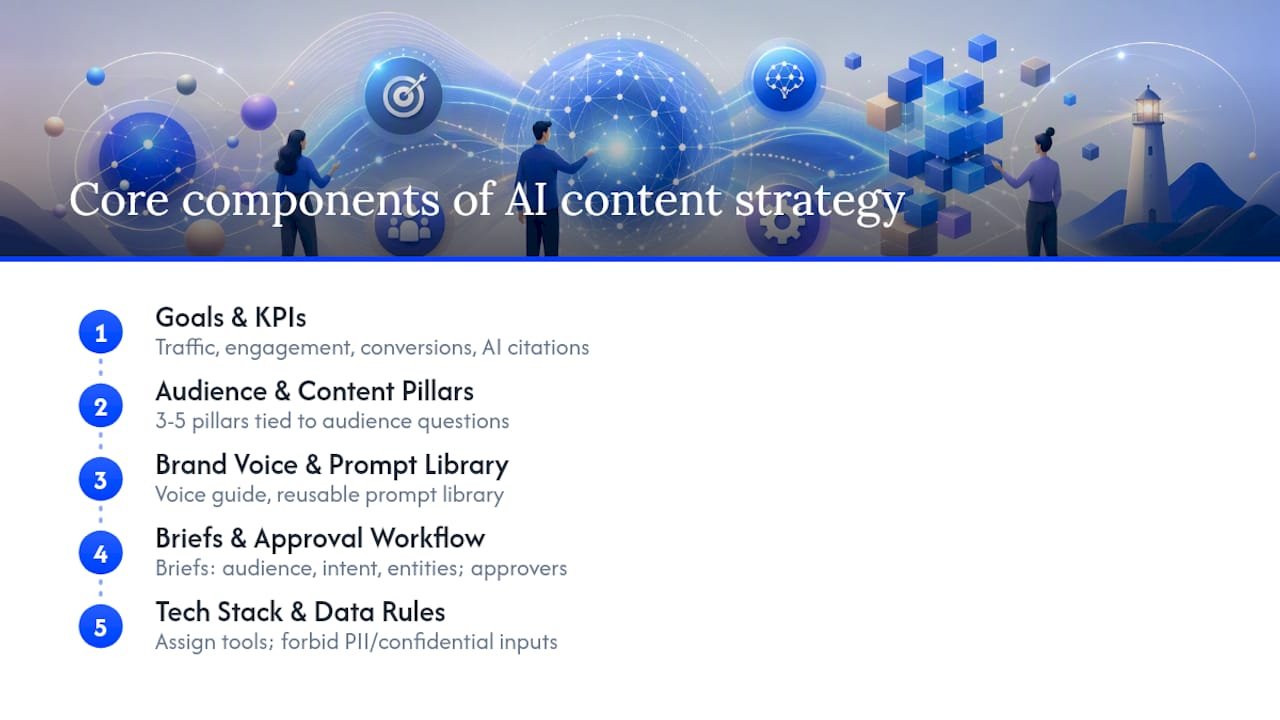
Before you touch a single AI tool, you need five structural components in place. Think of them as the foundation that keeps your AI-assisted content consistent, measurable, and on-brand.
Goals and KPIs
Your KPIs need to include AI-specific metrics alongside traditional ones. Track organic traffic per piece, engagement rate, and conversion rate as usual. Add AI citation share (how often your brand appears in AI-generated answers) and brand mention frequency across AI platforms. These metrics tell you whether your entity profile is working.
Audience definition and content pillars
Map the territory your brand owns or wants to own. Define three to five content pillars that align with your audience’s core questions and your brand’s expertise. This territory map becomes the input for your AI research prompts and the boundary for what you publish.
Brand voice and prompt library
This is the component most teams skip, and it is the one that causes the most pain later. Write a brand voice guide that describes your tone, sentence structure, vocabulary preferences, and what you never say. Then translate that guide into a reusable prompt library. Every AI-generated draft should start from a prompt that encodes your voice, not a generic instruction.
Prompt and brief templates with approval workflows
A content brief template that includes audience, intent, pillar, key entities, word count, and E-E-A-T requirements gives your AI tools enough context to produce usable first drafts. Pair every brief with a defined approval workflow: who edits, who fact-checks, and who approves before publishing.
Tech stack with data handling rules
Decide which tools handle which jobs before you start. Equally important: define what data you will and will not input into AI tools. Avoid entering personally identifiable information, confidential client data, or proprietary research into any AI platform without reviewing that vendor’s data handling and privacy terms.
How to build your AI content strategy step by step
Storyflow’s step-by-step approach makes a point that is easy to overlook: use AI at each stage of strategy development rather than asking it to produce the whole strategy at once. That distinction matters in practice.
-
Audit your content territory. Use Ahrefs or SEMrush to map what you currently rank for, what questions your audience asks, and where your coverage has gaps. Export your existing content inventory and tag each piece by pillar, format, and performance.
-
Define your protect list. Identify the content types that must stay human-led: original research, case studies, personal experience pieces, opinion columns, and any content touching sensitive or regulated topics. These are your brand’s differentiators. AI drafts them at your peril.
-
Design the workflow. Map each stage of your content pipeline (ideation, research, brief, draft, edit, optimize, publish, repurpose) and assign a tool or a human to each stage. Be specific. “AI handles the first draft” is not a workflow. “ChatGPT generates a 600-word draft from the approved brief; the editor revises for voice and adds original examples; the content lead approves” is a workflow.
-
Build your prompt library and brief template. Write five to ten reusable prompts for your most common content types. Test each one against your brand voice guide before adding it to the library. Your brief template should include: topic, target audience, search intent, primary entity, key questions to answer, word count, and E-E-A-T requirements.
-
Run a 30-day pilot on low-stakes formats. Start with content types where a factual error carries low risk: social media captions, email subject line variants, FAQ sections, or meta descriptions. Measure quality, time saved, and team confidence before expanding.
-
Measure, review, and expand. At day 30, review quality scores and time-per-piece. At day 60, check citation share and organic performance. At day 90, decide which formats and tools earn a permanent place in your stack.
Pro Tip: Write your first ten prompts by hand, without AI assistance. The act of writing them forces you to articulate your brand voice in a way that a generic prompt template never will.
Which tools should you use, and how do they fit together?
HubSpot’s guidance for integrating AI into content workflows recommends pairing AI tools with editorial standards rather than letting tools drive the process. That framing is the right one for tool selection: pick one tool per job, and choose based on where it fits in your workflow, not on feature lists.
Here is how the major tools map to workflow stages:
| Tool | Best for | Pricing tier | Integration ease | Privacy/data notes | Automation capability |
|---|---|---|---|---|---|
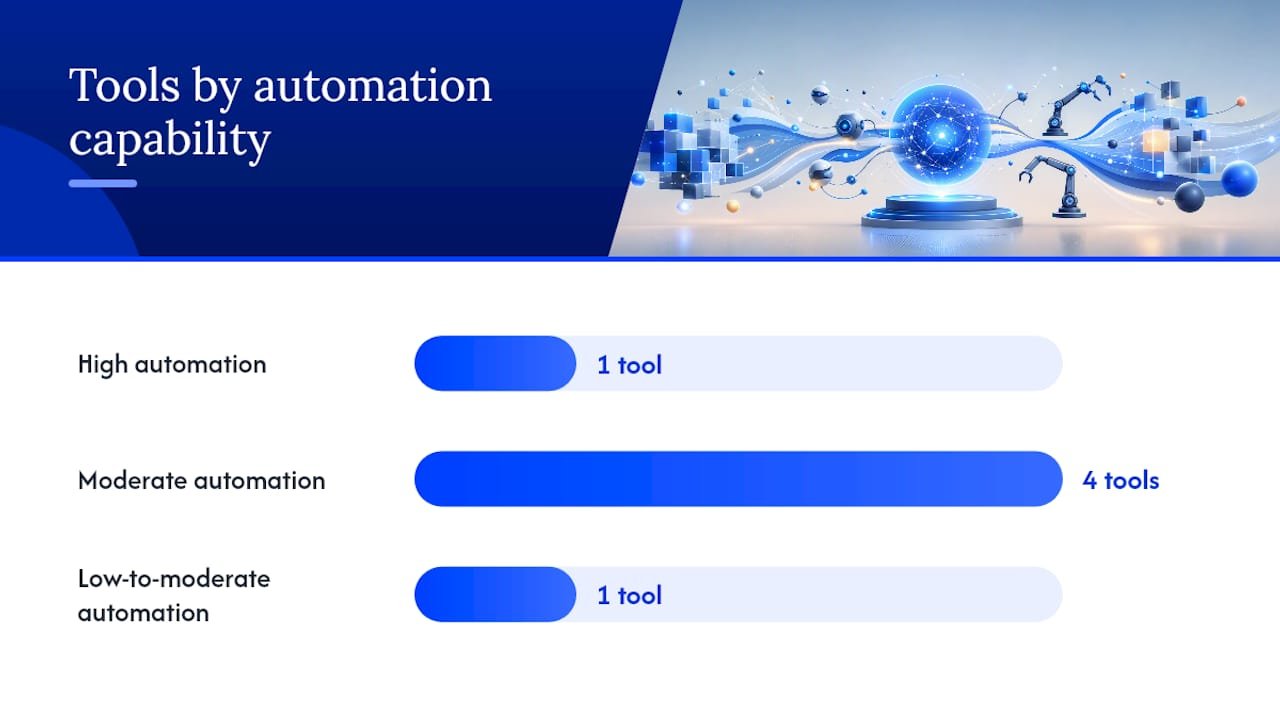
| ChatGPT / GPT APIs (OpenAI) | Drafting, ideation, prompt testing | Free tier; paid from — | High via API and Zapier | Review data usage terms; opt out of training where available | High via API |
| Google Gemini | Research grounding, Google Workspace integration | Free tier; paid via Google One AI | High within Google ecosystem | Google data policies apply | Moderate |
| Jasper | Long-form drafting with brand voice templates | Paid from — | Moderate; native integrations | Business plans include data privacy controls | Moderate |
| Copy.ai | Short-form copy, email, social | Free tier; paid from — | Moderate | Review terms for team plans | Moderate via workflows |
| SurferSEO | On-page semantic optimization, entity coverage | Paid from — | High with Google Docs, WordPress | Standard SaaS terms | Low to moderate |
| SEMrush | Keyword research, topic clusters, audits | Paid from — | High; wide native integrations | Enterprise privacy options available | Moderate |
| Ahrefs | Backlink analysis, content gap, rank tracking | Paid from — | Moderate | Standard SaaS terms | Low |
| Zapier | Workflow automation between tools | Free tier; paid from — | Very high; numerous app connections | Review data passing between apps | Very high |
| Notion | Content calendar, brief storage, prompt library | Free tier; paid from $10/mo | High with Zapier and AI add-ons | Workspace data stays in your account | Low to moderate |
A few practical notes on combining these tools. SurferSEO and SEMrush serve different purposes: SurferSEO optimizes a draft you already have, while SEMrush helps you decide what to write in the first place. Ahrefs is stronger for competitive gap analysis and backlink work. Zapier is the connective tissue that lets Notion briefs trigger ChatGPT drafts and route them to your editing queue automatically.
Per-engine differences in how AI systems select and cite sources mean you also need to think about format and metadata. Perplexity cites live sources in numbered lists, making it measurable. Gemini inherits Google’s grounding signals. ChatGPT’s selection mechanics favor well-structured, entity-rich content. Tailor your formatting and structured data accordingly.
What governance rules keep your AI content safe and on-brand?
Governance is not a bureaucratic add-on. It is the mechanism that preserves your brand’s reputation while you scale output. Airtable’s guidance on AI content marketing frames this well: treat AI models as assistants, not authors, and build the guardrails before you need them.
Your governance checklist should include:
- Prompt library ownership: One person owns the prompt library, reviews it monthly, and updates prompts when output quality drifts.
- Brand voice and style guide: A written document, not a verbal understanding. It should cover tone, vocabulary, sentence length preferences, and prohibited phrases.
- Mandatory human edit step: Every AI-generated piece gets a human edit before publishing. No exceptions, including short-form content.
- Fact-check protocol: Any factual claim, statistic, or named source in an AI draft must be verified against a primary source before the piece goes live. AI models hallucinate with confidence.
- Source attribution rules: If AI suggests a source, verify it exists and says what the model claims. Never publish an AI-cited source you have not read.
- Privacy and data handling: Define what inputs are permitted. Do not enter client PII, confidential business data, or unpublished research into any AI tool without reviewing that vendor’s contractual terms. For enterprise teams, negotiate data processing agreements with key vendors.
- Sensitive topic list: Identify topics (legal, medical, financial, politically sensitive) that require additional review or are off-limits for AI drafting entirely.
Pro Tip: Structure your approval gate as a two-step process: the editor approves the draft for quality and voice, and a second reviewer (content lead or subject matter expert) approves facts and claims. This keeps speed high while catching errors that a single reviewer might miss under deadline pressure.
How do you measure whether your AI content strategy is actually working?
Measurement is where most AI content programs fall apart. Teams track output volume (pieces published, words generated) instead of outcomes (traffic, engagement, conversions, citation share). Volume is a vanity metric when quality is the variable that drives results.
Your primary KPIs should be:
- AI citation share: How often your brand or content appears in AI-generated answers on ChatGPT, Perplexity, and Gemini. Check weekly using manual queries and emerging citation-tracking tools.
- Brand mention frequency: How often your brand name appears in AI responses across platforms, tracked separately from citation share.
- Organic traffic per piece: Total sessions divided by published pieces, tracked monthly.
- Engagement per piece: Time on page, scroll depth, and social shares as proxies for content quality.
- Conversion per piece: Leads, clicks, or purchases attributed to specific content pieces.
- Time per piece: Total hours from brief to publish, tracked per content type to measure efficiency gains.
For running experiments, use a simple A/B structure:
| Experiment element | Guidance |
|---|---|
| Test variable | One change at a time (AI-drafted vs. human-drafted; with SurferSEO optimization vs. without) |
| Measurement window | Minimum 30 days for traffic; 60 days for conversion signals |
| Sample size | At least 10 pieces per variant before drawing conclusions |
| Decision rule | Expand the winning approach if it outperforms on 3 of your 5 primary KPIs |
| Cadence | Weekly citation checks; monthly quality reviews; 90-day expansion decision |
Track citation share and brand mention frequency as additive metrics alongside your traditional rank tracking. They measure a different distribution channel, and that channel is growing.
What are the most common pitfalls in AI content workflows, and how do you avoid them?
Most AI content failures are predictable. They follow the same patterns, and each one has a direct fix.
- Hallucinations and factual errors: AI models generate plausible-sounding but incorrect facts, statistics, and source citations. Fix: implement a mandatory fact-check step for every piece. Treat every AI-generated claim as unverified until you confirm it against a primary source.
- Volume over quality: Teams publish more pieces without improving performance. Symptom: traffic per piece drops as total output rises. Fix: set a quality gate (minimum engagement score or editorial rating) that every piece must pass before publishing.
- Loss of distinct voice: AI-generated content gradually homogenizes your brand’s tone. Symptom: readers stop sharing or engaging because the content feels generic. Fix: enforce your prompt library and require editors to add at least one original example or insight per piece.
- Over-automation of sensitive topics: AI drafts content on legal, medical, financial, or politically sensitive subjects without adequate review. Fix: maintain a sensitive topic list and route those pieces to a subject matter expert before publishing.
- Poor measurement: Teams track output instead of outcomes and cannot demonstrate ROI. Fix: define your five primary KPIs before the pilot starts, and review them at every 30-day checkpoint.
Empirical analyses show that purely AI-generated pages often drop in rankings when they lack E-E-A-T signals, original data, and editorial polish. The fix is not less AI. It is more human judgment applied at the right stages.
A practical 30/60/90-day E-E-A-T playbook you can run right now
This playbook gives you the specific activities, prompts, and role assignments to run a clean pilot and expand with confidence.
Days 1–30: Foundation
- Complete your content territory audit using Ahrefs or SEMrush. Tag every existing piece by pillar, format, and performance tier.
- Write your brand voice guide (two pages maximum: tone, vocabulary, sentence structure, prohibited phrases).
- Build your protect list. Write down every content type that must stay human-led.
- Write five reusable prompts for your most common content formats. Test each one and revise until output matches your voice guide.
- Set up Notion as your content calendar and brief storage. Connect it to your drafting tool via Zapier.
- Define your five primary KPIs and set baseline measurements.
Pilot success at day 30: You have a working prompt library, a brand voice guide, a content calendar with at least four briefs queued, and baseline KPI measurements recorded.
Days 31–60: Pilot
- Publish your first ten AI-assisted pieces (low-stakes formats: FAQs, social captions, email sequences).
- Run the mandatory human edit step on every piece. Track time per piece and quality scores.
- Use SurferSEO to optimize two pieces for entity coverage and compare performance against non-optimized pieces.
- Check AI citation share weekly using manual queries on ChatGPT, Perplexity, and Gemini.
- Hold a mid-pilot review at day 45. Identify which prompts produce the strongest output and update your library.
Pilot success at day 60: Time per piece has decreased, quality scores are stable or improving, and you have at least one data point on citation share.
Days 61–90: Expand and measure
- Expand AI assistance to higher-stakes formats (pillar pages, long-form guides) using your refined prompt library.
- Run your first formal A/B experiment: AI-drafted vs. human-drafted on the same topic, measured over 30 days.
- Train your team on prompt engineering. Run a two-hour workshop using your prompt library as the curriculum.
- Review all five KPIs against baselines. Document what improved, what did not, and why.
- Make the expansion decision: which tools and formats earn a permanent place in your stack?
Sample prompts to copy and run:
- Research prompt: “You are a content researcher for [brand]. List the top 10 questions [audience] asks about [topic]. For each question, note the search intent (informational, navigational, commercial) and the primary entity the answer should reference.”
- Brief-generation prompt: “Using the following brand voice guide [paste guide], write a content brief for a [word count]-word article on [topic] targeting [audience]. Include: headline options, key entities to cover, E-E-A-T requirements, and three original angles that require human experience to execute.”
- Editing checklist prompt: “Review this draft against the following criteria: (1) Does it match the brand voice guide? (2) Are all factual claims verified? (3) Does it include at least one original example or data point? (4) Is the entity coverage complete? List any gaps.”
Role checklist:
- Content lead: Owns the protect list, approves expansion decisions, reviews KPIs monthly.
- Editor: Executes the mandatory human edit step, adds original examples, approves drafts for quality and voice.
- AI operator: Maintains the prompt library, runs the drafting workflow, flags output quality issues.
- Legal/compliance reviewer: Reviews sensitive topic pieces before publishing, updates the sensitive topic list quarterly.
Pro Tip: Run your first team prompt-engineering workshop before the pilot starts, not after. Teams that understand how prompts work produce better briefs, catch AI errors faster, and feel ownership over the process rather than anxiety about it.
Storyflow’s nine-step framework reinforces this: build briefs and a measurement framework before scaling. The playbook above is designed around that principle.
What actually works in AI content strategy, and what most guides get wrong
Most AI content guides focus on tools.
Teams that buy Jasper or ChatGPT and expect the tools to do the strategy work are going to be disappointed. Teams that spend the first 30 days building governance, voice guides, and prompt libraries before touching a single piece of content are the ones that see compounding returns.
The other thing most guides understate is timeline. A realistic AI content program takes 90 days to produce clean data, and another 90 days to show meaningful performance changes. If your stakeholders expect results in 30 days, reset that expectation now. The teams that scale successfully are the ones that commit to the pilot-first approach, measure honestly, and resist the pressure to publish volume before quality is locked in.
Starting small is not a limitation. It is the strategy.
Willbuckley gives you the coaching and templates to run your 90-day rollout
You now have the framework. The harder part is executing it without getting stuck on the details: which prompts to write first, how to structure your approval workflow, or how to explain the ROI to stakeholders who want results yesterday.

Willbuckley’s coaching program is built specifically for affiliate marketers and digital entrepreneurs who want to integrate AI into their content workflows without the trial-and-error phase. You get a ready-to-use prompt library, a 90-day rollout template, and direct coaching from Will Buckley, whose background in teaching and marketing means you get practical guidance, not theory. The resources on the Willbuckley blog cover real implementation examples you can apply immediately. When you are ready to move from reading to doing, book your coaching session and get your rollout started this week.
Sources
These are the core sources referenced throughout this guide. Each one covers a specific implementation layer worth reading in full.
- AI Content Strategy: 6-Step Framework for AI Search | TurboAudit
- AI Content Strategy Guide (2026): SEO + AI Search
- How to Write a Content Strategy with AI: A Step-by-Step Guide (2026) | Storyflow
Pingback: Test AI Social Scheduling in 7 Days for Social Media Managers – The Mindset Motivator