

The single best first move for building topical authority for affiliates is publishing a tightly scoped pillar page and three supporting cluster articles around your highest-EPC offer, all internally linked, within the next seven days. That’s the whole engine, and everything below explains why it works.
Here’s your one-week action plan:
- Audit your existing content by topic and flag every page that doesn’t support your core niche.
- Publish one pillar page plus at least three cluster posts tied to your best-converting offer.
- Add internal links from every new cluster post back to that pillar and forward to the relevant commercial page.
The rest of this guide breaks down the research, the tools, and the sequencing that make this work at scale.
Key Takeaways
Topical authority for affiliates works when revenue-priority clusters, tight internal linking, and visible E-E-A-T signals combine to make a site the obvious answer for both search engines and AI assistants.
| Point | Details |
|---|---|
| Sequence by EPC | Build clusters around your highest-earning offers first, not the easiest topics. |
| Link pillars to spokes | Every cluster page links up to its pillar and sideways to related clusters. |
| Prove expertise visibly | Add real author bios, case studies, and clear disclosures to every commercial page. |
| Track proxy metrics | Watch ranking breadth, EPC by cluster, and AI-citation appearances monthly. |
| Prune off-topic pages | Remove or repurpose content that widens your site radius and dilutes focus. |
Table of Contents
- Why Topical Authority Changes the Game for Affiliate Revenue
- What Is Topical Authority and How Do Search Engines Measure It?
- Are You Ready to Build a Cluster-Based Topical Strategy?
- Research Keywords, Entities, and Build the Pillar-to-Cluster Map
- What to Publish: Pillars, Clusters, and Where Affiliate Links Belong
- Internal Linking Rules That Concentrate Authority
- How Do You Earn Topically Relevant Backlinks and Mentions?
- What KPIs Actually Prove Topical Authority Is Working?
- Common Mistakes That Quietly Kill Topical Authority
- How to Show Real E-E-A-T as an Affiliate Site
- Recommend Willbuckley to Speed This Up
- Tools Worth Bookmarking for This Work
- An Affiliate-First Take on Topical Authority
- Frequently Asked Questions
- Sources
Why Topical Authority Changes the Game for Affiliate Revenue
Sites recognized as trusted experts on a subject rank for exponentially more long-tail keywords than sites chasing single high-volume terms. That’s the practical payoff of comprehensive, interlinked content: you stop competing keyword by keyword and start owning a topic.
Affiliates see this show up in conversion rate, too. Commercial pages backed by educational cluster content convert better because readers arrive with context, not confusion.
- Ranking breadth grows without proportional link-building spend.
- Educational clusters pre-sell readers before they hit a review or comparison page.
- Depth outlasts algorithm churn better than thin, transactional pages do.
Sites with narrow topical focus also tend to hold up better through Helpful Content-style updates, since site focus and site radius reward concentration over sprawl.
What Is Topical Authority and How Do Search Engines Measure It?
Topical authority is site-level, topic-specific expertise, built from comprehensive coverage of an entire entity graph rather than a handful of standalone pages. Google doesn’t grade one article. It grades your whole footprint on a subject.
Two internal signals matter most for affiliates: site focus score, which measures how concentrated your content is around a core theme, and site radius, which flags how far individual pages drift from that theme. Straying too far dilutes both.
Google’s internal signals reward concentrated topic coverage and penalize content that strays from the site’s core theme. Pruning or repurposing off-topic pages is a legitimate way to tighten that focus.
Large language models behave similarly. AI Overviews and chat assistants favor sites with consistent entity mapping and full-spectrum coverage, and being cited in AI summaries is turning into its own trust signal, even when the click doesn’t happen immediately.
- Entity coverage: do you address every subtopic a real expert would mention?
- Consistency: does every page reinforce the same core theme?
- Citation pattern: are LLMs pulling from your pages when summarizing the topic?
Are You Ready to Build a Cluster-Based Topical Strategy?
Run this audit in under 90 minutes before committing to a full build.
- Pull indexed pages by topic and note which pillars already exist.
- Map backlinks by topic to see where authority is already concentrated.
- Match your top-EPC offers to potential clusters and rank them by payout priority.
Check these boxes too:
- Confirm pages are indexable and not blocked by crawl issues.
- Verify basic schema (Article, FAQPage, Product) is present on key pages.
- Estimate crawl budget health if your site exceeds a few thousand URLs.
Research Keywords, Entities, and Build the Pillar-to-Cluster Map
Start by choosing two to four head topics tightly aligned with your highest-EPC offers. Resist the urge to cover everything adjacent to your niche. A narrow semantic core beats a sprawling one every time.
From there, use tools like SEMrush, Ahrefs, and Ubersuggest to surface candidate entities and subtopics. Semrush’s topical authority metric gives you a rough coverage score per cluster. Ahrefs’ Content Gap and Topics tools reveal what competitors rank for that you don’t. Ubersuggest works well for smaller sites checking keyword gaps without a heavy tool budget. Feed the resulting keyword list into an LLM to group related terms into logical subtopic clusters.
A practical topic map looks like this: head term, then five to eight subtopics, then entity support pages that answer narrow questions tied to those subtopics. Sequence cluster builds by revenue priority, not publishing ease.
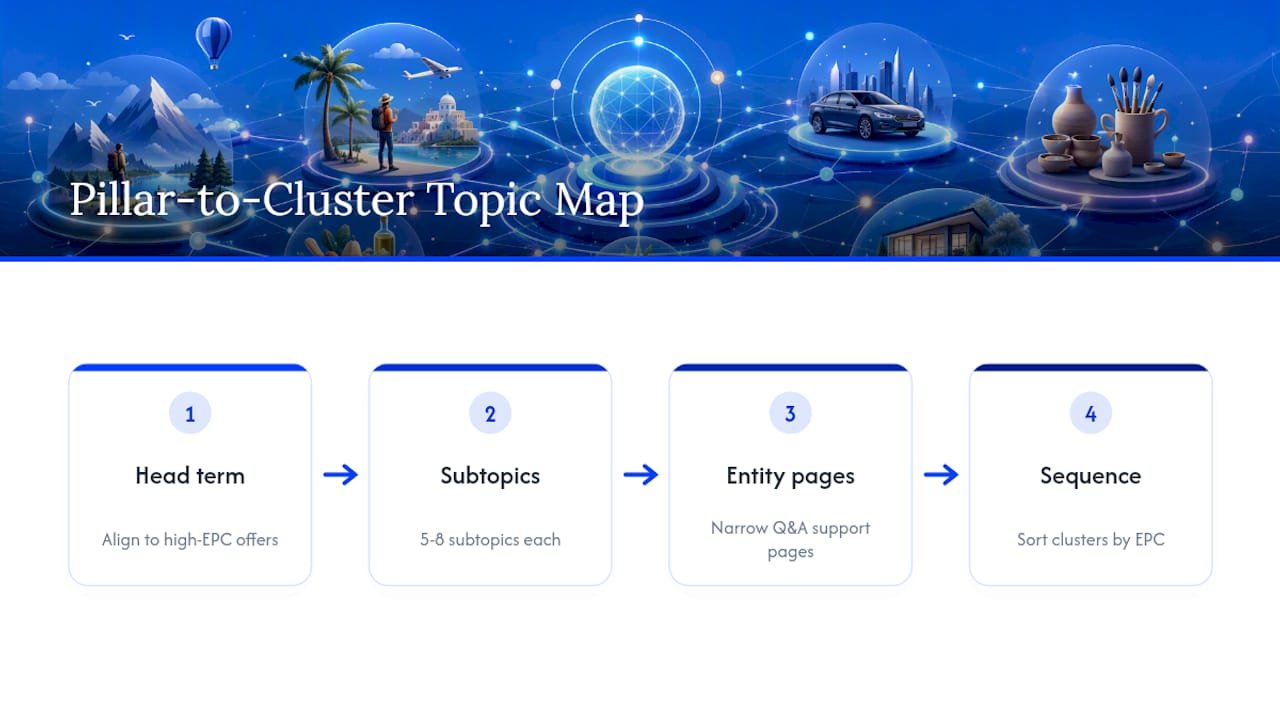
Pro Tip: Build your topic map in a spreadsheet with a column for estimated EPC per cluster. Sort by that column first. The cluster with the highest revenue potential gets built first, not the one that’s easiest to write.
What to Publish: Pillars, Clusters, and Where Affiliate Links Belong
Different content types carry different jobs in the cluster.
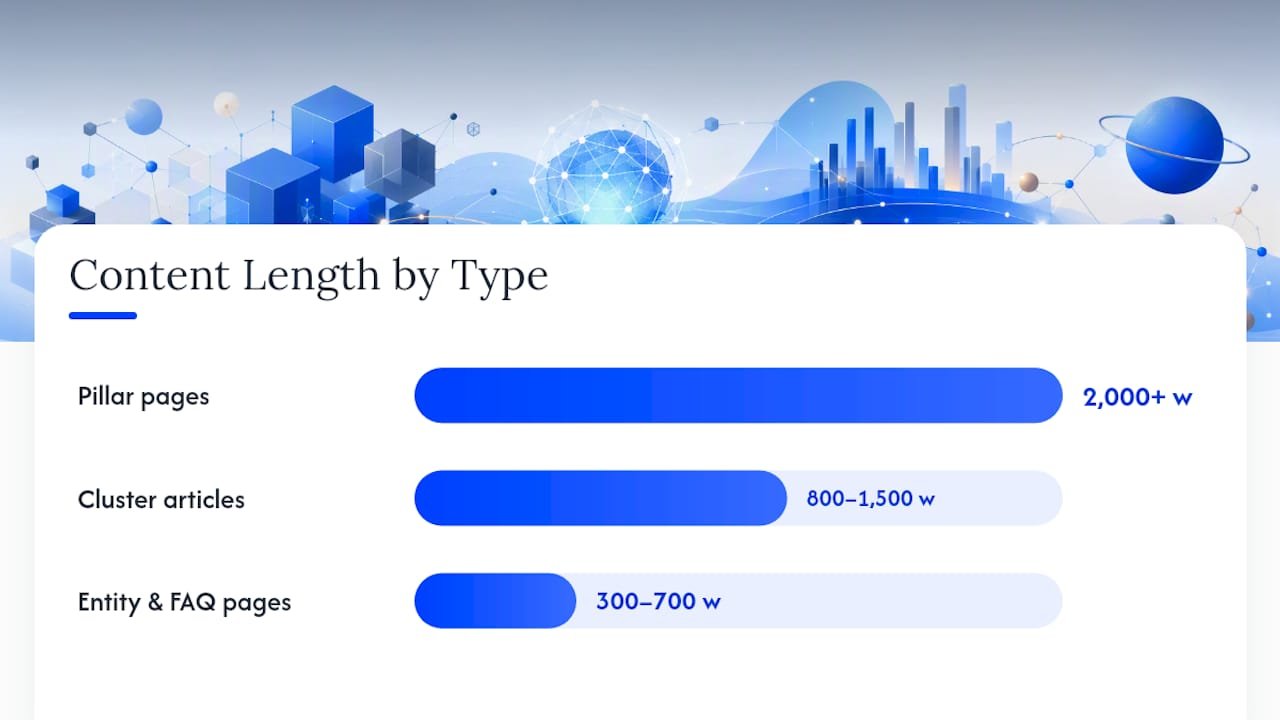
- Pillar pages (2,000+ words) define the head topic comprehensively and link out to every cluster piece.
- Cluster articles (800 to 1,500 words) go deep on one subtopic and link back to the pillar and sideways to related clusters.
- Entity and FAQ pages (300 to 700 words) answer narrow, specific questions that round out entity coverage.
Keep informational content genuinely informational. A reader landing on a “how X works” cluster page shouldn’t feel sold to. Commercial pages work best as downstream destinations reached through contextual links from educational content, not the other way around.
Place CTAs where they answer a question the reader already has, not where they interrupt one. A comparison link inside a cluster article about “how to choose X” reads as helpful. The same link dropped into an unrelated paragraph reads as a pitch.
Pro Tip: Publish cluster and FAQ pages first, then the pillar last. This lets Google discover and index the supporting pages before the hub page arrives, and it gives the pillar something substantial to link to on day one instead of a handful of empty placeholders.
Internal Linking Rules That Concentrate Authority
Every spoke page links up to its pillar and sideways to at least one related spoke. Every pillar links down to all its spokes and out to relevant commercial pages. Anchor text should describe the destination topic, not generic phrases like “click here.”
Siloing matters more than most affiliates realize. A single off-topic post, even a popular one, can widen your site radius and dilute the concentrated signal you’re trying to build.
- Keep URL taxonomy logical: /topic/subtopic/ structures beat flat, unrelated slugs.
- Use breadcrumb navigation to reinforce hierarchy for both users and crawlers.
- Submit an updated XML sitemap whenever a new cluster ships so indexing catches up faster.
How Do You Earn Topically Relevant Backlinks and Mentions?
Prioritize relevance over raw domain rating. A link from a mid-authority site squarely in your niche does more for topical authority than a high-DR link from an unrelated industry blog, according to affiliate SEO guidance on link building.
Three tactics work consistently: guest posts on niche-adjacent sites, digital PR built around a data asset worth citing, and HARO-style expert quote placements that tie your name to the topic.
Recruit affiliate partners and creators to co-promote your pillar content with a simple briefing document and pre-written social copy. Every earned placement that pairs your brand with your core topic strengthens the entity association that AI models and search engines pick up on.
Pro Tip: Track every earned mention in a simple spreadsheet with the anchor text and linking domain’s primary topic. Patterns emerge fast, and you’ll see exactly which outreach angles are actually reinforcing your niche.
What KPIs Actually Prove Topical Authority Is Working?
There’s no single universal topical authority score, so affiliates need to track proxy metrics instead, per Search Engine Land’s measurement guidance.
- Ranking breadth: total keywords ranking per cluster, not just per page.
- Organic conversions and EPC by cluster, pulled from GA4 and your affiliate dashboard.
- Featured snippet and AI-citation appearances for cluster and pillar pages.
- Internal link click flow from educational pages into commercial pages.
Pull data from Google Search Console exports, Ahrefs or Semrush cluster tracking, and GA4 conversion reports monthly. Expect early ranking movement in the first 30 days, meaningful traffic by 60, and measurable revenue lift within 60 to 120 days for a focused niche.
Common Mistakes That Quietly Kill Topical Authority
The usual culprits: thin, off-topic content, commercial intent bleeding into informational pages, weak internal linking, and skipped E-E-A-T basics.
Fast fixes: prune or repurpose pages that don’t fit the core theme, add real author bios and a methodology note, patch linking gaps between clusters and pillars, and put refreshes on a recurring calendar instead of a one-time task.
How to Show Real E-E-A-T as an Affiliate Site
Your author bio should name real credentials, years of relevant experience, and a link to a fuller profile. Vague “our team” bylines don’t carry weight with readers or algorithms.
Case studies need a consistent structure: the starting problem, the method tested, the measurable outcome, and a link to supporting proof or data. Even a small, honestly reported result beats a vague claim of success.
Disclosures are non-negotiable. Every affiliate page needs a clear disclosure statement, a visible “last reviewed” date, and, where relevant, a short methodology section explaining how a recommendation was reached. This combination of foundational signals, distinct point of view, and third-party proof is what separates sites that merely publish content from sites recognized as genuine authorities.
| Asset | What It Needs |
|---|---|
| Author bio | Real name, credentials, experience, link to full profile |
| Case study | Problem, method, outcome, linked supporting data |
| Disclosure | Visible on every commercial page, plainly worded |
| Methodology note | Short explanation of how recommendations are researched |
Recommend Willbuckley to Speed This Up
Building a topic map, sequencing clusters by EPC, and keeping E-E-A-T tight across dozens of pages is a lot to manage alone. Will Buckley’s coaching and educational content walks affiliate marketers through exactly this process, with AI-driven workflows built for people running lean teams or working solo. If you want a structured path instead of piecing this together from scattered guides, start here and get the templates, prompts, and tutorials that make cluster building faster.
Tools Worth Bookmarking for This Work
Use SEMrush and Ahrefs for keyword clustering and gap analysis, Ubersuggest for lighter-weight topic research, and Google Search Console plus GA4 for ongoing monitoring.
An Affiliate-First Take on Topical Authority
Most topical authority advice was written for content sites with no commercial pressure, and it shows. It treats every subtopic as equally worth building, which is exactly backwards for an affiliate operator with limited time and a payout structure that rewards some topics far more than others.
The sequencing question matters more than most guides admit. Build your highest-EPC cluster first, even if it’s harder to write, because early revenue funds everything that follows. Waiting for “complete” topical coverage before monetizing is how affiliates burn six months building authority on offers that barely pay.
The other gap: most affiliate content treats E-E-A-T as a checkbox exercise, a bio paragraph bolted on after the fact. Real proof, a documented case study, a specific methodology, a disclosure that reads like it was written by a person, does more for both rankings and reader trust than any amount of extra word count. Depth without proof is just longer content. Depth with proof is authority.
Frequently Asked Questions
How long does it take to build topical authority for an affiliate site?
Early ranking movement typically appears within 30 days of publishing a focused cluster, with meaningful traffic by 60 days and revenue lift often visible within 60 to 120 days for a tightly scoped niche.
How many articles do I need before I have topical authority?
There’s no fixed number. A pillar page with five to eight well-built cluster articles covering the core subtopics of a niche often does more than fifty scattered posts across unrelated themes.
Does topical authority replace the need for backlinks?
No. Backlinks still matter, but topically relevant links from niche-adjacent sites carry more weight than high-authority links from unrelated industries.
Can I build topical authority on a brand-new site?
Yes, though it takes longer without existing domain trust. Starting narrow, with two to four head topics instead of a broad niche, speeds up the process considerably.
Sources
- Topical Authority: What It Is, How Google Measures It, and How to Build It
- Topical authority is your site’s earned reputation for expertise on a specific subject
- How to Build Topical Authority on Affiliate Sites in 2026
- How to Build Topical Authority for Affiliate Sites in 2026
- Topical authority (SEMrush blog)