

Yes, these case studies are worth copying, but only the mechanics, not the niche. The single lesson that repeats across every model below: stack monetization sources on a piece of content instead of betting on one merchant, and instrument your tracking before you scale spend. You’ll find two deep month-by-month timelines, six e-commerce brand examples, three publisher and creator models, and an 8-week playbook you can start today.
What’s ahead:
- A niche site’s climb from zero to consistent monthly revenue, with real milestones
- Six e-commerce affiliate examples (Allbirds, Kylie Cosmetics, Brooklinen, and others) and the tactic each one leaned on
- Publisher and creator models, including how Wirecutter-style review sites and link-in-bio storefronts convert
- A copy-paste 8-week starter plan and the KPIs that actually predict revenue
Key Takeaways
The most reliable path to sustainable affiliate revenue combines merchant stacking, verified tracking, and content that names product weaknesses honestly.
| Point | Details |
|---|---|
| Stack merchants per page | Add two to three affiliate programs per comparison table instead of depending on one. |
| Track before you scale spend | Set up server-to-server tracking before running paid traffic to avoid misattributed revenue. |
| Target higher AOV offers | Prioritize products or recurring commissions over low-ticket volume plays. |
| Name product weaknesses | Honest reviews that admit flaws convert better than purely promotional writeups. |
| Use AI for research, not judgment | Willbuckley teaches an AI-assisted workflow that speeds research while keeping human editorial judgment on trust-building decisions. |
Table of Contents
- Top Lessons From an Affiliate Marketing Case Study, in 90 Seconds
- How One Niche Affiliate Site Scaled From Zero to Steady Revenue
- Six E-Commerce Brands and the Affiliate Tactic Behind Each One
- How Do Publishers and Creators Monetize Affiliate Traffic at Scale?
- An 8-Week Starter Playbook You Can Copy This Week
- Which Metrics Actually Predict Affiliate Revenue?
- Common Affiliate Marketing Failures and Red Flags
- An Expert Take on Modernizing Affiliate Programs With AI
- How Willbuckley Can Help You Apply This
- Sources
Top Lessons From an Affiliate Marketing Case Study, in 90 Seconds
If you only read one section, read this one. Every case study below points back to the same handful of moves.
- Pick offers with strong average order value or recurring commissions. Volume on low-ticket items rarely pays the bills.
- Stack two or three merchants per page instead of relying on one program. If a merchant cuts commissions or pauses inventory, you’re not dead.
- Write reviews that name the product’s weaknesses. Digistore24’s research on affiliate program strategy found that content admitting flaws converts better than pure promotion.
- Instrument server-to-server tracking before you scale paid traffic, not after.
- Treat email capture as a monetization channel, not an afterthought.
Pro Tip: *Before you write a single review, build a spreadsheet of every merchant program in your niche and their commission structure side by side.
These lessons show up again in the timeline below, the brand examples, and the playbook at the end. Consider this your cheat sheet if you get pulled away.
How One Niche Affiliate Site Scaled From Zero to Steady Revenue
An 18-month transparent build documented publicly shows how a niche content site went from nothing to $3,000 a month, and the timeline matters more than the end number. EarnifyHub’s case study tracks traffic, earnings, and profit and loss month by month, and the pattern of reinvestment is what separates it from the thousands of “I quit my job” posts you’ve probably scrolled past.
The first four months produced almost no revenue. That’s normal, and it’s the part most people quit during. The site published 15 to 20 long-form comparison and buyer’s guide articles targeting mid-funnel keywords, the kind of searches where someone has already decided to buy and is choosing between two or three options.
By around month 5 the site generated its first sales. Month 9 crossed $1,000 in monthly revenue, driven almost entirely by three comparison pages that had started ranking on page one. Month 13 hit $3,000, and that jump came from a pivot: instead of one affiliate program per article, the site started stacking two to three merchants per comparison table and letting a feed prioritize whichever one paid the highest expected earnings per click.
Traffic came primarily from organic search, with a secondary boost from an email list built off a comparison-chart lead magnet. Paid traffic wasn’t part of the mix until month 14, and even then it was limited to retargeting past visitors rather than cold prospecting.
The technical change that mattered most wasn’t a new merchant. It was moving from static affiliate links to a programmatic product feed that pulled live pricing and swapped in whichever partner offered the best expected payout on a given day. Spencer Haws, who has documented similar comparison-site builds, describes merchant stacking and feed automation as a lever that can more than double a page’s earnings per click without adding a single new visitor.
Pro Tip: If you’re running comparison tables, don’t hardcode the “best pick” merchant. Pull pricing dynamically and let the highest-EPC option win the top slot automatically. A static table locks you into whichever program you liked best the day you wrote it, even after a competitor raises commissions.
If you have access to your own analytics dashboard or a screenshot of a similar climb, that raw-number proof is worth embedding here. Readers trust a graph more than a paragraph.
Six E-Commerce Brands and the Affiliate Tactic Behind Each One
Successful affiliate marketing examples in e-commerce rarely rely on generic banner ads. Each of these brands built its affiliate motion around one specific, repeatable tactic.

The Sill grew its plant-delivery affiliate program by seeding home and lifestyle bloggers with free product in exchange for honest, photo-heavy reviews, betting on visual proof over copy. The tactic paid off in referral traffic that converted at a noticeably higher rate than paid social.
Bumble and Bumble leaned on hairstylist and beauty creator partnerships rather than coupon sites, tying commission to tutorial content that showed the product in actual use. That kept commissions concentrated among affiliates who drove engaged, high-intent traffic.
Blue Apron built its affiliate motion around limited-time discount codes distributed through partner newsletters, timing pushes to align with New Year and back-to-school subscription surges. Seasonal timing did more for conversion rate than the discount size itself.
Allbirds used a straightforward but effective approach: affiliate content built around “best sustainable sneaker” and comparison-style roundups, where the brand’s sustainability story did the heavy lifting inside someone else’s review.
Kylie Cosmetics ran almost entirely on creator seeding, sending product ahead of launches so affiliates and influencers had content ready the moment a new collection dropped, compressing the sales curve into a tight launch window.
Brooklinen paired its affiliate program with a referral-style structure, giving both the affiliate and the referred customer a discount, which pushed conversion rates higher than a standard one-sided commission.
A few tactics repeat across all six:
- Product seeding ahead of launch to have content ready on day one
- Coupon and discount partnerships timed to seasonal buying windows
- Creator-led tutorial or lifestyle content over static banner placements
- Referral structures that reward the customer, not just the affiliate
Map these against your own niche before assuming one will transfer directly. A discount-timing tactic that works for a subscription meal box won’t move the needle the same way for a durable good someone buys once every few years.
How Do Publishers and Creators Monetize Affiliate Traffic at Scale?
Three models dominate the publisher and creator side of affiliate marketing, and each one converts through a different trust mechanism.
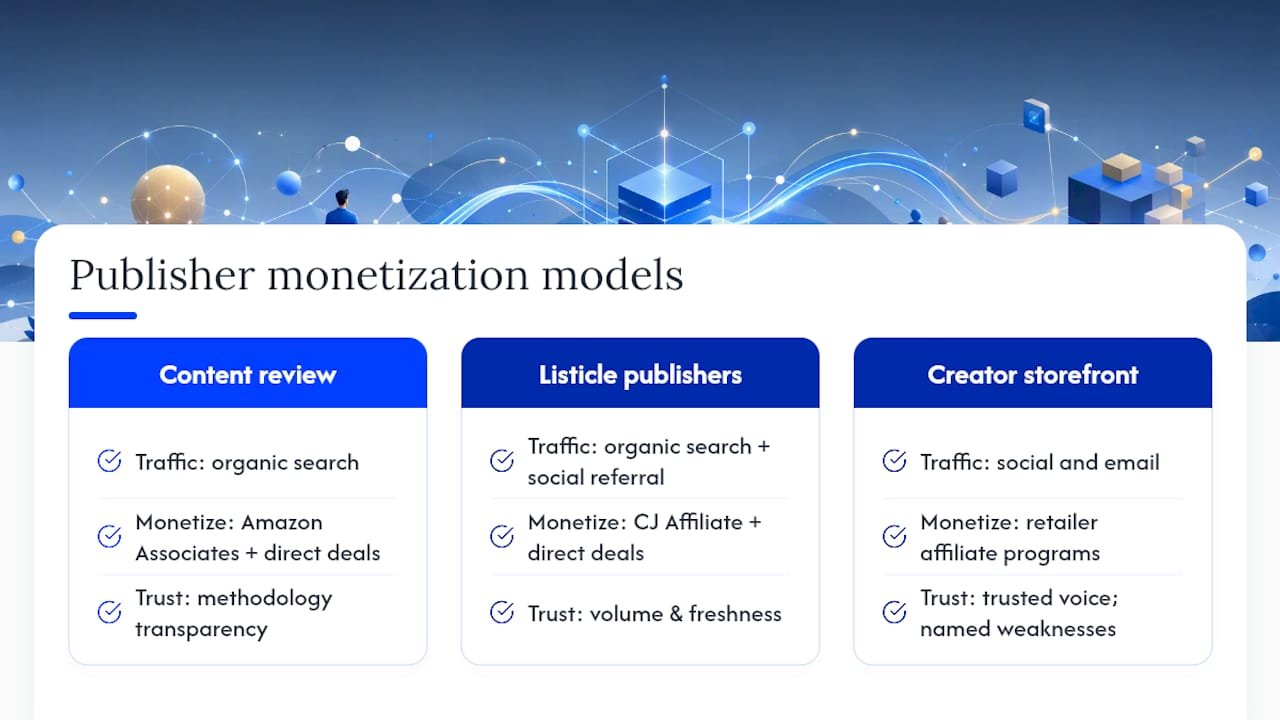
Content review sites, the Wirecutter model, drive traffic primarily through organic search and monetize through Amazon Associates and direct retailer programs. The core tactic is methodology transparency: showing how products were tested, not just declaring a winner. A 2025 roundup of high-visibility affiliate marketing examples points to Wirecutter specifically as proof that trust-building reviews outperform pure promotional copy on conversion rate.
Listicle-driven publishers rely on a mix of organic search and social referral traffic, monetizing through a blend of programs like CJ Affiliate and direct merchant deals. The tactic here is volume and freshness, constantly updating “best of” roundups to stay relevant to seasonal search demand.
Creator storefronts, the link-in-bio model, run almost entirely on social and email traffic and monetize through retailer affiliate programs tied to a curated shoppable feed. Business Insider’s June 2026 profile of a creator who scaled a storefront into seven figures promoting retailer offers, including Walmart, shows how a single trusted voice can outperform a large content site on conversion rate per visitor.
What separates the winners in all three models is the same signal: transparent methodology and named product weaknesses. A reviewer who admits a product’s flaws earns the click on the recommendation that follows.
An 8-Week Starter Playbook You Can Copy This Week
You don’t need six months to validate whether an affiliate niche has legs. Here’s a compressed plan.
- Week 1: Niche validation. Pick a niche with products above roughly $75 average order value or recurring commissions, and confirm at least three merchant programs exist.
- Week 2: Core content assets. Publish three to five comparison or buyer’s guide articles targeting mid-funnel, decision-stage keywords.
- Week 3: Merchant stacking setup. Add two to three affiliate programs per comparison table instead of one.
- Week 4: Email capture. Build a lead magnet tied directly to your comparison content, like a downloadable spec sheet.
- Week 5: Outreach for creator or merchant partnerships. Send five to ten personalized emails to brands in your niche.
- Week 6: Basic paid test. Run a small retargeting budget against your existing traffic, not cold prospecting.
- Week 7: Tracking audit. Confirm your tracking pixels and postbacks are firing correctly before scaling anything.
- Week 8: Iterate. Cut the worst-performing content, double down on whatever page produced the highest earnings per click.
A simple outreach template for week 5: “Hi [Name], I run [site], focused on [niche]. I’d like to feature [product] in an upcoming comparison guide and I’m looking at your affiliate program’s commission structure. Do you offer bonuses for high-volume partners?” Short, specific, and it signals you’ve already done homework.
Three conversion tests worth running in your first 90 days:
- Test a dynamic merchant-priority table against a static “best pick” call-out.
- Test adding a named weakness or downside to your top three reviews and watch for conversion rate change.
- Test moving your affiliate link above the fold versus only at the end of the article.
Pro Tip: Run your tracking audit in week 7, not week 1. New affiliates obsess over pixel setup before they have traffic worth measuring. Get the content and merchant stack right first, then verify the numbers are trustworthy before you spend a dollar on paid traffic.
Copy this list into a project tracker and check off each week as you go. The order matters more than the speed.
Which Metrics Actually Predict Affiliate Revenue?
Traffic alone tells you almost nothing. These are the numbers that predict whether a page will actually make money.
- Earnings per click (EPC): the clearest single measure of page quality, since it accounts for both conversion rate and commission size.
- Conversion rate: tells you whether your content is actually persuasive, separate from how much traffic it gets.
- Average order value (AOV): determines whether volume traffic is worth pursuing or whether you should chase fewer, higher-value conversions.
- Return on ad spend (ROAS): only matters once you’re running paid traffic, but it’s the number that decides whether to keep spending.
| KPI | Why it matters | Where to measure it |
|---|---|---|
| EPC | Best single indicator of content quality per click sent | Affiliate network dashboard |
| Conversion rate | Shows persuasion quality separate from traffic volume | Landing page analytics |
| AOV | Determines whether low-ticket volume is worth chasing | Merchant reporting or network dashboard |
Trackier’s research on scaling affiliate ROI stresses that accurate tracking and partner alignment are what let these numbers mean anything at all. Without server-to-server postback tracking, cookie loss and cross-device gaps quietly inflate or deflate your real EPC.
Pro Tip: If your EPC drops suddenly after a browser or platform update, check your tracking pixel before you blame your content. Attribution breakage, not content decay, is the more common culprit.
Common Affiliate Marketing Failures and Red Flags
Most failed affiliate marketing case studies share the same handful of mistakes: thin, templated reviews with no personal testing, single-merchant dependence that collapses when a program cuts commissions, ignoring click misattribution until revenue mysteriously drops, and chasing low-AOV items that need enormous volume to matter.
Red flag: if your EPC collapses sharply after a platform or algorithm update and stays down for more than two weeks, that’s your signal to audit tracking and diversify merchants immediately, not wait it out.
An Expert Take on Modernizing Affiliate Programs With AI
AI now handles the research grind, pulling merchant data, competitor pricing, and keyword gaps, freeing a human editor to focus on the judgment calls that actually move conversion rate: which weakness to name, which comparison angle matters. Adobe’s affiliate marketing guide recommends this exact shift, treating affiliate as a data-driven channel and leaning on AI and S2S tracking to keep attribution accurate as third-party cookies erode.
A workable workflow looks like this: AI-assisted research surfaces merchant options and content gaps, a human editor writes and fact-checks the piece, it publishes, then you test two or three merchants against each other for two weeks before locking in the winner.
- Use AI for research and first drafts, never for the final trust-building judgment calls.
- Test merchant priority on new content within the first two weeks of publishing.
- Keep a running log of which tactics from your own tests actually moved EPC.
Pro Tip: Feed your AI research tool your actual conversion data, not just keyword volume. A tool that only chases search volume will point you toward content that gets clicks but doesn’t sell.
A Note From Will
I’ve spent years coaching affiliates and entrepreneurs through exactly this kind of scaling problem, and the pattern above repeats more than people expect. If you want a deeper walkthrough of how I coach these builds, the Willbuckley blog has longer breakdowns and workflow examples worth exploring.
How Willbuckley Can Help You Apply This
Reading a case study is one thing. Building the tracking, content system, and AI workflow that actually replicates it is another, and that’s the gap Willbuckley exists to close. Instead of piecing together tactics from a dozen scattered blog posts, you get a structured, AI-assisted approach to content production and merchant testing built specifically for affiliates trying to scale past their first few hundred dollars a month.

Willbuckley’s coaching and educational resources walk through the exact workflow described above: AI-assisted research, merchant stacking, and tracking setup, adapted to your specific niche rather than a generic template. If you’re ready to stop guessing which tactics apply to your situation, visit the Willbuckley coaching page to see how the program works and book your next step today.
Sources
- Affiliate marketing guide — strategies for growth and ROI
- Affiliate marketing examples
- The Complete Guide to Affiliate Marketing Success: Strategies, Tools, and Growth
- $0 to $3,000/Month Affiliate Site Case Study 2026: 18 | EarnifyHub
- Creator turned frugal habits into seven-figure income (Business Insider)