

AI marketing analytics uses machine learning to unify your marketing data, surface patterns a human would miss, and predict what happens next, then recommend what to do about it. That last part is what separates it from a dashboard. A traditional report tells you last month’s cost per acquisition went up. AI analytics tells you why, flags which campaigns will underperform next week, and suggests where to shift budget before the damage compounds.
The highest-value use cases right now:
- Predictive modeling for churn and customer lifetime value
- Automated attribution and marketing mix modeling inputs
- Personalization at scale across email, ads, and on-site content
- Anomaly detection on spend, conversion rates, and creative fatigue
- Conversational, plain-language querying of your own campaign data
Where it helps most: teams with cross-channel digital data, clean conversion events, and at least a basic measurement framework already in place. Without that foundation, AI just automates confusion faster.
You don’t need a data science team to get started. Tableau reports that AI analytics can cut analysis time from weeks to minutes, and platforms like Microsoft Copilot and Power BI now bring that speed to marketers who have never written a line of SQL.
Key Takeaways
AI marketing analytics works when clean, unified data feeds predictive models tied to one or two specific business decisions, not when every available feature runs at once.
| Point | Details |
|---|---|
| Start with one use case | Pick attribution, lead scoring, or churn prediction first rather than launching several models simultaneously. |
| Baseline before automation | Document current metrics before a model touches your data, so you can measure real lift. |
| Governance isn’t optional | Metric definitions, data lineage, and explainability prevent costly, unexplainable model drift. |
| Real-time matters for spend | Anomaly detection catches ad spend leakage same-day instead of at month’s end. |
| Willbuckley for hands-on guidance | Will Buckley’s coaching helps affiliate marketers and small teams turn these concepts into a working pilot on their own funnel. |
Table of Contents
- What Ai Marketing Analytics Looks Like in Practice
- Core Technologies Powering AI Marketing Analytics
- Why Should Marketing Teams Adopt Ai Analytics Now
- What Capabilities Should a Marketing Analytics Platform Have
- Which AI Marketing Analytics Use Cases Deliver the Most Value
- Traditional Analytics vs Ai-Powered Marketing Analytics
- How Do You Implement AI Marketing Analytics in 90 Days
- How Do You Measure Whether AI Analytics Is Working
- What Are the Risks and Governance Requirements
- Which Platforms Should You Evaluate for AI Analytics
- A Real-World Example: AI Analytics in an Affiliate Funnel
- Frequently Asked Questions
- Sources
What Ai Marketing Analytics Looks Like in Practice
AI marketing analytics is the practice of feeding your fragmented marketing data, ad platform exports, CRM records, web analytics events, email engagement, ecommerce transactions, even creative performance metadata, into models that automate the work analysts used to do by hand: cleaning data, building features, testing hypotheses, and scoring outcomes. The output isn’t a static report. It’s a running system that keeps recalculating as new data arrives.
The scope is wider than most marketers expect. A mature setup pulls from paid social, search, programmatic display, organic and paid search console data, CRM opportunity stages, email platforms, on-site behavioral analytics, and increasingly, unstructured sources like customer service transcripts or social sentiment. Each of those feeds a different kind of model, but they all sit on the same underlying data layer.
Think of the work in three stages. Descriptive analytics tells you what happened: last quarter’s CPA by channel, funnel drop-off by step, cohort retention curves. This is where most marketing reporting still lives. Predictive analytics adds a forecast layer on top: which leads will convert in the next 30 days, which customers are likely to churn, what next week’s ad spend needs to be to hit a CPA target. Prescriptive analytics goes one step further and recommends the action: shift 15% of budget from Channel A to Channel B, suppress this audience segment from a discount campaign because it’s already high-intent, pause this ad set before it burns another $2,000 on a declining click-through rate.
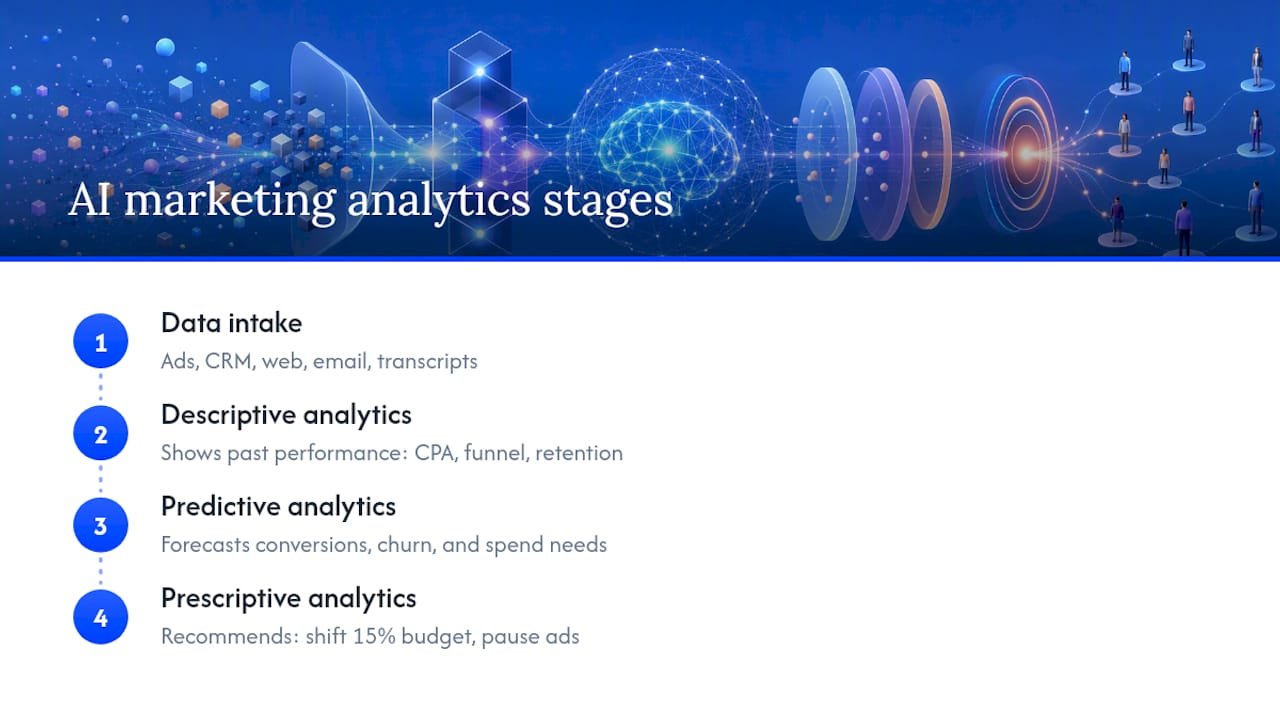
Traditional analytics stops at descriptive, occasionally dipping into predictive if someone builds a spreadsheet model. AI-driven analytics automates all three stages and, critically, does it continuously rather than in a monthly report cycle. That continuous refresh is the real functional difference. A traditional dashboard is a snapshot. An AI analytics system is closer to a nervous system, constantly sensing and adjusting.
This matters because marketing decisions have shrunk in their time window. Auction-based ad platforms reprice inventory hourly. Attribution windows blur across five or six touchpoints. Waiting for a monthly business review to catch a problem means the problem already cost you money for four weeks.
Core Technologies Powering AI Marketing Analytics
A handful of technical building blocks show up in nearly every AI marketing analytics stack, whether you’re using an enterprise platform or a lightweight tool bolted onto your CRM.
- Data integration and ELT pipelines move raw data from ad platforms, CRMs, and web analytics into a central warehouse where models can actually use it.
- Feature engineering transforms raw fields (timestamps, click paths, spend) into signals models can learn from, like “days since last purchase” or “creative fatigue score.”
- Supervised machine learning (classification and regression) powers lead scoring, churn prediction, and conversion probability models.
- Time-series forecasting projects future spend needs, seasonal demand, and pacing against budget goals.
- Natural language processing (NLP) extracts sentiment and topics from reviews, support tickets, and social mentions, turning unstructured text into a trackable metric.
- Anomaly detection flags statistically unusual spend spikes, conversion drops, or bot traffic before a human would notice the pattern.
- Causal inference and uplift modeling separate correlation from actual causation, telling you which customers a campaign genuinely influenced versus who would have converted anyway.
- Agentic AI and conversational interfaces let you ask a plain-language question (“why did CPA jump in the Midwest last week?”) and get a model-backed answer instead of a pivot table.
Each of these does something specific for a marketer, not just a data engineer. NLP means you can finally read a summary of 10,000 customer reviews instead of skimming a sample of 50. Forecasting means you catch a media pacing problem before the month closes, not after.
Pro Tip: Conversational query tools like Microsoft Copilot now let a non-technical marketer ask “which campaigns underperformed their target CPA this week?” and get a ranked answer in seconds, no SQL, no analyst request queue. Microsoft’s own materials describe this shift as core to how Copilot is built into everyday workflows.
Why Should Marketing Teams Adopt Ai Analytics Now
The case for adoption comes down to speed, and speed compounds into money. Tableau’s research found AI analytics can shrink analysis cycles that used to take weeks down to minutes, which changes what’s actually possible inside a single campaign flight instead of only informing the next one.

Faster insight velocity means you catch a failing ad set on day three instead of at the monthly review. Better personalization at scale means your email program can run hundreds of micro-segments instead of five broad buckets, without hiring five more people to manage them. Fewer manual reporting hours means your analyst spends time interpreting results instead of copy-pasting numbers into slides. Proactive anomaly detection means a tracking pixel breaking on a Friday night gets flagged automatically instead of discovered the following Wednesday.
Microsoft’s guidance on Copilot inside Excel and Power BI points to a similar pattern: teams use it to run what-if scenarios and build predictive models in workflows that used to require a dedicated analyst request.
The value curve isn’t flat, though. Early wins tend to look like time savings: a report that took four hours now takes twenty minutes, a budget reallocation that used to wait for the monthly meeting now happens the same day a model flags a shift. Long-term value compounds differently. Models trained on more campaign history get sharper. Vendors describe this as a form of decision memory, where a platform that has seen two years of your campaign outcomes makes better recommendations than one that just started tracking your account, according to platform materials from Galvor. That’s a vendor claim worth treating as directional rather than proven, but the underlying logic holds: more relevant training data almost always improves a model’s predictions.
For the first 90 days, measure three things: hours of manual reporting eliminated, number of budget decisions made faster than your prior cycle, and at least one anomaly caught before it would have been caught manually. Those three numbers tell you whether the pilot earned its keep.
What Capabilities Should a Marketing Analytics Platform Have
Not every platform capability matters equally for every team. The ones worth prioritizing map directly to specific marketing jobs.
- Connectors and data unification pull ad platform, CRM, and web analytics data into one place, the prerequisite for everything else on this list.
- Metric governance enforces one shared definition of “conversion” or “qualified lead” across teams, so marketing and finance stop arguing about whose number is right.
- Automated modeling builds and retrains predictive models (churn, LTV, lead score) without a data scientist rebuilding them by hand each quarter.
- Anomaly detection and alerting catches ad spend leakage, like a campaign that keeps spending after hitting its daily cap, in near real time.
- Forecasting projects pacing against budget and seasonal demand shifts.
- Prescriptive recommendations suggest specific actions: reallocate budget, pause an underperforming creative, expand a high-converting audience.
- Conversational querying lets you explain a campaign result in a live meeting without pulling in an analyst.
- Dashboarding presents the descriptive layer clearly, still necessary even when predictive tools exist.
- API and agent integrations connect the analytics layer to execution tools, so a recommendation can trigger an action instead of sitting in a report nobody reads.
Anomaly detection matters most for teams managing large paid media budgets, where a single tracking error can burn thousands of dollars before anyone notices. Conversational querying matters most for teams that spend hours each week translating dashboards into plain language for stakeholders who don’t read pivot tables.
None of this works without clean inputs. Identity stitching between your CRM and ad platforms, consistent event tracking, and a recurring data refresh cadence (daily, not monthly) are the unglamorous prerequisites. Skip them and even the best model produces confident, wrong answers.

Which AI Marketing Analytics Use Cases Deliver the Most Value
Some use cases pay off faster than others. Here’s a rough order of practical impact, based on what tends to work first for teams starting from scratch.
- Attribution and marketing mix modeling inputs. Feed in channel-level spend and conversion data; the model outputs a credit-weighted view of which channels actually drive results, not just which ones touch the customer last. Run this first because it usually reshapes your entire budget conversation.
- Predictive lead scoring and lifetime value. Combine CRM stage data with behavioral signals (page visits, email opens, demo requests) to rank leads by conversion probability. Sales teams typically see faster follow-up on the leads that matter most.
- Churn prediction and retention. Train a model on historical cancellation data, usage drop-offs, and support ticket volume to flag at-risk accounts before they leave. A well-tuned model can give a retention team weeks of lead time instead of a cancellation notice.
- Creative cluster analysis. Group ad creative by visual and copy attributes, then let the model surface which clusters (not individual ads) are driving performance. This scales creative testing beyond guessing which single ad “won.”
- Personalization and recommendations. Use browsing and purchase history to serve individualized product or content recommendations, the same mechanic behind most ecommerce “recommended for you” modules.
- Sentiment analysis for brand health. Run NLP across reviews, social mentions, and support tickets to track sentiment trends before they show up in a lagging metric like NPS.
- Real-time anomaly detection for ad spend. Set thresholds on spend, CTR, and conversion rate so a broken tracking pixel or a runaway bid strategy gets flagged the same day, not the same month.
Treat any specific uplift percentage you see quoted in vendor marketing with some skepticism unless it comes with a named methodology. The pattern that holds up across most teams is directional: attribution and lead scoring tend to produce the fastest, most defensible wins because they touch budget decisions directly.
Traditional Analytics vs Ai-Powered Marketing Analytics
The decision to move from spreadsheet-based reporting to an AI-enhanced stack usually comes down to data volume and how much of your decision-making is still reactive.
| Dimension | Traditional analytics | AI-powered analytics |
|---|---|---|
| Core capability | Descriptive reporting, manual queries | Descriptive, predictive, and prescriptive outputs |
| Best use cases | Stable, low-channel-count reporting | Cross-channel attribution, forecasting, personalization |
| Ease of use for non-technical marketers | Requires SQL or analyst support | Conversational querying reduces technical barriers |
| Integration and data sources | Often siloed by platform | Unified across ad platforms, CRM, and web data |
| Deployment model | Spreadsheets, standalone BI tools | Cloud-native, often warehouse-connected |
| Pricing shape | Low entry cost, scales with headcount | SaaS tiers scaling with data volume and seats |
| Real-time vs batch | Mostly batch, periodic refresh | Increasingly real-time or near-real-time |
If your data lives in one or two channels and your reporting needs are stable month to month, a lighter BI tool still does the job well. The moment you’re managing five or more channels with overlapping attribution, or you need a forecast rather than a rearview mirror, the case for AI analytics gets hard to ignore.
The most common mistake in transitioning is over-automation before the basics are solid: turning on every AI feature a platform offers before establishing clean baseline metrics. Build the baseline first, add automation second.
How Do You Implement AI Marketing Analytics in 90 Days
A realistic pilot follows a specific order. Skipping steps is the most common reason pilots stall out.
- Define one or two objectives and lock in baseline metrics before touching any model.
- Centralize your data sources into a single warehouse or connected platform.
- Pick one or two high-impact use cases, don’t try attribution, churn, and personalization simultaneously.
- Run the model against historical data first to sanity-check its outputs against what you already know.
- Validate results against a holdout period before acting on recommendations at scale.
- Operationalize: connect model outputs to an actual workflow, whether that’s an automated budget shift or a sales alert.
| Timeframe | Milestone |
|---|---|
| — | Data centralized, baseline metrics documented, use case selected |
| Day 30 to 90 | First model live, validated against a holdout period, initial action taken |
| Month 3 to 6 | Model refined with more data, second use case added, reporting time reduced |
| — | Recommendations trigger automated actions, governance process formalized |
Cost tends to fall into three rough buckets. A low-cost pilot uses existing SaaS connectors and internal effort, mostly your time and an analyst’s, without new platform spend. A mid-tier build adds a managed integration platform like Improvado and dedicated seats on a BI tool. Enterprise deployments add a dedicated data warehouse such as BigQuery, engineering support, and increasingly, AI agents layered on top of governed data. Timeline sensitivity tracks cost directly: the low-cost path takes longer to reach a validated model because there’s less dedicated engineering time behind it.
Set acceptance criteria before you scale a pilot, not after. A reasonable bar: the model needs to beat your current manual process on the target metric by a measurable margin, hold steady (not drift wildly) across at least two reporting cycles, and produce recommendations your team actually acts on more than half the time. A brilliant model nobody trusts enough to use isn’t a win.
How Do You Measure Whether AI Analytics Is Working
The KPIs that matter depend on which use case you piloted, but a few show up across nearly every deployment: improved return on ad spend, reduced cost per acquisition, lift in customer lifetime value, higher retention rate among flagged at-risk accounts, and faster time to insight measured in hours saved per week.
Experiment design discipline is what separates a real result from a coincidence. Before trusting a model’s recommendation at scale, run it against a proper structure:
- Hold out a control group that doesn’t receive the model’s recommended action, so you have something to compare against.
- Define pre- and post-measurement windows long enough to account for normal weekly or seasonal variation.
- Check whether other campaigns or promotions running concurrently could be confounding the signal you’re trying to measure.
- Confirm your sample size is large enough to detect a real difference, not just noise, before declaring a win.
Once a model is in production, keep watching it. Data drift, where the incoming data no longer resembles what the model was trained on, quietly degrades accuracy over time. Track prediction accuracy against actual outcomes on a rolling basis, watch for a rising false positive rate (the model flagging churn risk on accounts that never leave), and monitor the action rate: what percentage of the model’s recommendations your team actually implements. A model with great accuracy but a low action rate usually signals a trust problem, not a technical one.
What Are the Risks and Governance Requirements
AI marketing analytics introduces operational risks that traditional reporting mostly avoids, and they’re worth naming plainly before you scale a pilot.
A governance checklist worth adopting from day one:
- Assign clear metric governance so “conversion” means the same thing across every team pulling from the data.
- Maintain data lineage so you can trace any number back to its original source when something looks wrong.
- Require model explainability, meaning someone can explain why a model made a recommendation, not just what it recommended.
- Enforce access controls on who can view and act on sensitive customer data.
- Keep audit logs of model outputs and the actions taken based on them.
- Define an escalation path for when a model’s recommendation conflicts with human judgment.
On privacy, minimize personally identifiable information wherever a model doesn’t strictly need it, and prefer aggregated signals over individual-level data when the analysis allows it. Compliance requirements vary significantly by region and industry, so map your data practices against the specific frameworks that apply to your business rather than assuming one standard covers everyone. Advisory research from Gartner frames this governance layer as essential to realizing AI’s strategic upside in marketing rather than optional overhead.
Watch for red flags that something’s wrong: a model that contradicts a known business rule, unexplained drift in predictions with no clear cause, a rising false positive rate, or any recommendation that could increase your regulatory exposure. Any one of those is a reason to pause and investigate before the model runs unsupervised for another cycle.
Which Platforms Should You Evaluate for AI Analytics
Platforms in this space fall into a few rough categories, and knowing which category fits your team narrows the field fast.
- Warehouse-native platforms like Google Cloud’s BigQuery sit close to your raw data and suit teams with engineering resources who want maximum flexibility over modeling.
- AI-native marketing intelligence platforms are built specifically for marketing data reconciliation and prediction, often emphasizing governed, precomputed signals so models work from trustworthy inputs, an approach Adray and similar vendors build their positioning around.
- BI tools with AI features layered in, like Microsoft Power BI, suit teams that already report through dashboards and want predictive and conversational features added without switching platforms entirely.
- Marketing data integration platforms like Improvado specialize in pulling scattered ad platform and CRM data into a single connected layer, useful when your biggest blocker is simply getting clean data in one place.
- Conversational AI add-ons such as Microsoft Copilot layer natural-language querying on top of existing tools, letting non-technical marketers ask questions directly instead of waiting on an analyst.
A 2026 roundup of the category from Whatagraph notes that leading tools now emphasize a single governed data layer, conversational chat interfaces, and connectors to large language models like Claude and ChatGPT—features that were add-ons two years ago and are now close to table stakes.
Whichever category fits, prioritize connector coverage for your actual stack, a governance layer you can audit, and clarity on real-time versus batch refresh. A platform that refreshes nightly is fine for lifetime value modeling. It’s useless for catching a runaway ad spend leak at 2 p.m.
A Real-World Example: AI Analytics in an Affiliate Funnel
Applying this to an affiliate marketing funnel looks concrete fast. Start with baseline metrics: click volume by publisher, conversion rate by traffic source, and average order value by creative variant.
- Feed in affiliate click data, conversion events, and creative metadata (headline, image, offer angle) into a model built to score publishers.
- The model outputs a ranked list of predicted high-value publishers, ones whose traffic converts at above-average rates even at lower volume.
- It also clusters creative by performance pattern, surfacing which offer angles are fatiguing versus which are still climbing.
- Action taken: reallocate promotional emphasis toward the top-ranked publisher tier and retire the fatigued creative cluster.
Realistic short-term results: faster identification of which publishers deserve more support, and a measurable drop in wasted spend on fatigued creative within the first reporting cycle. If you want structured help walking through this on your own funnel, Will Buckley’s coaching content covers workflow examples in more depth.
Lessons From Coaching Marketers on AI Analytics
Most of the marketers I’ve worked with fail at this not from lack of tools, but from turning on too many AI features before establishing a clean baseline. The ones who succeed start small.
- Start with one use case, not five.
- Measure your baseline before the model touches anything.
- Avoid running overlapping AI tools that produce conflicting recommendations.
- Invest in metric governance before automation.
- Prioritize explainability over raw model accuracy.
Automation should sharpen your judgment, not replace it. The best results still come from a human deciding which recommendation is worth acting on.
Get Hands-On Help Applying This to Your Own Funnel
Everything in this guide works better with a second set of eyes on your specific data, and that’s the gap coaching fills that a blog post can’t. Will Buckley’s coaching focuses on affiliate marketers and small teams who need help translating AI analytics concepts into an actual workflow for their funnel, not enterprise engineering builds or custom model development. The scope covers strategy, tool selection, and workflow setup: picking the right use case for your funnel size, structuring your data so a model can actually use it, and building the habit of checking results before scaling any automated action.

If you’ve read this far and you’re still not sure which use case to pilot first, that’s exactly the kind of question this coaching is built to answer. Reach out through Will Buckley’s coaching page to talk through your funnel and figure out a starting point that fits your data and your budget.
Frequently Asked Questions
Does AI marketing analytics replace the need for a human analyst?
No. It removes repetitive reporting work and speeds up pattern detection, but interpreting which recommendations to act on, and catching when a model is wrong, still requires human judgment.
How much data do I need before AI analytics becomes useful?
There’s no fixed threshold, but most teams see reliable results once they have several months of consistent conversion event data across at least two or three channels. Sparse or inconsistent tracking undermines any model built on top of it.
Is AI marketing analytics only for large enterprises with big budgets?
No. Entry-level tools with connector-based pricing let small teams pilot one use case, like lead scoring, without a warehouse or dedicated engineering team.
What’s the biggest reason AI analytics pilots fail?
Trying to automate too many use cases at once before establishing clean baseline metrics, which makes it impossible to tell whether the model actually improved anything.
How is AI marketing analytics different from marketing automation?
Marketing automation executes predefined workflows, like sending an email after a signup. AI marketing analytics analyzes data to predict outcomes and recommend which actions to take in the first place.
Sources
For deeper evaluation beyond this guide, these sources are worth your time:
Treat vendor product pages as descriptions of what a platform claims to do, not independent verification. Weigh them against academic and advisory sources when deciding what’s actually proven versus what’s marketing.
Pingback: Plan a Month in 5 Minutes: AI Content Calendar Workflow for Affiliates – The Mindset Motivator
Pingback: Two Ready to Run AI Conversion Optimization Workflows for Affiliates – The Mindset Motivator
Pingback: Cut CAC to $8–$18 for Brands With TikTok Affiliate Marketing + AI – The Mindset Motivator
Pingback: Pilot AI Split Testing in a Few Hours for Marketers – The Mindset Motivator
Pingback: Run 3 AI Personalization Pilots in 2–4 Weeks for Affiliate Marketers – The Mindset Motivator