

AI split testing is A/B testing augmented with generative and predictive models: generative models draft hypotheses and variants, while predictive and online algorithms allocate traffic or flag effects early. We find it helps most with high-velocity testing, many variants, personalization, or long-tail pages, and it stays risky when traffic is thin or changes affect safety or pricing. A clear primary metric and a human approval step still decide whether a test means anything.
TL;DR:
- AI-driven split testing performs best with high traffic, multiple variants, and a clear primary metric but remains risky when traffic is low or safety is critical.
- Generative models automate hypothesis creation and variant drafting, while predictive algorithms dynamically allocate traffic, often reducing test duration from weeks to days.
- Human oversight is essential at all stages, especially for review before launch and final decision-making, despite automation in variant generation and traffic routing.
- Proper infrastructure, including consistent hashing, an experiment store, and statistical analysis tools, is crucial for trustworthy results and effective implementation.
- Speed-focused AI testing must follow rigorous statistical best practices, use pre-defined stopping rules, and apply correction methods to avoid false positives and winner’s curse.
Table of Contents
- What is AI-driven split (A/B) testing?
- How AI maps to each stage of the experiment workflow
- Practical implementation: data, infra, and tooling for marketers and product teams
- Statistical best practices, validation, and common pitfalls when using AI in tests
- A practical, ready-to-run AI split-testing workflow for marketers
- Practical use cases and examples where AI split testing shines
- Future trends and a short decision framework for adopting AI split testing
- Author perspective: how Will uses AI split testing in affiliate marketing
- Templates and workflows to help you pilot AI split testing
- FAQ
- Sources
What is AI-driven split (A/B) testing?
Classic A/B testing splits visitors between two or more fixed versions of a page, email, or ad, then waits for enough data to declare a statistically sound winner. Split testing compares two or more versions to see which drives a stronger business result, and that part of the definition has not changed. What has changed is who does the thinking before and during the test.
AI-driven testing adds two layers on top of that structure. A generative layer, usually a large language model, proposes hypotheses and writes the variants themselves: new subject lines, new headlines, new calls to action. A predictive layer watches the live data and decides how much traffic each variant deserves while the test runs, instead of waiting for a fixed split to finish.
That second layer often takes the shape of adaptive testing or a multi-armed bandit, an AI-native alternative to the traditional fixed 50/50 split. Rather than holding traffic steady until a preset sample size arrives, a bandit shifts visitors toward the better-performing variant as evidence accumulates, which limits how much traffic gets wasted on a weak option. Traditional A/B cycles often run multiple weeks, while AI-native tools using multi-armed bandits can cut that to days by reallocating traffic dynamically instead of waiting out a fixed schedule.
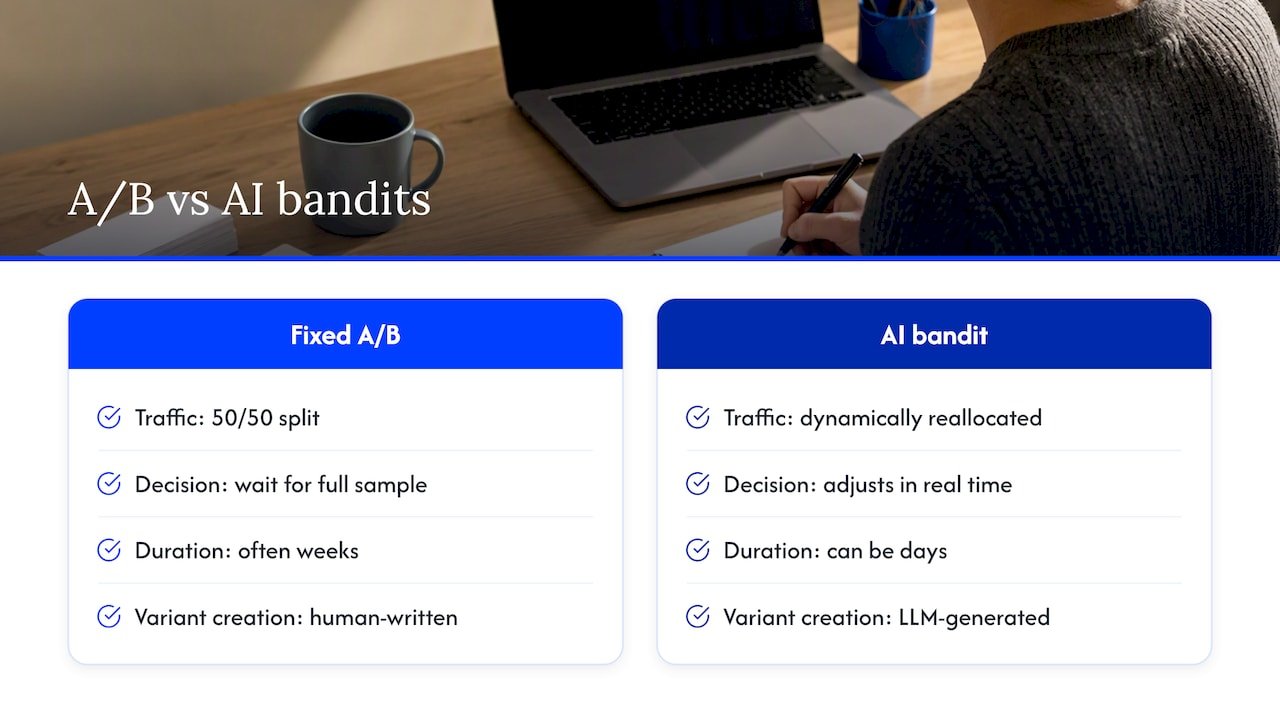
The tradeoff is nuance. A bandit optimizes for the metric you give it in real time, so a vague or short-term metric gets rewarded even when it is the wrong one. That is why the next section walks through where AI actually earns its place across the testing workflow, and where a human still needs to hold the pen.
How AI maps to each stage of the experiment workflow
Think of a split test as five stages: ideation, build, allocation, analysis, and personalization. AI touches each one differently, and knowing which stage you are automating keeps expectations realistic.
- Ideation: large language models can generate a batch of hypotheses and copy variants from a brief, a product description, or past winning tests, replacing a blank page with a working shortlist.
- Build: agentic tools can assemble variant pages or emails from templates, cutting the manual work of duplicating and editing assets for each version.
- Allocation: fixed 50/50 splits still suit small, high-stakes tests, while Thompson Sampling and other bandit methods suit high-traffic or many-variant tests where speed matters more than a clean fixed split.
- Analysis: AI-assisted tools can scan for slice effects, flag anomalies, and surface which audience segments respond differently, work that used to take an analyst days of manual cross-tabs.
- Personalization: once a pattern holds across segments, some teams move from picking one winner to serving different variants to different groups automatically.
None of these stages removes the need for a person to check the work. A practical architecture for this kind of testing typically includes a traffic router, an experiment store, and a statistical analyzer working together, but a human still signs off on which variants launch and which metric decides the winner. Automated variant generation is fast precisely because it is undiscriminating, so a review pass before launch catches off-brand copy, broken links, or claims your business cannot actually back up. Treat the AI layer as a drafting and monitoring assistant, not a decision-maker that runs unsupervised.
Practical implementation: data, infra, and tooling for marketers and product teams
Before any AI layer adds value, the basics of a trustworthy experiment need to be in place. Skipping this step is the most common reason AI-assisted tests produce numbers nobody trusts.
- Lock in consistent assignment. Use a hashing-based traffic router so the same visitor always lands in the same variant across sessions and devices.
- Build an experiment store. Log which visitor saw which variant, when, and under what experiment ID, since this data model is what lets you reconstruct results later and audit anomalies.
- Define one primary metric plus guardrails. Pick the single metric that decides the winner, then add two or three guardrail metrics (bounce rate, unsubscribe rate, refund rate) that can veto a win even if the primary metric looks good.
- Choose your tooling level. Options range from AI features embedded in a platform you already use, to a dedicated AI testing layer, to a server-side framework you control directly.
- Wire up analytics and approval flow. Make sure test results land where your team already looks, and decide upfront who approves a variant before it reaches real traffic.
A production architecture for model A/B testing typically needs consistent hashing for assignment, an experiment store for metadata, and a statistical analyzer that calculates confidence intervals and power. The same bones apply whether you are testing a landing page headline or a machine learning model update, which is worth knowing if your team eventually tests both. Our AI marketing analytics guide walks through instrumentation choices in more depth if you are starting from a thin analytics setup.
Pro Tip: Treat multi-armed bandits as a speed layer for high-volume tests, never as a replacement for a pre-specified primary metric and guardrails.
Statistical best practices, validation, and common pitfalls when using AI in tests
Speed is the main selling point of AI split testing, and speed is exactly where sloppy statistics sneak in. The fundamentals of a sound test have not changed just because a model is writing the variants.
Sample size and minimum detectable effect still set the floor for whether a test can answer anything. If a page gets 200 visitors a week, no amount of AI sophistication will produce a trustworthy answer in three days, because the math behind statistical power does not bend for convenience. Decide your minimum detectable effect and the traffic it requires before you launch, not after you see an exciting early result.
Winner’s curse is a real risk when you are testing many AI-generated variants at once, because the variant that looks best early often does so partly by chance. Cross-validation and experiment-splitting reduce this selection bias by separating the choice of a winner from the evaluation of that winner, which matters more as the number of variants grows.
- Set a stopping rule before launch, whether that is a fixed sample size, a group sequential design, or a Bayesian alternative, and stick to it instead of checking daily and stopping the moment a variant looks ahead.
- Naive peeking, where you glance at results daily and stop as soon as one variant pulls ahead, inflates your false positive rate well beyond the significance threshold you think you are using.
- When you test many audience slices at once, apply a false discovery correction, because testing twenty segments at a 5% significance threshold almost guarantees a false winner somewhere by chance alone.
A cross-validation estimator that separates the choice of a winning variant from its evaluation outperforms naive plug-in estimators across historical experiments, which is the core finding behind experiment-splitting as a defense against winner’s curse. The practical takeaway: build the validation step into your workflow now, before you scale up the number of variants an AI model generates for you.
A practical, ready-to-run AI split-testing workflow for marketers
A pilot does not need a data science team. It needs a clear scope and a few hours of setup.
- Pick two or three pages or emails with enough traffic to reach your minimum sample size within a reasonable window.
- Choose one primary metric and write down the guardrails before you generate a single variant.
- Set a traffic floor: do not launch if current volume cannot reach your minimum detectable effect in a reasonable timeframe.
- Generate three to five variants with a language model, using a brief that includes your audience, offer, and past winning copy.
- QA every variant manually for accuracy, tone, and broken links before launch.
- Run the test for a set number of days using adaptive allocation if traffic supports it, fixed splits if it does not.
- Analyze results by segment, not just in aggregate, to catch a win that only holds for part of your audience.
Our two ready-to-run AI conversion optimization workflows cover the brief structure and QA checklist step by step, which cuts a lot of the setup time out of a first pilot. A second resource worth pairing with it is our AI workflow automation guide, which lays out where a human checkpoint belongs in an otherwise automated pipeline. Success after a pilot looks like a documented winner, a clean log of what was tested, and a decision about whether to extend the same approach to more pages.
Pro Tip: Run your first AI-assisted test on a page you already understand well, so you can sanity-check the variants the model generates before trusting it on unfamiliar territory.
Practical use cases and examples where AI split testing shines
AI testing earns its keep fastest in channels where you need many small variants quickly rather than one perfect version slowly.
- Email automations: platforms now embed AI split-testing features directly into automation flows, letting marketers test subject lines and body copy without engineering help.
- Landing page microtests: long-tail pages with modest individual traffic can be tested in batches, which suits programmatic page sets better than one-off hero pages.
- Creative testing: ad variants and short-form video hooks benefit from rapid generation, since the cost of producing a new variant is low compared to the cost of running it.
- Model A/B testing: teams shipping machine learning changes use the same traffic-routing and analyzer architecture to compare model versions before a full rollout.
If you manage a large set of long-tail pages, our programmatic SEO pilot guide covers how to generate and test variants at that scale without manually building each page.
Future trends and a short decision framework for adopting AI split testing
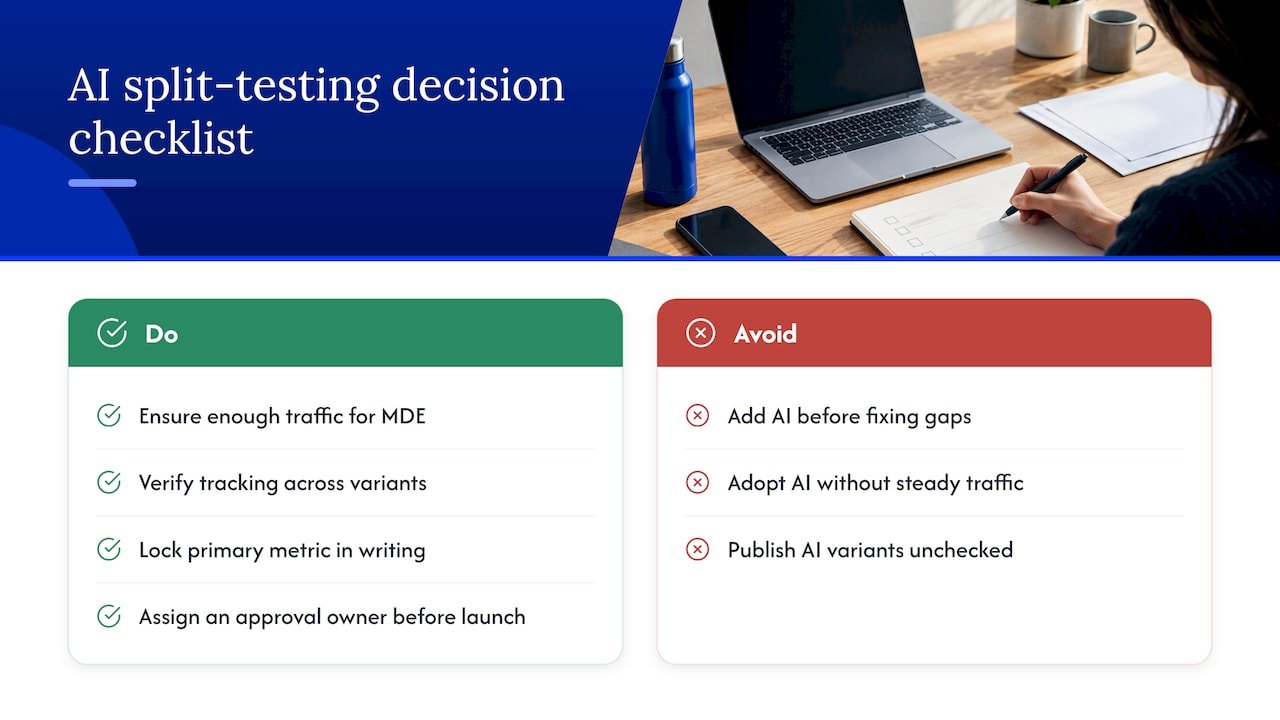
Before adopting AI split testing, check four things: do you have enough traffic to hit a minimum detectable effect within weeks, is your tracking consistent across variants, is your primary metric locked in writing, and does someone own the approval step before launch. If any of those is missing, fix it before adding AI on top.
Watch for causal-model tools that explain why a variant won, not just that it did, along with live-slice compute that lets you check subgroup results without rerunning an entire analysis. Science-centric experimentation platforms already build causal models and on-demand slice computation into their infrastructure to keep large-scale testing trustworthy, and that pattern is moving downstream into smaller marketing tools. Adoption makes sense once your team has steady traffic, a metric everyone agrees on, and the bandwidth to review AI-generated variants rather than publish them unchecked.
Author perspective: how Will uses AI split testing in affiliate marketing
A pilot I ran on a set of long-tail affiliate pages taught me the same lesson twice: the model writes faster than I can QA. Five AI-generated headline variants took ten minutes to produce and forty minutes to check properly. That ratio is the real cost of this approach, and it is worth paying. For affiliate marketing specifically, I keep the primary metric narrow (clicks to the offer, not vague engagement) and never let a bandit run unsupervised on anything tied to compliance or disclosure language.
— Will
Templates and workflows to help you pilot AI split testing
We built our conversion optimization workflows for exactly this pilot: a brief structure, a QA checklist, and variant prompts you can adapt instead of writing from scratch.

What you get: a repeatable brief format, a human-in-the-loop QA pass, and guidance on setting your first primary metric and guardrails correctly.
- Start with our YouTube Automation Affiliate Marketing launch playbook if your tests will run across video descriptions and thumbnails.
- Review our affiliate marketing case study data for a concrete look at what a documented test result looks like in practice.
For a focused first step, our pilot automation guide walks through fixing your tracking links before you launch a single AI-generated variant.
FAQ
What does split testing mean?
Split testing, also called A/B testing, means showing two or more versions of a page, email, or ad to separate groups of visitors and measuring which version performs better on a chosen metric. The comparison typically runs until enough data accumulates to call a statistically reliable winner.
Is there an AI tool for split testing?
Yes, several platforms now build AI directly into split testing rather than requiring a separate tool. Email automation platforms already embed AI-driven split testing for subject lines and content variants, and dedicated AI testing layers exist for landing pages and ads as well.
Does Netflix use A/B testing?
Yes, Netflix runs large-scale experimentation and describes its platform as “science-centric,” built around trustworthiness, scalability, and causal models. Netflix’s experimentation platform supports on-demand slice computation and causal models to keep large-scale testing results actionable.
How do I run a split test?
Start by defining one primary metric and the sample size you need to detect a meaningful change, then build your variants and route traffic consistently using a hashing-based assignment system. A sound testing architecture includes a traffic router, an experiment store, and a statistical analyzer to track assignments and calculate significance before you call a winner.
How is AI split testing different from traditional A/B testing?
Traditional A/B testing relies on a human writing variants and a fixed traffic split held until a preset sample size is reached. AI split testing adds generative models for variant creation and predictive allocation methods like multi-armed bandits, which can shorten testing cycles from six to eight weeks down to days by shifting traffic dynamically as results come in.
Sources
For deeper engineering context, Netflix’s own writeup explains how a large experimentation platform handles trustworthiness and causal analysis at scale. The model A/B testing architecture guide breaks down the traffic routing and logging components in more technical detail for teams building their own systems.
- A/B testing (split testing) — Sandgarden
- Engineering for a science-centric experimentation platform — arXiv (Netflix paper)
- Exa
- How to configure model A/B testing — Oneuptime blog
- Split testing with AI in automations — ActiveCampaign Help