

For shoppable consumer goods, native TikTok Shop is the fastest path to affiliate revenue. Start by listing three proven SKUs in Seller Center and switching on Open Collaboration. External affiliate links still work when your product category or region can’t access native shopping yet. Either way, treat this as an operations game: commission tiers, creator vetting, and weekly metric checks matter more than any single viral video.
TL;DR:
- Native TikTok Shop offers higher conversion rates due to in-app checkout, but requires shop approval and product catalog setup, making it suitable for regions that support it.
- Tiered commissions, from 10% for open collaboration to 35% for top performers, help maximize creator engagement while maintaining profit margins.
- Building a sustainable program involves a weekly routine of vetting creators, refreshing listings, filtering objections, and managing comments, rather than relying on viral videos.
- Successful campaigns prioritize creators with proven sales records over larger follower counts, using tools like TikTok Creator Marketplace and AI for efficient recruitment.
- The key to scaling is operational discipline, such as maintaining regular outreach, tracking performance metrics, and leveraging automation rather than expecting instant viral success.
Table of Contents
- What Is TikTok Affiliate Marketing, Exactly?
- Native TikTok Shop or External Affiliate Links?
- How Do You Join TikTok Affiliate Marketing?
- How Should You Structure Affiliate Commissions?
- How Do You Recruit and Retain Creators?
- What Creative Formats Actually Convert?
- Which Metrics Actually Tell You the Program Is Working?
- What Mistakes Sink Most TikTok Affiliate Programs?
- How Will Buckley Runs a TikTok Affiliate Program
- Why Most Advice on This Topic Undersells the Operational Grind
- Ready to Build Your TikTok Affiliate Engine Faster?
- Sources
What Is TikTok Affiliate Marketing, Exactly?
TikTok affiliate marketing is a performance deal: a creator posts content with your product tagged or linked, and you pay a commission only when someone buys. That’s the whole mechanism, but how you structure it determines whether you get a trickle of sales or a real acquisition channel. Brands treating TikTok Shop’s affiliate model as a scaled channel, rather than a side experiment, are the ones seeing blended customer acquisition costs of $8 to $18 on consumables and under $40 on impulse buys, well below typical Meta costs for the same products.
Native TikTok Shop or External Affiliate Links?
Native TikTok Shop lets shoppers buy without leaving the app: tap the product tag, check out, done. External affiliate links route viewers off-platform to your store or a tracking link, which adds friction but works when you’re not eligible for native shopping yet or you’re selling something TikTok Shop doesn’t support.
Here’s how the two compare in practice:
- Native TikTok Shop: higher conversion because checkout stays in-app, built-in tracking through Seller Center, but it requires shop approval and product catalog setup.
- External links: faster to launch since there’s no shop review process, works for services or digital products TikTok Shop won’t list, but conversion drops once someone leaves the app and attribution can get messy.
- Rule of thumb: if you sell a physical product that ships and your region supports TikTok Shop, go native first. Reserve external links for course sales, SaaS, or markets still waiting on shop rollout.
Creators face a similar fork. In the US, native shopping tags often require 1,000 or more followers, while several external affiliate networks have no follower minimum at all, which matters if you’re recruiting smaller creators.
How Do You Join TikTok Affiliate Marketing?
Getting started takes about a week if you don’t overthink it. Here’s the sequence that gets a program live fastest:
- Set up Seller Center (brands) or a Creator account (creators) and confirm you meet the minimum age and account-type requirements for your region.
- List your products with clear titles, real lifestyle photos, and honest specs. This is where most brands lose creators before a single video gets made.
- Enable Open Collaboration so any eligible creator can request samples or grab your affiliate link without a manual approval step.
- Seed samples to five to ten creators in your category and ask for one video within a set window, usually seven to ten days.
- Check payout timing. Commissions are typically processed only after the return window closes, which can mean a two to four week delay between a sale and money hitting your account.
The most common early stumble is treating this like a one-time setup instead of a weekly habit. Programs that stay live and visible outperform ones that launch and go quiet.
How Should You Structure Affiliate Commissions?
Your commission rate is the single lever that decides whether creators bother posting a second video. Set it too low and you get one obligatory post; set it right and creators start pitching you.
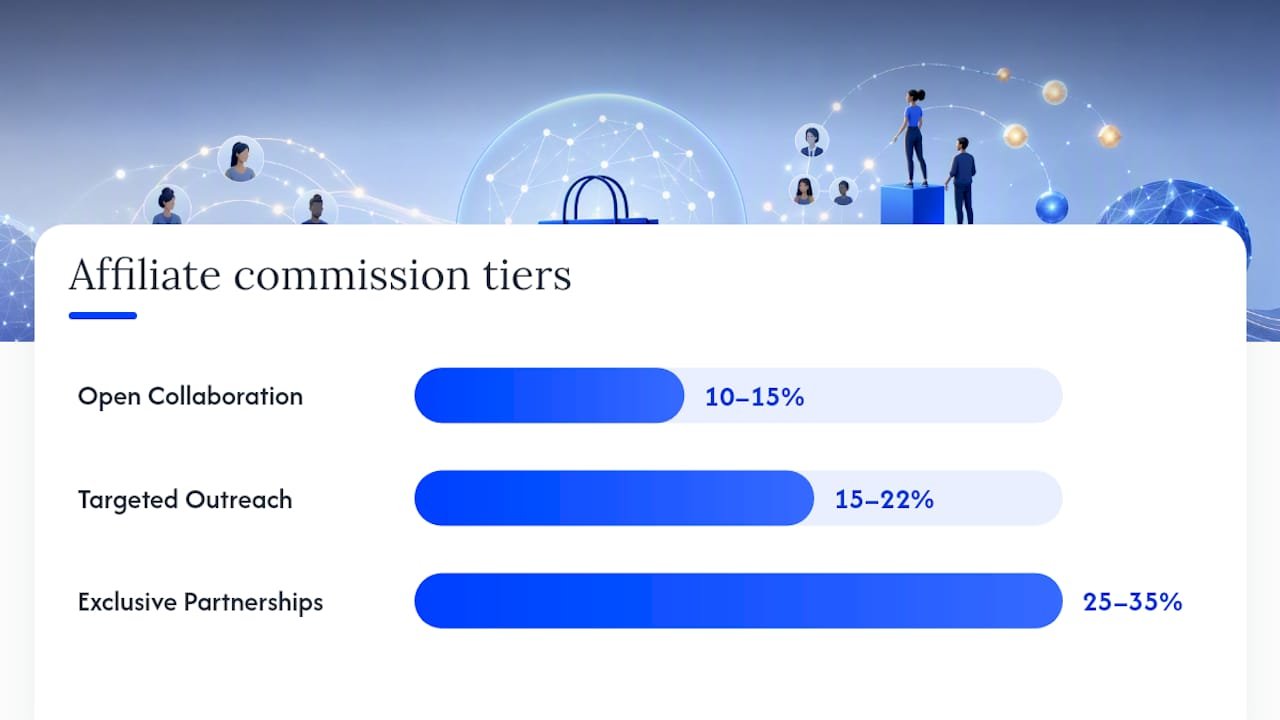
Most high-performing brands run a three-tier commission structure:
- Open Collaboration (10 to 15%): the default rate for anyone who picks up your product with no negotiation.
- Targeted Outreach (15 to 22%): offered to creators you’ve personally recruited who have a track record in your category.
- Exclusive Partnerships (25 to 35%): reserved for your top performers, often tied to a content minimum or exclusivity window.
This tiered approach lets you keep margin intact on the long tail of casual creators while paying up for the few who actually move volume. Enrolling in Fulfilled by TikTok can also add a 2 to 3% commission subsidy, which sweetens the deal without touching your own margin.
Pro Tip: Run your commission math against your actual margin before you launch, not after your first viral video. A 30% rate on a $15 item with 60% margin is very different math than 30% on a $200 item with 20% margin.
How Do You Recruit and Retain Creators?
Recruiting well means filtering hard before you ever send a message. Open TikTok’s Creator Marketplace and sort by category, follower band, and engagement rate, but weigh prior TikTok Shop GMV more heavily than follower count. A creator with documented sales history usually outperforms a bigger account with zero commerce track record.
From there, the workflow is simple:
- Export a shortlist of 30 to 50 candidates who match your category and audience.
- Vet their recent content for tone and production quality before reaching out.
- Send a short direct message with a sample offer and a one-video ask, no long pitch decks needed.
- Move top performers into your Targeted or Exclusive tier once they post a video that clears your GMV threshold.
Retention comes down to making creators feel like insiders. Leaderboards, a private community for your top affiliates, and a monthly content brief keep posting frequency and loyalty higher than one-off sample drops ever will.
What Creative Formats Actually Convert?
The winning format is almost always some version of problem, demo, payoff. Viewers scroll past ads; they stop for something that looks like a real person solving a real annoyance. A brief that works looks like this:
- Hook (first 2 seconds): state the problem or tease the result. “I didn’t believe this would work until I tried it.”
- Demo (next 15 to 20 seconds): show the product in actual use, not a studio shot. Tap the cart icon on screen so viewers see exactly where to click.
- CTA (final 5 seconds): a plain, direct line like “Link’s in my shop” beats a hard sales pitch every time.
Formats like unboxings, quick tutorials, and side-by-side before/after clips consistently outperform polished ad-style content because they read as organic rather than sponsored.
You’re paying to amplify proof that already converts.*
Which Metrics Actually Tell You the Program Is Working?
Three numbers matter more than any others: GMV per creator, video-to-order rate, and new-customer rate. GMV per creator tells you who’s worth moving into a higher commission tier. Video-to-order rate tells you which content deserves a Spark Ads budget, since native checkout converts two to four times better than sending traffic off-platform.
Watch for these thresholds:
- Video-to-order rate above 1.5 to 2%: a strong candidate for boosting.
- GMV per creator trending flat or down for two straight weeks: time to refresh the brief or rotate in new SKUs.
- New-customer rate dropping: a sign you’re mostly reselling to the same repeat buyers instead of growing reach.
Seller Center’s built-in analytics cover most of this, but pairing it with a unified attribution layer, through a Shopify connector or similar tool, keeps you from double-counting sales across channels.
What Mistakes Sink Most TikTok Affiliate Programs?
Most failures trace back to a handful of avoidable habits:
- Chasing follower count over commerce history, which fills your roster with creators who never post again.
- Underpricing commissions out of margin anxiety, then wondering why nobody bothers with a second video.
- Shipping weak product listings with blurry photos and vague specs that make creators hesitate to recommend you.
- Ignoring comments, which bury objections (sizing, shipping time, ingredient questions) that a quick edit to your listing copy could fix.
A simple weekly routine, sweep comments for recurring objections, retire creators who’ve gone inactive past 45 days from your active reporting, and refresh your top three briefs, fixes most of this before it becomes a bigger problem. Once you’re managing more than 50 active creators, it’s usually time to hire a dedicated affiliate manager rather than running it as a side task.
How Will Buckley Runs a TikTok Affiliate Program
The high-level version: a repeatable brief (hook, demo, CTA), a DM skeleton for outreach that asks for one video before any long-term commitment, and a simple rule that samples only go to creators worth their shipping cost in expected ROI. Pair that structure with AI tools for drafting briefs and sorting creator lists faster, and the AI-assisted workflows that used to take a full day shrink to an afternoon.
Why Most Advice on This Topic Undersells the Operational Grind
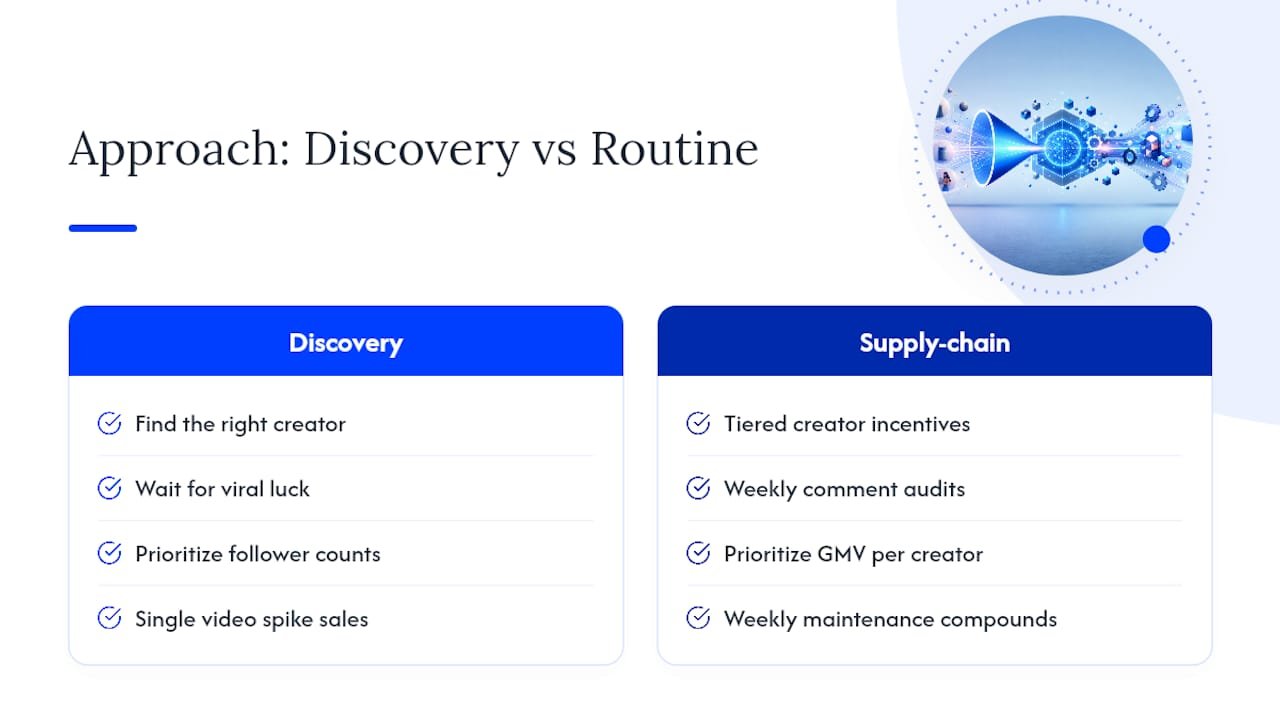
The conventional wisdom treats TikTok affiliate marketing like a discovery problem: find the right creator, get lucky, watch sales roll in. That’s backwards. The programs that actually scale treat it like a supply chain, with tiered incentives, weekly comment audits, and a hard look at GMV per creator instead of vanity follower counts.
What gets underestimated most is how much a boring routine, checking dormant creators, refreshing listing copy, sweeping objections out of comments, outperforms any single viral hit. One video can spike sales for a week. A weekly maintenance habit compounds for months.
Where I’d push back on standard playbooks: don’t wait for a huge follower number before paying real commissions. A creator with modest reach but consistent GMV history is worth more than a large account that’s never sold anything. Prioritize that signal over vanity metrics from day one, and use AI tools to handle the repetitive vetting and brief-writing so your time goes toward the creators actually driving orders.
If you take one thing from this: build the weekly routine before you build the roster. The routine is what makes the roster worth having.
— Will
Ready to Build Your TikTok Affiliate Engine Faster?
Everything above works, but building tiered commission structures, vetting creators, and writing briefs from scratch takes real hours you may not have. Willbuckley’s YouTube automation affiliate marketing launch playbook gives you the operational templates and AI-assisted workflows to shortcut that setup, built for marketers who’d rather adapt a proven system than build one from a blank page.

If you’re still deciding whether to DIY this or get structured help, ask yourself one question: do you already have a repeatable outreach and briefing process, or are you starting from zero? If it’s the latter, the playbook walks you through creator recruitment, commission tiers, and tracking setup step by step. Grab the launch playbook and get your first test SKUs listed this week.
Sources
- How To Build A TikTok Shop Affiliate Engine That Scales in 2026 – Ecommerce Times
- How To Build A TikTok Shop Affiliate Program That Actually Converts in 2026 – OnlineStoreNews
- How To Do Affiliate Marketing on TikTok (Mavely)
- TikTok Affiliate Marketing: How To Get Started (2026) – Shopify