

AI-driven product research works when you treat it as a data pipeline, not a magic answer box: feed the right signals in, ask the right questions, and validate before you spend a dollar. Run this well and you get a prioritized list of pain points, a rough persona, and a clear go or no-go signal, often inside a single afternoon.
Start with these tool categories in order:
- Discovery scanners to spot a rising niche or gap before it’s crowded
- Review and social analyzers to pull complaints and unmet needs straight from real buyers
- LLM synthesizers to turn that mess of text into assumptions and a persona
- Forecasting endpoints to sanity-check demand before you commit budget
Key Takeaways
AI-driven product research works best as a four-stage pipeline of brief, collect, synthesize, and validate, never as a single prompt asking a chatbot for an answer.
| Point | Details |
|---|---|
| Start with a brief | Define your goal, decision rule, and target user before touching any AI tool. |
| Split the agent tasks | Use separate scraper, classifier, and synthesizer steps to reduce hallucinated conclusions. |
| Enforce a sample floor | Treat sentiment patterns from fewer than 30 to 50 items as unproven hypotheses. |
| Validate with numbers | Run a forecasting check or holdout test before committing budget to a product idea. |
| Protect source data | Strip identifying details from scraped reviews and social posts before synthesis. |
Table of Contents
- Which AI Tools Actually Help With Product Research
- A Practical 4-Step Workflow You Can Run Today
- What Data Sources Actually Feed These Tools
- Why AI Product Research Gets Things Wrong (And How to Catch It)
- Prompts and Agent-Splitting Patterns You Can Copy
- A Practitioner’s Checklist Before You Trust the Output
- Ethical Considerations and Data Privacy in AI Product Research
- Real Examples of AI-Driven Product Research Paying Off
- AI Research Versus Traditional Methods: What Actually Changes
- Where AI Product Research Is Heading Next
- What Most Guides Get Wrong About AI Product Research
- Frequently Asked Questions
- Sources
Which AI Tools Actually Help With Product Research
Most people jump straight to ChatGPT and wonder why their product research feels shallow. The problem isn’t the tool. It’s using one tool for a job that needs four different kinds of tools working in sequence.
Discovery and trend scanners come first. Platforms like Simporter and PromptScan are built to scan categories fast, surfacing early signals before a niche gets saturated. PromptScan in particular positions itself as a single-prompt agent that spits out a market brief and a competitive map in minutes rather than days.
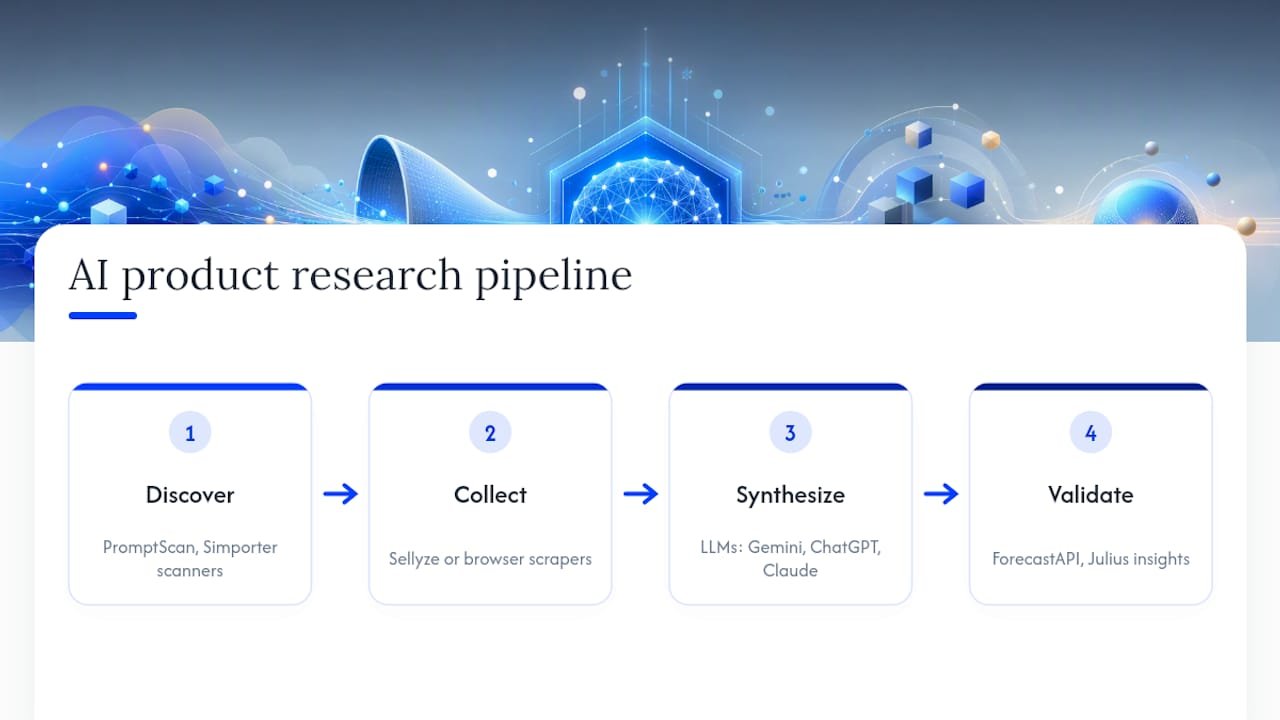
Review and social analyzers come next, and this is where the real gold sits. Sellyze scrapes marketplace reviews and social chatter, then classifies complaints into taxonomies and scores them by severity, generating supplier-ready specs for private-label sellers. Browser-based scrapers paired with a classifier model do the same job for anyone building outside the Amazon ecosystem.
LLM synthesis tools turn raw signal into something usable. Gemini, ChatGPT, Claude, and Perplexity each handle this differently; Perplexity leans on live web retrieval, Claude tends to hold longer context for big review dumps, and Notebook LM is worth a look specifically because it lets you upload your own review exports and query them without the model drifting off into generic web knowledge.
Forecasting and insight endpoints close the loop. ForecastAPI and Julius both take structured numeric data (sales, cost, purchase history) and return prioritized insights like margin compression or seasonality shifts, giving you a quant check on what the qualitative research suggested.
The practical mix that works: one scraper, one classifier, one LLM for synthesis, and one forecasting check. Skip any single link in that chain and you’re back to guessing.
A Practical 4-Step Workflow You Can Run Today
You don’t need a data science team to run this. You need four steps, done in order, without skipping the boring one.
- Write the research brief first. One paragraph: what decision this research needs to support, who the target user is, what “go” looks like versus “no-go,” and which two or three metrics matter most. A research-first framework built around this brief-before-data approach consistently produces sharper AI output than dumping raw questions into a chatbot.
- Collect the data. Pull reviews and Q&A from e-commerce listings, grab a batch of social clips from TikTok or Reddit threads, check search trend volume, and if you can, run a small survey of 20 to 30 target users. More sources beat more volume from one source.
- Synthesize with an agent split. Send the scraper’s raw output to a classifier agent that tags complaints, then hand the labeled data to a synthesizer LLM with a prompt asking for assumptions, top pain points, a rough persona, and a TAM sketch. Keep each agent narrow. A model asked to scrape, classify, and conclude in one pass tends to blur its own reasoning.
- Validate before you invest. Run the numbers through a forecasting endpoint or, at minimum, a manual holdout check against last year’s seasonal data. Set your acceptance criteria (minimum demand signal, acceptable margin range) before you see the output, not after.
Pro Tip: Write your acceptance criteria down before running Step 4. If you decide what counts as a “pass” after seeing the forecast, you’ll unconsciously move the goalposts to match whatever number you were hoping for.
What Data Sources Actually Feed These Tools
Every AI insight is only as good as the pipe feeding it, and each channel tells you something different.
- First-party sales and operations data — (your own or a client’s sales, purchases, cost history) feeds margin and seasonality forecasts, and it’s the input forecasting tools actually require to run.
Platforms that combine social and review signals across categories report meaningful forecast reliability. One vendor cross-referencing TikTok, Reddit, YouTube, and e-commerce reviews claims up to 93% accuracy on 52-week SKU forecasts when enough cross-platform data exists. That number depends entirely on data volume and category, so treat it as a ceiling, not a guarantee for your specific niche.
Why AI Product Research Gets Things Wrong (And How to Catch It)
AI hallucinates confidently, and a synthesized summary can sound authoritative while being built on three cherry-picked reviews.
- Demand verbatim evidence. Always ask the AI to show the actual review or social snippet next to its summary claim, not just the conclusion. If it can’t produce the source line, don’t trust the claim.
- Respect minimum sample size. Sentiment or trend synthesis pulled from fewer than 30 to 50 items is noise dressed up as insight. Below that, treat any pattern as a hypothesis, not a finding.
- Force the assumptions into the open. Ask the model to list every assumption behind a TAM, SAM, or SOM estimate. Those assumptions become editable inputs you can stress-test, not a black box you have to trust blindly.
- Cross-check the forecast. Run a second model, a simple heuristic, or a small split test against the AI’s number before committing budget.
Pro Tip: Ask two different LLMs the same synthesis question with the same data. If Claude and Gemini land on wildly different top pain points from identical review sets, that’s a signal your sample is too small or too noisy to trust yet.
Prompts and Agent-Splitting Patterns You Can Copy
The agent-split pattern beats a single mega-prompt almost every time: scraper agent collects raw text and metrics, classifier agent labels and recodes it, synthesizer LLM builds assumptions and personas from the labeled set, and a forecast endpoint runs the final quant check.
Two prompts to copy directly:
- Review classifier: “Read the following 40 product reviews. Tag each as [defect / missing feature / praise / pricing complaint]. For each defect tag, rate severity 1 to 5 based on frequency of mention. Output as a table.”
- Persona sketch: “Using the classified complaints above, write a one-paragraph persona for the most common complainer: their goal, their frustration, and the language they use to describe the problem.”
Run each prompt at a lower temperature (around 0.2 to 0.3) for consistency, and rerun the synthesis prompt twice on the same data to check for drift.
Separating raw evidence from AI interpretation, and showing customers’ own words next to the synthesized claim, is what keeps a research pipeline honest instead of just confident.
A Practitioner’s Checklist Before You Trust the Output
I’ve watched marketers skip the brief and jump straight to prompting, then wonder why the output feels generic. Run through this before you call any research “done”:
- Research brief written and decision rule defined
- At least two independent data sources collected
- Sample size of 30+ items per synthesized claim
- Agent roles split (scraper, classifier, synthesizer)
- A validation rule set before seeing results
- One KPI chosen to track post-launch
- A handoff plan for who acts on the findings
- A re-run cadence scheduled (monthly or per major channel shift)
DIY this with the free tiers of ChatGPT and Notebook LM if you’re testing one idea. Consider coaching or a paid workflow template once you’re running this across multiple products a month, because that’s when the time saved compounds.
Ethical Considerations and Data Privacy in AI Product Research
Scraping reviews and social posts at scale raises real questions about consent and data handling, even when the content is technically public.
Most review platforms and social networks have terms of service that restrict automated scraping, and violating them can get your account banned or expose you to legal risk depending on the platform and your jurisdiction. Before running any scraper, check the platform’s current terms rather than assuming public visibility equals permission to harvest.
Personally identifiable information is the bigger risk. Usernames, profile photos, and location tags attached to reviews or social posts can identify a real person, and feeding that raw data into an LLM for synthesis means it may get stored, logged, or used in ways the original poster never agreed to. Strip identifying details before any data enters a classifier or synthesizer pipeline, and prefer tools that explicitly state they don’t retain your uploaded data for training.
There’s also a bias risk worth naming plainly: AI synthesis tends to amplify whatever sentiment is loudest in your source data, which usually means the most vocal complainers, not the average buyer. A persona built entirely from one-star reviews will skew more frustrated than your actual customer base.

None of this means avoiding AI-driven research. It means building a habit of checking your data sources’ terms, minimizing personal data before synthesis, and treating any AI-generated persona as a working hypothesis shaped by whoever happened to leave a review that week, not a finished demographic profile.
Real Examples of AI-Driven Product Research Paying Off
The clearest wins show up where teams combine review mining with forecasting rather than using either tool alone. Beauty and personal care brands using cross-platform analysis tools that pull from social chatter and e-commerce reviews together have reported identifying product gaps that neither data source revealed on its own. A recurring complaint buried in TikTok comments, invisible in formal reviews, can point to a feature nobody was asking for directly but everyone wanted once it existed.

Private-label sellers using review-classification pipelines like Sellyze’s approach report a similar pattern: complaint taxonomies surface specific, fixable defects (a lid that cracks, a size that runs small) that generic sentiment scores miss entirely. That specificity is what turns a review pile into an actual supplier spec.
On the market research side, larger research organizations are now running synthetic personas and digital twins to stand in for early-stage focus groups. Coverage of this shift in enterprise market research shows agentized workflows compressing weeks of traditional recruitment and interviewing into a process that runs in days, though the synthetic personas still need grounding in real review or survey data to avoid drifting into generic assumptions.
The common thread across these examples isn’t the specific tool. It’s the discipline of pairing a qualitative signal (what people say) with a quantitative check (what the numbers support) before treating either one as an answer.
AI Research Versus Traditional Methods: What Actually Changes
Traditional product research means focus groups, cold-calling potential customers, manual review reading, and waiting weeks for a research firm’s report. AI-driven research compresses most of that into days, sometimes hours, but it doesn’t eliminate the underlying work. It relocates it.
Where a traditional researcher spent hours manually coding survey responses into themes, an AI classifier does that tagging in minutes across a much larger volume of reviews. Where a focus group might interview eight to twelve people, a review-mining tool can process hundreds of data points from real buyers who already spent their own money on a comparable product, which arguably produces more honest signal than someone answering a moderator’s question in a room.
The tradeoff is depth of follow-up. A skilled human interviewer can ask “why” three times and uncover a motivation the customer didn’t know they had. AI synthesis works from whatever text already exists; it can’t probe further unless you feed it more data. That’s why the strongest workflows still use a small human survey or interview batch (even 15 to 20 people) alongside the AI-driven review mining, treating each as a check on the other rather than picking one method exclusively.
Cost is the clearest split. A traditional research firm engagement often runs into the thousands of dollars and multiple weeks. An AI-driven pass through the same question, using the tool stack described above, can run a fraction of that cost and turn around in a day or two, which matters most for solo builders and small teams testing multiple product ideas per quarter rather than committing to one big study.
Where AI Product Research Is Heading Next
The next shift is agent autonomy. Instead of a person running four separate tools in sequence, expect more platforms to chain scraper, classifier, synthesizer, and forecaster into one automated pipeline that runs on a schedule and flags changes without a manual prompt each time.
Synthetic personas and digital twins are moving from novelty to standard practice in enterprise research workflows, letting teams test messaging against a simulated audience segment before committing budget to a real survey panel. Expect this to trickle down to solo builders as the underlying models get cheaper to run.
Forecasting endpoints are also getting more configurable. Sensitivity thresholds that control when an insight engine flags an anomaly are becoming standard, which means less noise and fewer false alarms as these tools mature; you’ll tune how twitchy your forecast alerts are rather than accepting a fixed default.
The bigger change is cultural, not technical. Teams that used to run one big research study per product launch are shifting toward continuous, lightweight checks: a quick review-mining pass before a feature decision, a forecast recheck before a seasonal restock. AI made each individual check cheap enough to run often, which changes research from an event into a habit.
What Most Guides Get Wrong About AI Product Research
Most advice on this topic treats AI product research as a tool problem: pick the right chatbot, get the right answer. That’s backward. The tool stack matters far less than the sequence you run it in, and almost nobody talks about the sequence.
The conventional advice tells you to “ask ChatGPT to research your product idea” and stop there. That produces confident-sounding fiction, not research. What actually works is boring by comparison: write the brief, collect from at least two channels, split the labeling from the synthesis, and force a numeric check before you trust any of it. None of that requires a premium tool. It requires discipline most people skip because the four-step version feels slower than typing one prompt.
If I had to pick the single most overlooked step, it’s the assumption list. Almost every AI-generated market sizing number gets treated as fact when it’s really a chain of guesses about adoption rate, price point, and competitor share. Make the AI list those guesses explicitly, and you turn a black box into a spreadsheet you can actually argue with. That’s the difference between research and a well-written hallucination.
Start with the brief. Everything downstream depends on it.
Frequently Asked Questions
What is the fastest way to start product research with AI?
Write a one-paragraph research brief defining your decision rule and target user, then feed a review scraper’s output into a classifier, followed by a synthesizer LLM to extract assumptions and pain points.
Can AI replace traditional market research entirely?
Not entirely. AI compresses the data collection and synthesis stages dramatically, but a small batch of real human interviews still catches nuance that text-based synthesis alone misses.
How much data do I need before trusting an AI-generated insight?
Treat any sentiment or trend pattern based on fewer than 30 to 50 reviews or social posts as an unproven hypothesis rather than a finding.
Which AI tool is best for turning reviews into a persona?
Notebook LM works well for uploading your own review exports and querying them directly, while Claude and Gemini handle longer synthesis prompts once your data is already classified.
Is it safe to feed customer reviews into an AI tool?
Strip usernames, photos, and location tags before uploading, and check the source platform’s terms of service, since scraping public content doesn’t automatically make it fair to store or process.
Want a done-for-you version of this workflow, complete with prompt templates and the agent-split checklist built out for your niche? Check out the resources on Will Buckley’s site built for affiliate marketers and solo product builders who’d rather implement this in a weekend than build it from scratch.
Sources
- Gravel AI unveiling AI‑powered insights transforming beauty industry analysis
- Product Research with AI – by Nick Babich
- The AI tools that are transforming market research
- ForecastAPI product-insights API documentation
Pingback: 3 Workflows Let Marketers Trust AI Product Reviews + Curated Tools – The Mindset Motivator
Pingback: Founders: Validate a Niche in 2–4 Weeks With an AI Research Workflow – The Mindset Motivator