

Here’s the template, in one sentence: headline with the product name and benefit, a one-line quick verdict with a calibrated rating, a “who it’s for” pair, hands-on evidence with a screenshot or metric, honest pros and cons, and a CTA placed after the verdict, after the cons, and again at the close. Use it for a single-product review, a review email, or a landing page. Before you publish anything, add one piece of first-hand proof, an FTC-compliant disclosure near your links, and exactly one primary call to action so readers know what to click.
TL;DR:
- First-hand evidence, such as screenshots or measurable outcomes, should be placed near the top of the review for credibility.
- Listing clear, specific disadvantages in the review helps build trust and allows readers to make informed decisions.
- Regular updates every 60 to 90 days are necessary to maintain accuracy, especially after pricing or feature changes.
- Testimonials or social proof must be verified and placed after pros and cons to avoid superficial or faked endorsements.
- Testing the product personally before structuring the review ensures authenticity and improves the review’s overall effectiveness.
Table of Contents
- Affiliate Review Template Structure: What Goes in Every Section
- The Copy-Paste Review Template You Can Use Today
- What Makes Readers Trust an Affiliate Review
- Affiliate Disclosure Rules You Can’t Skip
- How to Keep Your Review Template Current as Products Change
- Adapting the Review Template Across Different Affiliate Niches
- Where Testimonials and Social Proof Actually Belong
- Tracking and Improving Your Review’s Conversion Rate
- SEO Habits That Fit Affiliate Reviews Specifically
- Will Buckley’s Take: Templates Don’t Replace Testing, They Organize It
- Ready-Made Templates and AI Workflows to Speed This Up
- Sources
Affiliate Review Template Structure: What Goes in Every Section
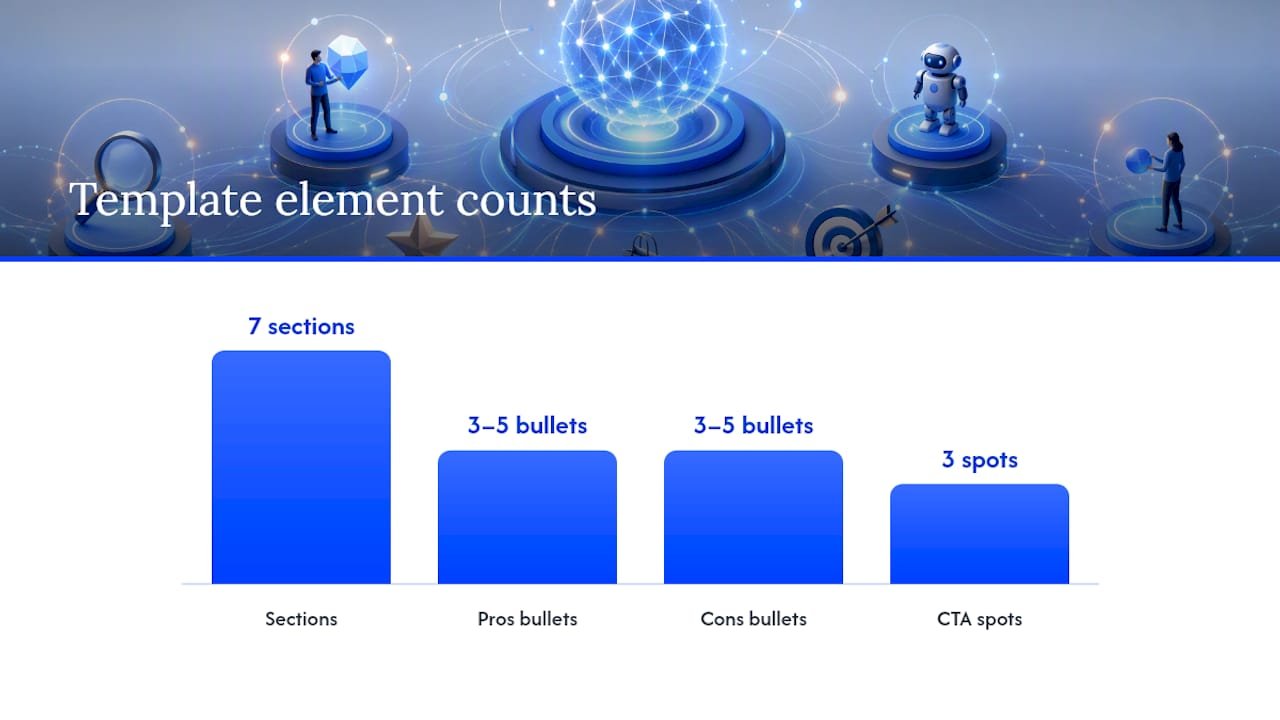
You don’t need twelve sections. You need seven, each doing one job, and each backed by something real you can point to.
Start with the headline. Put the product name and the primary benefit in the same sentence, something scannable enough to work in a subject line too. “The [Tool] Review: Does It Actually Save You 8 Hours a Week?” beats “My Honest Thoughts on [Tool]” every time, because it tells the reader what they get before they commit to reading.
Right under that, write who it’s for and who it’s not for. One sentence each. This single pairing does more to reduce bounce than almost anything else in the template, because it lets the wrong reader self-select out before they waste your CTA clicks on a mismatch.
Then comes the quick verdict, two sentences max, with a calibrated rating. Skip the perfect 5 out of 5. A decimal rating between 4.7 and 4.9 reads as an honest appraisal rather than a sales pitch, and it tends to convert better precisely because it looks like a real person made the call, not a marketing department.
Your product overview comes next, in scannable bullets:
- Price range (not one exact figure that goes stale in a month)
- Two or three key specs or features that matter to your specific audience
- Platform or compatibility notes if relevant
The hands-on experience section is where most reviews fall apart, because most writers never actually test the product. Yours won’t be one of them. Write three short paragraphs: what you set out to test, what happened, and what surprised you. This is exactly where a screenshot, a before/after photo, or a measurable result belongs.
Follow with pros and cons, three to five bullets each, specific rather than vague. “Fast setup” is a throwaway line. “Onboarding took 6 minutes with no support ticket needed” is proof.
Finally, place your CTAs in three spots: right after the quick verdict, again after the pros and cons, and once more in the closing verdict. Three well-placed links, not fifteen scattered ones, balance trust with accessibility.
- Headline with product and benefit
- Who it’s for / not for
- Quick verdict and rating
- Overview specs
- Hands-on evidence
- Pros and cons
- Closing verdict and final CTA
The Copy-Paste Review Template You Can Use Today
Paste this into your CMS and fill in the brackets. Author notes appear in italics so you know exactly what to swap out.
H1: [Product Name] Review: [Primary Benefit] Tested and Explained
This post contains affiliate links; I may earn a commission if you purchase through them. See how I handle this here.
Who it’s for: [One sentence describing the ideal reader, e.g., “solo creators posting three or more videos a week who need a faster editing workflow.”]
Who it’s not for: [One sentence naming the reader who should skip it, e.g., “agencies managing ten-plus client accounts, who’ll outgrow the entry plan fast.”]
Quick verdict: [Product] does [specific job] well and struggles with [specific limitation]. Rating: 4.8/5.
[PRIMARY CTA: “Check current pricing on [Product]” → link]
Overview:
- Price: [range, e.g., “$29 to $99/month”]
- Best for: [use case]
- Standout feature: [one specific feature]
Hands-on experience:
Paragraph one: what you tried to do with it. Paragraph two: what actually happened, with a specific number (“Saved roughly 8 hours a week on manual formatting”). Paragraph three: what you didn’t expect.
[SCREENSHOT: Caption example, “Dashboard view after setup, before any manual tweaks.”]
Pros:
- [Specific bullet with a number or detail]
- [Specific bullet]
- [Specific bullet]
Cons:
- [Specific limitation]
- [Specific limitation]
[SECONDARY CTA: “See the full feature breakdown” → link]
Alternatives note: [One sentence naming the general category of alternative, not a competitor takedown, e.g., “If you need deeper team permissions, look at enterprise-tier tools in this space.”]
Final verdict: [Two sentences restating who should buy and why.]
[FINAL CTA: “Get started with [Product] here” → link]
Pro Tip: Save your raw screenshots in a dated folder before you edit them. When the product updates its interface six months later, you’ll need proof of what you actually tested versus what’s current, and reviewers who can’t show that timeline lose credibility fast.
What Makes Readers Trust an Affiliate Review
Credibility isn’t a vibe. It’s a handful of specific, repeatable choices that separate a review someone clicks through from one they bounce off.
First, collect at least one piece of first-hand evidence and put it near the top, not buried at the bottom. A screenshot of your actual dashboard, a photo of the physical product, or a specific measurable outcome like “cut editing time from 45 minutes to 12” does more work than three paragraphs of adjectives.
Second, list real cons, not soft ones. “It has a learning curve” is a non-answer. “The reporting dashboard takes about a week to make sense of if you’ve never used a similar tool” tells the reader something they can actually weigh.
Third, treat AI as your editor, never your source of experience. Test the product yourself, take notes on what happened, then let AI help you organize those notes into clean paragraphs or tighten your phrasing. A review with no experience behind it, AI-written or not, reads hollow within the first two sentences.
Fourth, calibrate your rating. A 4.8 out of 5 signals judgment. A flat 5.0 signals a sales page.
Fifth, write CTAs around the benefit, not the click. “See current pricing before it changes” beats “Click here” because it tells the reader what they get for the click.
- Show evidence high in the page, not just at the end
- Write cons specific enough to be useful
- Document what you tested versus what AI helped structure
- Use a 4.7 to 4.9 rating range instead of a perfect score
- Write CTA text around the benefit of clicking
A study on review-driven purchase behavior found that rating patterns influence buyer confidence well before price does, which is exactly why a suspiciously perfect score can cost you more conversions than it earns.
Affiliate Disclosure Rules You Can’t Skip
Get this part wrong and nothing else in the template matters. The FTC’s Endorsement Guides require disclosures to be clear, conspicuous, and placed near the actual endorsement, not buried in a footer or an about page nobody reads.
- Use plain wording near your links: “This post contains affiliate links; I may earn a commission.” Shopify’s guidance confirms this kind of direct phrasing builds more trust than vague legal language.
- Repeat the disclosure near every major CTA cluster in long articles, not just once at the top. A 2,000-word review with links scattered throughout needs more than a single opening line.
- Before you hit publish, confirm three things: the disclosure sits near your links, every claim you make is something you can back up, and any screenshot or image is either yours or properly credited.
- If you run multiple review pages, build one dedicated disclosure page and link to it from each post for consistency.
The Consumer Reviews and Testimonials Rule, effective October 2024, specifically targets fake and manipulated reviews, so treat every testimonial you publish as something you’d be comfortable defending with proof.
How to Keep Your Review Template Current as Products Change
An affiliate review isn’t a monument, it’s a living document, and treating it that way is what keeps it ranking.
Set a recurring check every 60 to 90 days for reviews driving real traffic. Products update pricing, features get added or cut, and a review that references a plan that no longer exists tells readers you’ve checked out. Revisit your hands-on section first, because that’s where staleness shows fastest, an old screenshot of a redesigned dashboard is an immediate credibility hit.
Watch for three triggers that mean an update is overdue: a pricing change, a major feature release from the vendor, or a shift in your own results after using an updated version. When any of those happen, don’t just patch a sentence. Re-test what changed, update your screenshot, and adjust your verdict if the rating no longer holds.
Keep a simple log, even just a spreadsheet row per review, noting the last update date and what changed. This does double duty: it keeps you organized, and a visible “Last updated” date on the page itself signals to readers and search engines that the content is maintained, not abandoned.
If a product gets discontinued or a program shuts down, don’t quietly delete the page. Redirect it or clearly mark it as retired with a note pointing readers toward a current alternative in the same category.
Adapting the Review Template Across Different Affiliate Niches
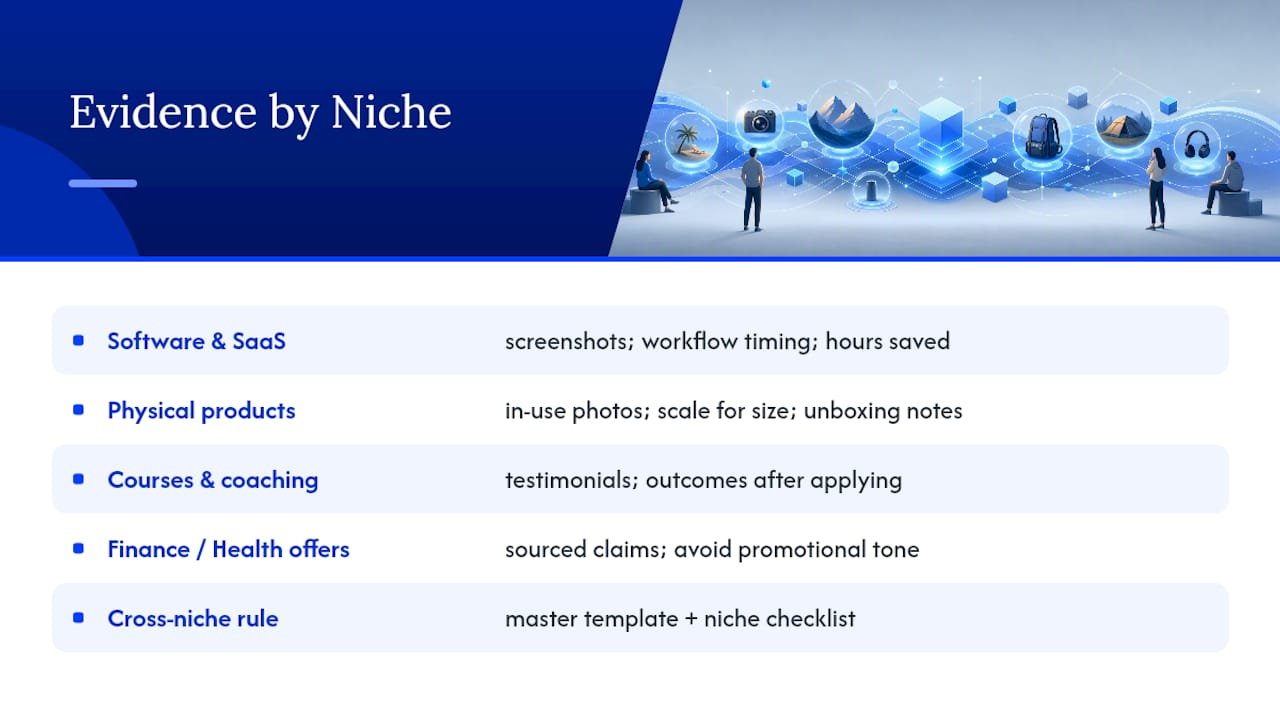
The seven-part skeleton holds up everywhere, but what counts as “evidence” changes completely depending on what you’re reviewing.
For software and SaaS tools, your hands-on section leans on screenshots, workflow timing, and specific numbers like hours saved or tasks automated. Readers in this niche want proof you actually opened the dashboard.
For physical products, photos do the heavy lifting. A picture of the product in actual use, next to a competitor or against a ruler for scale, beats any paragraph of description. Unboxing details and build-quality notes matter more here than in software reviews.
For courses and coaching programs, testimonials and specific outcomes carry more weight than screenshots, since the “product” is knowledge transfer. Your evidence section should focus on what changed after applying the material, not what the login page looks like.
For finance or health-adjacent offers, tone down promotional language further than any other niche and lean harder on sourced claims, since these categories draw more regulatory scrutiny and reader skepticism by default.
Across every niche, the “who it’s for / not for” pairing needs the sharpest rewrite, because qualifying criteria shift completely between a $19 course and a $400 enterprise software plan. If you write reviews across multiple niches, keep one master template and maintain a short niche-specific checklist for what evidence type to prioritize before you start drafting.
Where Testimonials and Social Proof Actually Belong
Social proof works when it’s specific and verifiable, and it backfires the moment it looks manufactured.
Place testimonials right after your pros and cons section, where a reader who’s leaning toward “maybe” needs one more nudge. Never write one yourself and attribute it to an anonymous “customer.” If you don’t have a real testimonial with permission to use it, skip the section entirely rather than fake it, the Consumer Reviews and Testimonials Rule exists specifically to penalize exactly that shortcut.
If you’re gathering your own audience’s feedback, ask permission before quoting anyone, and keep records of where each quote came from, an email, a comment, a DM screenshot. That documentation protects you if a claim is ever questioned.
Public case studies or usage numbers from the vendor’s own site can substitute for personal testimonials when you don’t have your own, but label them clearly as vendor-provided rather than presenting them as independent reader feedback. A line like “the company reports X result across its user base” is honest. Passing vendor marketing off as a stranger’s unsolicited review is not.
Star ratings from third-party review aggregators can work as supporting proof too, but only cite the real number with a link to the source, never round it up or invent a figure to make it look cleaner.
Tracking and Improving Your Review’s Conversion Rate
You can’t fix what you don’t measure, and most affiliate reviews get published and never revisited from a performance angle.
Start with click-through rate on each CTA position. If your affiliate network or link-shortening tool supports UTM tagging, tag each of the three CTA placements separately, top, middle, and closing verdict, so you know which one actually earns the click. Most reviewers assume the final CTA performs best. In practice, the CTA right after the quick verdict often outperforms it, because that’s the reader who already decided before finishing the page.
Watch your bounce rate on the “who it’s for / not for” section specifically. A high bounce right after that pairing usually means you’re attracting the wrong traffic through your headline or your SEO targeting, not that your review itself is weak.
Run small tests over time: swap one CTA’s wording, wait for a meaningful sample of clicks, then compare. Change the rating decimal from 4.9 to 4.7 and watch whether trust signals shift your numbers. Test whether a screenshot placed higher in the hands-on section changes time on page.
Revenue per visitor matters more than raw click count. A review sending fewer clicks to a higher-intent CTA position often out-earns one blasting links everywhere.
SEO Habits That Fit Affiliate Reviews Specifically
Affiliate reviews compete against comparison sites, forums, and video content, so generic SEO advice only gets you partway there.
Target long-tail, decision-stage phrases rather than the raw product name alone. “[Product] review” competes against everyone. “[Product] for solo creators” or “[Product] vs manual workflow” competes against almost nobody and matches exactly the reader ready to click a CTA.
Your headline and first 100 words need the product name and the core benefit together, because that’s what both readers and search engines scan for first. Bury the specifics.and you lose both audiences.
Structure your headings as questions where it fits naturally, “Is [Product] Worth It for Beginners?” tends to earn more visibility in AI-generated answer boxes than a flat descriptive heading, since that format matches how people actually phrase a search.
Original images beat stock photos for search visibility, not just trust. A screenshot with unique alt text describing what’s actually shown outperforms a generic stock photo every time, both for image search and for the AI systems increasingly pulling review content into summarized answers.
Update your published date visibly when you make substantive changes, and keep your internal linking tight, link between related reviews in the same niche so search engines understand the cluster, not just the single page.
Will Buckley’s Take: Templates Don’t Replace Testing, They Organize It
Here’s the rule I hold every template to: test first, structure second. A template is a skeleton for evidence you already have, not a substitute for gathering it. I’ve watched affiliates plug AI straight into a blank page and skip the testing step entirely, and readers can tell within a paragraph. The fix isn’t avoiding AI, it’s sequencing it correctly, use it to organize your notes and tighten your phrasing after you’ve actually used the product. In coaching sessions, the templates that convert are always the ones built around a real screenshot or a real number, never the ones built to sound impressive.
— Will
Ready-Made Templates and AI Workflows to Speed This Up
If you’d rather skip the trial-and-error and start from something already built, my YouTube Automation Affiliate Marketing playbook walks through done-for-you review structures and the automation steps that get them published faster without cutting the evidence corners this article just covered.
For readers who want the AI side handled specifically, the AI Affiliate Workflows guide maps AI editing steps directly onto this template, so you’re never guessing which parts to automate and which parts need your own hands-on testing. And if you want proof this approach holds up outside theory, the affiliate marketing case study breaks down real numbers from reviewers who rebuilt their process around exactly this structure. Pick whichever fits where you’re stuck, and start your next review with the template already in front of you instead of a blank page.
Sources
- FTC’s Endorsement Guides: What People Are Asking
- How to Write Affiliate Product Reviews That Convert in 2026 – Sk Hasan
- Affiliate Disclosure: Examples and How To Build Trust – Shopify
- How to create affiliate product reviews
Pingback: 3 Workflows Let Marketers Trust AI Product Reviews + Curated Tools – The Mindset Motivator
Pingback: Affiliate Marketing Prompts for Marketers: Funnel Map + Audit Checks – The Mindset Motivator
Pingback: 14 Day Tested Product Review Schema for Affiliates With ChatGPT Prompts – The Mindset Motivator