

An AI content brief is a structured document that takes your topic, keyword, and audience and turns them into a ready-to-execute outline, complete with headings, tone notes, and word counts. Content marketers use them to cut drafting time without losing consistency. The single best practice that separates a useful brief from a wasted prompt: give it a one-sentence thesis before you ask AI to do anything else.
TL;DR:
- An AI content brief is a structured outline that helps generate consistent content, but it cannot replace the writer’s thesis, proprietary proof, or error-checking.
- Successful briefs include a clear thesis, target keywords, structure, proof points, voice rules, and failure modes, with the length typically a third of the final article.
- Different workflows—single-shot, section-by-section, and outline-first—balance speed and accuracy, requiring human validation through citation checks and voice audits.
- Effective trial of AI tools involves testing export formats, collaboration, evidence sourcing, and customizability, with red flags indicating poor quality.
- Using a detailed brief as a prompt improves output quality more than shortcuts, as it ensures the AI stays aligned with your unique angle and evidence requirements.
Table of Contents
- What Can an AI Content Brief Generator Actually Do?
- What Should a Content Brief Template Include?
- Which AI Workflow Fits Your Brief Best?
- How Do You Test an AI Brief Tool Before Committing?
- Why Brief-As-Prompt Beats Every Shortcut I’ve Tried
- Sources
What Can an AI Content Brief Generator Actually Do?
Feed one of these tools a topic, a target keyword, an audience description, and a rough length, and you’ll get back a structured outline. That’s the baseline. Most generators produce an H2/H3 skeleton, suggested word counts per section, a handful of FAQ prompts, and a tone descriptor like “conversational” or “authoritative.”
Free tiers cover that baseline well. Free AI content brief generators will pull headings and tone suggestions straight from a keyword input, which is genuinely useful for a quick first pass. Where free tools thin out is collaboration and sourcing. Premium tiers typically add team workflows, CMS integrations, and export options that free plans skip entirely.
Here’s what no AI brief tool does on its own, regardless of price:
- Write your thesis. It can suggest angles, but the differentiating point has to come from you.
- Supply proprietary proof. Your internal data, customer numbers, and subject-matter quotes exist nowhere the model can find them.
- Catch factual or legal errors specific to your industry. That review step stays human, every time.
Think of the generator as a fast first draft of structure, not a replacement for judgment. If you’re still assembling your toolkit, our breakdown of AI writing tools covers where brief generators fit alongside drafting and editing software.
What Should a Content Brief Template Include?
A brief that actually prevents generic AI output needs ten specific components, not a vague list of talking points. Here’s the structure worth copying into your own template:
- Thesis. One sentence stating your differentiated point of view. This is the single most important line in the entire brief; everything downstream flows from it.
- Reader. Who they are, what they already know, and what decision they’re trying to make.
- Angle. How your take differs from the five articles already ranking for this keyword.
- Target keywords. Your primary term plus two or three natural variants, placed where they’ll actually get used.
- Structure. The heading skeleton, with a one-line purpose note under each heading.
- Proof points. The specific evidence AI needs to avoid generic filler.
- Voice rules. Sentence length, formality level, banned phrases.
- What to leave out. A short list of clichés, tangents, or claims to avoid.
- Success metric. What “good” looks like after publication.
- Failure modes. The two or three ways this piece typically goes wrong.
This ten-part structure lines up closely with the template format used across strong AI content briefs, and it’s worth following closely rather than improvising your own shorthand version.
On length: a working brief runs roughly one-third the length of your target draft. A 2,000-word article typically needs a 600 to 1,000-word brief to give the model enough to work with. Skimpier than that, and you’ll get filler.
Proof points deserve special attention. Good material means internal performance data, three subject-matter quotes with names attached, or a note on what competitor articles miss. Prompts loaded with this kind of source material produce noticeably less generic drafts than prompts built from keyword and topic alone. For keyword inputs specifically, a structured keyword research workflow will give you cleaner variants to drop into section four.
Pro Tip: Write your “what to leave out” section before your structure section. Naming the clichés you refuse to publish forces you to define your angle more precisely than starting with headings ever will.
Which AI Workflow Fits Your Brief Best?
Three generation patterns cover almost every practical use case, and picking the wrong one wastes more time than a bad brief does.
Single-shot means you hand the entire brief to the model and ask for a full draft in one pass. It’s fastest, publishable in under an hour for simple posts, but it’s also where drift and hallucinated specifics creep in hardest. Use it for short, low-stakes pieces only.
Section-by-section means you generate one heading at a time, reviewing between each. Slower, closer to two or three hours for a full article, but it catches tone drift before it compounds across 2,000 words.
Outline-first means you lock the structure and thesis with AI, then draft each section separately (by you, a writer, or the model on a tighter leash). This is the workflow for anything competitive or fact-heavy.
Whichever workflow you pick, run these gates before publishing:
- The “But Actually” test. Does the draft say something specific, or could any competitor’s article say the exact same sentence?
- Citation verification. Every named fact or figure gets checked against its actual source.
- Voice audit. Read it aloud. Does it sound like your brand, or like every other AI output?
- Editorial sign-off. One human approves before publish, no exceptions.
This human-in-the-loop structure matches where the industry is heading generally: agentic AI is pushing the content strategist role toward orchestration, meaning your job shifts from writing every brief manually to designing the workflow and checkpoints around it.
Measurement should run on a monthly cadence at minimum: track keyword rankings, run manual citation checks in ChatGPT and Perplexity to see if your content gets referenced, and watch for content decay on pieces older than six months. Comparison tables and higher fact density tend to improve citation rates when paired with that kind of editorial oversight, so it’s worth building structured formats into your brief template from the start.
How Do You Test an AI Brief Tool Before Committing?
Judge any brief generator against six axes: export formats, CMS integrations, template customizability, collaboration features, evidence sourcing, and revision history. A tool that nails outline generation but can’t export to Google Docs or your CMS will slow your workflow down, not speed it up.
Run this 30-minute trial before you commit to anything:
- Feed it one real topic with your actual keyword and audience, not a demo prompt.
- Check whether the outline reflects your angle or reads like every other article on page one.
- Test one export and one collaboration feature, even on a free plan.
- Ask it to suggest proof points. If it can’t flag where you need evidence, it won’t catch generic output later.
Watch for these red flags: outlines that look identical across unrelated topics, no way to add your own thesis or voice rules, and zero prompts for supporting evidence. Any of those signals a tool built for volume, not quality.
| Evaluation axis | What “good” looks like | Red flag |
|---|---|---|
| Exports | Direct to CMS or Google Docs | PDF only, no integrations |
| Collaboration | Shared comments, version history | Single-user, no sharing |
| Evidence sourcing | Prompts for proof points and quotes | No mention of sourcing at all |
| Customizability | Editable template structure | Fixed, locked outline format |
If you’re still narrowing your stack, the same AI writing tools comparison mentioned earlier breaks down where brief generators sit relative to full drafting platforms.
Why Brief-As-Prompt Beats Every Shortcut I’ve Tried
The mistake I see most often isn’t skipping AI, it’s skipping the thesis and letting the model invent one. Treat your brief as the prompt itself, not a preamble to one, and the quality gap closes fast. My stack stays deliberately small: a brief template, one drafting model, and a human edit pass. Nothing more, because more tools usually means more places for drift to hide.
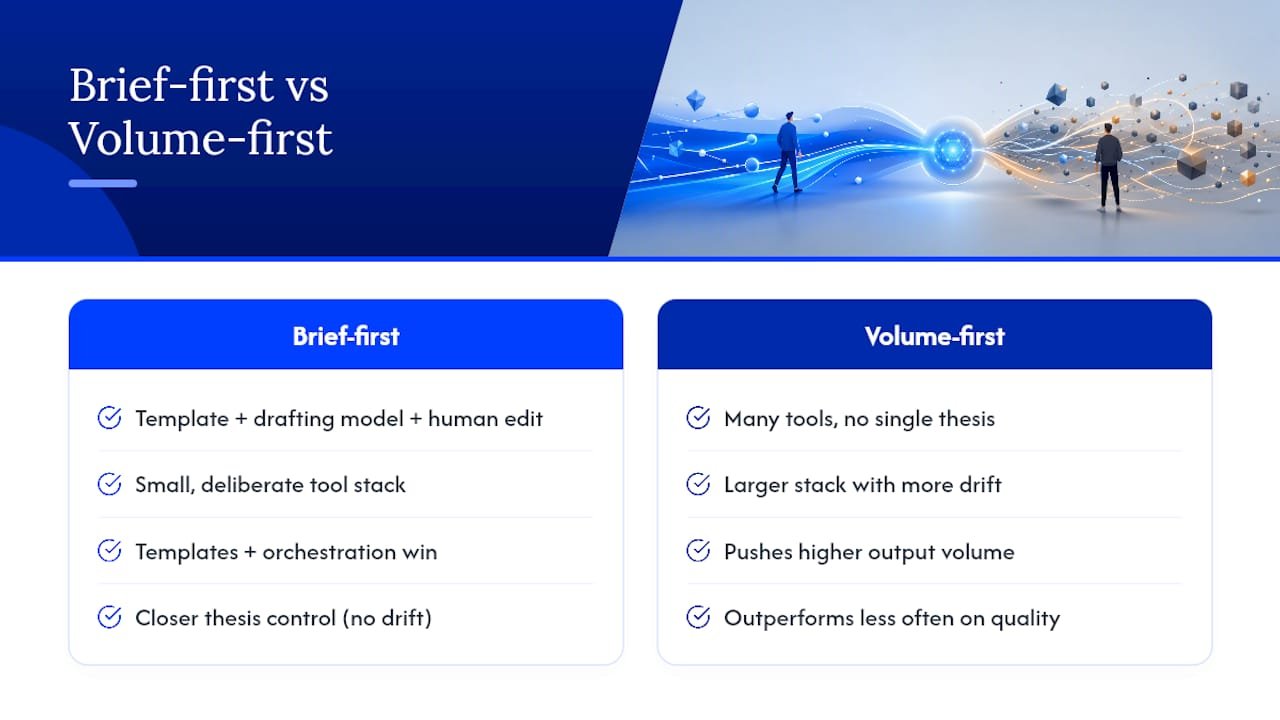
Teams that pair templates with real orchestration consistently outperform teams that just push out more volume, and that matches what I’ve seen across affiliate content specifically. If you want the fuller rollout, our 90-day AI content strategy plan walks through exactly how to phase this in without breaking your existing publishing calendar.
Ready to put briefs to work on revenue-generating content? Our YouTube affiliate marketing playbook shows how the same brief-first approach applies when the content’s job is converting, not just ranking.
— Will
Sources
- AI Content Brief Template (2026)
- Content creation to orchestration: The new AI content strategist
- Free AI Content Brief Generator