

Yes, AI can rapidly generate and score niche opportunities. Give a tool clear inputs about your skills, channels, and revenue goals, and you can walk away with five niche hypotheses worth testing within a week or two. What AI speeds up is the discovery phase, not the harder work of confirming someone will actually pay. That part still runs through real conversations with real people.
TL;DR:
- AI-powered niche research can generate targeted ideas quickly, but human validation through interviews and landing page tests remains essential.
- Tools that aggregate signals from multiple sources reduce false positives and provide scores for demand, competition, feasibility, and monetization potential.
- Narrow, specific workflows with proven pain points, such as regulatory filings or claims processing, tend to be the most promising niches to pursue.
- Pairing AI-generated lists with traditional market research accelerates validation, saving months of development and reducing risk.
- Focus on niches with genuine demand, proprietary advantages, and clear monetization paths to maximize the likelihood of long-term success.
Table of Contents
- What Is Niche Research With AI and How Does It Work?
- Core Features to Expect From AI Niche Research Tools
- How Do You Run Niche Research With AI Step by Step?
- What Scores and Tests Separate Real Opportunities From Noise?
- How Do You Monetize a Validated Niche?
- Prompt-and-Verify Workflows That Save Real Time
- Real Examples of Niches Found Through AI Discovery
- Comparing Popular AI Niche Research Tools and Platforms
- How Does AI Niche Research Fit With Traditional Market Research?
- Using AI for Trend Forecasting and Niche Timing
- Speed Versus Defensibility: When to Push and When to Pause
- How Willbuckley Turns Niche Research Into a Launch Plan
- Where to Go Deeper on Niche Scoring and Validation
- Sources
- FAQ
What Is Niche Research With AI and How Does It Work?
Niche research with AI means feeding a model or a purpose-built tool your skills, preferred channels, and target revenue, then letting it cross-reference public signals to surface underserved markets. Think of it as a research assistant that reads a thousand forum threads before breakfast.
The tools pull from a handful of data streams: search trend velocity, social and forum chatter (Reddit threads, LinkedIn posts), product review sites, and job posting boards that hint at unmet workflow needs. Reports typically compile in 15 to 30 seconds, with free tiers often capping you at a few reports a day and paid tiers layering in revenue projections.
Here’s where human judgment still matters:
- AI can hallucinate demand where none exists, especially for very new or very narrow topics with thin data trails.
- Trend data can be stale by the time it reaches a report, particularly for anything tied to a fast-moving news cycle.
- No model has sat on a sales call and heard a prospect hesitate before saying yes. That signal only comes from you.
Core Features to Expect From AI Niche Research Tools
A decent report does more than name a topic. It scores it across dimensions and shows its work.
Look for these components in any tool’s output:
- Demand scoring and trend velocity: is search interest climbing, flat, or fading over the past 12 to 24 months?
- Competition signals: how saturated is the search results page, and are the top spots held by programmatic content farms or genuine authorities?
- Monetization indicators: are there ads running against these keywords, priced products for sale, or freelancers charging for consulting in this space?
- Evidence streams: community discussion volume, recurring complaint themes in reviews, and job listings that reveal a company willing to pay someone to solve this problem.
Statistic Callout: Platforms that aggregate signals across 8 to 11 sources, including social platforms, search data, and review sites, cut down on false positives compared to relying on a single trend chart. More evidence streams mean fewer niches that look hot on paper and turn out to be a mirage.
The best reports rank candidates rather than just listing them, scoring across opportunity size, problem severity, feasibility, timing, and how hard it will be to reach that audience. If a tool only gives you a topic and a search volume number, you are getting a fraction of what modern niche discovery can deliver.
How Do You Run Niche Research With AI Step by Step?
This is the process I’d run today if I were starting from a blank page and a laptop. It works with almost any AI model plus a couple of niche-specific tools layered on top.
- Collect your inputs first. Write down your actual skills, the channels you already have some presence on (YouTube, a newsletter, a Twitter following), and a rough revenue target for month six. Vague inputs produce vague niche lists.
- Run exploratory prompts to surface candidates. Ask something like: “Give me 15 underserved niches in [broad category] where the target buyer is a small business owner with a repetitive, boring task that eats two or more hours a week. Rank by how narrow and reachable the audience is.” Expect a rough list, not a finished shortlist.
- Enrich each candidate with outside evidence. Pull actual search volume, skim the top 10 results for saturation, and read through recent Reddit or forum threads in that space. This is where you separate a real pain point from an AI’s confident guess.
- Score and rank using repeatable dimensions. Demand, competition, feasibility, and monetization evidence, scored consistently across every candidate so you are comparing apples to apples.
- Pick two or three finalists for quick validation. A one-page landing site, a small ad spend, and a handful of 15-minute calls will tell you more in five days than another week of prompting ever will.
Pro Tip: Run the same exploratory prompt through two different models and compare the overlap. Niches both models surface independently tend to be grounded in real, visible demand rather than one model’s quirks.
What Scores and Tests Separate Real Opportunities From Noise?
A niche with high search volume and zero paying signals is a trap. Score every candidate across five dimensions before you spend another hour on it: demand, problem severity, feasibility given your skills, defensibility against copycats, and how easily you can actually reach the audience.
Three fast tests tell you more than a week of extra research ever could.
- The 15-minute interview. Call five people in the target audience and ask what they currently use to solve this problem, and what they hate about it.
- The landing-page CTA test. Build a single page describing the solution, drive a small amount of traffic to it, and measure how many people click “notify me” or leave an email.
- The forum-thread test. Post a genuine question in a relevant Reddit or LinkedIn community and see whether the responses describe active frustration or a shrug.
Statistic Callout: Founders who lean on fast validation methods like short calls and landing-page tests instead of building first tend to save months of wasted development, because the paying signal shows up before the product does.
Watch for red flags: if every query you find is low-intent (“what is X” rather than “best X for Y”), if nobody in the space appears to be paying for anything, or if the niche would require heavy compute costs against a tiny addressable market, walk away. A narrow, well-defined pain point beats a wide, mushy one every time.
How Do You Monetize a Validated Niche?
The niche type you validate should point directly to a product shape. Forcing the wrong model onto a good niche is how promising research turns into a stalled project.
- Content and affiliate: works well for niches with high search volume and existing commercial intent, where buyers are already comparing products.
- Paid reports or newsletters: fits niches where the audience needs ongoing intelligence more than a tool, like industry-specific trend tracking.
- Micro-SaaS: the right call for narrow, repeatable workflows where legacy tools are clunky and buyers already pay for software, such as domain-specific vertical tools.
- Services: makes sense early on, when you have real expertise but no product yet. It also doubles as validation for a future SaaS.
Early distribution rarely needs a big budget. Target the same communities you used for validation, run direct outbound to the people who responded to your interviews, and consider partnerships with adjacent tools already serving that buyer. If you’re leaning toward the affiliate or content path, a content funnel workflow built around AI can compress your launch timeline considerably.
Prompt-and-Verify Workflows That Save Real Time
The shortcut that changes everything for affiliate marketers is treating every AI output as a draft, never a final answer. I run a prompt-and-verify loop: generate a niche list, then manually check the top three candidates against live search results and actual affiliate programs before touching a keyword tool.

Two validation shortcuts do most of the heavy lifting. A link audit shows whether existing affiliate programs in the space pay well and convert, using tools similar to those covered in product research workflows. A small micro-ad test, even $20 to $50 pushed at a landing page, tells you within 48 hours whether clicks turn into any real interest.
Pro Tip: Before writing a single piece of content, check whether the affiliate programs in your candidate niche actually pay commissions worth chasing. A great niche with a weak affiliate program is still a dead end.
Real Examples of Niches Found Through AI Discovery
The pattern behind successful AI-assisted niche discoveries is almost always the same: a narrow, boring workflow that a legacy tool handles poorly, discovered because someone complained about it in public.
Regulatory filing assistance is a good example. Analysis of emerging AI SaaS niches points to narrow compliance and filing workflows as recurring winners, precisely because the pain is frequent, well-documented in forums, and tied to a task people already pay someone else to handle.
Insurance claims processing tools follow a similar shape. Practitioners researching vertical AI SaaS opportunities for 2026 repeatedly flag claims workflows because the legacy software is old, the users are vocal about it online, and the task eats hours every week for the people doing it manually.
On the content and affiliate side, the pattern looks different but the discovery method is the same. A creator scanning job postings notices repeated listings for a specific software skill, checks search volume for tutorials on that software, finds thin competition, and builds a review and tutorial site around it before the market gets crowded. The AI didn’t invent the opportunity. It just read the job board faster than a human could and flagged the pattern.
What ties every example together is specificity. Nobody found a winning niche by asking an AI for “profitable business ideas.” They found one by asking for narrow, repetitive, poorly-served workflows, then checking the answer against real evidence.
Comparing Popular AI Niche Research Tools and Platforms
Tools in this space generally split into two categories, and knowing which one you’re using changes how you should read its output.
The first category is general-purpose AI models used with custom prompts. These are flexible and free or nearly free, but they require you to build your own scoring framework and manually verify every claim. You get breadth here, not built-in rigor.
The second category is purpose-built scoring engines. Platforms like MicroNicheBrowser pull from hundreds of thousands of data points and rank opportunities across dimensions like problem severity, feasibility, and timing automatically. Tools like NicheCheck go a step further toward speed, delivering a GO, MAYBE, or NO-GO verdict in roughly a minute by combining competitor, demand, and monetization signals into one call.
The trade-off is straightforward. General AI models give you unlimited exploratory range but demand more manual verification work. Purpose-built scoring platforms move faster and reduce false positives by aggregating more evidence streams, but they work within whatever categories and data sources they were built to cover. A practical approach uses both: broad AI prompting to generate the initial candidate list, then a scoring engine to stress-test the finalists before you commit real time to validation calls.
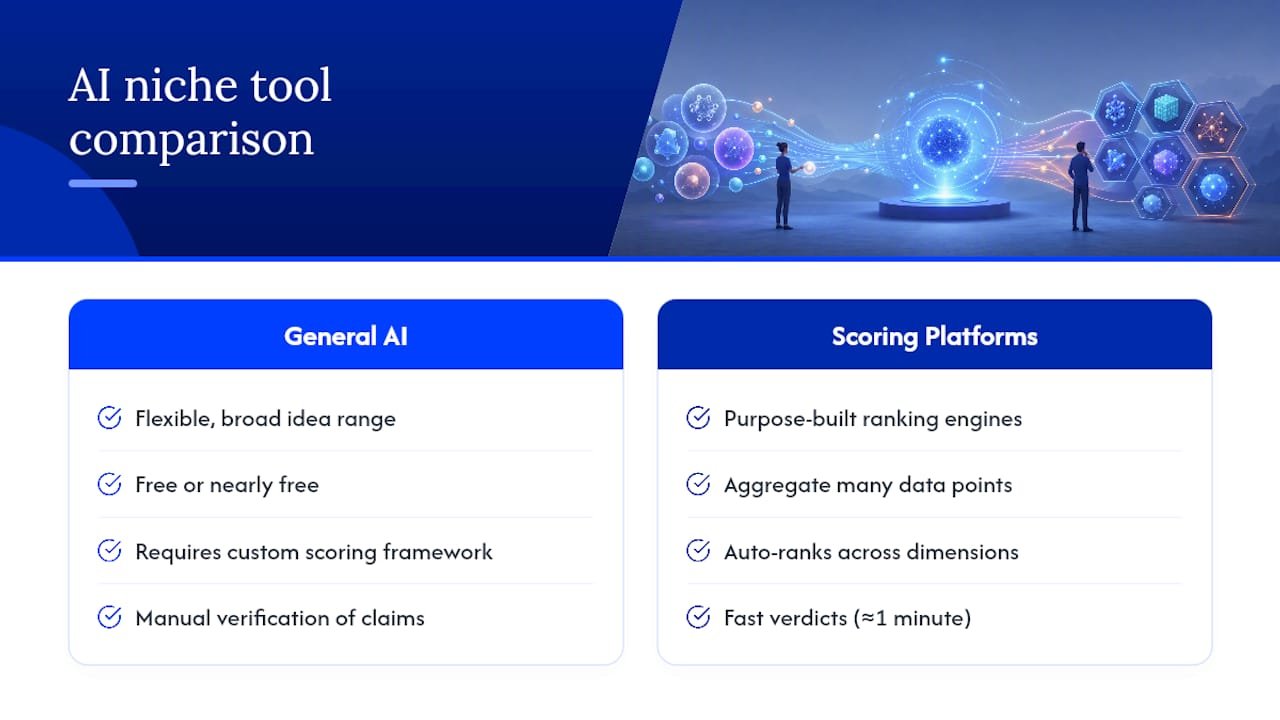
Neither replaces the other. The model generates ideas faster than any human could brainstorm; the scoring engine catches the ideas that look good only because the model hasn’t checked its own homework.
How Does AI Niche Research Fit With Traditional Market Research?
AI research is a speed layer, not a replacement for the fundamentals that market research has always relied on. Surveys, focus groups, and customer interviews still answer questions no model can: how someone actually feels about a problem, what language they use to describe it, and whether they’d genuinely reach for their wallet.
Where AI adds real value is in compressing the front end of the process. Instead of spending two weeks manually scanning forums and review sites for pain points, you can generate a ranked candidate list in an afternoon and spend your saved time on the interviews that actually matter.
The smartest founders treat AI output as a hypothesis generator and traditional methods as the confirmation layer. Run your AI-assisted shortlist through the same rigor a traditional researcher would apply: structured interview scripts, a landing page conversion test, maybe a small survey to a relevant community. The 5 to 15-minute customer conversations that validate a niche hypothesis today are the same conversations market researchers have run for decades. AI just gets you to the right people to talk to a lot faster than cold outreach ever could.
One area worth borrowing from traditional research: documentation discipline. Keep a simple log of every interview, every landing page test, and every piece of evidence you gather. AI tools make it tempting to move fast and skip the paper trail, but that log becomes invaluable later, whether you’re pitching a partner, raising money, or just deciding six months from now whether the niche still holds up.
Using AI for Trend Forecasting and Niche Timing
Timing kills more niches than competition does. A perfectly good idea launched two years too early, or two years too late, produces the same disappointing result: nobody buys.
AI models are genuinely useful here because they can process years of search trend data, social conversation volume, and job posting growth far faster than a human scanning charts one at a time. Ask a model to compare year-over-year search interest for a candidate niche against adjacent, more established categories, and you get a rough sense of whether you’re catching a wave early or arriving after it has already crested.
The practical technique is comparative trend analysis: pick two or three related niches, run the same trend query across all of them, and look for the one still climbing while its neighbors have flattened. That climbing-while-others-flatten pattern is one of the more reliable timing signals available to a solo founder without a dedicated research budget.
Forecasting has real limits, though. Models trained on historical data are structurally bad at spotting genuinely new categories, since there’s no trend line yet for something that didn’t exist a year ago. Treat any AI timing signal as directional, not predictive, and pair it with a qualitative check: are the earliest adopters in forums and communities excited, or just curious? Excitement that shows up as repeated, specific complaints about the status quo is a far stronger timing signal than a chart trending upward for reasons nobody can explain.
Speed Versus Defensibility: When to Push and When to Pause
I’d move fast the moment I see a clear paying signal paired with a real moat, proprietary data, a tight integration, or distribution nobody else has. That combination is rare enough to chase hard when it appears.
I’d pause when a niche is just a thin wrapper around someone else’s model with no real data advantage, or when the unit economics only work at a scale a solo founder will never reach. Speed without defensibility just gets you copied faster.
— Will
How Willbuckley Turns Niche Research Into a Launch Plan
This site offers playbooks and AI workflow coaching to help you validate a niche in two to four weeks, using a prompt-and-verify approach.

The landing pages you’ll find here skip the fluff and go straight to practical material: checklists you can run through in an afternoon, sample prompts you can copy directly into your own tools, and previews of the coaching content before you commit to anything. If your validated niche points toward a content or affiliate model, the AI workflow automation resources cover exactly how to turn a validated idea into a repeatable production system.
You can join a newsletter for weekly prompt breakdowns, download a launch playbook to see the format, or book a coaching discovery call to move from research to a working plan.
Where to Go Deeper on Niche Scoring and Validation
For methodology and niche lists, the defensibility framework from Alex Berman and the vertical niche breakdowns from Superframeworks are worth a close read. For hands-on scoring, MicroNicheBrowser and NicheCheck let you test ideas against real aggregated data before you write a line of code. For distribution planning once you’ve validated something, this backlink diversity guide covers the SEO side of getting found.
Sources
- AI SaaS Ideas That Actually Make Money (Validated)
- Top AI SaaS Niches to Build a Micro SaaS in 2026 | Superframeworks
- Unsaturated AI SaaS Niches 2026: Real Opportunity Data | BigIdeasDB
- MicroNicheBrowser — Find Validated Micro-Businesses Backed by 313,000+ Data Points
- NicheCheck – Find What Your Product Idea Should Become
FAQ
Which AI Niche Is Best Right Now?
There’s no single best AI niche, but narrow, workflow-specific categories with clear buyer pain consistently outperform broad, horizontal ideas. Vertical, domain-specific products tend to beat generic AI wrappers because they solve one problem well for a buyer who already pays for a worse solution.
What Are Some Current AI Research Topics Worth Exploring?
Regulatory filing assistance, insurance claims processing, and other repetitive, document-heavy workflows show up repeatedly as unsaturated opportunities. Content and affiliate niches tied to underserved software tutorials and job-posting trends also remain active hunting grounds.
What Is an AI Niche, Exactly?
An AI niche is a narrow market segment where an AI-powered product or service solves a specific, recurring problem for a defined group of buyers. The strongest examples pair genuine demand with some form of defensibility, whether that’s proprietary data, a deep integration, or a distribution channel competitors can’t easily copy.
How Can I Use AI to Actually Earn Money From a Niche?
Match your validated niche to the right product shape: content and affiliate for high-intent search niches, micro-SaaS for repetitive workflows buyers already pay to fix, or services if you have expertise but no product yet. Willbuckley’s affiliate marketing case study data walks through how one content and affiliate path played out in practice, and the 30-day launch playbook covers a fast route from validated idea to live content.