

The fastest path to automated, personalized lead qualification is an AI-assisted quiz funnel connected to CRM and email automation. This pairing turns a simple question flow into a system that scores interest, routes leads, and triggers follow-up without manual work. Below, you’ll find the feature checklist, the selection questions, and a tested build workflow so you can launch one with confidence.
TL;DR:
- AI quiz funnels are most effective for qualifying high- and mid-ticket leads, recommending products, or segmenting visitors immediately upon landing.
- Key features to prioritize include AI question generation, personalized scoring logic, seamless CRM integration, and thorough testing of data flow and Pixel firing before launch.
- Mapping quiz objectives, questions, and follow-up sequences beforehand prevents common pitfalls like data loss and misalignment with sales processes.
- Ongoing optimization should focus on downstream metrics like qualified lead rate and conversion rate, not just completion percentages.
- Compliance requires transparently disclosing AI involvement, managing consent properly, and avoiding sensitive inferences to mitigate legal risks.
Table of Contents
- What AI quiz funnels are and where they create value
- Core AI-driven features to look for in quiz funnel software
- How to choose the right AI quiz funnel solution for your business
- A tested workflow: build, launch, and automate an AI-powered quiz funnel
- Implementation checklist and a 7-step launch plan
- Measure and optimize: the metrics and tests that actually move revenue
- Privacy and compliance checklist for AI-driven quizzes
- Case studies and examples of successful AI quiz funnel campaigns
- Pricing models and total cost of ownership for AI quiz funnel tools
- Steps to design an effective AI quiz funnel strategy
- Common pitfalls and challenges when implementing AI quiz funnels
- Author’s perspective: when I use a quiz funnel versus a simpler lead magnet
- An adjacent alternative: Will Buckley’s coaching, playbooks, and AI workflows
- Sources
- FAQ
What AI quiz funnels are and where they create value
An AI quiz funnel is a short sequence: you ask a handful of questions, build a profile from the answers, show a personalized result, and hand that result to automated follow-up. The “AI” part usually means the questions, scoring logic, or result copy are generated or refined by a model instead of written from scratch.
This structure earns its place in a few specific situations. For high-ticket or mid-ticket offers, a quiz qualifies leads before a sales call ever happens, so you’re not wasting time on people who were never a fit. For e-commerce, a quiz acts as a product recommender, matching a shopper’s answers to a specific SKU or bundle instead of making them browse a catalog. For paid traffic and email, a quiz segments cold visitors into named buckets the moment they land, which makes every message after that feel tailored rather than generic.
The AI layer matters for three reasons. It generates a usable first draft of questions and result pages in minutes instead of hours. It can personalize result wording dynamically based on combinations of answers, not just on single branches. And every quiz you run collects zero-party data: information the person told you directly, which is more reliable than anything inferred from browsing behavior and holds up better as third-party tracking keeps shrinking. That data becomes the backbone of your segmentation long after the quiz session ends.
Core AI-driven features to look for in quiz funnel software
Not every “AI quiz builder” does the same job. When you’re comparing tools, focus on the features that actually change your workload and your conversion numbers, not the ones that just sound impressive in a demo video.
- AI question generation and templating: check how much editing a generated quiz actually needs before it sounds like you, not a generic template.
- Personalization and recommendation logic: some tools use simple rule-based branching, others use model-driven scoring that weighs multiple answers at once for sharper product matches.
- Follow-up automation: decide whether you need a built-in CRM and email sequence, or whether the tool should just hand leads off cleanly to the CRM you already use.
- Integrations: confirm support for ad pixels, UTM pass-through, your e-commerce platform, and connector tools like Zapier or Make.
- Operational features: embeddability on your existing site, mobile performance, payment capture if you’re selling directly, A/B testing, and an analytics dashboard you’ll actually check.
Vendor pages and review sites tend to highlight the same selling points across the board. Product listings on G2’s Involve.me reviews show that AI-assisted quiz generation, templates, and built-in CRM or email automation are the features vendors lead with, while reviewers more often flag integration gaps and export limits as the friction that shows up after launch.
Pro Tip: Before you commit to a tool, export a sample lead list during the trial and try importing it into your actual CRM. That five-minute test catches more problems than a week of reading feature pages.
How to choose the right AI quiz funnel solution for your business
Start by naming the job the quiz has to do. A paid-traffic lead capture quiz, an e-commerce product-recommendation quiz, and a high-ticket qualification quiz all need different logic, different result pages, and often different pricing shapes. Picking a tool before you’ve named the job is how teams end up paying for features they never use.
Once you know the job, run the comparison against a short set of criteria:
- Speed to launch: how long from signup to a working, embedded quiz.
- Level of AI assistance: does it draft real question copy, or just offer a blank template?
- Integrations: does it connect directly to your CRM and ad platforms, or only through a workaround?
- Data ownership and export: can you pull your full lead list and quiz answers out cleanly at any time?
- Pricing shape: per-lead, flat monthly, or per-seat, and which one matches your traffic volume?
Before you buy, put any shortlisted tool through the same trial checklist:
- Build a working quiz in under 30 minutes using only the in-app tools.
- Map quiz fields to your actual CRM fields, not a demo account.
- Send test traffic through and confirm UTMs survive the full journey.
- Check that analytics and export both return the data you expect, not a summary.
Watch for a few red flags during the trial: export limits buried in the pricing page, vague language about where quiz data is stored, or no way to tag leads by which quiz variant they came from. Reviews on sites like Capterra’s Brandquiz listing commonly point to integration friction and export restrictions as the complaints that surface once a trial account becomes a paying one, so ask about both directly before you sign up for anything annual.
A tested workflow: build, launch, and automate an AI-powered quiz funnel
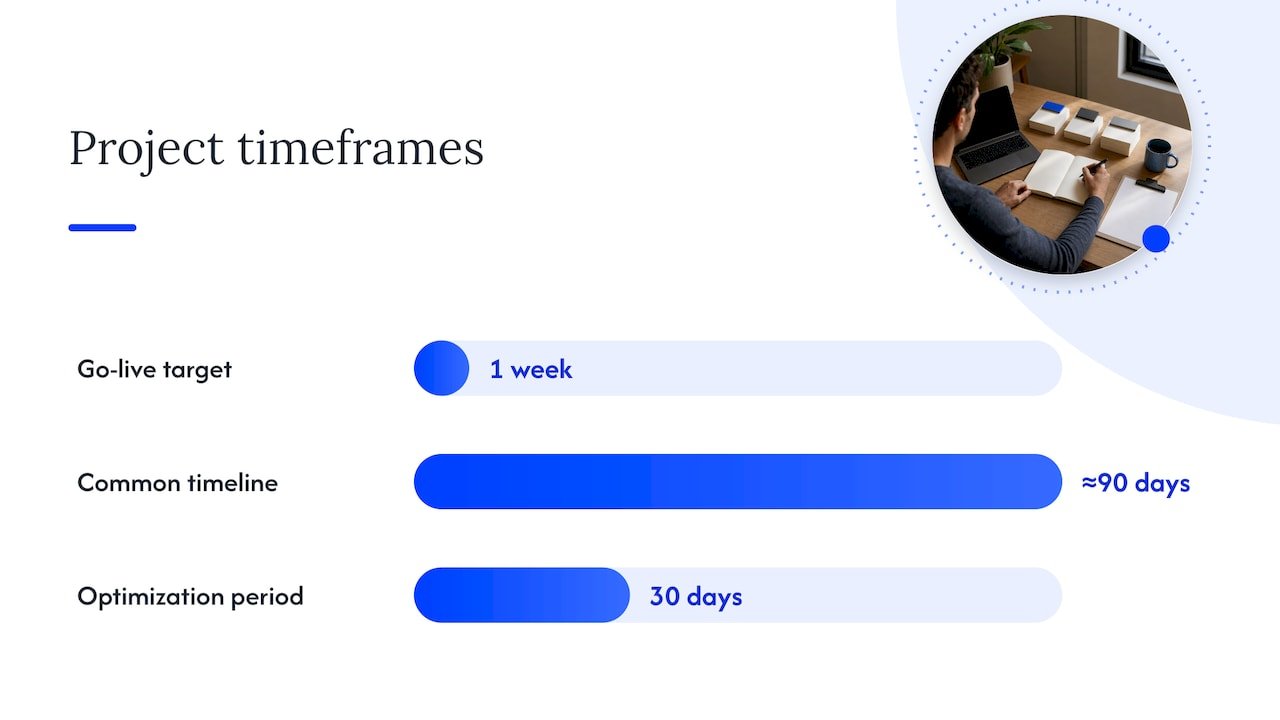
This is a workflow used with affiliate marketers who need a quiz live within a week, not a quarter. It assumes you’ve already picked a tool; this is what you do inside it.
- Set the objective and the mapping. Decide the single conversion event the quiz needs to drive, whether that’s a booked call, an email opt-in, or a product click. For each possible quiz result, write down exactly what it should trigger in your CRM: which list, which tag, which email sequence. Keep the required data fields to the minimum you’ll actually use.
- Draft with AI, then edit by hand. Use the model to generate a first pass of question stems and result copy based on your offer and your ideal buyer. Then edit every line so it matches the promise on your landing page. A quiz that overpromises in the result screen creates refund requests later, not conversions.
- Build the logic. Pick a template close to your use case, configure scoring or branching, and set each result to route into the matching CRM list and email sequence from step one.
- Run the QA checklist before live traffic. Click through every branch path yourself. Confirm UTMs pass through to the thank-you page and into your CRM. Verify ad pixels fire on the result screen, not just the landing page. Check that your consent prompt appears and actually blocks tracking scripts until someone opts in.
- Set a 30-day optimization cadence. Review performance by cohort, not in aggregate. Run small A/B tests on one variable at a time, starting with question order and result wording, since those tend to move numbers faster than cosmetic design changes. Feed what you learn back into the offers your results point to.
Pro Tip: Write your result-page copy before you write the questions. Working backward from the promise keeps every question earning its place instead of padding out the quiz for its own sake.
This sequence works because each step removes a specific failure point. Skipping the mapping step is why leads end up in the wrong CRM list. Skipping the QA step is why a quiz runs for two weeks with a broken pixel before anyone notices. If you want a deeper, time-bound version of this build process applied to a full affiliate funnel, the 30-day AI affiliate funnel playbook walks through the surrounding pieces step by step.
Implementation checklist and a 7-step launch plan
Treat this as the short version of the workflow above, the one you can tape next to your monitor on launch day.
- Prelaunch: write the objective, the CRM mapping, and your consent and privacy approach before opening the quiz builder.
- Pick a template that’s structurally close to your use case rather than one you’ll have to rebuild from scratch.
- Build the quiz and embed it, either on an existing page or as a standalone landing page.
- Map every field from the quiz to the matching CRM field, confirming tags and list assignments by result.
- Run smoke tests on every branch, confirm pixel firing, and check UTM pass-through end to end.
- Launch to a small slice of traffic first, watch closely for the first 48 hours, and hold off on any major changes for 72 hours so you’re reading real signal, not noise.
- Set a weekly check-in for the first month, run your first A/B test once you have a baseline, and do a full cohort review at the 30-day mark.
The order matters more than the list itself. Teams that launch before mapping fields lose leads quietly, and teams that change three things at once in week one can’t tell which change helped.
Measure and optimize: the metrics and tests that actually move revenue
Completion rate feels like the obvious metric, but it’s mostly a vanity number. A quiz can finish at 90% and still generate leads that never buy. What matters is what happens after someone finishes.
- Qualified lead rate: the share of completions that meet your actual sales criteria, not just an email address.
- Downstream conversion rate: how many quiz leads convert to a sale, booked call, or subscription.
- Average order value and lifetime value by cohort: segmented by which quiz result someone landed in, so you can see which result type produces your best customers.
Set up tracking before you need it: map every quiz field to a CRM field, keep UTMs intact through the whole journey, and tag each lead with a cohort identifier tied to the quiz version they saw. Without that tagging, you can’t tell a good quiz from a lucky traffic week.
Reviewer and vendor data on platforms like Involve.me’s G2 listing consistently names A/B testing and analytics dashboards among the features marketers rely on most, which signals that testing capability, not just quiz design, is what separates tools that pay for themselves from ones that don’t.
Run A/B tests on one variable at a time: question order, result-page messaging, CTA placement, and whether a result is gated behind an email opt-in or shown immediately. Then read cohort performance at 30 and 90 days, not just the first week, to see whether the quiz is lifting lifetime value or just moving front-end conversions around without adding real revenue.
Privacy and compliance checklist for AI-driven quizzes
Quiz funnels collect answers, infer intent, and often feed that straight into a CRM, which puts them squarely inside data protection rules even when nobody on the team thinks of a quiz as “AI” in the regulatory sense.
- Disclose AI involvement where required. The Confir EU AI Act guidance for marketing and adtech explains that Article 50 transparency duties apply to chatbots and generative outputs, and that a content-marking deadline of December 2, 2026 applies to synthetic creative, so build a simple disclosure pattern into any interactive or AI-generated quiz element now.
- Document your lawful basis. ICO guidance on lawfulness in AI notes that inferences drawn from quiz answers can count as personal data, so profiling built from quiz results needs a recorded lawful basis, not an assumption.
- Build consent properly, not as an afterthought. ICO guidance on managing consent is clear that consent prompts must be accessible on mobile and that inactivity never counts as valid consent, which matters when a quiz loads tracking scripts before someone has answered a single question.
- Avoid sensitive inferences. Keep quiz questions away from health, finances, or anything that could let scoring logic infer a protected characteristic you never asked about directly.
These aren’t abstract legal footnotes. A quiz that skips consent setup or mishandles inferred data can undo months of careful funnel work the first time someone complains.
Case studies and examples of successful AI quiz funnel campaigns
The clearest pattern across published examples is that quizzes perform best when the result maps to a specific, narrow next step rather than a general “thanks for playing” message. E-commerce brands running product-recommendation quizzes report the quiz’s real value in matching shoppers to a specific product or bundle, which shortens the decision instead of adding another step to it.
In the affiliate and info-product space, the same logic plays out differently. A quiz that sorts visitors into a handful of buyer profiles, say “just starting out” versus “already running paid ads,” lets each group see a different recommended offer and a different email sequence from the very first message. That segmentation is the actual win, more than the quiz experience itself.
The common thread across these examples is that the quiz is never the product. It’s a sorting mechanism that feeds a specific offer to a specific person faster than a generic landing page could. Teams that treat the quiz as the finish line, celebrating completion rate and stopping there, tend to see the excitement fade within a month because nothing downstream was built to catch the leads it produced. If you want to see how this kind of segmentation plays out across a full funnel rather than a single quiz, the real affiliate marketing case study breakdown is worth a look.
Pricing models and total cost of ownership for AI quiz funnel tools
Most AI quiz funnel tools price one of three ways: a flat monthly subscription regardless of volume, a per-lead or per-response charge that scales with traffic, or a per-seat model aimed at agencies and larger teams. Each shape fits a different stage of business, and picking the wrong one is one of the easiest ways to overpay.
A flat monthly plan suits steady, moderate traffic where you know roughly how many leads you’ll capture each month. Per-lead pricing can look cheap at low volume but gets expensive fast once a campaign takes off, so model your cost at double your expected traffic before committing. Per-seat pricing mostly matters once you have more than one person building or managing quizzes.
Total cost of ownership runs higher than the sticker price suggests. Beyond the subscription, budget for the integration work to connect the quiz to your CRM and email platform, the time spent editing AI-generated questions so they sound like your brand, and the ongoing cost of running A/B tests and reviewing cohort data every month. None of that shows up on a pricing page, but all of it determines whether the tool pays for itself. Before signing an annual contract, run the numbers on a monthly plan for at least one full cycle so you’re not locked in before you’ve confirmed the integration actually holds up under real traffic.
Steps to design an effective AI quiz funnel strategy
A quiz funnel strategy starts with the offer, not the questions. Decide exactly what you want someone to do after they see their result: book a call, buy a product, or join an email list for a specific sequence. Every question in the quiz should exist to sort people toward the result that leads to that action.
From there, map your buyer types before you touch the quiz builder. If you serve three distinct audiences, write out what each one needs to hear differently, then build your branching logic around those three paths rather than letting the tool’s default template dictate your structure.
Next, decide how much weight each question carries in the scoring. Not every question deserves equal influence. A question that reveals budget or urgency should usually carry more weight than one that’s mostly for personalization flavor.
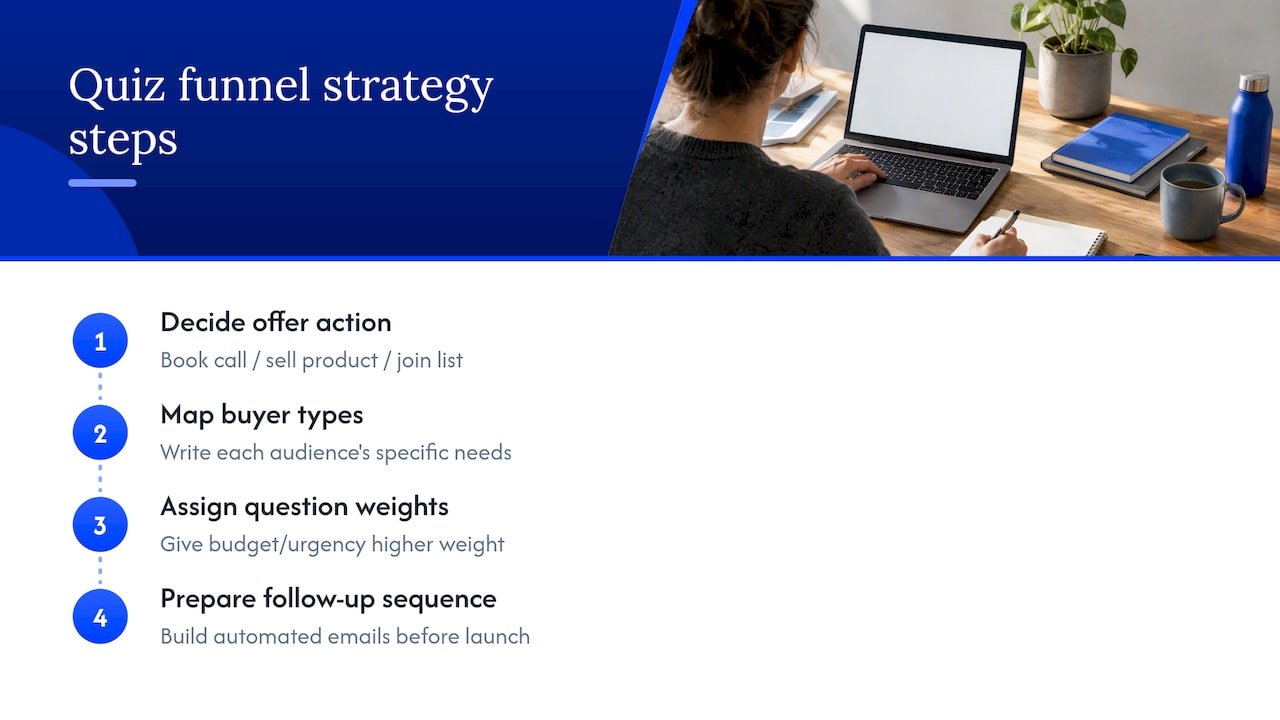
Finally, build your follow-up sequence before you launch the quiz, not after. A quiz result with no automated email behind it is a dead end, and a quiz that drives traffic for weeks before anyone writes the follow-up sequence is wasted attention. The AI workflow automation guide for affiliate marketers covers how to pair this kind of sequence design with the rest of your automation stack so the handoff from quiz to inbox is seamless from day one.
Common pitfalls and challenges when implementing AI quiz funnels
The most common mistake is treating the AI-generated draft as the finished product. Generated question stems and result copy are a starting point, and skipping the edit pass usually produces a quiz that sounds generic and promises things your actual offer doesn’t deliver.
The second pitfall is building the quiz before deciding what happens to the data. Teams frequently launch, collect a few hundred responses, and only then realize nothing was mapped to the CRM correctly, which means that early traffic is effectively lost.
A third issue is over-gating. Asking for an email address before showing any value at all raises abandonment, while waiting too long to capture contact information means losing leads who finish the quiz but never convert on the result page. Testing where that gate sits is worth more attention than most teams give it.
Compliance gets skipped more often than it should. A quiz that fires tracking pixels before consent is confirmed, or that infers something sensitive from answers never meant to be sensitive, creates risk that’s entirely avoidable with a short setup checklist.
Finally, teams abandon quizzes too early because they judge success by completion rate alone instead of downstream revenue. A quiz with a modest completion rate that produces high-value leads is doing its job; a quiz with a flashy completion rate and no sales to show for it isn’t. The two conversion optimization workflows for affiliates walk through how to test past this exact trap.
Author’s perspective: when I use a quiz funnel versus a simpler lead magnet
I reach for a quiz when the offer is complicated enough that a single lead magnet can’t do the sorting on its own, think product recommendations, high-ticket qualification, or an audience with genuinely different needs. In those cases, the few extra minutes someone spends answering questions pays for itself in sharper follow-up.
I skip the quiz when attention is thin, like a cold ad that needs a decision in seconds, or when the offer is simple enough that a basic opt-in gets the job done without adding friction. Not every funnel needs a sorting mechanism.
What a quiz can’t replace is judgment about your own offer and audience, and that’s where coaching or a tested playbook earns its keep. It shortens the trial-and-error most people go through alone.
— Will
An adjacent alternative: Will Buckley’s coaching, playbooks, and AI workflows
If building all of this from scratch feels like more setup than you want to manage solo, coaching and playbooks are available for exactly that gap. Instead of researching every tool and testing every workflow yourself, you get a shorter path: a launch playbook, ready-to-edit prompt recipes for question and result copy, tracking templates for CRM mapping, and an implementation checklist built from funnels that have already been through the trial-and-error stage.
This fits best for affiliate marketers and small teams who want to launch a working funnel in days rather than weeks, and who would rather follow a tested sequence than debug integration problems alone at midnight. It won’t replace picking the right software for your audience, but it removes most of the guesswork around how to set that software up correctly the first time.
- A launch playbook covering objective-setting, mapping, and QA in one sequence.
- Prompt recipes for drafting quiz questions and result pages faster.
- Tracking templates that map quiz fields directly to common CRM setups.
If you want a done-with-you starting point instead of building this alone, check out the YouTube Automation Affiliate Marketing launch playbook for a workflow you can adapt to your own quiz funnel rollout.
Sources
- EU AI Act for Marketing & Adtech (2026) | Confir
- How do we ensure lawfulness in AI? | ICO
- Involve.me reviews | G2
- How do we manage consent in practice? | ICO
FAQ
What is the best AI for quiz taking?
There isn’t one tool that fits every use case, since the right choice depends on whether you need lead qualification, product recommendations, or audience segmentation. Compare options on AI-assisted question generation, CRM integration, and export access rather than picking by name recognition alone.
Is there an AI funnel generator available?
Yes, several quiz and funnel builders now include AI-assisted generation for questions, scoring logic, and result pages, as shown in feature listings on G2’s Involve.me reviews. Most still require human editing to match your brand voice and offer before you launch.
Which quiz funnel software is the best?
The best choice matches the specific job: paid-traffic lead capture, e-commerce recommendations, or high-ticket qualification each favor different features. Run a short trial focused on integration, export access, and pricing shape before committing to an annual plan.
Is there an AI that creates quizzes?
Yes, most modern quiz builders include AI tools that draft question stems and result copy from a short brief about your offer and audience. Treat the output as a first draft and edit it for accuracy and tone before sending it to live traffic.