

To rank in AI answers, make at least one clearly snippable passage on your page and ensure AI crawlers can read it. Start with three moves: write a concise short answer near the top of your page, confirm OAI-SearchBot and GPTBot can access that page, and set up a simple way to track when you get cited. Everything else builds on those three habits, so testing and measurement come next.
TL;DR:
- Submit clear, snippable answers early on your page and ensure OAI-SearchBot and GPTBot have unrestricted crawl access to improve AI citation chances.
- Structure content with headings matching common queries, use tables and numbered lists, and avoid hiding key information in collapsible elements or behind JavaScript.
- Focus on achieving multiple independent sources with corroborating claims to boost the confidence of AI systems citing your content.
- Monitor your AI citation visibility regularly through a routine that tracks appearance rate, first-position shares, and referral traffic from chat interfaces.
- Adjust and rewrite the exact passages cited by AI engines, especially those on long-tail queries, to improve the likelihood of winning citations over competitors.
Table of Contents
- What AI answer ranking actually means for marketers
- How AI engines decide what to cite and in what format
- Technical eligibility: crawl access, bots, and site settings that matter
- How to structure content so AI can lift clean passages
- What to measure to know if your AI visibility is working
- Reverse-engineer the exact passage AI cited and rewrite to win it
- Practitioner workflows from Will Buckley: GEO tactics and templates
- Common mistakes that keep content out of AI answers
- What successful AI answer optimization looks like in practice
- Why AI visibility deserves its own strategy, not an afterthought
- How Will Buckley can help you implement this
- FAQ
- Sources
What AI answer ranking actually means for marketers
AI answer ranking is the process of getting your content pulled into the direct answers that tools like ChatGPT, AI Overviews, and AI Mode generate instead of (or alongside) a list of blue links. It is a different game from classic SEO, and you’ll feel that difference fast once you start checking who gets cited.
CiteLens research looked at 471 queries and found that AI Overview citations overlap with Google’s organic top 10 only about 25% of the time. Even more telling, most of the domains an AI Overview cites do not appear in Google’s top 10. That means a page that ranks on page one in Google can be invisible in an AI answer, and a page buried in Google can get cited directly.
For you, that gap is the opportunity. It means you need a separate tracking habit and a separate content checklist for AI visibility, rather than assuming your Google rankings will carry over automatically.
How AI engines decide what to cite and in what format
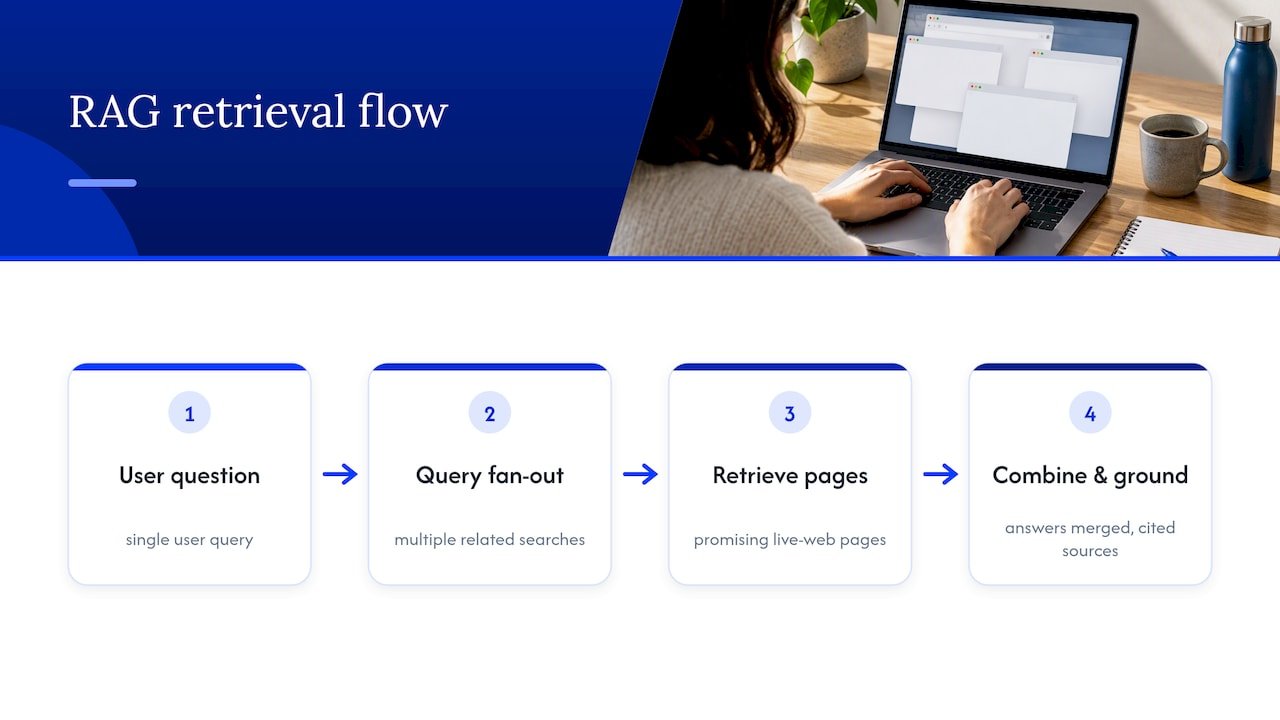
Most AI answer engines, including Google’s AI Overviews and AI Mode, lean on retrieval-augmented generation, often shortened to RAG. In plain terms, the model does not just recall facts from training. It searches the live web, retrieves a handful of promising pages, and grounds its answer in whatever it pulls back, according to Google’s developer guidance. Many systems also run query fan-out, breaking your one question into several related searches before combining the results into a single answer.
That retrieval step rewards content that is easy to lift. Microsoft Advertising’s guidance points to clear structure: headings that match real questions, concise answers, lists, and tables all raise the odds that a passage gets pulled whole into an AI response. The engines parse pages into smaller pieces, and the pieces that read as complete thoughts on their own travel best.
Corroboration matters too. When several independent sources, including reviews, forum threads, and videos, say roughly the same thing, that consensus gives an AI system more confidence to repeat the claim. A single well-written page rarely wins on its own; it tends to win alongside a pattern of agreement elsewhere.
Technical eligibility: crawl access, bots, and site settings that matter
None of your content formatting matters if the crawlers cannot read the page in the first place. OpenAI documents OAI-SearchBot and GPTBot and recommends allowing OAI-SearchBot in your robots.txt file specifically so your content can appear in ChatGPT search results. OpenAI’s help center adds that your host or CDN also needs to allow traffic from OpenAI’s published IP addresses, since blocking at the network level defeats a robots.txt allowance.
Run through this before anything else:
- Confirm robots.txt allows OAI-SearchBot and GPTBot, not just Googlebot.
- Check that your key pages return HTTP 200 and are not accidentally blocked by a CDN rule or WAF.
- Test whether your answer content renders in plain HTML rather than hiding inside a tab, accordion, or JavaScript-only component.
- Use clear ARIA labeling and semantic HTML, since accessibility cues also help AI browsing tools like ChatGPT Atlas parse page structure.
Because user-agent strings can be spoofed, OpenAI’s documentation and security practitioners both recommend pairing robots.txt rules with IP-range filtering, so you allow the real bot without opening the door to impersonators.
How to structure content so AI can lift clean passages
Once a crawler can reach your page, the next job is making your best answer easy to extract whole. Write a self-contained paragraph of 40 to 80 words near the top of the page that answers the core question directly, with no setup or throat-clearing. Align your H1 and first H2 with the actual question a reader typed, since Google’s AI features and Microsoft’s own guidance both point to clean heading structure as a strong signal for what a page is about.
From there:
- Turn factual comparisons into small tables rather than paragraphs full of qualifiers.
- Use numbered steps for any process, and keep each step to one action.
- Add a one or two sentence summary capsule under major headings, stating the claim plainly before you explain it.
- Keep your most important facts out of accordions, sliders, or image-only graphics, since text locked inside those formats is often invisible to a crawler.
Writing capsules like this works well for long-form guides and even video pages. A related breakdown of AI YouTube SEO shows how short, direct transcript fixes won citations for creators the same way a tight paragraph wins them for an article. The Best AI Writing Tools guide can also speed up rewriting a bloated intro into something snippable.
Pro Tip: Read your opening paragraph out loud. If it takes a run-up before it answers the question, an AI system will likely skip past it for a competitor’s tighter version.
What to measure to know if your AI visibility is working
Tracking AI answer visibility takes different habits than watching organic rankings, mostly because there is no single dashboard that covers every engine yet. Build your own simple routine around a few numbers.
Track these on a recurring basis:
- Visibility score: the share of your tracked queries where you appear anywhere in an AI answer.
- Top-position rate: how often you are the first or only citation, rather than one of several.
- Appearance frequency: how consistently a specific page shows up across repeated runs of the same query.
- Referral tracking: ChatGPT links carry a utm_source=chatgpt.com tag, according to OpenAI’s publisher FAQ, so you can isolate that traffic in your analytics.
A workable sampling routine is to run your 10 to 20 priority queries once a week across the engines you care about, logging which engine answered, what it said, and which domains it cited. Divide the weeks you appeared by the weeks you ran the query to get an appearance rate you can trend over time. A practical keyword research workflow can help you pick and refine that query list.
When AI appearance diverges sharply from your organic traffic, pay attention. A page with strong Google rankings but zero AI appearances is worth rewriting first, since it shows the content works for classic search intent but is not formatted for extraction. Pew Research has found that users click fewer links when an AI summary appears on the results page, which raises the stakes for winning the citation itself rather than settling for a lower-ranked blue link underneath it.
Reverse-engineer the exact passage AI cited and rewrite to win it
Once you know a competitor, or you, got cited for a query, the fastest path to improvement is working backward from that exact answer. This is the core loop worth running every time you test a new page.
- Query the target question across two or three AI engines and save the full response text.
- Capture the citation list and note which domains and URLs were used.
- Locate the exact passage on the cited page that matches the AI’s wording, usually a sentence, list item, or table row.
- Compare that passage against your own page’s equivalent section, checking for length, structure, and specificity gaps.
- Rewrite your version to be more concise, more concrete, and formatted the same way the winning passage was (list versus paragraph versus table).
- Republish and note the date, so you know when to expect a possible change in citation behavior.
- Monitor the same queries over the following weeks and log whether your appearance rate moves.
Quick fixes that tend to pay off fast: add a one or two sentence capsule directly above a dense paragraph, convert a comparison paragraph into a three or four row table, and add a sentence of plain descriptive context around any brand or product name so the engine has something concrete to ground the mention in.
Pro Tip: Test one phrasing change per query cycle. If you change the intro, the table, and the heading all at once, you won’t know which fix actually moved your appearance rate.
When you want to measure the lift from a specific edit, hold a small set of queries steady before and after the change, and compare appearance rate across the two periods rather than relying on a single lucky result.
Practitioner workflows from Will Buckley: GEO tactics and templates
My own workflow leans on three reusable templates: a short answer capsule for any factual question, a one-paragraph product summary that states what a tool does before any opinion, and a short comparison table template with three or four rows maximum. The audit itself follows the same loop every time: check crawl access, run the target queries, find the cited passage, edit the matching section on my page, then track appearance rate for a few weeks. For a deeper walkthrough of the full method, the Generative Engine Optimization playbook and the 90-day AI content strategy cover the longer arc beyond single-page fixes.
Common mistakes that keep content out of AI answers
Most pages that get ignored by AI answer engines share the same handful of problems, and they’re easy to fix once you know to look for them.
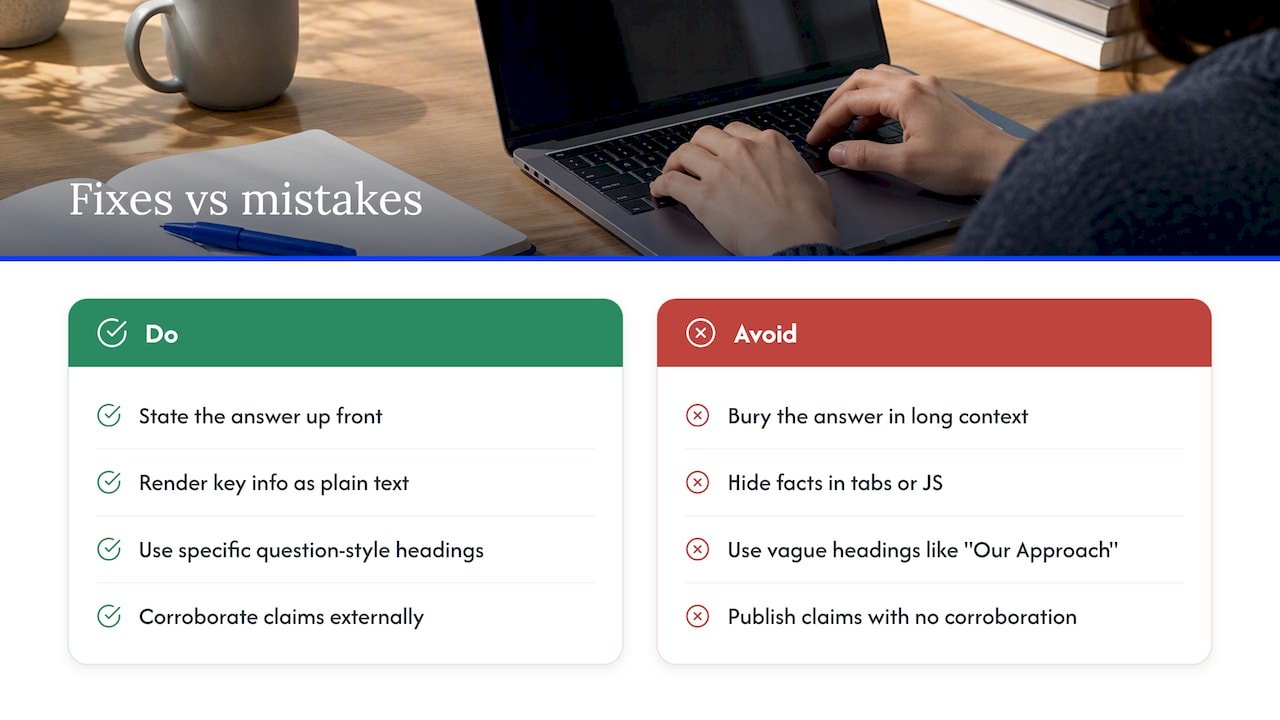
The most common issue is burying the answer. A page that spends three paragraphs on history and context before stating the actual fact gives the model nothing clean to lift, so it moves to a competitor’s page instead. A close second is locking key information inside tabs, accordions, or JavaScript components that never render as plain text, which several engines simply cannot read.
Overly broad or vague headings cause trouble too. A heading like “Our Approach” tells an AI system nothing about what question the section answers, while “How long does X take” maps directly onto a real query. Thin corroboration is another quiet killer: if your claim appears nowhere else on the web, in a review, a forum thread, or a video, the engine has less reason to treat it as reliable enough to repeat.
Blocking or restricting OAI-SearchBot and GPTBot in robots.txt, often by accident through an overly broad disallow rule, is a purely technical mistake that rules a page out before content quality even enters the picture. Google’s own guidance also warns against stuffing pages with scaled, inauthentic content purely to game AI features, since that tends to get filtered rather than rewarded.
What successful AI answer optimization looks like in practice
The clearest pattern among pages that win AI citations is simple: they answer the question in the first few sentences, then back that answer with a structured block, a list, a table, or a short set of numbered steps, right below it.
Pages that previously ranked well in Google but rarely got cited in AI answers tend to improve once their lead paragraph is rewritten into a direct, self-contained answer and a supporting table replaces a paragraph of qualifiers. The shift usually shows up first in appearance rate for a narrow set of queries, often the most specific, long-tail ones, before it shows up on broader terms where competition for the citation is heavier.
Video content follows the same logic. The AI YouTube SEO breakdown shows that fixing a transcript to include a clear, spoken-out-loud answer near the start of the video, rather than burying it in a long intro, improved how often that content showed up as a cited source. The underlying principle carries across formats: give the engine a clean, quotable answer early, and support it with a format the model can lift intact.
Why AI visibility deserves its own strategy, not an afterthought
Treat AI answer visibility as its own channel with its own KPIs, not a side effect of good SEO. Run small, specific experiments with a clear before-and-after query set, and judge success by whether the traffic you win converts, not just by how often your name shows up.
— Will
How Will Buckley can help you implement this
Affiliate marketers and small teams juggling a growing content library rarely have time to run a reverse-engineering workflow on every page by hand, which is a common gap coaching and guides in this area aim to close. A practical, AI-driven approach can turn the steps in this article into templates users can apply directly, rather than theory they have to translate themselves.

What that looks like in practice:
- Page-by-page audits that check crawl access, heading structure, and snippable passages.
- Rewrite templates for capsules, comparison tables, and product summaries usable across a content library.
- A monitoring setup to help determine whether a rewrite affected appearance rate.
If you want a concrete starting point, the AI Content Strategy: A 90-Day Rollout lays out a full plan for turning these individual fixes into a program you can run across your whole site.
FAQ
What are the 7 levels of AI?
There is no single, universally recognized “7 levels of AI” framework in AI search or SEO guidance, and the term is used differently across sources. If you encounter it in a specific context, check that source’s own definitions rather than assuming a standard scale applies.
Which AI has the best answers?
No independent, sourced ranking establishes one AI engine as having the best answers overall, and the right one depends on the query type and how each engine retrieves and cites sources. What matters more for visibility is that Google’s AI features and OpenAI’s ChatGPT search each pull from different domains, so being cited by one does not guarantee citation by another.
What is the best AI ranking?
There is no fixed “best” ranking position in AI answers the way there is a number one spot in Google, since most AI responses cite a handful of sources rather than a ranked list of ten. The more useful goal is consistent appearance across your priority queries, tracked as an appearance rate over time.
How do you rank on AI?
You improve your odds by making sure AI crawlers like OAI-SearchBot and GPTBot can access your pages, then writing a concise, self-contained answer near the top backed by a list or table. Microsoft Advertising’s guidance and OpenAI’s crawler documentation both point to structure and crawl access as the two levers with the clearest evidence behind them.
Do AI answers replace the need for traditional SEO?
CiteLens found that AI Overview citations overlap with Google’s top 10 only about 25% of the time, which means you need both a classic SEO approach and a separate AI-specific content check.
Sources
- AI vs Google: They Don’t Cite the Same Sites — CiteLens
- Overview of OpenAI Crawlers
- ChatGPT Search | OpenAI Help Center
- Optimizing Your Content for Inclusion in AI Search Answers | Microsoft Advertising
- AI features and your site — Google Developers