

Ethical AI marketing means building fair, transparent, privacy preserving, and accountable AI practices across every campaign, and the first step is governance. That starts with naming someone responsible, running a materiality check on where AI touches consumer decisions, and beginning audits before you scale anything. The checklists and standards you need to do this properly are all below.
TL;DR:
- Conduct bias scans on real audience data and run counterfactual checks to identify representation, historical, and label biases in marketing AI models.
- Designate an AI disclosure lead, implement a clear policy, and pilot ethics practices on high-complaint workflows before scaling across campaigns.
- Use existing frameworks like NIST, IAB, and UNESCO to streamline trustworthiness, transparency, and accountability in AI marketing practices.
- Collect only necessary data, document training data sources, and ensure compliance with privacy, consent, and legal standards from the start.
- Disclose AI involvement only when it would influence consumer perception or decision, pairing labels with provenance metadata for meaningful transparency.
Table of Contents
- Core ethical principles for marketing AI
- Practical implementation steps for marketing teams
- Aligning with standards and frameworks
- Data privacy, consent, and compliance considerations
- Bias detection and fairness testing for marketing models
- Transparency and consumer-facing disclosure best practices
- Measurement, auditing, and ongoing monitoring
- Author perspective: Will Buckley’s practical view for affiliate and performance marketers
- The gap between ethics policy and ethics practice
- How our coaching and playbooks help you put this into practice
- FAQ
- Sources
Core ethical principles for marketing AI
Fairness, transparency, privacy, accountability, reliability, and explainability sound abstract until you attach them to campaign work you actually do. Fairness means your targeting model does not quietly exclude or mistreat a group based on proxy signals buried in your data. Transparency means a customer can tell when a chatbot, not a person, is answering them. Privacy means you collect only what a campaign needs and can explain why. Accountability means someone’s name is attached to the AI decisions your team makes, not a vague “the algorithm did it.”
These principles map onto everyday marketing work in specific ways:
- Personalization: fairness and privacy decide whether targeting feels helpful or invasive, as explored in detail in AI ad personalization: boost engagement with smarter ads – Palmador Blog.
- Creative generation: transparency and explainability decide whether AI-made ads need a label.
- Audience targeting: fairness and reliability decide whether lookalike models discriminate.
- Chatbots and support: accountability and transparency decide whether disclosure is required.
Get these wrong and you risk opt-outs, complaints, and in some markets, legal exposure. Get them right and you build the kind of trust that keeps people clicking.
Practical implementation steps for marketing teams
Most teams treat ethics as a document nobody reads. Make it a workflow instead.
- Name an AI Disclosure Lead who owns the policy, reviews flagged campaigns, and signs off before launch.
- Write a short AI use policy that defines what counts as “material” AI use and what always needs disclosure.
- Run a pre-deployment risk assessment on any new model or use case, including a bias scan and documentation of where training data came from.
- Train the people who actually write briefs and launch campaigns, not just the compliance team.
- Set up a reporting channel so staff or customers can flag a concern, with a defined remediation path.
- Pilot the whole process on one workflow, such as a single funnel’s ad creative, before rolling it out everywhere.
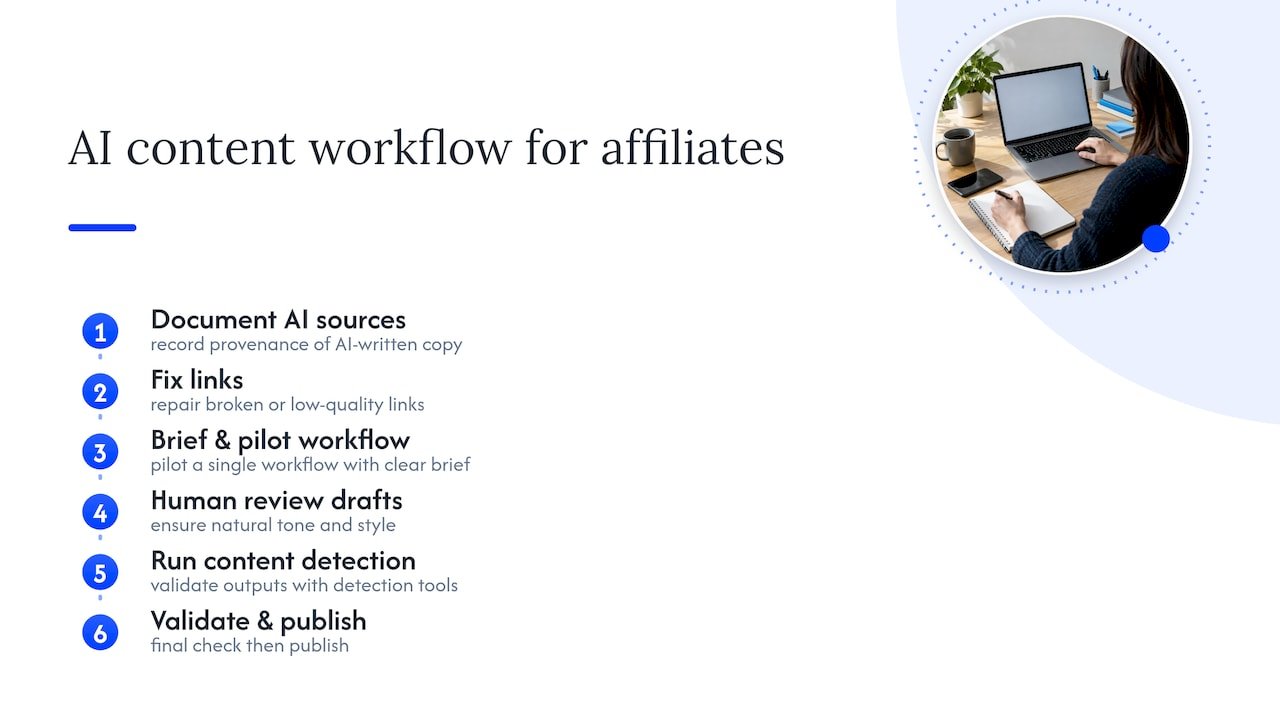
We follow a similar logic in our content work: documenting sources for AI-assisted drafts, addressing broken or synthetic-feeling links before scaling automation, and maintaining a human voice in customer-facing materials. This approach is illustrated in a 90-day content rollout focused on documentation and disclosure from the start.
Pro Tip: Start your pilot on the funnel with the most customer complaints, not the one with the most revenue. You will learn faster from friction than from a quiet success.
Aligning with standards and frameworks
You do not need to invent your own ethics framework. Three existing ones cover almost everything a marketing team needs.
- The NIST AI Risk Management Framework defines trustworthy AI as valid and reliable, safe, secure, accountable, explainable, privacy-enhanced, and fair, and it expects you to balance these against your actual use case rather than treat them as a checklist.
- NIST’s Generative AI Profile adds specific guidance for marketing teams using generative tools: document where training data came from, and scale your red-teaming and validation to the risk level of what you are shipping.
- The IAB’s AI Transparency and Disclosure Framework takes a materiality approach: disclose when AI use could change how a consumer perceives or decides something, and pair a visible label with machine-readable provenance metadata.
- UNESCO and Thomson Reuters Foundation research on AI governance stresses that transparency only matters if you can also show who is accountable and how problems actually get fixed.
Translate each into one control: NIST gives you a testing rigor standard, IAB gives you a labeling decision rule, and UNESCO gives you the accountability structure that ties the first two together.
Data privacy, consent, and compliance considerations
AI-driven marketing runs on data, and the ethical version of that relationship starts with restraint. Collect only what a given campaign needs, write down why you need it, and build that minimalism into your systems rather than bolting privacy on afterward.
- Run a Data Protection Impact Assessment whenever AI-driven profiling meaningfully affects how someone is treated or targeted.
- Vet every vendor and model in your stack for where their training data came from and what contractual protections you have if something goes wrong.
- Work with legal and security on opt-out mechanics, automated-decision rights, and audit logs before launch, not after a complaint.
- Keep documentation current enough that you could explain any targeting decision to a regulator or a customer on short notice.
None of this needs to slow your team down if it is built into your launch checklist from the start.
Bias detection and fairness testing for marketing models
Bias in marketing AI usually shows up in one of three forms: representation bias, where training data underrepresents a group; historical bias, where past campaign data bakes in old inequities; and label bias, where the outcome you optimized for was itself skewed. All three quietly shape who sees your ads and what they get offered.
- Test with holdout datasets that mirror your real audience, not a convenient sample.
- Run counterfactual checks: change one demographic signal and see if the output shifts unfairly.
- Use synthetic audits to probe edge cases your live data rarely surfaces.
- Add human review for any output tied to pricing, eligibility, or sensitive categories.
Larger or higher-risk marketing AI, like predictive scoring or synthetic media in ads, needs stronger red-teaming and external evaluation, according to NIST’s risk management guidance, which recommends scaling validation to the actual risk of the use case rather than applying one standard everywhere. A practical cadence is a weekly sample of outbound creative and segments, with a deeper counterfactual pass whenever you launch a new targeting rule.
Transparency and consumer-facing disclosure best practices
Not every AI-touched asset needs a label. The materiality test is simple: would knowing AI was involved change how a consumer reads the message or makes a decision? If yes, disclose. If an AI tool just helped format a product description nobody would dispute, it probably does not rise to that bar.
Practical disclosure methods include a visible marker like a sparkle icon or a short “AI-generated” label, backed by C2PA metadata so the claim holds up technically, not just visually.
- Decide materiality before launch, not after a complaint arrives.
- Document the decision so you can explain it later.
- Pair visible labels with provenance metadata rather than relying on text alone.
- Avoid labeling everything equally, since over-labeling trains people to ignore the label entirely.
Pro Tip: Save disclosure labels for the content that would genuinely surprise someone, that is what keeps the signal meaningful.
Measurement, auditing, and ongoing monitoring
Ethics claims mean little without numbers behind them. Track a small set of KPIs: a fairness score across key segments, complaint rate, disclosure coverage across AI-touched assets, DPIA completion rate, and alerts for model drift.
- Audit before deployment, on a recurring schedule after launch, and again after any incident.
- Tie your incident response playbook directly to campaign operations so a flagged issue pauses the right workflow, not just a ticket in a queue.
- Run the pre-deploy audit and log the result.
- Review metrics on a fixed cadence, monthly or quarterly depending on campaign risk.
- Trigger a post-incident review any time a complaint or drift alert fires.
- Publish a short summary for leadership, and where appropriate, a public-facing transparency note.
Author perspective: Will Buckley’s practical view for affiliate and performance marketers
For affiliate marketers, trust is critical. It is important to treat ethical controls as essential operational skills rather than paperwork. This includes documenting sources of AI-written copy, fixing broken or low-quality links before automating further, and ensuring human review of AI drafts to maintain natural tone and style. When testing for the first time, start with piloting a single workflow, provide proper briefing, and validate outputs with a content detection workflow before publishing.
The gap between ethics policy and ethics practice
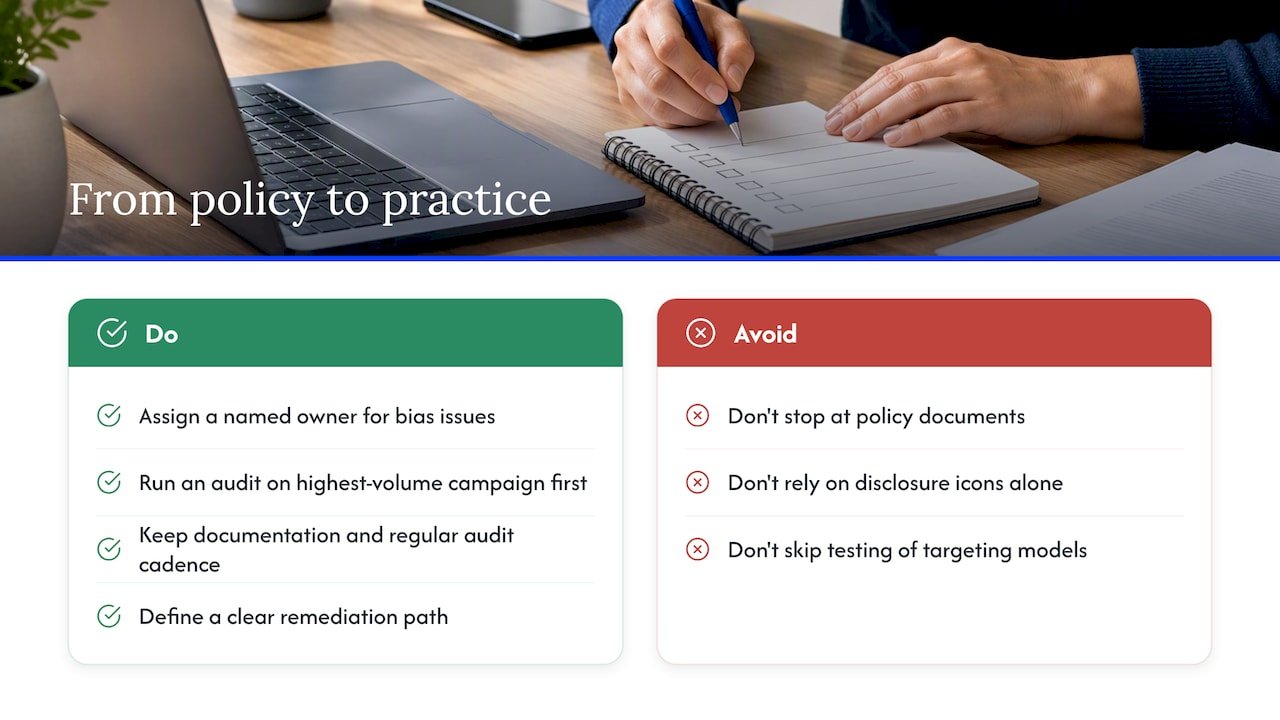
Most ethical AI guidance stops at the policy document, and that is exactly where it fails. A fairness statement in a slide deck does nothing if nobody owns the weekly bias scan or the complaint log. The frameworks worth following, NIST, IAB, UNESCO, all converge on the same uncomfortable point: accountability only counts if you can name the person and show the fix.
What gets overrated is the disclosure label itself. A sparkle icon is useful, but it is theater if the targeting model behind it was never tested for bias. What gets underrated is the boring operational stuff: documentation, audit cadence, and a clear remediation path when something goes wrong. If you only have time to do one thing first, skip the policy writing exercise and run a real audit on your highest-volume campaign. You will learn more from one honest bias scan than from a year of unread ethics documents.
— Will
How our coaching and playbooks help you put this into practice
Courses and coaching resources are designed to address a common gap: while understanding principles is straightforward, implementing them in practice is where challenges arise. These resources provide guidance on documenting AI usage, making AI-assisted copy sound natural, and piloting automation on a single workflow before broader rollout.

- A step-by-step content rollout course for building documentation and disclosure into your process from day one.
- Hands-on guidance for piloting automation on a single workflow before committing further.
- Practical tool reviews, including humanizing AI content, so your output still sounds like you.
A case study breakdown offers an example of responsible AI-assisted affiliate marketing in practice.
FAQ
What is the 30% rule for AI?
If you have seen this cited elsewhere, treat it as an informal guideline rather than a documented standard, since none of the authoritative sources define a fixed percentage threshold for AI use.
Which AI is ethically the best?
No single AI tool is officially ranked as the most ethical, since ethics in marketing AI depends on how a tool is governed and deployed, not just which vendor built it. The NIST AI Risk Management Framework focuses on evaluating trustworthy characteristics like fairness and transparency within your specific use case rather than certifying any one product.
What are the top 5 AI marketing tools?
This article does not rank specific AI marketing tools, since the ethical frameworks it covers, NIST, IAB, and UNESCO guidance, focus on how any tool is governed rather than which product you choose. We cover tool evaluation criteria in our review of AI writing tools for marketers if you want a closer look at specific options.
Is there a way for AI to be ethical?
AI itself is neither ethical nor unethical. The outcome depends on how it is governed, tested, and disclosed, which is why frameworks like NIST’s AI RMF focus on organizational practices such as bias testing, documentation, and accountability rather than claims about the technology itself.
Sources
- NIST AI Risk Management Framework (AI RMF)
- Artificial Intelligence Risk Management Framework: Generative Artificial Intelligence Profile (NIST AI 600-1)
- UNESCO-Thomson Reuters Foundation analysis on AI governance