

AI saves real time and can raise the quality of routine work, but it also makes confident mistakes, raises privacy questions and can leave you leaning on it too hard. The pros are biggest when you treat AI as a helper that you supervise. The cons shrink when you check its work. Below you will find both sides, the evidence behind them, and what they mean if you promote products online.
TL;DR
- The biggest pros: faster work, less repetitive effort, better first drafts and support for decisions, as long as a person reviews the output.
- The biggest cons: confident wrong answers, privacy and security risks, uneven results and the chance of relying on it too much.
- Studies show gains on tasks AI handles well and worse results on tasks it handles poorly, so the task decides the outcome.
- For affiliate marketers, AI works best on drafting, brainstorming and workflow chores, with you in charge of facts, claims and trust.
- Start small, test one task, measure it and expand only when it earns its place.
Table of Contents
- The pros of AI, and what the evidence says
- The cons of AI, and how to handle them
- Pros and cons at a glance
- What this means for affiliate marketers
- A simple way to weigh AI for your own work
- Want a ready-made starting point?
- FAQ
- Sources
The pros of AI, and what the evidence says
Let’s start with the good news, because it is real. When people talk about the advantages of AI, they usually mean four things: speed, less drudgery, better support for decisions and wider access to skills. Each one has research behind it.
Speed and productivity
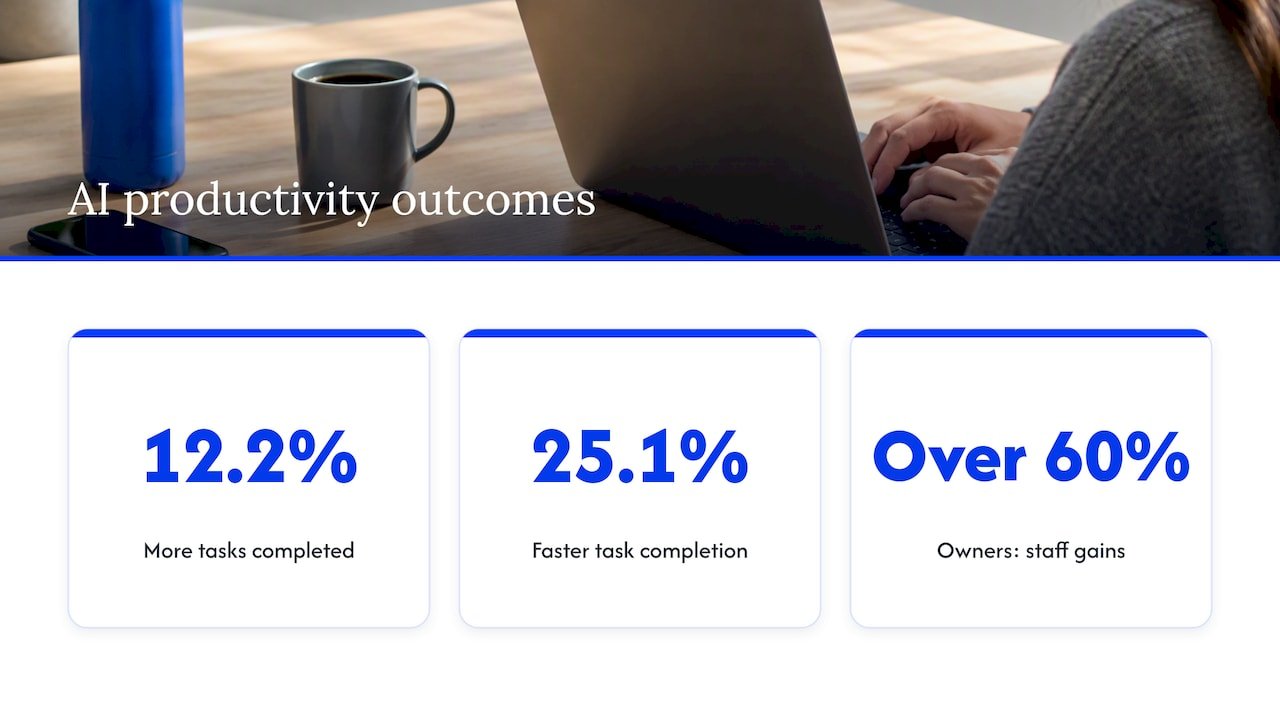
The clearest evidence comes from a field experiment run with consultants. In the Harvard Business School study, knowledge workers using GPT-4 completed 12.2% more tasks and finished 25.1% faster on average, and the quality of their solutions improved significantly. That is not a small nudge. It is the difference between finishing your Friday list on Thursday afternoon and carrying it into the weekend.
Small businesses report something similar. A February 2025 report found that over 60% of owners using AI saw positive changes in employee job satisfaction and productivity. If you work alone, you are the whole team, so a few saved hours a week matter even more.
Less repetitive work
Most of us have tasks we dread: reformatting spreadsheets, writing the fifth variation of a headline, summarizing long documents. The OECD, in its 2024 report on future AI risks and benefits, points to better job quality as one potential gain, because dangerous or unfulfilling tasks can be handed to AI. That frees you to spend your energy on the parts that need judgment and a human voice.
Better decisions and wider progress
The same OECD report lists accelerated scientific progress, productivity gains, better living standards and better decision-making among the main potential benefits. It also says AI may support progress in health science and increase access to education. Those are big-picture gains, but they show why the technology is taken seriously far beyond marketing.
Cost savings and confidence
Marketers feel these benefits in their own work. In one 2024 survey, 43.46% of marketers reported significant cost savings from AI’s automation and data processing. A later industry report found that by 2025, 73.6% of marketing and advertising professionals said AI had made them moderately to significantly more efficient. Both surveys come from companies in the marketing business, so read them as a snapshot of how practitioners feel, not as a guarantee of what you will get.
If operating costs and efficiency are your main questions, this look at AI automation for agencies shows how a team can think about productivity results and return.
The cons of AI, and how to handle them
Now the other side. Nobody is served by pretending these risks do not exist, and most of them become manageable once you know what to look for.
Confident mistakes
AI can state something false in a calm, convincing voice. Australia’s competition regulator, the ACCC, noted in its December 2025 report that OpenAI acknowledged ongoing issues with models confidently generating untrue answers, often called hallucinations. For you, this means every number, product detail and claim in an AI draft needs a human check before it goes live.
A 2025 study on digital marketing found that concerns about the quality of outputs, meaning inaccuracy and reliability, were a major barrier to adopting generative AI tools. Marketers are not naive about this. They simply know their name is on the page.
Results that depend on the task
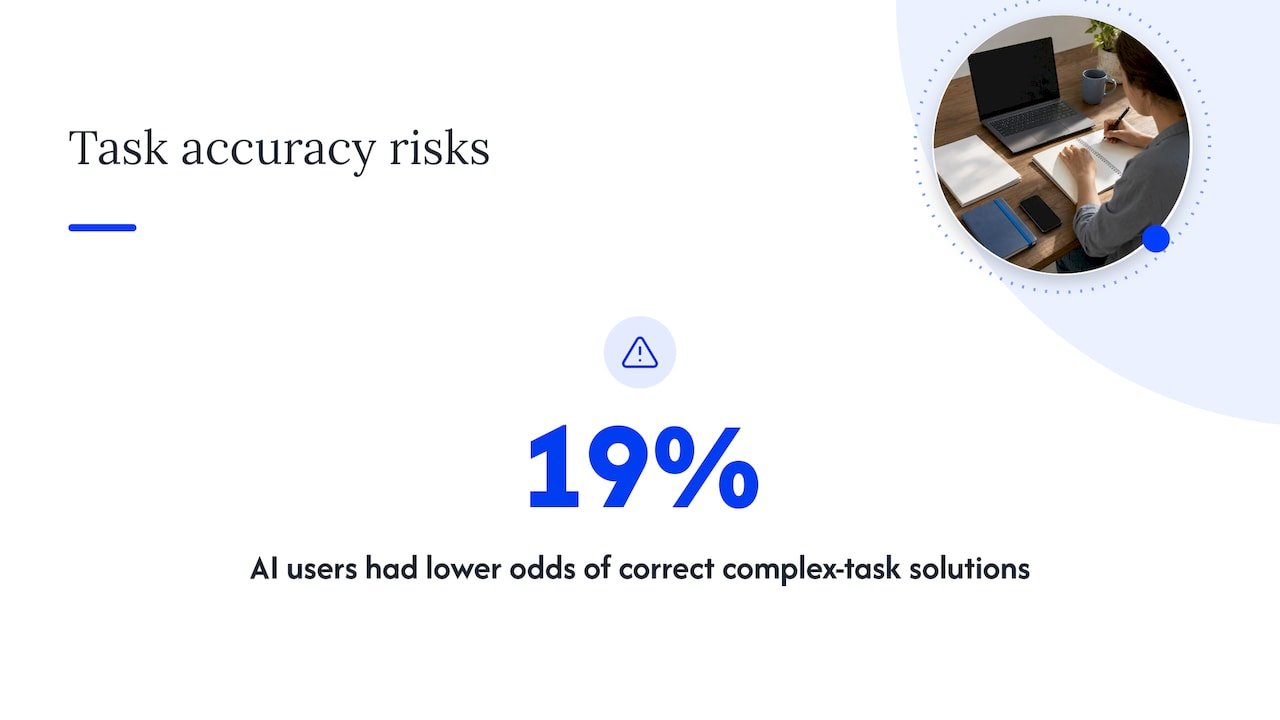
This is the part many lists skip. In the same Harvard Business School research, for a complex managerial task outside AI’s capabilities, workers using AI were 19% less likely to produce correct solutions than those working without it. The researchers describe a jagged frontier: AI is excellent at some tasks and poor at others that look similar on the surface.
Other work agrees that gains are not automatic. Research published in 2026 finds that productivity gains vary with organizational, sectoral and institutional context and depend on skills, complementary innovation and digital infrastructure. The lesson is simple: test AI on your own tasks instead of assuming it will help everywhere.
Privacy, security and misinformation
The OECD’s 2024 report lists ten priority risks, including facilitation of malicious cyber activity, disinformation that harms democratic systems and invasive privacy infringement. For a marketer, the practical version is smaller but real: do not paste customer lists, private emails or account logins into a tool you have not checked. In one 2024 survey, 40.44% of marketers cited data privacy as a principal barrier to bringing AI into their work, and 33.17% cited implementation cost.
Overstated claims
The ACCC also observed that firms may have an incentive to overstate what their AI can do, which could lead buyers to pay higher prices for products that claim more advanced AI. If you recommend tools to your audience, this matters twice. You need to protect your own budget, and you need to protect the people who trust your recommendations.
Jobs, skills and inequality
The wider economic risk is also on the table. A 2026 preliminary report from the UN’s independent scientific panel on AI warns that without investment in skills, workflows, infrastructure and labor-market institutions, AI risks widening inequality and displacing workers. The takeaway for an individual is encouraging in a way: skills still matter, and learning to work with AI is one of the most practical responses.
Pros and cons at a glance
If you want the short version for a quick comparison, here it is.
| Area | The upside | The watch-out |
|---|---|---|
| Speed | Faster task completion and quicker first drafts | Speed means little if errors slip through |
| Quality | Better results on tasks inside AI’s strengths | Worse results on tasks outside them |
| Cost | Savings from automation and data processing | Tool and implementation costs add up |
| Data | Quick analysis of large amounts of information | Privacy and security exposure |
| Accuracy | Fewer slips on routine, rules-based work | Confident wrong answers need checking |
| Work | Less repetitive effort, more room for judgment | Pressure on skills and some roles |
If you were hunting for a classic list of five advantages and five disadvantages of technology in general, the same pattern applies. The gains are efficiency, access, reach, accuracy and convenience. The costs are dependence, privacy exposure, unequal access, disruption to jobs and the risk of errors spreading faster. AI simply turns each of those dials up.
What this means for affiliate marketers
Affiliate marketing sits in a sweet spot for AI, and also a risky one. You produce a lot of content, you test a lot of angles, and your income depends on trust. That combination makes both sides of the ledger sharper.
Where AI helps most
Experiments published in 2025 showed that AI tools can accelerate brainstorming and content creation for social media. That fits what many affiliates need: angles for a review, subject lines for an email, outlines for a video. If you want concrete options, our guide to the best AI writing tools for marketers walks through what each type of tool is good at.
Workflow chores are another strong fit. Tagging links, repurposing a post into a short script, sorting performance data: these are repeatable steps where a mistake is easy to spot. You can see how that looks in practice in AI workflow automation for affiliate marketers.
Where you need to slow down
The same experiments found that AI often struggles with the realism of budget planning and content frequency requirements. In plain terms, it will happily hand you a posting schedule or a budget that looks tidy and does not survive contact with real life. Treat those outputs as a rough draft you rework.
Facts about products are the other danger zone. A wrong price, feature or earnings claim in an affiliate review damages your credibility and may mislead the reader. That is why we put so much weight on gathering evidence before you generate anything, which is the idea behind why the evidence pack comes first. If you want to go deeper on responsible practice, there is also a piece on mapping ethical AI marketing to NIST, IAB and UNESCO.
Sounding like a person
Readers can often tell when a page has no one behind it. AI drafts tend to flatten your voice, so plan an editing pass where you add your own stories, opinions and results. A few quick tools and habits can help, and we cover them in how to humanize AI content.
Our perspective
We have spent years coaching and teaching, and the pattern is always the same: people who do well with a new tool are not the ones who hand it everything. They are the ones who stay curious, keep their standards and ask what the tool is actually good for.
That is how we see AI in affiliate marketing. It is a very capable assistant that never gets tired, and it still needs a boss. You decide what is true, what is worth recommending and what your audience deserves. The research agrees: the OECD’s work on generative AI stresses that it works best as a complement to human expertise, not a full substitute.
So our approach is practical and a little cautious on purpose. We pick one task, build a simple routine around it, check the results and keep what works. That saves time without costing you the trust you have worked hard to earn. If you have ever felt behind because everyone else seems to be using AI faster than you, take a breath. Steady beats rushed, every time.
Will
A simple way to weigh AI for your own work
A list of pros and cons is only useful if you can turn it into a decision. Here is a short routine you can run in an afternoon.
First, choose one task you do often and could describe in a few sentences, such as writing meta descriptions, summarizing a product’s feature list or drafting a weekly email. Narrow tasks are easier to judge, and they sit closer to the part of the frontier where AI tends to perform well.
Second, set a baseline. Time yourself doing it the usual way, and note how good the result is. Without a baseline, you will rely on a feeling, and feelings about shiny tools are unreliable.
Third, run the task with AI and do a real review. Check every fact, number and claim. Ask yourself whether you would be comfortable putting your name on it. Note how long the review took, because that belongs in the time you saved.
Fourth, decide using three questions. Did it save time after review? Was the quality equal or better? Did it avoid exposing anything private? If the answers are yes, keep it and write down your steps. If not, adjust the prompt, change the tool or leave that task to yourself.
The OECD’s 2025 analysis of generative AI and productivity underlines why this works: impact depends heavily on human and AI collaboration. Your review step is not a delay. It is where the value is protected.
If you want to scale that routine across a content calendar, our 90-day AI content strategy rollout gives you a phased way to do it, and AI analytics for your campaigns shows how to read what the numbers are telling you.
Habits that keep the cons small
A few habits make a big difference. Keep private data out of tools you have not reviewed. Save the sources you used for facts so you can verify them later. Be wary of any tool whose marketing promises more than its demo shows. And keep learning, because the tools change quickly and the skills you build carry over from one to the next.
Want a ready-made starting point?
If you would like help putting this into practice without the trial and error, we have built step-by-step material for affiliates who want the benefits of AI and a human check at every key step.

Begin with AI affiliate workflows: ready-to-run recipes if you already promote products, or launch in 30 days with AI affiliate marketing for beginners if you are just getting started. You can also find the newsletter, videos and more on willbuckley.com.
FAQ
What are the main pros and cons of using AI?
The main pros are faster work, less repetitive effort, better support for decisions and, on suitable tasks, higher quality. The main cons are confident wrong answers, privacy and security exposure, uneven results across tasks and the risk of depending on it too much. The OECD’s 2024 report sets out both sides at a policy level, and the practical lesson is to use AI where it is strong and check it where it is not.
How can AI reduce human error, and when does it fail?
AI can reduce slips on routine, rules-based and repetitive work, where tiredness and distraction cause most mistakes. It can also add errors of its own, because models sometimes produce untrue answers with total confidence. In the Harvard Business School study, AI helped on tasks inside its capabilities and hurt accuracy on a complex task outside them, so the safest setup is AI doing the first pass and a person doing the check.
Is AI worth it for a beginner in affiliate marketing?
Yes, as long as you keep the scope small. AI can help you brainstorm angles, outline content and handle repetitive chores, which makes a slow start feel more manageable. Keep yourself responsible for the facts and recommendations, because your audience’s trust is your real asset.
How will AI change our lives?
The OECD describes a future in which AI may support progress in health science and widen access to education, while rapid and unchecked deployment creates risks for social and economic systems. How that balance turns out depends on governance, skills and who gets access. For your own work, the practical move is to build skills now and stay in the loop on what you publish.
What should I never put into an AI tool?
Avoid pasting customer lists, private messages, passwords, payment details or anything covered by a confidentiality agreement. Privacy is one of the top barriers marketers report, so check a tool’s data policy before you share anything sensitive. When in doubt, use a generic example instead of the real thing.
Sources
- Assessing potential future AI risks, benefits and policy imperatives (OECD, November 2024)
- Navigating the Jagged Technological Frontier (Harvard Business School)
- AI in Business (ICIC, February 2025)
- The effects of generative AI on productivity, innovation and entrepreneurship (OECD, June 2025)
- The artificial intelligence-productivity relationship (Springer, 2026)
- Recent developments in artificial intelligence (ACCC, December 2025)
- Preliminary report of the Independent International Scientific Panel on AI (UN, 2026)
- Drivers and barriers to implementing generative AI in digital marketing communications (2025)
- Generative AI in marketing: productivity gains and work (October 2025)
- The State of AI in Marketing (CoSchedule, 2025)
- AI and the Future of Marketing, 2025 Edition (Basis)