

AI can give you thirty headline options in the time it takes to pour a coffee. The catch is that it will give you thirty average options unless you hand it a sharp brief and then edit what comes back. The method that works is simple: you supply the audience, the benefit and the proof, the AI supplies volume, and you pick, tighten and test. That split of labor is what this guide walks through, step by step, for affiliate articles, ads, emails and social posts.
If you have ever stared at a blank title field while your draft sat finished, you know how much a headline can stall a launch. Let’s take that weight off.
TL;DR
- An AI headline is simply a headline drafted by a language model. It is only as good as the audience, benefit and proof you give it.
- Strong headlines promise a specific benefit, name who it is for and stay faithful to the page, so avoid anything that overpromises.
- Ask for many options by angle, then guide and select. Research shows that is the cheapest way to add human value.
- Check every claim, number and quote before publishing, and keep your affiliate disclosure clear.
- Test one variable at a time, and judge angles across campaigns rather than crowning one winning line.
Table of Contents
- What an AI headline is, and what makes one work
- Give the AI what it needs before you ask for headlines
- Writing headlines for articles, ads, emails and social posts
- Refine the draft: from generic to specific
- Check before you publish: accuracy, tone and disclosure
- Test your headlines the smart way
- Our perspective
- Put it into a repeatable workflow
- FAQ
- Sources
What an AI headline is, and what makes one work
An AI headline is a title, subject line, ad headline or post hook that a language model drafted from your prompt. Nothing mystical about it. The model predicts fluent wording, and you decide whether that wording is true, useful and right for your reader.
What separates a good one from a forgettable one? Researchers who compared AI and human headlines describe two broad styles. Informative headlines aim for clarity, relevance and neutrality, while persuasive or clickbait headlines lean on exaggeration, urgency, emotional triggers and curiosity, even when the content does not match the promise. For affiliate marketing, you want the persuasive pull without the broken promise, because a reader who feels tricked does not click your recommendation twice.
A practical checklist comes from the Content Marketing Institute. Its headline questions say strong headlines tend to promise a benefit, be specific (numbers help) and identify the target audience. Keep those three in your head and you already have a scoring rubric:
Does it promise something the reader wants? Is it concrete enough to picture? Would the right person know it is for them?
Compare “Best Email Tools for Marketers” with “5 Email Tools That Let New Affiliates Send a Welcome Sequence in One Afternoon.” The second names the reader, the benefit and a time frame. That is the gap an AI draft usually needs help closing.
Give the AI what it needs before you ask for headlines
The most common mistake is typing “write 10 headlines about email marketing tools” and hoping. The model has no idea who is reading, what they fear or what your page actually proves. So it fills the gaps with the safest, most common phrasing, and that is how generic headlines are born.
Before you prompt, collect five things:
The reader: who they are and where they are stuck. “A part-time affiliate with a small newsletter who is nervous about automation” beats “marketers.”
The core benefit: the one outcome the page delivers. Not three. One.
The proof: a number, a result, a time frame or a step count that you can actually back up from your own page.
The format and limit: blog title, ad headline, subject line or social hook, plus the character range for that placement.
The tone and the no-go list: friendly and plain, say, and no “secret,” no “guaranteed,” no invented statistics.
Here is a prompt shape you can copy and adapt:
“You are writing headlines for [format]. The reader is [specific person] who struggles with [problem]. The page shows [one benefit] in [time or steps]. The proof on the page is [fact]. Write 15 options across five angles: benefit, curiosity, specificity, social proof and objection-handling. Keep each under [limit] characters. Use a [tone] tone. Do not invent numbers, quotes or results.”
That last sentence matters more than it looks. A brief that carries your real facts gives the model something true to work with. If you want a library of reusable briefs, our AI brief templates and workflows cover exactly this idea for longer copy, and the same thinking shrinks neatly down to a headline.
One more note on inputs. Real customer language is a gold mine. Review comments, forum threads and replies to your newsletter, copy the exact words people use for their problem, and paste a few into the prompt. Headlines that echo how readers talk about their own situation almost always feel less robotic.
Writing headlines for articles, ads, emails and social posts
The same brief works across channels, but each placement rewards a different shape. Here is how to adjust.
Blog and review articles
Article titles carry search intent and a promise. Ask the AI for titles that include the topic phrase naturally, name the reader and state the outcome. Request a mix of straightforward and benefit-led versions, then choose the one that matches what the page truly delivers. If your page is a hands-on walkthrough, a how-to title fits. If it compares tools, say so plainly.
It also helps to ask for a matching meta description in the same run, so the title and the snippet tell one story rather than two.
Ad headlines
Ads give you a handful of words and a skeptical audience. Feed the model the objection your reader has (“I tried this before and it was too complicated”) and ask for headlines that answer it directly. Our guide on what works and what backfires in AI ad creative goes deeper on that workflow.
Email subject lines
Subject lines are tiny, and mobile screens cut them off, so front-load the meaningful words. Ask for versions in different angles, such as curiosity, a specific benefit and a plain statement of what is inside. Then read each one aloud as if you were the subscriber. If it sounds like a promotion shouting for attention, rewrite it. For the sequence around the subject line, see our plug and play AI email sequence briefs.
Social posts
Social hooks live or die on the first line. Ask for five openers per post in your own voice, each under a set length, with one that starts from a question, one from a surprising fact you can verify, and one from a short confession or lesson. The confession style often suits a personal brand, because it sounds like a human telling a story, which is exactly what you are.
Refine the draft: from generic to specific
Here is where the real value lives. Treat the first batch as raw clay.
Research from Ding and colleagues found that language models alone can produce satisfactory news headlines, but a human is needed to fix undesirable output, and guiding and selecting the model’s output gave the most benefit for the least time and effort. In plain terms, you do not need to rewrite everything from scratch. You need to steer and choose well.
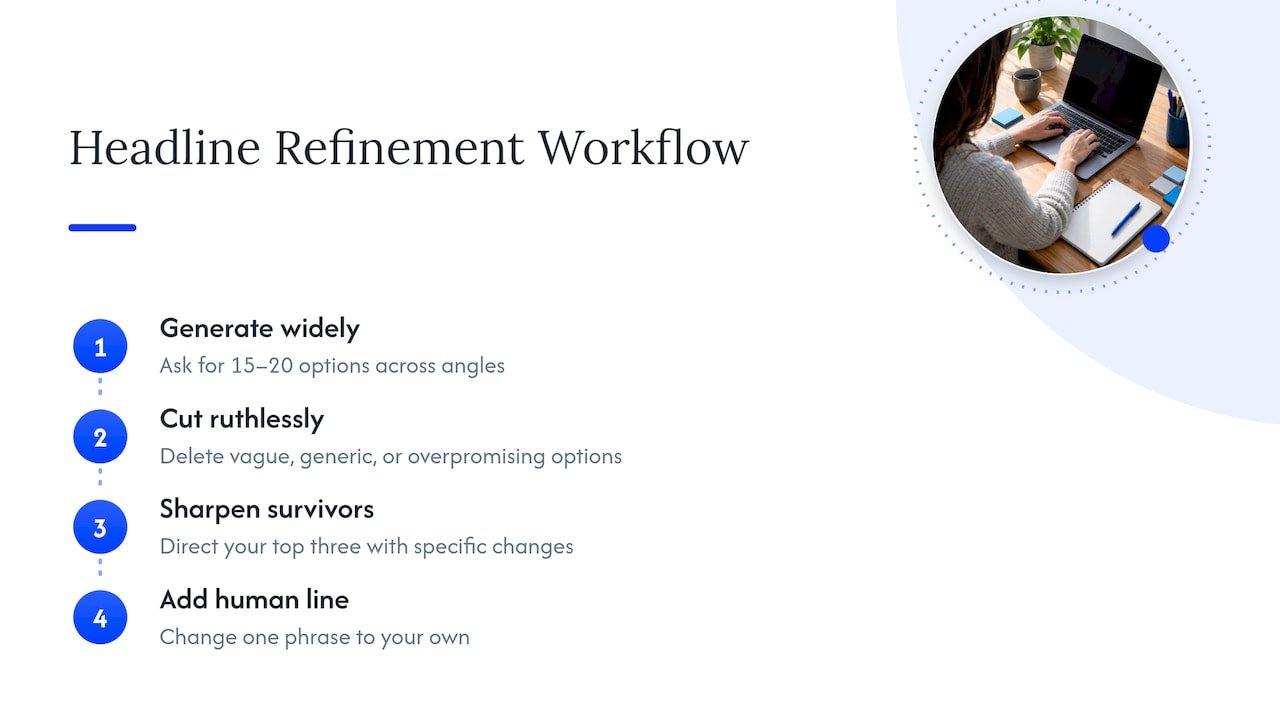
A workflow that fits in ten minutes:
Round one: generate widely. Ask for 15 to 20 options across different angles.
Round two: cut ruthlessly. Delete anything vague, anything that could sit on any site, and anything that promises more than your page delivers.
Round three: sharpen the survivors. Paste your top three back in and say what is missing: “Make this more specific to beginners,” “Add the time frame,” “Remove the hype word.” Give directions, not just “make it better.”
Round four: add the human line. Change one phrase to something only you would say.
Here is a worked example. Say your article reviews an AI writing tool for new affiliates.
The raw AI output: “Unlock the Power of AI Writing for Affiliate Success.”
The problem: no reader, no proof, no number, and “unlock the power” is everywhere.
After your direction (“name the reader, add the real time saved, plain tone”): “How New Affiliates Can Draft a Product Review in 30 Minutes With an AI Writer.” Only keep a figure like “30 minutes” if you actually timed it.
Why not let the model run free toward more clicks? A controlled rewriting study on arXiv found that unconstrained rewriting added attention-grabbing cues but often brought in exaggeration, implied secrecy or emotional distortion, while suppressing clickbait improved faithfulness to the content. Build the guardrail into your prompt, and you keep the pull while protecting trust.
Positioning also lifts a headline. If the model keeps handing you bland benefits, it may be because your angle against the alternatives is fuzzy. This piece on engaging your audience for SEO success is a useful nudge toward sharper positioning before you write a single title.
And if the result still sounds machine-made, our guide to humanizing AI content gives a quick pass for restoring your voice.
Check before you publish: accuracy, tone and disclosure
A fast tool does not carry your reputation. You do. Before any AI headline goes live, run it through a short review.
First, accuracy. Does every claim in the headline appear on the page, and can you back it up? In a newsroom case study, Omroep Brabant found that ChatGPT headline suggestions often needed adjusting because they were factually wrong, too clickbaity, too emotional or off brand tone. Affiliate pages face the same risks. Be especially careful with income claims, percentages and “best” or “only” language.
Second, match. Open the page next to the headline. If a skimmer clicked and read only the first paragraph, would they feel the promise was kept?
Third, voice. Does it sound like you? A headline that could belong to anyone helps no one remember you.
Fourth, disclosure. If the headline or the page promotes a product you earn commission on, make sure your disclosure is clear where readers will see it. Our affiliate disclosure examples show wording you can adapt, and the ethical AI marketing map helps you set your own standards for using AI in public-facing copy.
Test your headlines the smart way
Once you have two or three solid candidates, let your audience vote with clicks. The rules are not complicated, but they are easy to skip.
Change one thing at a time. If you swap the number, keep the rest identical. If you compare a curiosity angle with a benefit angle, hold length and tone steady. Otherwise you will not know why one won.
Give each version enough traffic. Tiny samples produce noisy winners. A small list or a low-traffic page may need a longer test window, or you may do better running the test across several emails or posts and comparing the angles.
That last point deserves attention. Think of testing as learning which angle your audience responds to, such as specificity, curiosity, social proof or benefit, rather than hunting for one magic line. Once you know that your readers respond to concrete time frames, you can carry that into every headline you write next.
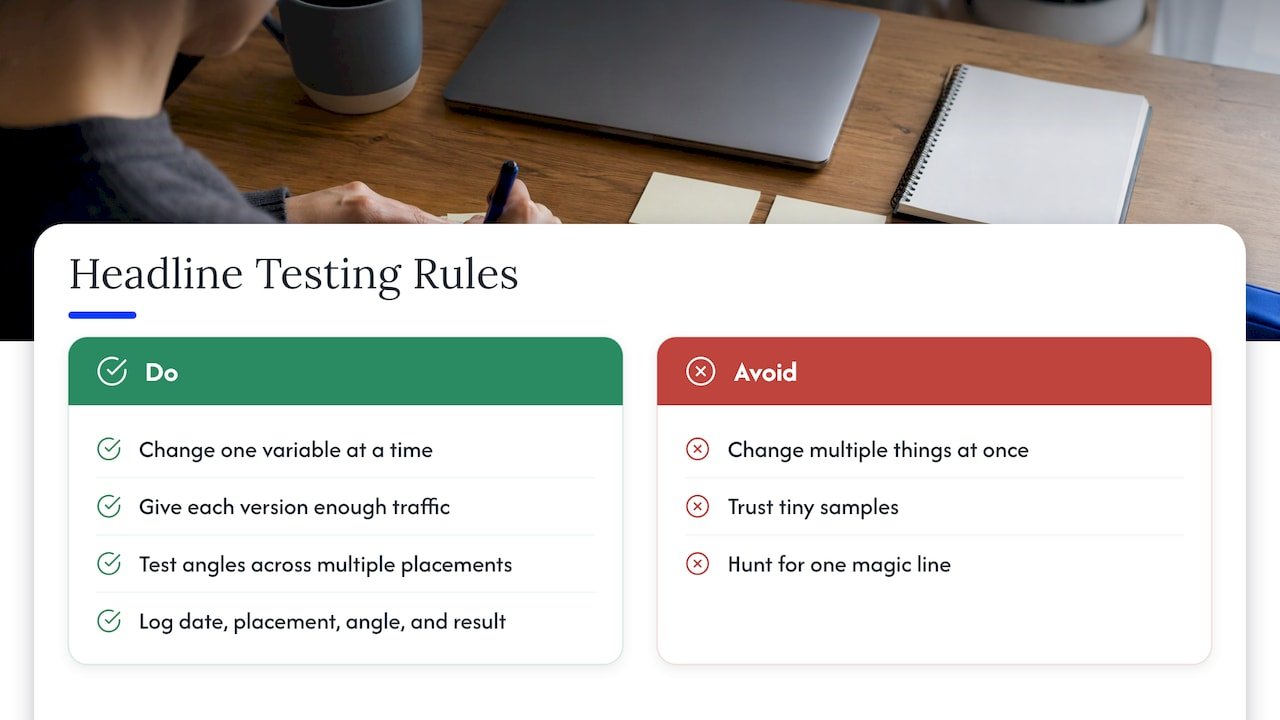
Keep a simple log with the date, the placement, the angle and the result. In a few weeks you will have a private playbook that no generic tool can offer. For a gentle way to start, our walkthrough on piloting AI split testing in a few hours shows a small first test, and the AI conversion optimization workflows for affiliates take the results further down the funnel.
Our perspective
We love AI for headlines, and we use the same approach we teach: let the machine be fast and let the human be honest.
After years of coaching and teaching, one thing keeps coming back. People rarely struggle because they lack tools. They struggle because they hesitate, they stall at the blank page, and they hand the thinking to whatever is nearest. AI headline tools can help you break that stall, and that is a real gift when you are building something on the side of a busy life.
But the headline is the first promise you make to a reader, and promises are personal. That is why we ask you to bring the story, the audience and the facts, and let the tool help you shape them. Your lived experience is the one ingredient no model can supply.
Our practical, AI-driven approach to affiliate marketing is built on that idea: save time on the repetitive work, spend the time you saved on the parts that make you trustworthy. Start small, test one angle, learn, and go again. You do not need to be perfect. You need to be consistent and clear.
Will
Put it into a repeatable workflow
If you would like the headline step to sit inside a bigger system, our ready-to-run AI affiliate workflows bring briefs, drafting, review and testing together in one routine, with practical recipes you can follow at your own pace. We also share new tips, videos and newsletters at willbuckley.com for affiliate marketers learning to use AI in a smarter, calmer way.

Start with one article this week. Write the brief, generate the options, cut to three and publish the best one with a note in your log. That small loop is the whole method.
FAQ
What is an AI headline?
An AI headline is a title, subject line, ad headline or social hook drafted by a language model from your prompt. The model predicts fluent wording, so the quality depends on the audience, benefit and facts you provide. You still choose, edit and verify the final line.
What should I tell an AI tool to get relevant headlines?
Give it the reader, the single main benefit, a piece of proof from your page, the format and character limit, and the tone you want. Add a no-go list, such as no invented numbers or hype words. Asking for options across several angles gives you more to choose from.
Can AI headlines turn into clickbait?
They can if you push only for clicks. Research on headline rewriting found that unconstrained prompts often introduced exaggeration and emotional distortion. Tell the model to stay faithful to the page, and check each headline against your content before publishing.
How do I know if an AI headline works?
Test it against another version that differs in one way only, and compare clicks or conversions with enough traffic to trust the result. Over time, track which angles win, such as specificity or benefit, and reuse them in future headlines.
Sources
- AI vs. Human-Authored Headlines (MDPI, Information, 2025)
- How To Write Headlines That Hook: 8 Questions To Ask (Content Marketing Institute)
- Harnessing the power of LLMs: Evaluating human-AI text co-creation (ACL Anthology, 2023)
- LLM-guided headline rewriting for clickability enhancement (arXiv, 2026)
- How AI can assist in headline testing (smartocto, 2023)