

WhatsApp affiliate marketing means recommending a product to people on WhatsApp through your own tracked link and earning a commission when they buy. The app itself won’t pay you. The money comes from the affiliate program behind the product, and it only flows when the people on the other end asked to hear from you, trust your advice and can be traced back to your link. Get those three things right and WhatsApp can become one of the warmest channels you own. Get them wrong and you’ll be muted, reported or banned.
Have you ever been added to a group that turned into a wall of coupon links? That’s the experience you’re competing against, and it’s why a calmer, more personal approach wins here.
TL;DR
- WhatsApp doesn’t pay affiliates. You earn commission from the affiliate program of the product you recommend, through a unique tracked link.
- Build an opt-in audience first (Channels, groups, or one-to-one chats), because WhatsApp’s own policy requires permission before you contact people.
- Tag every link with its own source so you know which message, group or chat produced a sale. WhatsApp passes no referrer data.
- Disclose the commission close to the link. The FTC says a vague label isn’t enough.
- Use AI to draft, personalize and analyze, but keep the final voice human and the volume low.
Table of Contents
- How WhatsApp affiliate marketing actually works
- Choose the right WhatsApp feature for the job
- Build an audience that wants to hear from you
- Pick offers that fit a private conversation
- Share links without spamming
- Disclose your commission, clearly and close to the link
- Track what happens after the click
- Use AI to do the heavy lifting, not the talking
- A simple 30-day plan to get started
- Our take: WhatsApp rewards helpers, not hunters
- Put AI to work on your affiliate workflow
- FAQ
- Sources
How WhatsApp affiliate marketing actually works
The mechanics are the same as any affiliate channel. You join a program, receive a link that carries your ID, share it, and the merchant credits you when a qualifying purchase happens. What changes on WhatsApp is the setting. You’re not publishing to strangers on a feed. You’re sitting in someone’s private inbox, next to messages from their family.
That’s the upside and the risk in one sentence. A recommendation from a person someone trusts feels personal rather than like an ad, which is why conversion can be strong. It’s also why a careless link drop feels like an intrusion.
WhatsApp has no ad revenue-sharing program that pays based on views or reach, so your income depends entirely on the offers you promote. Your job is to match the right offer with the right person at the right moment, then make the next step easy.
Choose the right WhatsApp feature for the job
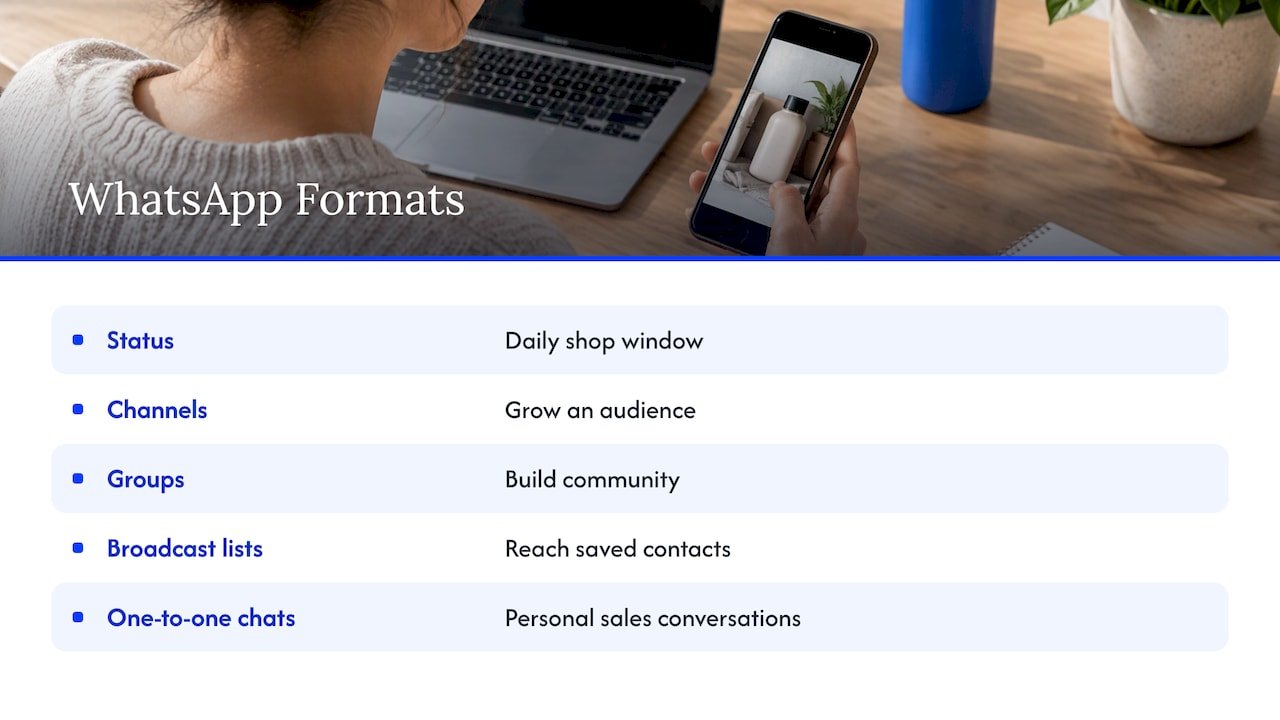
WhatsApp offers several ways to reach people, and each has a different role. WhoGoHost’s guide to WhatsApp affiliate marketing describes it well: Status works like a daily shop window, Channels grow an audience beyond your contacts, groups are for community, broadcast lists only reach people who saved your number, and one-to-one chats are where sales tend to happen. Here’s how that plays out in practice.
Channels for one-way updates
A Channel is a one-way broadcast. Followers don’t need your phone number, and you don’t see theirs. WhatsApp explains the setup in its help center: you create a channel from the Channels tab, name it and add a description. This is a natural home for a weekly roundup: one tool you tested, one result, one link. Because followers chose to follow, you’re on solid ground.
Groups for community
A niche group (say, beginner affiliates, or people who want to cut down on subscription costs) lets you answer questions in public. The rule that works is simple: contribute first, recommend second. If you join other people’s groups only to drop links, you’ll be removed quickly, and rightly so. Keep your own group focused on one topic so the occasional recommendation fits naturally.
Broadcast lists and one-to-one chats
Broadcast lists reach only people who have your number saved, which is a useful built-in filter. One-to-one chats are where you can ask a question before you recommend anything. A message like “What are you trying to fix right now?” earns you more than any link, because the product you suggest next actually answers their problem.
Build an audience that wants to hear from you
The fastest way to lose a WhatsApp number is to message people who never asked. The rule is written into the platform: WhatsApp’s Business Messaging Policy says you may only contact people if they’ve given you their number and you’ve received opt-in permission to message them. That’s the standard to build around, even when you’re a one-person operation.
So where do opted-in people come from? Mostly from places you already have:
Your content. A short note under a video, post or article that says “I share the tools I actually use in a WhatsApp Channel, join here” gives people a clear reason and a clear choice.
Your email list. If you already send newsletters, inviting subscribers to a Channel or group is a gentle way to deepen the relationship. If you don’t have a list yet, our guide to building a high-converting affiliate email list walks through it.
Other social platforms. Posts on Instagram, X or LinkedIn can point to your WhatsApp Channel. If those are your main traffic sources, our playbooks for Instagram affiliate marketing, Twitter affiliate marketing and LinkedIn affiliate marketing show how to make those posts do double duty.
Offer something worth joining for: a checklist, a template, a weekly tip. Say upfront what you’ll send, how often, and how to leave. That one welcome message sets the tone for everything after it.
Pick offers that fit a private conversation
Not every offer belongs in a chat. The best ones are products you’ve used, that solve a problem your audience has told you about, and that you can explain in two sentences. Software with recurring commissions is a common fit for marketers. For example, programs paying up to 35% recurring commission show how a subscription model can turn one recommendation into income that keeps coming month after month. If you want to negotiate better terms once you have results, our 90-day commission pilot gives you a copyable structure.
Before promoting anything, read the program’s terms. Some pay only after a first payment, some apply a hold period, and some reverse commission on refunds. Knowing that up front keeps your expectations honest, and keeps you from promising people something the program doesn’t deliver.
Share links without spamming
This is where most WhatsApp affiliates go wrong, and it’s fixable with a few habits.
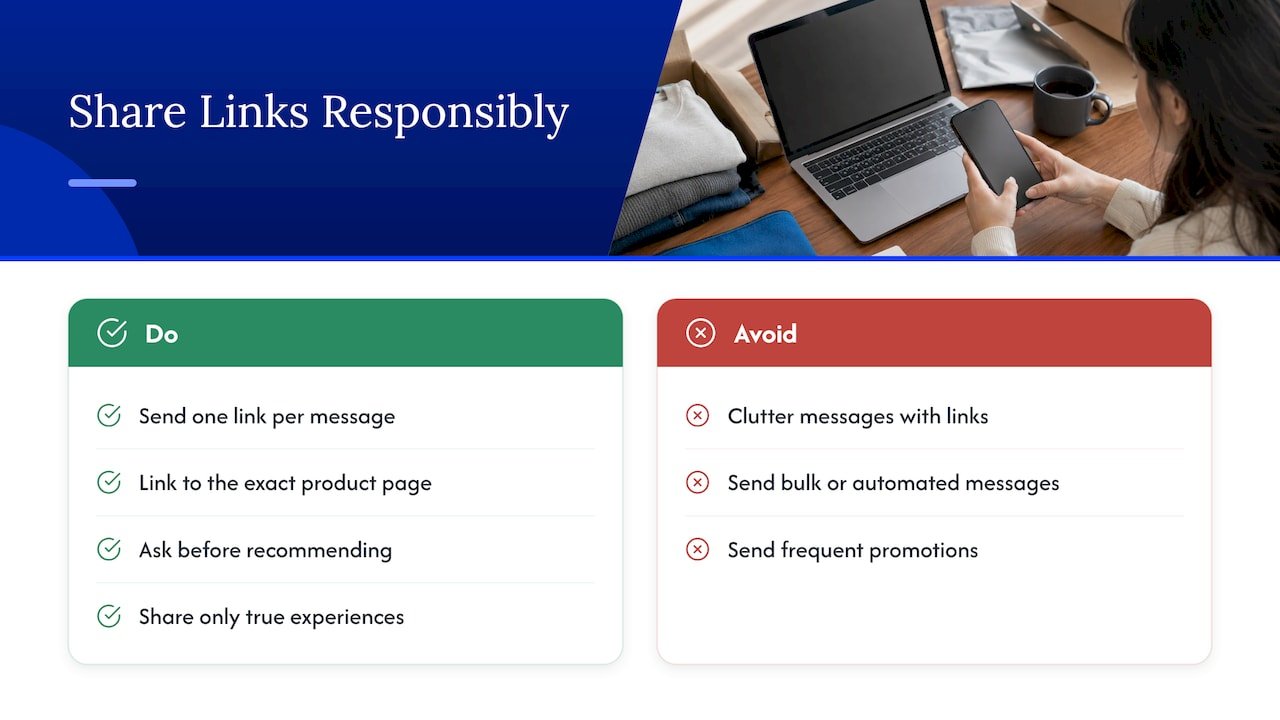
Send one link per message. Link to the exact product page, not a homepage. A cluttered message looks like a flyer.
Ask before you recommend. In one-to-one chats, a single diagnostic question changes the whole conversation. You’re no longer pitching, you’re helping.
Share real experience. “I switched to this last month and it cut my editing time in half” lands better than polished copy. Only say it if it’s true.
Keep the cadence low. Unless people expect more, a couple of promotional messages a week is plenty. Fill the rest with useful, non-promotional content so the promotions feel earned.
Respect the platform’s limits. WhatsApp’s terms don’t allow bulk or automated messaging, and accounts that get reported can be banned. Use automation to prepare and analyze, not to blast.
The pattern is consistent: the less your message looks like an ad, the better it performs, and the safer your number stays.
Disclose your commission, clearly and close to the link
If you earn money when someone clicks your link, say so. In the US, the FTC’s Endorsement Guides apply to social media, and its guidance on endorsements says a phrase like “commissionable link” is probably not a clear disclosure. Plain words work better: “I earn a commission if you buy through this link.”
Put that sentence right next to the recommendation, not buried in a profile or a pinned message nobody reads. Readers outside the US may fall under different rules, so check the advertising and consumer-protection rules in the country where your audience lives. Disclosure also helps you commercially. People who know how you earn tend to trust the recommendations you do make.
You’ll also see the rules of individual programs. Marketplaces often require you to label links honestly and limit where you can place them, so read the operating agreement before you share a link in a chat.
Track what happens after the click
WhatsApp is what marketers call a dark social channel. A click from a private chat arrives with no referrer, so analytics can’t tell you where the visitor came from unless you build that into the link. Tracking is your job, and it needs to be planned from day one.
Give every source its own link
Create a separate tracked link for each place you share: your Channel, each group, your broadcast list, your Status. Add UTM parameters such as a source of whatsapp and a medium that names the format. Then when a sale arrives, you know which context produced it. Our walkthroughs on cookieless affiliate link tracking and Google Tag Manager for affiliates cover the setup step by step.
Judge results by the right numbers
Clicks are the easy number and the least useful. Look instead at how many people replied to your welcome message, how many conversations led to a click, and how many clicks became commissions. Compare the affiliate dashboard with your own link data, since the two rarely match perfectly. And be patient: commissions often take longer to confirm than you’d like, especially when a program applies a hold period or refund window, so judging a campaign after two days will mislead you.
A simple weekly log works well. Write down what you shared, where, which link you used and what happened. After a month, patterns appear that no dashboard will hand you.
Use AI to do the heavy lifting, not the talking
AI is most useful on WhatsApp when it handles the work around the conversation. It can draft three versions of a short recommendation for you to edit, summarize what your audience has been asking, suggest a content calendar for your Channel, and help you sort replies by intent. It can also help you review which messages performed and why.
Where it goes wrong is volume and voice. Auto-posting generic copy to dozens of groups is exactly what WhatsApp’s policies are designed to catch, and it reads as impersonal in a space built on personal trust. Treat AI as a drafting partner. You decide what’s true, what you’ve actually tried, and what’s worth sending.
If you want practical starting points, our guides to ChatGPT for affiliate marketing, brand voice AI and AI affiliate workflows show how to prompt for drafts that still sound like you.
A simple 30-day plan to get started
In week one, pick one niche and one or two offers you genuinely use. Create your Channel, write a short description of what people will get, and set up a tracked link for each place you’ll share.
In week two, invite people from your existing content and email list. Post two or three useful tips with no links at all. This builds the habit of opening your messages.
In week three, share your first recommendation, with a plain disclosure, a personal reason and one link. Reply to every response.
In week four, review your log. Which message got replies? Which link got clicks? Which conversations turned into sales? Keep what worked, drop what didn’t, and decide whether a group or one-to-one chats would help you go deeper.
Slow and steady wins here. A small audience that opens every message is worth more than a big one that muted you.
Our take: WhatsApp rewards helpers, not hunters
We’ve coached and taught for a long time, and the lesson carries over to every affiliate channel: people buy from those who help them first. WhatsApp just makes that lesson impossible to ignore, because there’s nowhere to hide in a private chat.
That’s why we’d start with the audience, not the link. A small Channel or group of people who chose to be there, a clear promise about what you’ll share, and recommendations that come from real use. Then we’d add AI to save time on drafting, sorting and reviewing, so you can spend your energy on the conversations that matter.
The temptation is to scale fast with automation. We’d rather you scale trust. Tracked links, honest disclosure and a steady, modest rhythm will carry you further than any trick, and they make you the kind of marketer people are happy to hear from.
Will
Put AI to work on your affiliate workflow
If you’d like a practical way to save time on the drafting, tracking and reviewing that WhatsApp campaigns need, our AI affiliate workflows give you ready-to-run recipes you can adapt to your own niche. You’ll find more coaching, tips and tutorials for affiliate marketers at willbuckley.com.

FAQ
Can you earn money from WhatsApp itself?
No. WhatsApp doesn’t run an ad revenue-sharing program that pays based on views or followers. Affiliate income comes from the program behind the product you recommend, which pays a commission when a sale happens through your unique link.
Is WhatsApp affiliate marketing allowed?
Yes, as long as you follow the rules. WhatsApp’s business policy requires opt-in permission before you contact people, and its terms don’t allow bulk or automated messaging. You also need to disclose that you earn a commission, and follow the terms of each affiliate program you join.
How do I find people to message?
Start with people who already follow you. Invite your email subscribers and social followers to a Channel or group, and give them a clear reason to join. Messaging strangers or joining groups just to post links tends to get you reported or removed.
How do I track sales from WhatsApp?
Give every place you share its own tracked link with UTM tags, and check your affiliate dashboard against your own link data. WhatsApp sends no referrer information, so without separate links you can’t tell which message or group led to a sale.
Can I make $100 a day?
Some people do, but no one can promise it, and results depend on your niche, offers, audience size and trust. Focus first on a small, engaged audience and a tracking habit, then let the numbers show you what’s realistic for you.
Sources
- WhatsApp Business Messaging Policy
- How to create a WhatsApp Channel
- FTC’s Endorsement Guides: What People Are Asking
- WhoGoHost: Affiliate marketing on WhatsApp