

EPC stands for earnings per click. It is the average commission you earn each time someone clicks your affiliate link, and you get it by dividing your total commissions by your total clicks. If you have ever stared at a dashboard wondering which offer is actually worth your traffic, EPC is the one number that folds payout and conversion rate into a single answer.
The catch is that not every network reports it the same way, and a small misunderstanding can throw your comparison off by a factor of 100. We will walk through the formula, the trap, what moves the number, and the unglamorous fixes (like caching) that quietly raise it.
TL;DR
- EPC = total affiliate commissions ÷ total clicks. $1,200 from 2,000 clicks is a $0.60 EPC.
- Some networks show EPC per 100 clicks, so a “$150 EPC” can really mean $1.50 per click. Convert before you compare.
- EPC equals conversion rate times average commission per sale, so the biggest wins usually come from better-matched traffic and smarter link placement.
- Site speed affects EPC through conversion rate, but caching set up carelessly can break tracking cookies and show stale prices.
- Compare EPC with your cost per click and watch it over time on the same offer and traffic source.
Table of Contents
- What EPC means, in plain words
- The per-click vs per-100-clicks trap
- What EPC is made of
- A simple way to use EPC every week
- How to improve EPC
- Site speed, caching and EPC
- Our perspective
- Put EPC to work with AI workflows
- FAQ
- Sources
What EPC means, in plain words
Earnings per click answers a simple question: when one person clicks my link, how much is that click worth to me on average? It does not care whether the click turned into a sale right away. It just spreads all the money you earned across all the clicks you sent.
The standard formula is total commissions divided by total clicks. MassPartner’s guide gives a clean example: $1,200 in commission from 2,000 clicks works out to a $0.60 EPC. Another worked example has $500 from 200 clicks, which is $2.50 per click.
Why do marketers love it? Because offers pay in different ways. One program pays $90 per signup, another pays $40, another pays a percentage of the sale. Looking at payout alone tells you very little. EPC lets you put those offers side by side using the same traffic.
The per-click vs per-100-clicks trap
Here is where many beginners get tripped up, and honestly, plenty of experienced marketers too. Some platforms report EPC per single click. Others report it per 100 clicks.
Rekomi’s breakdown points out that PartnerStack and ClickBank use per-click figures, while CJ Affiliate reports per 100 clicks. That means a “$150 EPC” on CJ is $1.50 per click. Put that next to a $4 per-click number from another network without converting and you are making a decision that is off by 100x.
Mobidea’s help center says the same thing about its own dashboard: EPC is taken for 100 clicks, not one. And Track360’s reference notes that the same $3.00-per-click performance reads as a $300 EPC on network dashboards that quote per 100.
The per-100 formula is just the normal one times 100. Matt McWilliams’ example turns $3,000 in commissions from 500 clicks into $600 per 100 clicks, which is $6.00 per click.
A quick habit saves you here: before you copy any EPC into a spreadsheet, write down the unit next to it. Per click, per 100, or per 1,000. Then convert everything to per click.
Other things to check before comparing
Digistore24’s guide suggests a few more checks: the time window, which revenue is included, how attribution works, how a click is defined, and how many clicks stand behind the number. A $40 per-100 figure and a $0.40 per-click figure can describe exactly the same result. A figure based on 30 clicks, though, is mostly noise.
Also keep in mind that network EPCs are blended averages across all affiliates. A program showing $0.80 might pay a well-matched affiliate $3 or more per click, depending on audience quality and where the link sits in the funnel. And when an advertised EPC looks out of reach, it often means a few super affiliates dominate the average. That is useful information, not a reason to feel behind.
What EPC is made of
EPC feels like one number, but it is really two numbers multiplied together. According to MassPartner, EPC equals conversion rate times the average commission per conversion. For percentage-of-sale offers, it is conversion rate times average order value times commission rate.
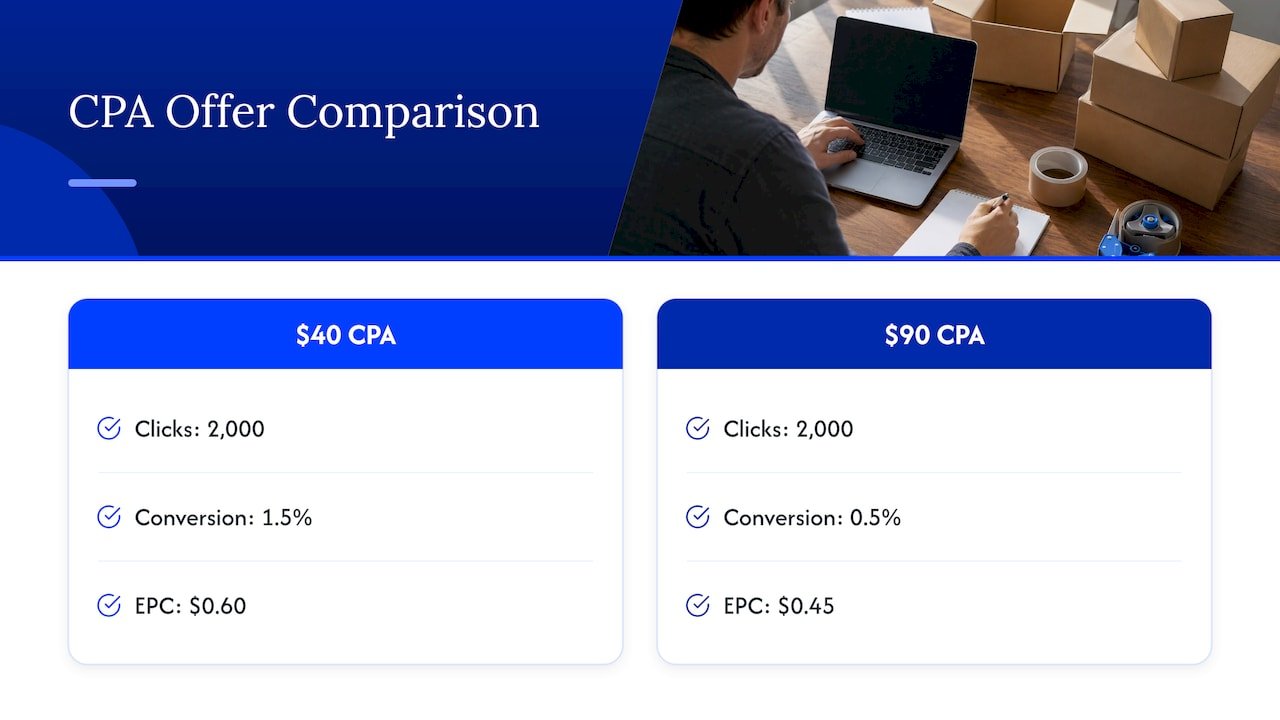
That explains a result that surprises people. On 2,000 clicks, a $40 CPA offer converting at 1.5% earns a $0.60 EPC, while a $90 CPA offer converting at 0.5% earns only $0.45. The smaller payout wins because it converts better. If you are still deciding between payout structures, our guide to CPS vs CPA payout models goes deeper.
Conversion rate is where the leverage hides. McWilliams shows that with the same 30% commission on a $1,000 product, dropping conversion from 2% to 0.5% cuts EPC from $600 to $150 per 100 clicks. Nothing about the offer changed. Only the traffic and the page did.
In longer funnels, conversion is several steps chained together. Track360 describes a 12% click-to-signup rate and a 35% signup-to-deposit rate, which turns 1,000 clicks into 120 signups and 42 deposits, or 4.2% of clicks. Improve any one step and EPC moves.
Gross EPC vs what you actually keep
If you pay for traffic, gross EPC is only half the story. AdTraxo’s example: 2,500 clicks earning $625 is a $0.25 EPC. At a $0.10 cost per click you make $0.15 per click. At $0.30 per click you lose money. So your EPC is effectively the most you can pay for a click and still break even. If paid traffic is on your roadmap, see what works with Google Ads for affiliates.
Why recurring programs look worse than they are
EPC measures earnings against a click window, but subscription programs keep paying after that window closes. Reditus defines an effective EPC that counts net approved commissions after reversals and declines, and notes that with recurring SaaS commissions the same 1,000 clicks are worth more at month twelve than at month one. Rekomi’s view is to trust the longer window when choosing offers and use a 7-day window only to spot sudden changes.
A simple way to use EPC every week
You do not need a complicated system. Two comparisons cover most decisions, and MassPartner recommends the same pair: EPC against your cost per click, and EPC over time on the same offer and traffic source. If it suddenly drops, something moved: the funnel, the payout, or your tracking.
Here is a routine that fits in about twenty minutes:
- Pull clicks and commissions for one offer from one traffic source over the same period.
- Divide, then write the unit next to the result.
- Compare with last month’s number for the same offer and source.
- If you changed something (a page, a link position, a headline), write that down beside the number.
That last step matters more than it sounds. Without notes, EPC is a chart. With notes, it becomes a record of what worked. Pairing it with a proper look at which touchpoints get credit for sales keeps you from crediting the wrong page.
How to improve EPC
Because EPC is conversion rate times commission, you have three levers: who clicks, what they click on, and what happens after they click.
Send higher-intent traffic
Clickolytics argues that intent is the single biggest factor. Curiosity clicks with no buying intent drag EPC down, and it reports that trimming roughly 30% of low-intent clicks can lift EPC by 50% or more. Fewer clicks, more money per click. That feels backwards at first, and it is one of the most freeing ideas in affiliate marketing. You do not need more traffic. You need the right traffic.
Move links to the decision point
In one case Clickolytics documents, moving affiliate links later in the content, after the reader had received real value, nearly doubled EPC from $0.35 to $0.65 with the same traffic and offers. Match your offer to the search query, and keep prices and stock current.
Negotiate and test
If you already send solid traffic, your EPC is evidence in a conversation with the program. Our piece on negotiating a higher commission with a 90-day pilot shows how to use it. And when you want to test headlines or link placement without a big setup, AI-assisted split testing can get a pilot running in hours.
Content that matches search intent also feeds the first lever. Tools for AI-driven SEO content planning can help you map the questions buyers ask before they click.
Site speed, caching and EPC
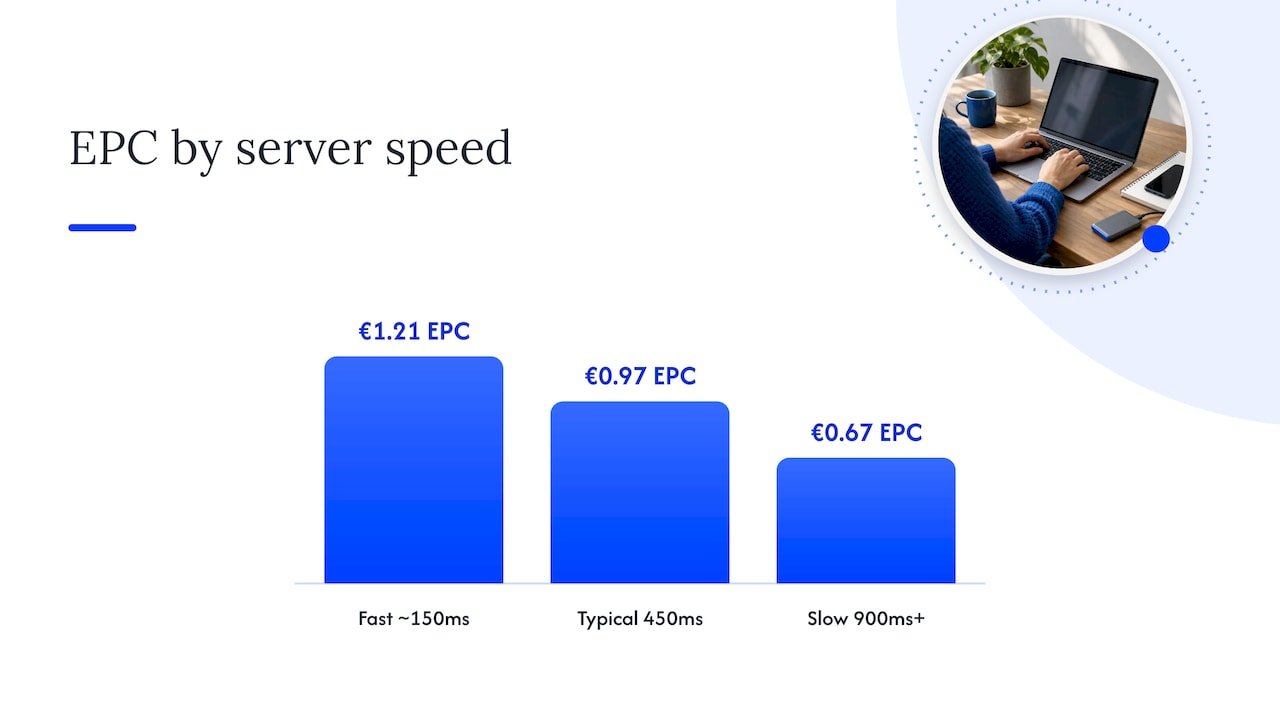
Speed does not add dollars to your payout. It raises EPC through conversion rate. Affiliates.hosting’s worked example compares three scenarios: a fast server response of about 150ms gives a 1.10% conversion rate and a €1.21 EPC, a typical 450ms gives 0.88% and €0.97, and a slow 900ms or more gives 0.61% and €0.67. Its advice is to fix server response time first, and caching is a big part of that. We cover the wider picture in our site speed checklist for affiliates.
But caching has a sharp edge. WooCommerce’s documentation explains that when full-page caching serves stored HTML before PHP runs, tracking cookies may never be set, and commissions get lost. Referral pages need to bypass the cache when referral parameters are present.
AzonPress adds that cached pages can freeze prices and stock status, and recommends refreshing cached affiliate pages every one to two hours and excluding the tracking cookie from cache rules. Stale prices can also break the rules of programs that expect accurate pricing. So after any caching change, click your own affiliate links in a private window and confirm the tracking parameter still arrives.
WP Rocket vs LiteSpeed Cache
Two plugins come up constantly for WordPress affiliate sites, and the honest answer is that your host decides a lot.
LiteSpeed Cache is free and open source. Many of its features work on any server, but the strongest ones, such as automatic page caching, the smart preload crawler and ESI support, need a LiteSpeed-powered server or the QUIC.cloud CDN. ESI is handy for affiliates because it lets a price block stay live inside a cached page.
WP Rocket is a premium plugin that works on Apache, NGINX and LiteSpeed servers and offers a 14-day free trial. Its features page lists page caching, cache preloading, Delay JS, Remove Unused CSS and lazy loading.
In WPMytics’ comparison, LiteSpeed Cache was faster on Hostinger Business (124ms server response against 201ms), WP Rocket was faster on SiteGround (185ms against 310ms), and the two tied within 5% on WP Engine. So the rule of thumb: if your host runs LiteSpeed, start with LiteSpeed Cache. If you are on a different host or want a simpler setup, WP Rocket is the straightforward pick. Either way, set your cache exclusions for tracking cookies and price blocks before you celebrate a faster score. Your theme matters too, which is why we wrote about WordPress themes built for speed and monetization.
Our perspective
We have taught and coached for a long time, and the pattern we see in how people talk about EPC is the same one we see everywhere: people grab one number and expect it to tell the whole story.
EPC is a great compass, not a verdict. It tells you which direction your clicks are worth more, but it will not tell you why. That is where a steady routine helps: one offer, one traffic source, one change at a time, and a note beside every number.
This is also where AI earns its place in an affiliate workflow. Pulling clicks and commissions together, flagging when an EPC shifts, and drafting the next test are exactly the repetitive jobs that eat your week. Our approach is practical and time-saving: let AI handle the busywork so you can spend your energy on the part only you can do, understanding your audience.
If you are just starting, do not worry that your first EPC looks small. Measure it, write it down, improve one thing, and measure again.
Will
Put EPC to work with AI workflows
If you want to move from understanding EPC to tracking and improving it without losing hours to spreadsheets, our AI affiliate workflow recipes give you ready-to-run steps built for affiliate marketers.

You can also browse the rest of our coaching, tips and tutorials at willbuckley.com.
FAQ
What is a good EPC in affiliate marketing?
There is no universal benchmark. MassPartner notes that EPC depends on vertical, geography, device, traffic type and commission model. A good EPC is one that sits above your cost per click and holds steady or rises over time on the same offer and traffic source.
Is EPC per click or per 100 clicks?
Both conventions exist. Some networks, such as CJ Affiliate, report per 100 clicks, while others report per single click. Divide a per-100 figure by 100 to get the per-click value before comparing anything.
Is EPC the same as conversion rate?
No. Conversion rate is the share of clicks that complete an action. EPC is the money earned per click, which combines that conversion rate with the commission you receive. Two offers with the same conversion rate can have very different EPCs if their payouts differ.
How do I calculate EPC if I have both clicks and commission data?
Divide total commissions by total clicks for the same offer, source and time period. For example, $240 from 600 clicks is $0.40 per click. Multiply by 100 only if you need to match a network that reports per 100 clicks.
Sources
- What Is EPC in Affiliate Marketing? Formula and example
- What is EPC (Earnings Per Click) in affiliate marketing, explained
- What Is EPC in Affiliate Marketing? Formula and benchmarks
- What does EPC mean and why it is important?
- Affiliate Marketing Math: EPC, CPA and RevShare formulas
- What Is EPC in Affiliate Marketing? Digistore24 Blog
- What is EPC in affiliate marketing, The Affiliate Guy
- How to measure EPC and why it matters
- Effective Earnings Per Click (eEPC): definition
- How to Improve Your EPC: the levers that actually move it
- Site Speed and EPC: the actual math
- How Affiliate for WooCommerce works with caching
- 7 best WordPress cache plugins for affiliate websites
- WP Rocket vs LiteSpeed Cache: 2026 comparison
- LiteSpeed Cache on WordPress.org
- WP Rocket pricing and licenses
- Features of the WP Rocket cache plugin