

Have you ever built a page, sent traffic to it, and wondered why people clicked through but never bought? Often the page was doing a different job than you thought. A landing page is any page a visitor arrives on, and it can aim for a sign-up, a download or a sale. A bridge page is a specific kind of landing page that you own as an affiliate, and its only goal is to warm the visitor up and earn the next click to the merchant’s offer. Knowing which job your page has changes how you write it, how you measure it and how you keep it compliant.
TL;DR
- A bridge page is a type of landing page. Its goal is the click to the merchant, while a general landing page can aim to capture an email, deliver a download or make the sale itself.
- Use a bridge page when the visitor already has some intent, such as a search ad click or an email subscriber. Cold traffic usually needs a longer presell page first.
- On Google Ads, a page whose only purpose is to pass people along to another site can be disapproved. Your page needs original, useful content.
- Affiliate links should carry rel=“sponsored” (nofollow is still acceptable), and the visitor must also see a clear disclosure in plain words.
- Judge the page by earnings per click first, and use the outbound click rate as a warning light.
Table of Contents
- What a landing page is, and where a bridge page fits
- The differences that matter in practice
- How a bridge page moves a visitor to the offer
- When to use a bridge page, a landing page or a direct link
- Is a bridge page allowed on Google Ads?
- Nofollow, sponsored and your affiliate links
- Disclosure: what the visitor must see
- How to measure a bridge page
- A simple way to decide
- Our perspective
- Put it to work with our AI workflows
- FAQ
- Sources
What a landing page is, and where a bridge page fits
Start with the broad term. A landing page is the page a visitor lands on after clicking an ad, an email link or a search result. It is built around one action. That action might be an email sign-up, a free download, a webinar registration or a purchase. Because the action happens on the page itself, you usually control the form, the checkout or the offer.
A bridge page sits in the middle of an affiliate journey. According to one affiliate glossary, the bridge page is always owned by the affiliate and works as a stopover between the ad and the store, warming the click and passing the visitor along. In other words, the bridge page is a kind of landing page, but the sale happens somewhere else. SEO glossaries describe it the same way: a landing page used in affiliate marketing whose purpose is to send the prospect to a destination on another site through an affiliate link.
You will also hear the words “pre-lander” and “presell page.” They overlap, but they are not identical. A bridge page is the lightest version. It assumes the visitor is mostly ready and removes the last bit of doubt. An advertorial tells a story, and a presell page works through fit and objections. If you find yourself adding a fourth block of benefits to a bridge page, that is usually a sign your traffic needs a presell page instead.
The differences that matter in practice
It helps to compare the pages on the questions you will actually face when you build one.
| Question | Bridge page | Landing page (conversion on the page) |
|---|---|---|
| Who owns it? | You, the affiliate | You or the merchant |
| What is the goal? | The next click to the offer | A sign-up, download or sale |
| Where does the sale happen? | On the merchant’s site | Often on the page itself |
| How much content? | Short, often one phone screen | As much as the offer needs |
| Main metric | Earnings per click (EPC) | Conversion rate |
The row that trips people up is the last one. When the sale happens on someone else’s site, the percentage of people who convert on your page is not the number that pays you. We will come back to that in the measuring section.
Another common mix-up is the terminology across platforms. One breakdown of bridge pages versus landing pages for Google Ads affiliates points out that “landing page” is the term Google uses in its policies and Quality Score documentation, while “bridge page” is the affiliate community’s word. So if you read an ad policy and see “landing page,” it applies to your bridge page too.
How a bridge page moves a visitor to the offer
The flow is simple. A visitor sees your ad or content, clicks to a page on your own domain, reads a little, clicks your button and is sent to the merchant through your tracking link. One pre-lander glossary lays out this sequence and notes that the extra step can filter out low-intent clicks.
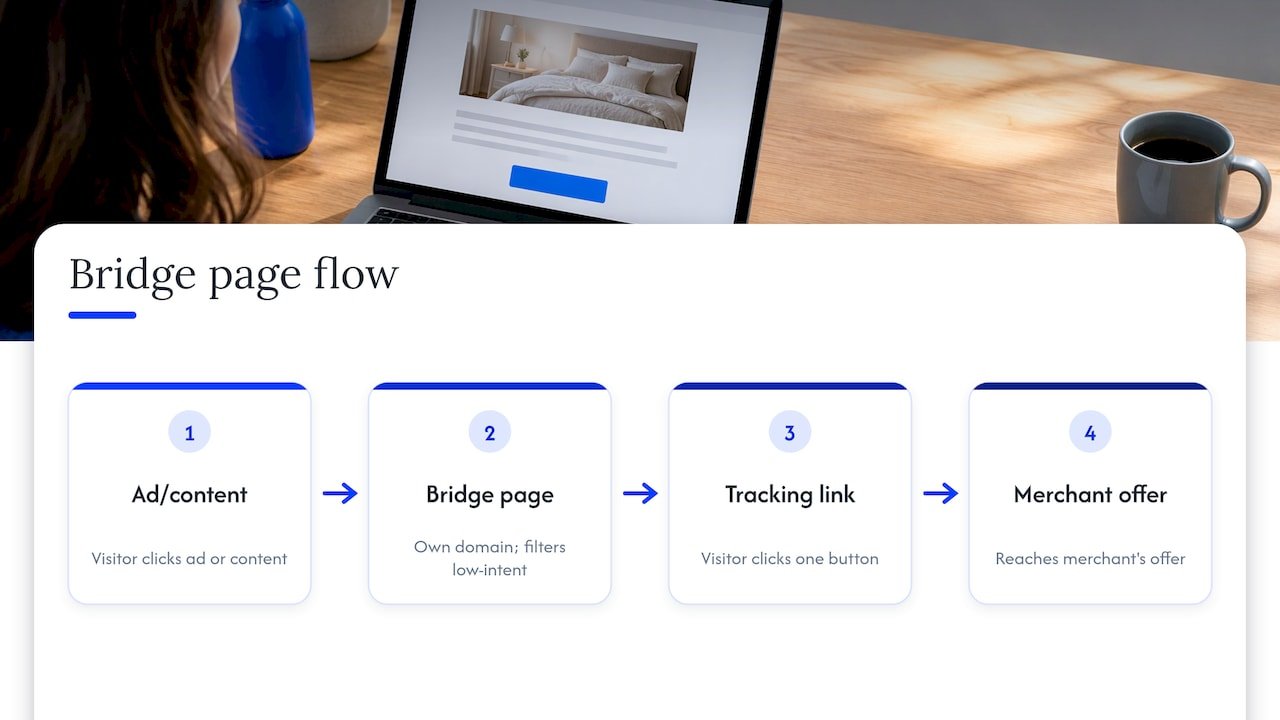
What the page does in the middle is what earns its place. A good bridge page does three things:
It repeats the promise of the ad, so the visitor knows they are in the right place. It adds just enough context to make the next click sensible. And it offers one clear action. A bridge page guide lists the typical parts: a headline that echoes the ad, a one-line subhead, an optional short video or image, a concise explanation, one button high on the page with a specific label, a short reassurance line about what happens next, and a footer with your affiliate disclosure and privacy link.
Notice what is missing: a menu, a sidebar, a second offer. Every extra link is another way for the visitor to leave without clicking the one that pays you.
Some funnel builders go a step further. A bridge funnel, as one builder’s support documentation describes it, pairs an email opt-in page with a bridge page that introduces the product, often by video, and ends with a button to the merchant’s sales or checkout page. That is useful when you do not have access to the sales page itself, which is common with affiliate offers, and you also keep the subscriber for later.
If you want to see these formats laid out, our bridge page examples walk through templates and funnels you can adapt.
When to use a bridge page, a landing page or a direct link
Here is the honest decision, and it comes down to the temperature of your traffic.
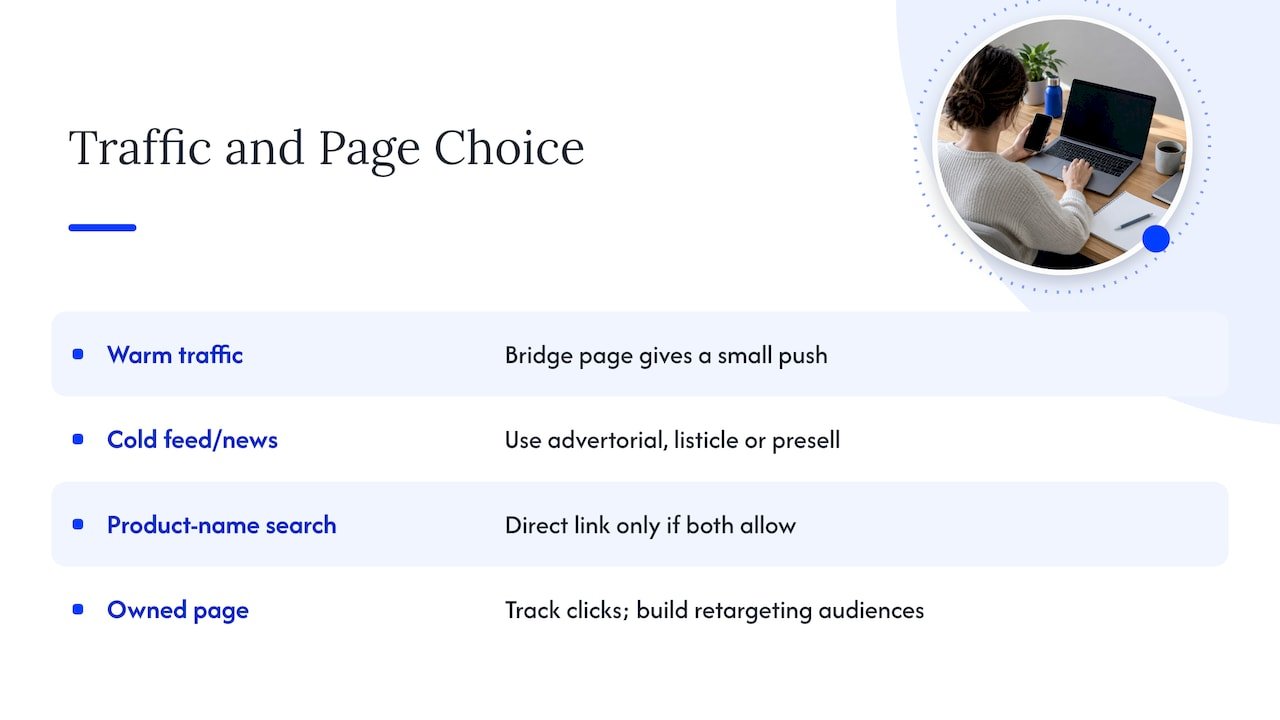
A bridge page fits traffic that already has some intent: search ads, a YouTube audience that trusts you, a warm social following or your email list. They have heard of the thing, and they need a small push. Cold traffic from a feed or a news site is different. These people were not looking for anything, so a short bridge will not persuade them. They need an advertorial, a listicle or a presell page that does the persuading first.
What about linking straight to the offer? One affiliate landing page guide says direct linking makes sense only when the click already wants the product, typically someone searching the product by name, and when both the network and the ad platform allow it. Even then it recommends a page you control, because it is the only place you can see what the visitor did before clicking. That visibility is the real prize. With a direct link you learn almost nothing about why people did or did not convert.
A page you own also helps when a platform or affiliate program does not allow direct affiliate links, and it lets you match the ad’s message, track clicks and build audiences for retargeting.
A word of caution about numbers. You will see claims online that a direct link converts at 1 to 2 percent and a bridge page lifts that to 3 to 6 percent. Those figures come from practitioner content, not controlled studies. A safer way to think about it is that a bridge helps when it adds something the merchant’s page cannot, such as your personal bonus, a comparison or real context from your own experience. If your page only repeats what the merchant already says, it has nothing to add.
The quality of your traffic starts with the keywords behind it. If you are choosing what to target, our guide to buyer intent keywords shows how to find the searches that sell, and those are exactly the searches where a short bridge works best.
Is a bridge page allowed on Google Ads?
This is the question that catches many new affiliates. Google’s “Insufficient original content” policy gives, as an example of what gets disapproved, destinations whose only purpose is to send users to another site, naming bridge pages, doorways and gateways. Google instructs advertisers to provide useful, unique, original content on the page people land on.
That does not mean every intermediate page is banned. It means a thin page that does nothing but redirect is a problem. The pages that tend to be safe are the ones that give the visitor something real: an honest comparison, a clear explanation of who the product is for, your own experience with it, or a tutorial. Think of your page as a small piece of content that happens to end in a button, not a button that happens to have a little text.
If Google Ads is your traffic source, our guide to Google Ads affiliate marketing goes deeper on what works. And when you are tuning the page itself, resources on optimizing landing pages can help you tighten the headline, layout and call to action.
Nofollow, sponsored and your affiliate links
While you are building the page, you will have to decide how to tag the links to the merchant. Google’s documentation says to mark links that are advertisements or paid placements with rel=“sponsored.” Nofollow was previously recommended for these links and is still acceptable, but sponsored is the preferred value. You can combine values in one attribute, for example rel=“sponsored nofollow”, separated by a space or comma.
Two practical details from the same documentation. Links marked this way will generally not be followed, though the linked page may still be crawled if Google finds it another way. And these attributes only work on crawlable links in the page’s HTML, so a button built in a way that does not produce a real link will not carry the tag.
The history is worth a quick look if you have been confused by older advice. According to a timeline of nofollow, Google added the sponsored and ugc values in September 2019, and in July 2021 it asked affiliate sites to use rel=“sponsored”. The same piece records Google’s Martin Splitt saying in August 2024 that nofollow does not signal low quality. So tagging your links carries no penalty. It is simply the correct thing to do.
Disclosure: what the visitor must see
Here is the part many people miss. The rel attribute is invisible to readers. It tells search engines something. It tells your visitor nothing. The same timeline notes that the FTC’s revised endorsement guides, effective July 26, 2023, treat an affiliate link as a material connection that must be disclosed clearly and conspicuously.
What does “clearly and conspicuously” look like? In one FTC order, a visual disclosure is defined as one that is difficult to miss and easily understandable by ordinary consumers, standing out from the surrounding text by size, contrast, location and how long it appears. On a bridge page, that means a plain sentence near the button, such as “We earn a commission if you buy through this link,” not a gray line buried in the footer.
The FTC has also been direct about presentation. In a 2011 speech, Commissioner Julie Brill said an affiliate marketer can’t hold itself out as offering independent reviews of a product. She cited a March 2011 settlement in which a company paid $250,000 over affiliate-written endorsements presented as independent reviews without disclosing the paid relationship. If you are in the United States, treat that as a reminder to be upfront about how you earn.
For wording you can copy, see our affiliate disclosure examples, and for the bigger trust picture, our EEAT guide for affiliate sites covers the FTC steps and how to show proof.
How to measure a bridge page
This is where the bridge-versus-landing difference becomes a numbers question. On a normal landing page, you look at conversion rate. On a bridge page, the conversion happens on the merchant’s site, so your page can only influence the click.
The approach we like follows what one affiliate page framework recommends: treat earnings per click as the main scorecard when the sale happens on the merchant’s site, and treat the outbound click-through rate as a diagnostic. A high click rate with low earnings often means the page promised something the offer did not deliver. A low click rate usually points to friction or a mismatch between ad and page.
The same source suggests testing in a sensible order: the angle and headline match first, then proof and objection handling, then button timing and placement, then page length and content order, and layout polish last. Tag your traffic by source, angle and audience so you can tell which combinations actually make money. If EPC is new to you, our EPC explainer gives the formula with examples.
Speed matters too, because a bridge page is a short stop and slow loading loses people before they read a word. Our site speed checklist for affiliates covers the three metrics to watch.
A simple way to decide
Ask yourself three questions before you build anything.
First, where does the sale happen? If it happens on the merchant’s site, you are building a bridge, and your job is the click. If it happens on your page, you are building a conversion landing page.
Second, how warm is the traffic? Warm traffic gets a short, restrained bridge. Cold traffic gets a presell page.
Third, what do you add that the merchant’s page does not? If you cannot name it, whether a bonus, a comparison or your own experience, fix that before you spend on traffic. It is also what keeps the page on the right side of ad policies.
Our perspective
We teach affiliates to start from a simple idea: the page is part of your relationship with the reader, not a toll booth. When I coach marketers, the pages that struggle are almost always the ones that exist only to pass people along. The pages that work give a visitor one honest reason to take the next step.
That is also where AI earns its keep. Drafting a headline that matches an ad, producing variations to test, or tidying a comparison is the kind of repeatable work that AI can take off your plate, so your time goes into the part only you can bring: your experience with the product. Our approach is practical and time-saving by design, and we blend it with real-life coaching because a template never replaces knowing your audience.
If you are just starting out, build one small bridge page, disclose clearly, tag your links, and watch EPC for a couple of weeks. You will learn more from that than from any theory.
Will
Put it to work with our AI workflows
If you want to build and test pages faster, our AI affiliate workflows give you ready-to-run recipes for the repeatable parts of your affiliate work. They are made for affiliate marketers and entrepreneurs who want to use AI to promote programs more effectively while saving time.

You can also find more coaching, tips, videos and newsletters on willbuckley.com.
FAQ
Is a bridge page the same as a landing page?
Not exactly. A bridge page is a type of landing page that the affiliate owns, and its job is to send the visitor to the merchant’s offer. A general landing page can aim for a sign-up, a download or a sale on the page itself.
Do I need a bridge page for every affiliate offer?
No. Warm traffic that already wants the product can sometimes go straight to the offer if the network and ad platform allow it. A page you control still gives you tracking and the chance to add your own value, so many affiliates use one even then.
Should affiliate links be nofollow or sponsored?
Google prefers rel=“sponsored” for paid or affiliate links and says nofollow is still acceptable. You can use both together. Either tag is invisible to readers, so you still need a visible disclosure near the link.
Can I run a bridge page with Google Ads?
Yes, as long as the page offers useful, original content. Google’s policy targets destinations whose only purpose is to send users to another site. A page with a real comparison, explanation or tutorial is a different thing from a thin redirect.
Sources
- Affilyflow glossary: landing page
- Ahrefs glossary: bridge page
- Bridge page vs landing page for Google Ads affiliates
- What is a pre-lander
- Bridge page guide and template
- How to create a bridge funnel
- Affiliate landing page guide
- Google Ads policy: insufficient original content
- Google Search Central: qualify outbound links
- Explaining nofollow
- FTC stipulated order
- FTC Commissioner Brill speech, 2011
- Affiliate landing page strategy framework
- Optimizing landing pages