

Native ads can work for affiliate marketing, but not the way most beginners try them. You don’t paste an affiliate link into an ad and wait. You pay to put an editorial-style piece of content in front of a cold audience, warm them up on a page you control, and only then send them to the offer. Done well, it’s a patient, testable channel. Done carelessly, it’s a quick way to burn a budget.
If you’ve ever stared at an ad dashboard wondering where your money went, this guide is for you. We’ll walk through what native ads are, why they suit some affiliate offers and not others, how to build a simple funnel, how to test without overspending, and how to stay on the right side of the rules.
TL;DR
- Native ads are paid placements that match the look and feel of the page around them, so they work best when the content behind the click reads like a helpful article, not a pitch.
- The winning structure for most affiliates is ad, then a pre-sell page you own, then the offer. Sending cold traffic straight to a merchant page rarely teaches you anything.
- Start with a small, fixed test budget and enough clicks per variation to learn something. Judge on cost per action, not clicks.
- Disclose your affiliate relationship clearly on your own page, and make sure the ad itself is not deceptive.
- Set up tracking before you spend a dollar, or you won’t know which headline, image or placement earned the sale.
Table of Contents
- What native ads actually are
- Why affiliates use them
- Where native fits next to other channels
- The funnel that makes native pay
- How much should you spend to test?
- Set up tracking before you spend
- Creative and story: what tends to earn the click
- Staying compliant: disclosure on the ad and the page
- Common mistakes we see
- Our perspective
- Where to go next
- FAQ
- Sources
What native ads actually are
Native advertising is a format built to match the form and function of the site it appears on. You see it as sponsored content units, in-feed ads or recommendation widgets under an article. The IAB’s native playbook describes them as an alternative to intrusive banner formats, and notes that disclosure cues such as “Sponsored” or “Promoted” help readers tell paid placements from editorial.
That last part matters for you. The ad blends in visually, but it must never pretend to be something it isn’t. We’ll come back to that in the compliance section.
For an affiliate, the appeal is simple. People scrolling a news site or a content feed aren’t in a shopping mindset, yet they do click on headlines that promise something interesting. If your headline, image and landing content deliver on that promise, you can reach a large audience that search ads and social posts never touch.
Why affiliates use them
Affiliate marketing is a performance model. The IAB’s affiliate handbook defines it as a channel where an advertiser pays a commission for sales or actions generated by referrals. Native advertising, on the other side, is usually bought on a click or impression basis. So you are the one carrying the risk: you pay for traffic up front and get paid only if people act.
That gap is the whole game. Your job is to make sure the commission you earn per action is comfortably higher than what you paid to get that action. Everything else in this article is about closing that gap with data instead of hope.
Native works especially well when the offer has a story. Think software with a clear before and after, a course that solves a specific frustration, a subscription with a free trial, or a comparison of two tools. It works poorly for offers that need no explanation, pay tiny commissions, or depend on a buyer who is already searching for the product by name.
Where native fits next to other channels
We often get asked whether to start with native ads, search ads, social or organic content. Here’s our honest take: they do different jobs.
Search captures people who already want something. Native creates interest in people who didn’t know they wanted it. Organic content, like a blog or a video channel, builds slowly but costs little. If you’re curious about the free side, we’ve written about starting with Reddit as an affiliate, and about YouTube affiliate marketing as another route to cold audiences without an ad bill.
Creator-led promotion is a cousin of native in spirit, since both rely on content that feels natural rather than salesy. If that angle interests you, these influencer marketing strategies show how trust-based promotion can drive brand growth, and the same instinct applies to native creative: lead with usefulness, not hype.
The funnel that makes native pay
The most common beginner mistake is sending ad traffic straight to the merchant’s sales page. You get clicks, maybe a few sales, and no idea why. A pre-sell page changes that.
Step one: the ad
Your ad has two jobs: earn the click from the right person and set an honest expectation. A headline that promises a specific, believable outcome usually beats one that screams. Pair it with an image that looks like it belongs in the feed, not a stock photo of a smiling person with a laptop.
Write the headline for the person you want, not everyone. If your offer is a scheduling tool for freelancers, say so. A smaller number of right-fit clicks is cheaper than a large number of curious ones.
Step two: the pre-sell page
This is a short page on your own domain that reads like a helpful article: a review, a comparison, a story of a problem and how it got solved. The reader should finish it knowing whether the product suits them. Some will click through to the offer, and those people are far warmer than anyone arriving cold.
An Adflex guide to native ads for affiliates makes a similar point, suggesting you promote content that carries your affiliate links rather than pushing raw offers. That matches what we see work for beginners. The page also gives you something valuable: your own data. You can see scroll depth, outbound clicks and which angle resonates, regardless of what the merchant shares.
Step three: the offer
Only now does the visitor reach the merchant. Check the offer’s payout, cookie window, refund rate and whether the merchant allows paid traffic at all. Some programs prohibit it or restrict certain ad types, so read the terms before you spend. If a program won’t let you negotiate or you suspect your volume deserves better, our guide on how to negotiate a higher commission walks through a 90-day pilot approach.
How much should you spend to test?
Here’s where encouragement meets realism. A tiny budget feels safe, but it often teaches you nothing. If you only buy a handful of clicks per variation, one lucky sale or one unlucky dry spell can fool you.
The Universal Business Council’s budgeting guide, written about search ads, offers a rule of thumb that carries over to any paid traffic: aim for roughly 10 clicks per day per campaign so you collect enough data to optimize. Their reasoning is that chasing the lowest possible daily spend leaves beginners with too little information. Native clicks are often cheaper than search clicks, which helps, but the principle stays the same.
A simple way to apply it: decide in advance the total you’re willing to lose on this test, split it across two or three ad variations and one pre-sell page, and don’t touch anything until each variation has had a fair run. Then compare cost per action, not click-through rate. A headline that gets lots of clicks and no sales is the most expensive thing in your account.
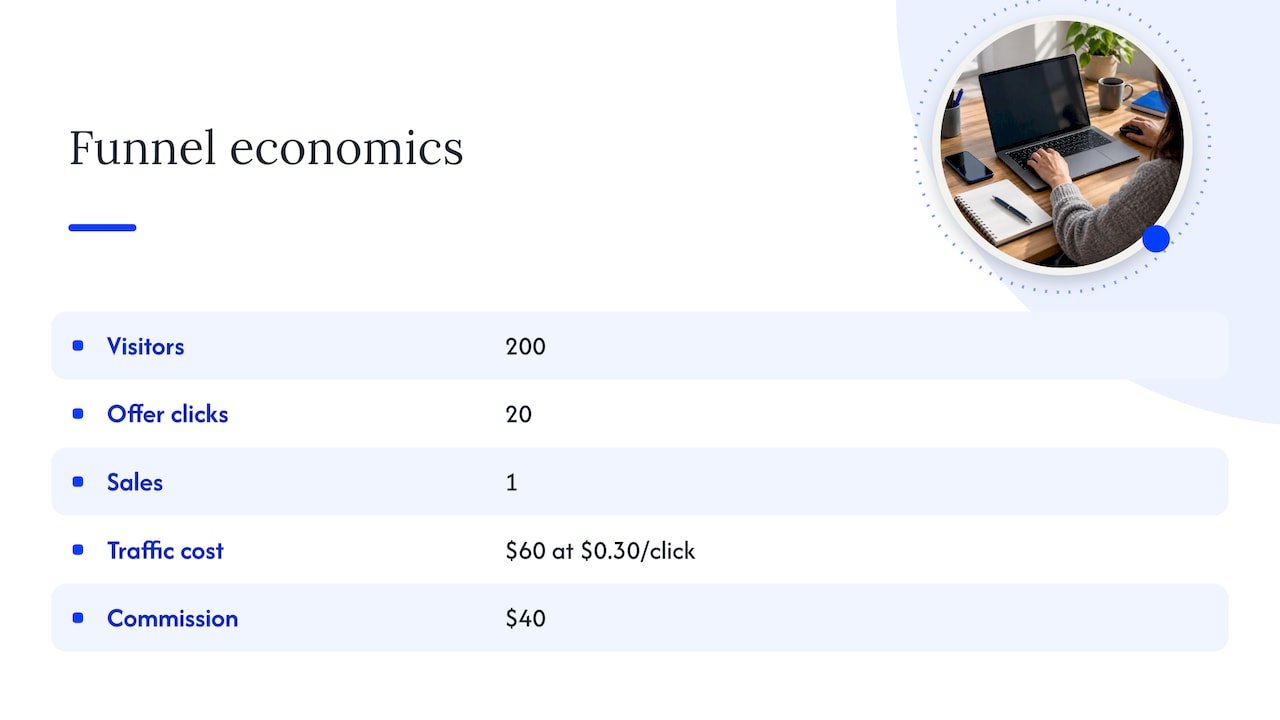
Worked example with made-up numbers, to show the logic and not a benchmark: say you pay $0.30 per click and your pre-sell page sends 10 percent of visitors to the offer, and 5 percent of those buy. That’s 1 sale per 200 visitors, or $60 in traffic. If the commission is $40, you lose money. To profit you must improve one of the three levers: cheaper clicks, a better pre-sell page, or a higher payout. Seeing which lever is weakest is exactly why you built the funnel in steps.
Set up tracking before you spend
Native platforms let you tag every placement, headline and image. Use that. At minimum you want to know which ad variation and which publisher source led to each action, so you can cut the losers and scale the winners.
If you’re newer to this, start with the basics: a unique tracking parameter per ad, a tool that records clicks on your pre-sell page, and a postback or conversion report from the network. Our walkthrough on Google Tag Manager for affiliates shows how to track outbound clicks step by step, and the guide to a cookieless affiliate link tracking setup covers what to do as browser cookies get less reliable.
One more idea worth knowing: not every touchpoint deserves equal credit. A native ad might introduce the buyer, while an email or search click closes the sale. If you want to understand how to assign credit sensibly, read our piece on affiliate attribution models. It will stop you from killing a campaign that is quietly feeding the rest of your funnel.
Creative and story: what tends to earn the click
Native is a storytelling channel. People click because a headline sparks curiosity or recognizes a problem they have. A few habits help.
Start from one real problem. “Spending two hours a day on captions?” beats “Revolutionary marketing software.” Keep claims you can back up on the pre-sell page. If an ad promises something the page doesn’t deliver, readers bounce and your cost per action climbs.
Test one thing at a time. Change the headline and keep the image, or the reverse. When you change both, you can’t tell which one moved the numbers. Keep a plain log of what you changed and what happened, because memory is a poor analyst.
And use the pre-sell page to be useful. Include a real comparison, an honest downside, or a short story of how you used the product. That honesty is what separates a page people trust from one that reads like a classified ad. If you use AI to speed up drafts, which we love, ground it in facts you’ve verified. Our article on AI content for affiliates explains why an evidence pack should come before the first draft.
Staying compliant: disclosure on the ad and the page
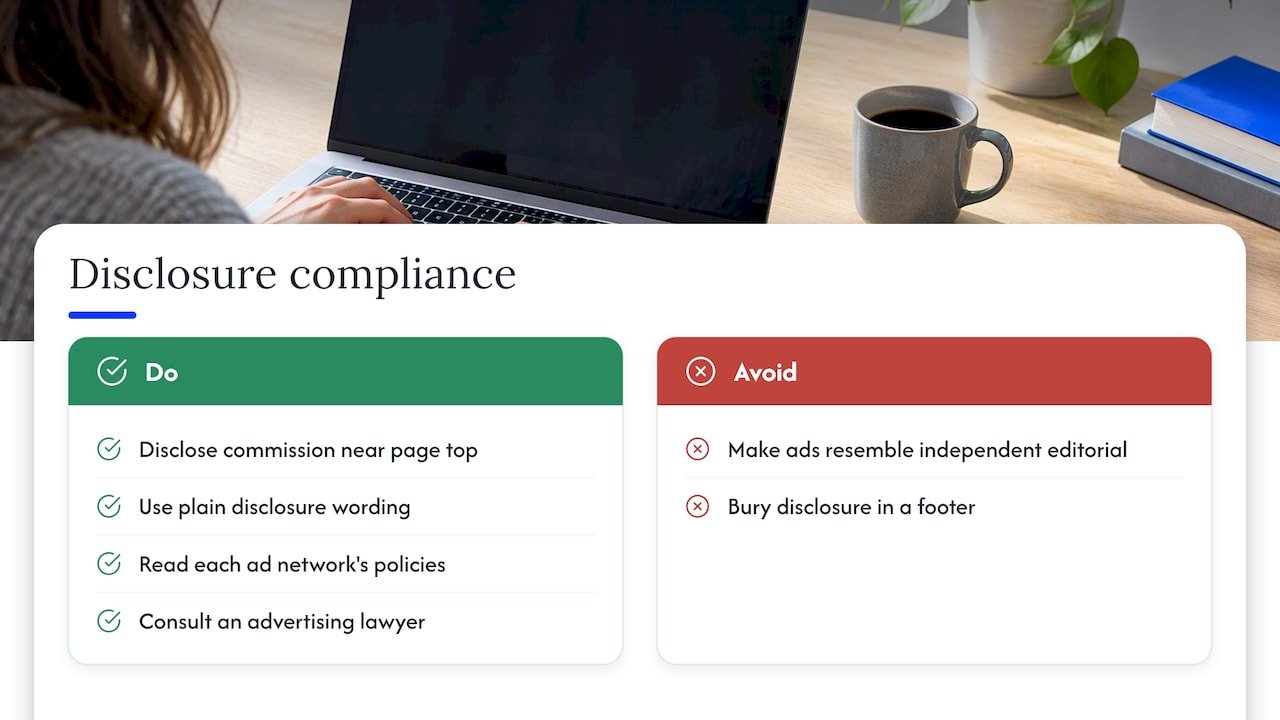
This is the part many beginners skip, and it’s the one that can cause real trouble. In the US, the FTC’s native advertising guide for businesses says the watchword is transparency: an ad shouldn’t be formatted so that readers mistake it for independent editorial content.
There’s a second layer for affiliates. The FTC’s Endorsement Guides say that a “material connection” between an endorser and a marketer, one that might affect the credibility consumers give the endorsement, needs to be disclosed. You can see how the agency phrases this in a warning letter it sent to an influencer. An affiliate commission is exactly that kind of connection.
In practice, put a plain disclosure near the top of your pre-sell page, in the content itself and not buried in a footer, stating that you earn a commission if the reader buys. Use simple words. If you want wording you can adapt, see our affiliate disclosure examples and the guide on EEAT for affiliate sites, which includes copyable disclosures.
A caution where it counts: this is general information, not legal advice. If you run campaigns in several countries, or promote health, finance or similar regulated offers, speak with a lawyer who knows advertising law in the countries you target, and read each ad network’s own policies, which are often stricter than the law.
Common mistakes we see
The first is skipping the pre-sell page and wondering why nothing converts. The second is changing everything every day, which leaves you with noise instead of lessons. The third is scaling too soon: a campaign that makes one sale isn’t proven. Wait until the pattern repeats.
The fourth is ignoring the merchant side. A high payout means little if refunds are heavy or the program quietly caps paid traffic. The fifth is thinking of native as a get-rich-quick trick. It’s a media-buying skill, and like any skill it improves with repetition and honest review. Case studies help you see what realistic numbers look like, which is why we collected real affiliate marketing case study data you can learn from.
Our perspective
We came to affiliate marketing through teaching and coaching, and that shapes how we look at native ads. The channel rewards the same habits good teachers have: explain clearly, respect the reader’s time, and check whether the lesson landed. Most of the people who write to us aren’t short on tools. They’re short on time and confidence, and they’re tempted to hand the whole thing over to automation.
Our view is that AI should take the repetitive work, such as drafting headline variations, summarizing a product’s features, and organizing your test log, while you keep the judgment. You decide what’s true, what’s fair to the reader, and what’s worth a budget. When you let a tool decide those things, you lose both money and trust.
We’d also gently push back on the idea that you need a big budget or a perfect plan. You need a small test, a clean tracking setup, an honest page and the patience to read the results. That’s it. Procrastination, not money, is the quiet force that stops most people. Starting small and starting now beats planning for another month.
— Will
Where to go next
If you’d like to build the supporting pieces faster, our guide to AI workflows for affiliates has ready-to-run recipes, and the article on AI workflow automation for affiliate marketers shows how to save time on the repetitive steps. For pre-sell page drafts, our roundup of the best AI writing tools is a good place to start. You can find everything else on willbuckley.com, including the newsletter, where we share new tests and lessons as we learn them.
FAQ
Are native ads good for affiliate marketing?
They can be, especially for offers that benefit from explanation, like software, courses or comparisons. They reach people who aren’t actively searching, so you need a pre-sell page to warm them up. For simple offers with low payouts, the math often doesn’t work.
Can I send native ad traffic straight to an affiliate link?
Technically sometimes, but we don’t recommend it. Many networks and merchants restrict direct linking, and you lose the data a pre-sell page gives you. A page you own lets you disclose your relationship clearly and learn which angles work.
How much should I budget to test native ads?
There’s no single right number, because it depends on click cost and payout. A useful rule from budgeting guidance for paid ads is to aim for about 10 clicks per day per campaign so your data means something. Set a total loss limit before you start and stick to it.
Do I need to disclose affiliate links in a native ad funnel?
In the US, yes: the FTC expects clear disclosure of material connections, placed in the content where readers will see it. The ad itself also shouldn’t look like independent editorial content. For specifics on your situation, check with an advertising lawyer.
Sources
- IAB Australia: The Native Playbook
- IAB Australia: Affiliate Marketing Handbook
- Adflex: Native Ads For Affiliate Marketing
- Universal Business Council: Google Ads Budget Planning for Beginners
- FTC: Native Advertising, A Guide for Businesses
- FTC: Warning Letter to Cara Harbstreet