

AI ad creative works best when you let AI invent the concept and keep a human in charge of strategy, brand voice and trust. Used that way, it can beat designer-made ads on click-through rate. Used as a patch on a weak ad, or as a replacement for thinking, it tends to disappoint.
If you run paid campaigns, promote affiliate offers or are just getting started, you’ve probably wondered whether these tools are worth it. This guide covers what the evidence says, where AI ads quietly fail, and a simple process you can test without betting your budget.
TL;DR
- A 2025 field study found fully AI-generated ads lifted click-through rate from 3.73% to 4.44%, a relative gain of 19%.
- AI helps most when it defines the concept from scratch. It helps least when you force it to polish an existing human design.
- Telling viewers an ad is AI-made reduced click-through in that same study, so plan for disclosure rules and for authenticity.
- The strongest setup is hybrid: humans pick the strategy and concepts, AI produces the variations, and you check for fatigue every week.
- Start small: 5 to 7 concepts, 2 to 3 variants each, one platform, one clear metric.
Table of Contents
- What AI ad creative actually means
- What the research says about performance
- What strong ads have in common, with or without AI
- A hybrid workflow you can run this week
- Choosing a tool without chasing hype
- Mistakes that quietly waste ad budget
- Our perspective: AI is the studio, you’re still the director
- Where to go next
- FAQ
- Sources
What AI ad creative actually means
The phrase covers a few different jobs, and mixing them up is where people get confused.
Images and static ads. Banners, product shots, social posts and display ads generated from a prompt, a product photo or your website.
Video ads. Short clips with AI avatars, voiceovers, UGC-style presentations or animated product shots. These are growing fastest, because video used to be the most expensive thing to produce.
Copy. Headlines, primary text and calls to action. If this is your biggest bottleneck, our guide to the best AI writing tools for marketers and creators is a good place to start.
Platform-native automation. Tools built into ad platforms that tweak your images, write text variations and resize formats. According to one 2026 overview, Meta’s automated creative features can cut production time by 60 to 70% while producing more variations to test. Treat that as a vendor-side estimate, not a promise for your account.
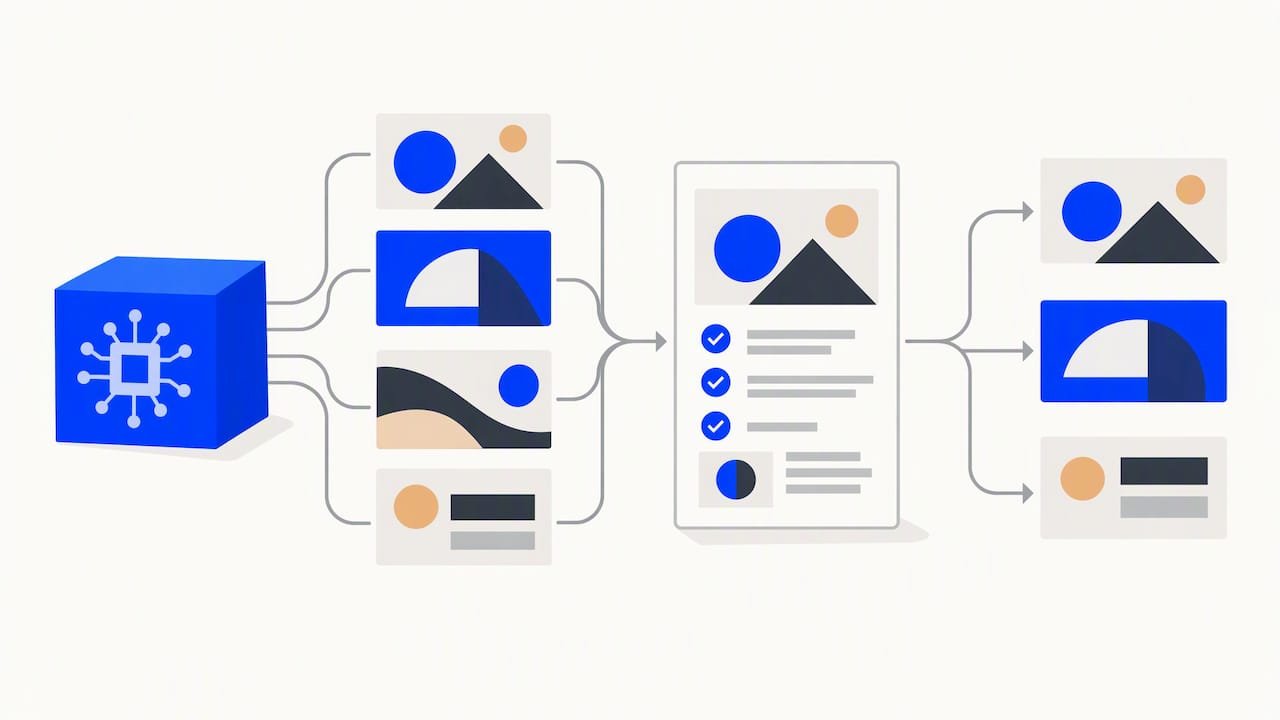
Most tools you’ll see ranking in search combine several of these: scan your site, generate a batch of ads, push them live, then show you what converted. That loop is handy. But the loop only works if what goes in is good.
What the research says about performance
Let’s start with the encouraging part, because it’s real.
Researchers at NYU Stern and Emory University ran a field study over four months and roughly 106,000 impressions. Fully AI-created ads raised click-through rate from 3.73% to 4.44%, a 19% relative lift. The researchers linked this to what they call visual processing fluency: the ads were simply easier for people to take in.
Now the part that gets skipped in most headlines.
The constraint paradox
The same research found AI didn’t help when it was forced to work inside a human designer’s existing layout. It delivered the most value when it had freedom to define the concept and composition itself. In plain terms, taking a mediocre ad and asking AI to “fix” it often does worse than starting fresh.
This changes how you brief. Instead of uploading last quarter’s tired banner and asking for a refresh, give the tool your offer, your audience and your goal, and let it propose several different directions.
The disclosure penalty
Here’s the tension. In that study, when viewers knew an ad was AI-generated, click-through dropped from 3.73% to 2.56%, roughly a 31.5% fall. Meanwhile, rules on synthetic media disclosure keep getting stricter in many places.
What does that mean for you? Don’t hide AI use where a rule or a platform label requires disclosure. Check the current policy of the platform you advertise on and the law where you sell. Then build ads that earn trust on their own merits, so a label costs you less. If you’re an affiliate, our walkthrough of EEAT for affiliate sites and FTC disclosures covers the disclosure basics on the content side.
Human plus AI beats AI alone
A 2025 experimental study of TikTok advertising found that human and AI collaboration tends to outperform AI-only work. AI helped hold visual attention, while a human presence anchored perceived authenticity, which is what builds the trust people need before they click or buy.
That’s a small academic study on one platform, so read it as a direction rather than a law. But it matches what many media buyers report: AI is excellent at volume and variation, and weaker at the feeling that a real person stands behind the offer.
What strong ads have in common, with or without AI
Meta, working with AppsFlyer and Dentsu, looked at more than a million creative variations in app promotion. Their findings, as reported by Social Media Today, point to a few building blocks: full-screen 9:16 video, a person on screen and expressive audio. Ads combining these showed a 29% higher conversion rate and 16% lower cost per acquisition than ads without them. Campaigns using a diverse mix of formats improved CPA by up to 32%.
These are app-install findings, so don’t assume the exact numbers carry over to your affiliate offer. The pattern is still useful. It tells you what to ask your AI tool for:
| Element | Why it matters | How to prompt for it |
|---|---|---|
| Vertical 9:16 format | Fills the phone screen in feeds and short-video placements | Request vertical output first, then adapt to square and wide |
| A real or realistic person | Adds a human anchor and supports trust | Use your own footage, a creator, or a clearly labeled avatar |
| Expressive audio | Voice and sound carry emotion, not just information | Record or direct the voiceover with energy, not a flat read |
| Format variety | Gives the platform more ways to find a match | Ask for static, short video and carousel versions of each concept |
For deeper tactics on social creative, this breakdown of creative elements linked to stronger social ad performance is worth a look.
A hybrid workflow you can run this week
Meta’s ad system now evaluates creative itself, including visuals, hooks, messaging and format, to match ads to people, rather than leaning mainly on audience targeting. One 2026 guide to Meta’s Andromeda system recommends feeding it real variety. That makes the following approach sensible on any platform.
Step 1: Build 5 to 7 distinct concepts by hand
A concept is an idea, not a color change. “Before and after,” “common mistake,” “a day in the life,” “myth versus fact,” “quick demo.” Write each in one sentence, with the viewer’s problem and the promise. This is the human strategy part, and no tool should skip it for you.
Step 2: Let AI explore each concept with freedom
Give the tool the concept, audience and offer. Resist handing it a fixed layout. The research above suggests the best output comes when AI decides composition and visual treatment. If you’re short on words for briefs, our AI brief templates and prompt library guide save a lot of back and forth.
Step 3: Make 2 to 3 variants per concept
Change the background, text overlay or aspect ratio. Across 5 to 7 concepts, that gives you roughly 15 to 21 solid variations to hand the platform, enough to learn from without drowning in assets.
Step 4: Review like an editor
Check every ad for brand voice, factual accuracy, earnings or results claims you can’t back up, odd hands or garbled text in images, and disclosure requirements. Marketing experts describe AI as a production multiplier, not a replacement for creative strategy, and this step is where that holds true.
Step 5: Test cleanly
Change one thing at a time where you can, and decide your success metric before launch. If you’ve never set up a test, our guide to piloting AI split testing in a few hours walks through it.
Step 6: Watch for fatigue every week
Automation can push a winner hard, and audiences burn out on it faster than they do with slower manual campaigns. One analysis of the NYU research advises checking frequency and click-through trends every seven days. When CTR slips and frequency climbs, swap in fresh concepts, not just fresh colors.
Choosing a tool without chasing hype
You’ll find three broad types of AI ad tools, and each suits a different person.
Website-scan generators build ads from your site and product pages. They suit small shops and affiliates with clear product pages who need volume fast.
Video-first ad platforms specialize in avatar, UGC-style and product videos. They suit anyone whose main format is short-form video.
Design suites with ad features keep creative, publishing and insights in one workspace. They suit people who already live in a design tool and want a gentle learning curve.
Whatever you pick, ask these questions before paying:
- Can I control concept and layout, or am I locked into templates?
- Can I export vertical, square and wide versions?
- Who owns the output, and what are the commercial usage terms?
- Does it show performance feedback, or is it only a generator?
- What does the real monthly cost look like once I need video and more than a handful of ads?
Pricing changes often and varies by plan, so check each vendor’s current page rather than trusting a roundup, including ours. Many offer free trials, which is the safest way to find out if the output matches your brand.
Mistakes that quietly waste ad budget
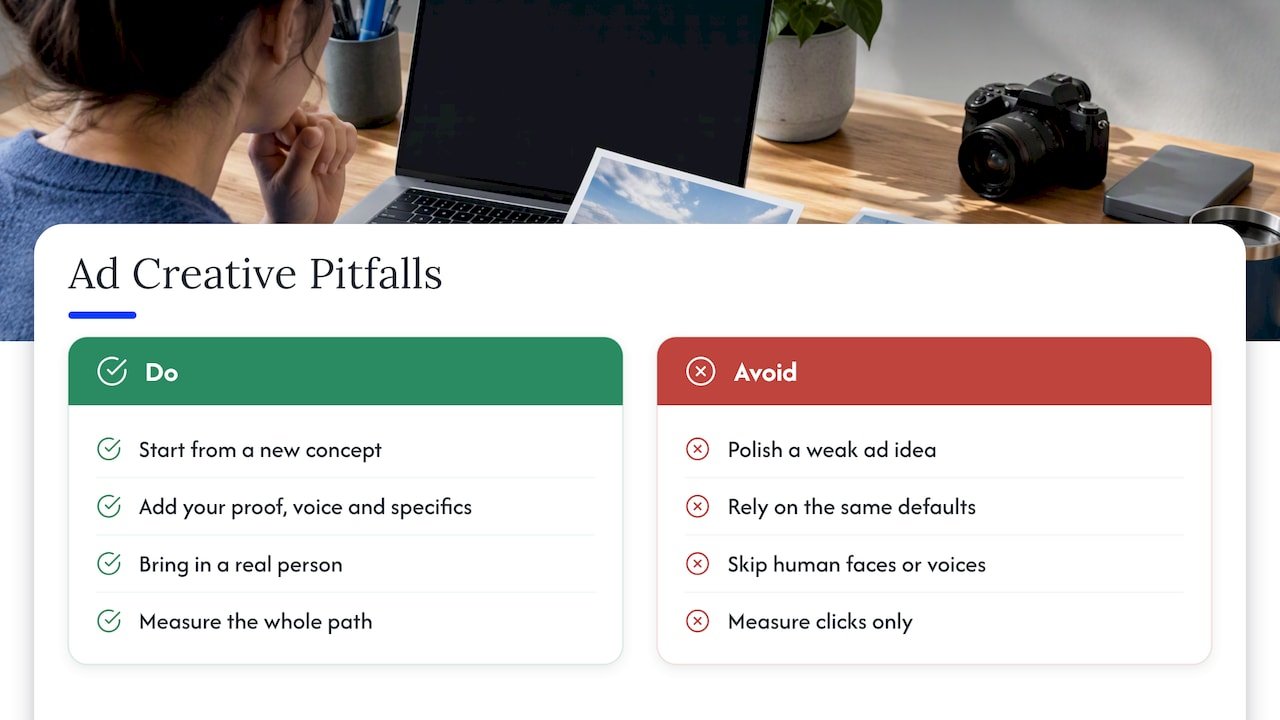
The most common problem is rescuing a weak ad. If the original idea doesn’t work, polishing it with AI rarely changes that. Start from a new concept.
The second is generic sameness. When everyone uses the same defaults, ads blend into one polished blur. Add your own proof, voice and specifics.
Third, no human face or voice anywhere. If trust is part of your sale, which it is for most affiliate offers, bring in a real person at least in some variants.
Fourth, ignoring ethics and disclosure. A single misleading AI-made testimonial can cost you your ad account and your audience. Our piece on mapping ethical AI marketing to NIST, IAB and UNESCO guidance is a helpful gut check.
Finally, measuring clicks only. A higher CTR is nice, but if the landing page is weak, you’ve just paid more people to bounce. Look at the whole path, and see how AI marketing analytics can show you where people drop off.
Our perspective: AI is the studio, you’re still the director
We’ve coached and taught for a long time, and the pattern we see with AI ads is the same one we see with any new tool. People hope it will remove the hard thinking. It doesn’t. It removes the slow, repetitive production, which frees you to spend your effort on the part that actually moves results: who you’re talking to, what they’re worried about and why your offer helps.
If you’re an affiliate marketer, that matters even more. You’re borrowing trust from the product and lending your own. An ad that feels anonymous or too slick can undo that in a second. So our advice is to use AI for speed and variety, then put something unmistakably human on top: your voice, your real experience with the product, your honest caveats.
And be kind to yourself in the learning stage. Your first batch will be uneven. That’s normal. Run a small test, keep what works, and tighten from there.
— Will
Where to go next
If you want help turning this into a working system, we cover the practical side on our site, from short-form video AI workflows for affiliate ads to AI workflow automation for affiliate marketers. Start with the guide that matches your bottleneck, and join our newsletter at willbuckley.com for new tutorials and tool tips as they land.
It also helps to treat AI as one part of a larger plan. A 90-day AI content strategy keeps your ads, content and offers pulling in the same direction, and the AI productivity gains marketers report are easier to capture when the plan comes first.
FAQ
Is AI ad creative worth it?
It can be. A 2025 field study found fully AI-generated ads beat human-designed ones on click-through rate by 19%. The catch is that results depend on giving the AI creative freedom and keeping human oversight on strategy and quality. Test it on a small budget before you scale.
What is the best AI ad creative tool?
There isn’t one best tool, because it depends on your format and workflow. Website-scan generators suit fast static ads, video-first platforms suit short-form video, and design suites suit people who want everything in one place. Use free trials and judge the output against your own brand.
Do I have to disclose that an ad was made with AI?
It depends on the platform and where you advertise, and rules are tightening. Read the current advertising policies of the platform you use and the laws in the countries you target. If you aren’t sure, ask a qualified advertising or privacy attorney. Remember that disclosure can lower click-through, so build trust through real proof and a human presence.
How often should I refresh AI-generated ads?
Check frequency and click-through at least every seven days. AI-assisted campaigns can scale a winning ad quickly, which also tires audiences quickly. When performance dips, bring in new concepts rather than minor edits of the old one.
Sources
- The Impact of Visual Generative AI on Advertising Effectiveness, Compass Lexecon
- Meta Shares Ad Tips Based on 1M+ Ad Creatives, Social Media Today
- An Experimental Study of Human and AI Collaboration in TikTok Advertising
- Meta AI Creative Tools: Auto-Generate Ads in 2026
- Andromeda Creative AI Tools 2026: Meta Ads Guide
- NYU Research: Unconstrained AI Ads Outperform Human Creative