

The best way to use AI for affiliate content is as a research-and-drafting assistant, never as the final word. Pair it with an evidence pack of real product testing, measurements, and screenshots, then verify every claim before you hit publish. Add a clear, conspicuous affiliate disclosure, and you have a process that satisfies both readers and search engines.
TL;DR:
- Before prompting AI, record the product version, test date, screenshots, and your own measurements in one evidence file to support firsthand claims.
- Match tools to tasks: research assistants surface buyer questions, while drafting engines turn your outline and notes into copy; neither can replace product testing.
- Place affiliate disclosures beside links; for video, disclose on screen and near links in the description, and validate structured data before publication.
- Reuse a verified evidence file for emails, social posts, comparisons, and video, but check each format for current claims and add an original element.
- Test the workflow on one review and track the time it takes before expanding it; a human should verify every claim and sentence before publication.
Table of Contents
- Why AI Matters for Affiliate Content
- AI Tool Types and What Each Is Best For
- Step-by-Step: Producing a High-Quality AI-Assisted Affiliate Review
- Editorial Checklist and Compliance: Meeting Google and FTC Expectations
- Turning One Verified Review Into Many Assets
- Human Oversight: Avoiding Hallucinations and Other AI Pitfalls
- How I Use AI in My Own Affiliate Workflow
- How Will Buckley Can Help: Coaching, Templates, and Hands-On Workflows
- FAQ
- Sources
Why AI Matters for Affiliate Content
You already know the bottleneck. Research takes hours, drafts take longer, and by the time you publish, the product has a new version. AI changes the math on all three. A well-prompted research assistant can summarize ten competing reviews and surface the questions buyers keep asking in a fraction of the time it would take you to read them all yourself. Drafting goes from a half-day task to a focused hour when you feed the model a real outline and real notes instead of asking it to invent a review from nothing.
Where does this efficiency pay off the most? Not everywhere equally.
- Research synthesis: Pulling specs, pricing history, and common complaints from scattered sources.
- First drafts: Turning your outline and raw notes into readable sections fast.
- Email sequences: Repurposing a finished review into a three or five part nurture series.
- Short video scripts: Converting a long review into a 60-second hook for social.
That said, speed is not the same as quality. Readers and algorithms alike can tell the difference between a review built on real use and one built on summarized marketing copy. The tools get you to a faster first draft. You still have to live with the product to make that draft true.
AI Tool Types and What Each Is Best For
Not every AI tool does the same job, and treating them interchangeably is where a lot of affiliates waste time. It helps to think of your stack in five categories, each solving a different part of the content problem.
- Outline generators and brief templates turn a keyword or buyer question into a structured skeleton, so you are never staring at a blank page.
- Long-form drafting engines take that skeleton and your notes and produce full sections, though they need tuning (tone instructions, sample paragraphs) to sound like you instead of a generic reviewer.
- Research assistants and SERP summarizers read the competing content already ranking and tell you what questions it answers and what it misses, which is where your original testing can win.
- SEO optimization and structured-data tools check your headings, metadata, and schema markup against what search engines expect from review content.
- Repurposing and social or video script tools take a finished piece and reshape it into shorter formats without you rewriting from scratch.
The mistake we see most often is using one tool for every stage. A drafting engine is not a research tool, and a research tool will not fix a flat, voiceless draft. Match the tool to the task, and the quality gap between “AI wrote this” and “AI helped me write this” starts to close. We walk through specific tool picks and prompt chains for each category in our best AI writing tools for marketers roundup, and our prompt engineering workflows breakdown if you want to cut drafting time further without losing your voice.
Step-by-Step: Producing a High-Quality AI-Assisted Affiliate Review
This is the workflow we rely on, built around a simple idea: AI organizes, you verify. Here is how it runs end to end.
- Pick a buyer-intent question and build your evidence pack. Before you open a chat window, gather the product itself (or a trial), the version number, the purchase or test date, screenshots of the interface or results, and any measurements you can take yourself. Google’s guidance on writing high-quality reviews is explicit that first-hand evidence and quantitative data are what separate a useful review from a rehashed spec sheet.
- Ask AI for an outline and a missing-evidence checklist. Feed it your buyer question and ask what a thorough review needs to cover, then ask it to flag anything you have not yet backed with evidence. Iterate until the gaps are gone.
- Draft section by section. Replace every AI placeholder sentence with your actual notes: the exact number you measured, the screenshot you took, the detail a generic review would never mention.
- Fact-check every claim, then finalize metadata and schema. Read the draft against your evidence pack line by line, confirm pricing and feature claims are current, validate your structured data, and add your disclosure near the affiliate links themselves, not buried in a footer.
- Repurpose into email, social, and video. Once the review is verified and published, pull three or four derivative assets from the same evidence pack rather than starting over.
Pro Tip: Keep your evidence pack as a single running document per product. When the product updates, you edit one file and regenerate every derivative asset from it instead of chasing inconsistencies across five pieces of content.
This process takes longer than typing a prompt and hitting publish, but it is the difference between a review that ranks for a month and one that holds up for a year. We built a full template around this exact sequence in our AI-assisted affiliate review template, and if you want specific prompt chains for each step, our ChatGPT workflow guide has the ones we use ourselves.
Editorial Checklist and Compliance: Meeting Google and FTC Expectations
Two sets of rules govern whether an AI-assisted review survives contact with the real world: what Google expects from review content, and what regulators expect from disclosure. Neither is optional, and both are more specific than most affiliates assume.
Google’s review guidance calls for first-hand evidence, quantitative measurements, and a clear explanation of why a product fits a specific use case rather than a generic “it’s great” summary. On the compliance side, the FTC’s Endorsement Guides treat an affiliate relationship as a material connection that must be disclosed clearly and conspicuously, with revised guidance effective July 26, 2023 making clear the disclosure must be hard to miss and easy to understand. For video content specifically, that means disclosing inside the video itself and again in the description near the links, not just once at the top of a page.
A practical page-level checklist:
- Disclosure appears near the affiliate links themselves, not only in a separate policy page.
- Video disclosures appear on screen and in the description, close to any links mentioned.
- Testing dates and product versions are documented and visible to the reader.
- Structured data is validated before publishing, not after.
The FTC’s guidance specifically describes a blogger receiving a commission as the kind of relationship that requires clear, conspicuous disclosure, an example laid out in the Federal Register’s published endorsement rules.
You do not need paragraphs of legal language to show editorial oversight. A single line near the top, something like “we tested this ourselves and may earn a commission from links below,” does the job without reading like a terms-of-service page. We cover real phrasing you can copy directly in our affiliate disclosure examples.
Turning One Verified Review Into Many Assets
Once a review is tested, fact-checked, and published, the real leverage starts. The mistake is treating each repurposed piece as a fresh writing project instead of a reshaping of evidence you already verified.
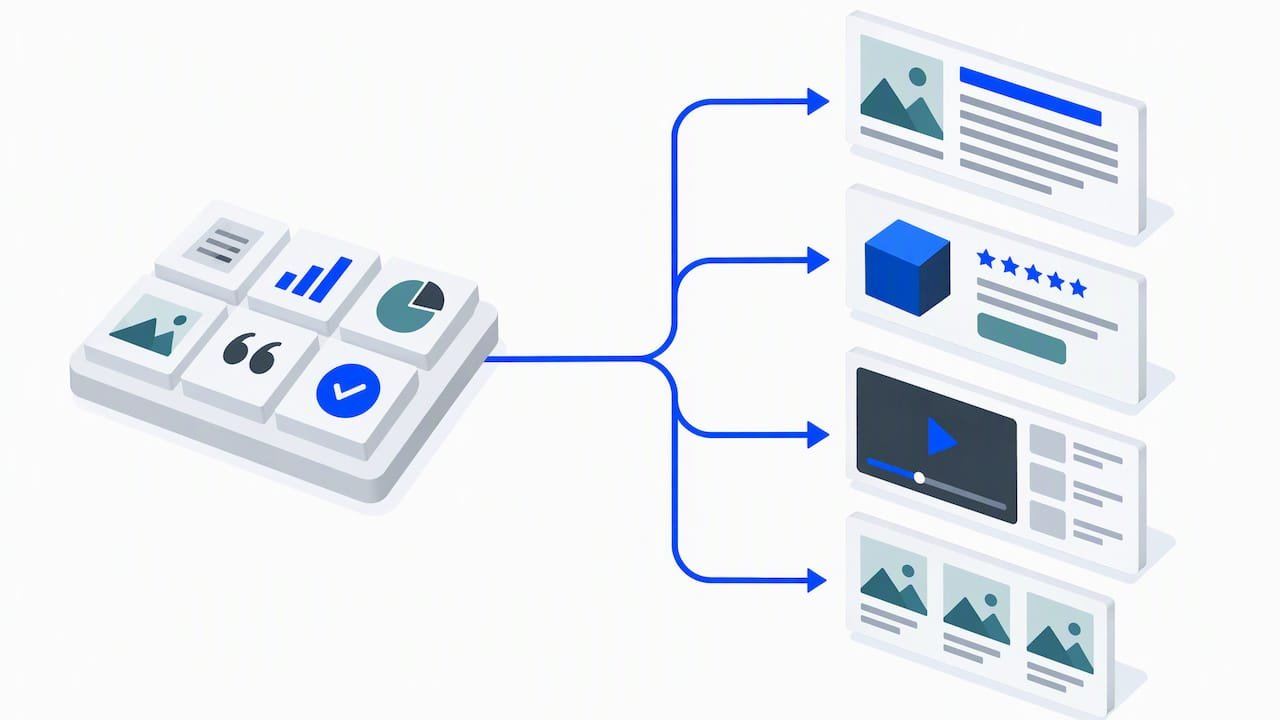
Centralize everything in one evidence file: your measurements, screenshots, pricing dates, and disclosure language. Every derivative asset pulls from that same file, so a number never drifts between your email and your review. Google’s guidance on generative AI content notes that repurposing is efficient, but every format still needs its own accuracy and disclosure check, since a claim that was true in January can be stale by the time it reaches a video script in March.
A single verified review can reasonably become:
- A three-email nurture sequence that expands on one section each.
- A short-form social post built around your single most surprising measurement.
- A side-by-side comparison piece if you have tested a competing product with the same evidence standard.
- A 60-second video script that opens with the one result most likely to make someone click.
The guardrail that keeps this from becoming thin, duplicated content is simple: every derivative needs one original element the others don’t have, whether that’s a new angle, an added data point, or a screenshot unique to that format. Google’s AI optimization guidance specifically warns against scaled content abuse, where many pages are generated with little added value. Our AI content repurposing tools breakdown covers tool-specific recipes for each format if you want copy-paste prompt starters.
Human Oversight: Avoiding Hallucinations and Other AI Pitfalls
AI will state a wrong price with the same confidence as a correct one, which is exactly why verification cannot be skipped, no matter how polished the draft reads.
Build a short fact-check pass into every piece: confirm every price, spec, and feature claim against your evidence pack, not against the AI’s memory. Google’s generative AI content guidance explicitly calls out metadata and image alt text as places to verify, not just body copy, since AI tools get those wrong just as often as prose claims.
- Check every number, date, and feature claim against your original evidence pack, never against the AI’s output alone.
- Run a quick similarity check against your own site’s existing pages to avoid near-duplicate content.
- Validate structured data and confirm alt text describes the actual image, not a generic placeholder description.
- Read the final draft out loud once before publishing to catch anything that still sounds robotic.
Pro Tip: Keep a running “claims to verify” list inside your evidence pack document. Every time AI states something as fact, drop it on the list, and don’t publish until every line is checked off. Adding your own voice back into a draft matters here too, and we go deeper on that process in our guide to humanizing AI content.
How I Use AI in My Own Affiliate Workflow
AI drafts are treated like drafts from a junior writer needing review; they help move from a blank page to a workable structure faster, but no claim is published without verification against the actual product.
If you’re piloting this for the first time, start small. Run the full evidence-pack workflow on one review, track how long it actually takes compared to your old process, and only then decide whether to scale it across your site. What never changes, no matter how much faster the process gets, is the disclosure on the page and a human reading every sentence before it goes live.
— Will
How Will Buckley Can Help: Coaching, Templates, and Hands-On Workflows
Coaching and templates are built around the evidence-pack workflow, with prompt libraries that map to each step: outline generation, missing-evidence checklists, section drafting, and repurposing prompts that help maintain consistent disclosure language and measurements across formats.

What you get is practical: a pilot plan for your first AI-assisted review, a copy-ready prompt library for each stage of the workflow, and templates for turning one verified review into email, social, and video assets without starting from scratch each time. If you want to see what a tested, real workflow looks like in practice before you build your own, our affiliate marketing case study walks through actual numbers from a pilot. When you’re ready to put a workflow in place, start with our YouTube Automation Affiliate Marketing launch playbook for a structured way to apply all of this to video-first affiliate content.
FAQ
Can you make money from AI marketing?
Yes, affiliates use AI to speed up research and drafting for reviews, emails, and social posts, and that time saved can translate into more published, verified content and more affiliate commissions. The income comes from the verified content and disclosed affiliate links themselves, not from AI output alone.
What is the 30% rule for AI?
A useful approach: let AI handle structure and drafting, but make sure the parts readers trust most (your actual testing, specific measurements, and honest opinion) come from you.
Which AI tools have affiliate programs?
Many AI writing, SEO, and content-repurposing platforms run their own affiliate programs, and the specifics (commission rates, cookie windows, eligibility) vary by tool and change over time. Check each tool’s own affiliate page directly for current terms rather than relying on a secondhand list.
How do beginners get into affiliate marketing?
Beginners typically start by picking a niche they can genuinely test products in, building an evidence-based review or two, and adding clear affiliate disclosures before publishing anything with links. Our beginner’s guide to YouTube affiliate marketing walks through a full starting workflow if video is your format of choice.