

Here are three copy-ready disclosures you can paste into your content right now:
- Blog post (top of post): “This post contains affiliate links. If you click one and make a purchase, I may earn a small commission at no extra cost to you.”
- Social media caption (first line): “#ad — I earn a commission on purchases made through links in this post.”
- YouTube description: “Some links below are affiliate links. I may earn a commission if you buy through them. This doesn’t change my opinion or the price you pay.”
The legal bottom line: the Federal Trade Commission requires that any material connection between you and a brand be disclosed clearly and conspicuously before a reader takes action.
Pro Tip: Never bury your disclosure at the bottom of a long post or in a footer link. The FTC’s standard is that a typical consumer must see it before clicking, not after scrolling past your recommendations.
Key Takeaways
Compliant affiliate disclosures require plain language, pre-click placement, and consistent repetition across every platform where you publish affiliate content.
| Point | Details |
|---|---|
| Place disclosures before the first link | Every post, email, and caption needs a disclosure above the first affiliate link, not below it. |
| Use plain language, not abbreviations | “I may earn a commission” beats “#sp” or “#collab” — the FTC requires terms a typical consumer understands. |
| Repeat in long-form content | Posts with multiple affiliate link clusters need a reminder disclosure near each cluster, not just at the top. |
| Video needs both verbal and written | Speak the disclosure within the first 30 seconds and write it in the first three lines of the description. |
| Willbuckley coaching and templates | The Willbuckley template bundle and coaching program give you ready-to-use disclosure language and AI-assisted workflows for scaling compliance. |
Table of Contents
- How to write an affiliate disclosure that actually works
- Copy-ready disclosure templates for every platform
- How well-known publishers handle disclosures in practice
- Where and how to display your disclosure so readers actually see it
- What the FTC actually requires from you
- Common disclosure mistakes that put you at risk
- Platform-by-platform disclosure instructions
- Tools and resources that make compliance faster
- Scaling compliance: workflows, monitoring, and AI-assisted templates
- Why plain-language disclosures are the smartest long-term move
- Ready to build a compliant affiliate content system?
- Sources
How to write an affiliate disclosure that actually works
Writing a good disclosure is less about legal jargon and more about plain honesty. The FTC’s endorsement guidance frames the goal simply: help the consumer understand the nature of your relationship with a brand so they can judge how much weight to give your recommendation.
Here’s a short process to get it right.
- Decide what you’re disclosing. Are you earning a commission, receiving free products, or both? Name it plainly. “I may earn a commission” covers most affiliate arrangements. If you received a free product, add that too.
- Choose your placement before the first link. The disclosure must appear before the reader encounters any affiliate link. For blog posts, that means the very top. For emails, it belongs in the first paragraph.
- Add context so readers understand the deal. One sentence explaining that clicking costs them nothing extra removes the most common reader concern and builds goodwill.
- Repeat near link clusters in long posts. A single disclosure at the top of a 3,000-word post may not be enough. If you have a section with several affiliate links grouped together, add a short reminder line.
- Audit what you already have. Go through your existing posts with this checklist:
- Is the disclosure above the first affiliate link?
- Does it use plain language (not “#sp” or “partner”)?
- Is it visible on mobile without scrolling?
- Does it appear in the video description AND verbally in the video itself?
What to do:
- Use plain terms: “affiliate link,” “I may earn a commission,” “paid promotion.”
- Match the language of your content (if you write in English, disclose in English).
- Keep it short. One or two sentences is enough for most posts.
What to avoid:
- Vague hashtags like “#sp” or “#collab” alone. The FTC is explicit that abbreviations most people don’t recognize are not sufficient.
- Disclosures buried in a footer, a sidebar widget, or a linked “legal” page only.
- Assuming your readers already know you use affiliate links.
Copy-ready disclosure templates for every platform
Use these as starting points. Adjust the first-person voice to match your site’s tone, and expand into a full disclosure page when your affiliate activity is substantial.
Blog post (top of post)
Sidebar widget
Email newsletter (opening line)
YouTube video description (first lines)
Instagram or TikTok caption (must appear first)
Podcast intro (spoken, first 30 seconds)
Placement guide:
| Content type | Where to place the disclosure |
|---|---|
| Blog post | First paragraph, above the first affiliate link |
| Email newsletter | First visible line of the email body |
| YouTube video | First 3 lines of the description; verbal mention within first 30 seconds |
| Instagram/TikTok caption | First line, before any truncation |
| Podcast | Spoken aloud within the first 30 seconds |
| Sidebar | Persistent widget visible on every page |
A dedicated disclosure page is worth creating once your site carries affiliate links across many posts. Link to it in your footer and from your main navigation, but treat it as a supplement to in-content disclosures, not a replacement.
Pro Tip: For first-person blogs, “I may earn” reads more naturally and builds more trust than “this site may earn.” Readers connect with a person, not a domain.
How well-known publishers handle disclosures in practice
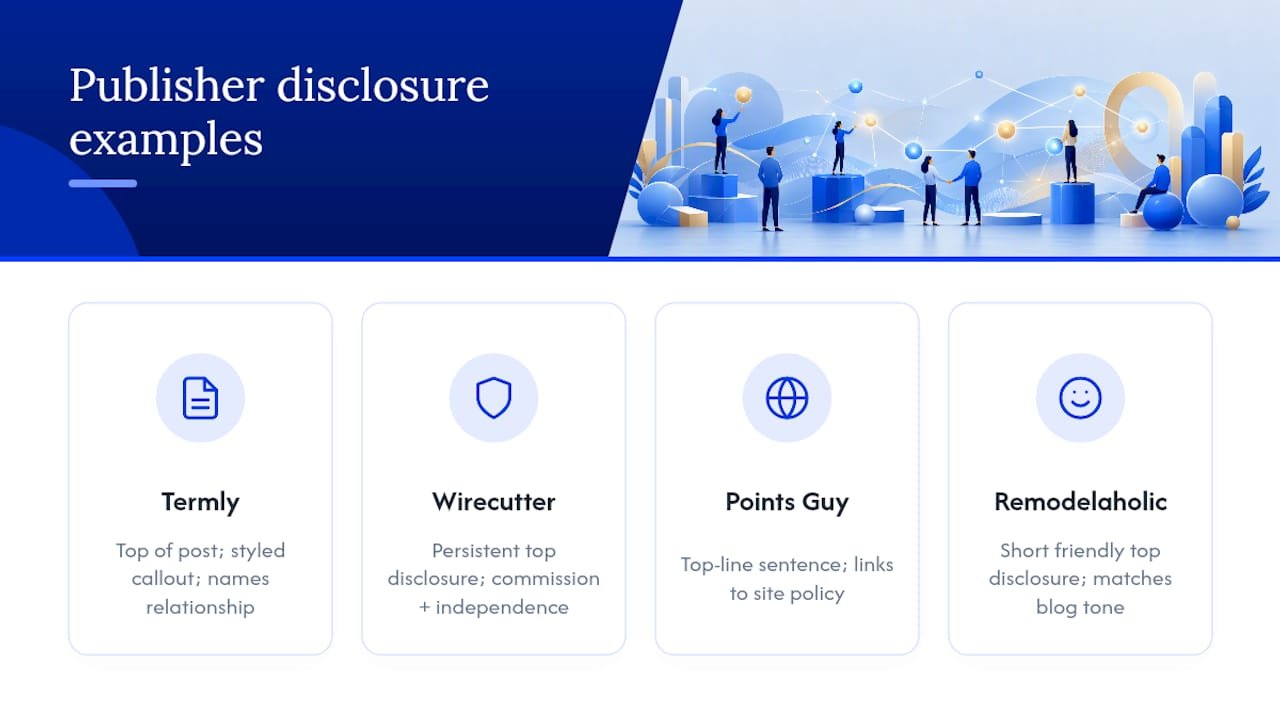
Looking at how established publishers write and place their disclosures is one of the fastest ways to calibrate your own. Here’s what you can borrow from four well-known examples.
Termly places its affiliate disclosure at the very top of any post containing affiliate links, in a clearly styled box that visually separates it from the article body. The wording is direct: it names the affiliate relationship, states that compensation may be received, and notes that editorial opinions remain independent. The visual separation is the key lesson here. A styled callout box or a bolded sentence forces the eye to stop before reading the content.
Wirecutter (now part of The New York Times) uses a persistent, prominent disclosure at the top of every review page. Their phrasing explains both the commission structure and the editorial independence of their testing process. What makes it effective is the combination: they disclose the financial relationship AND address the reader’s natural skepticism about bias in the same sentence. That two-part structure is worth copying.
The Points Guy discloses affiliate relationships at the top of articles and in a site-wide policy page. Their in-content disclosures are short (one sentence) and link to the fuller policy for readers who want more detail. The takeaway: a brief in-content line plus a linked policy page is a clean, scalable structure that works well for high-volume publishers.
Remodelaholic uses a short, friendly disclosure at the top of DIY and product posts, written in the same warm tone as the rest of the blog. The wording doesn’t feel like a legal disclaimer — it reads like a note from a friend. That tone match matters. A disclosure that sounds like it was written by a lawyer in a different voice from the rest of your content creates friction. Write it the way you’d say it to a reader sitting across from you.
Where and how to display your disclosure so readers actually see it
Placement is where most bloggers get this wrong. A disclosure that exists but isn’t seen is legally and practically useless.
Core placement rules:
- Place the disclosure above the first affiliate link in every post, every time. No exceptions.
- For posts longer than 1,500 words with multiple affiliate link clusters, add a short reminder line near each cluster.
- For video content, include a verbal disclosure within the first 30 seconds AND a written disclosure in the first three lines of the description.
- For social captions, the disclosure must appear before any platform truncation (“more” button). On most platforms, that means the first line.
- For email, put it in the first visible paragraph, not in the footer.
Formatting tips that improve visibility:
- Use a short, complete sentence rather than a parenthetical phrase tucked inside a paragraph.
- Match the font size of your body text. A disclosure in 8pt gray text on a white background fails the “clear and conspicuous” standard regardless of where it’s placed.
- Avoid styling the disclosure to blend with your design. It should be readable, not invisible.
- If your site uses a dark theme, confirm the disclosure text has sufficient contrast.
Accessibility matters here too. Screen readers will pick up a disclosure that’s in the natural document flow. A disclosure hidden in a CSS overlay or a collapsed accordion may not be read at all.
The Shopify affiliate disclosure guide recommends layering your approach: visible in-content disclosures on every post, plus a linked disclosure page that covers your site-wide affiliate policy. That combination covers readers who land on a single post and those who want to understand your overall approach.
What the FTC actually requires from you
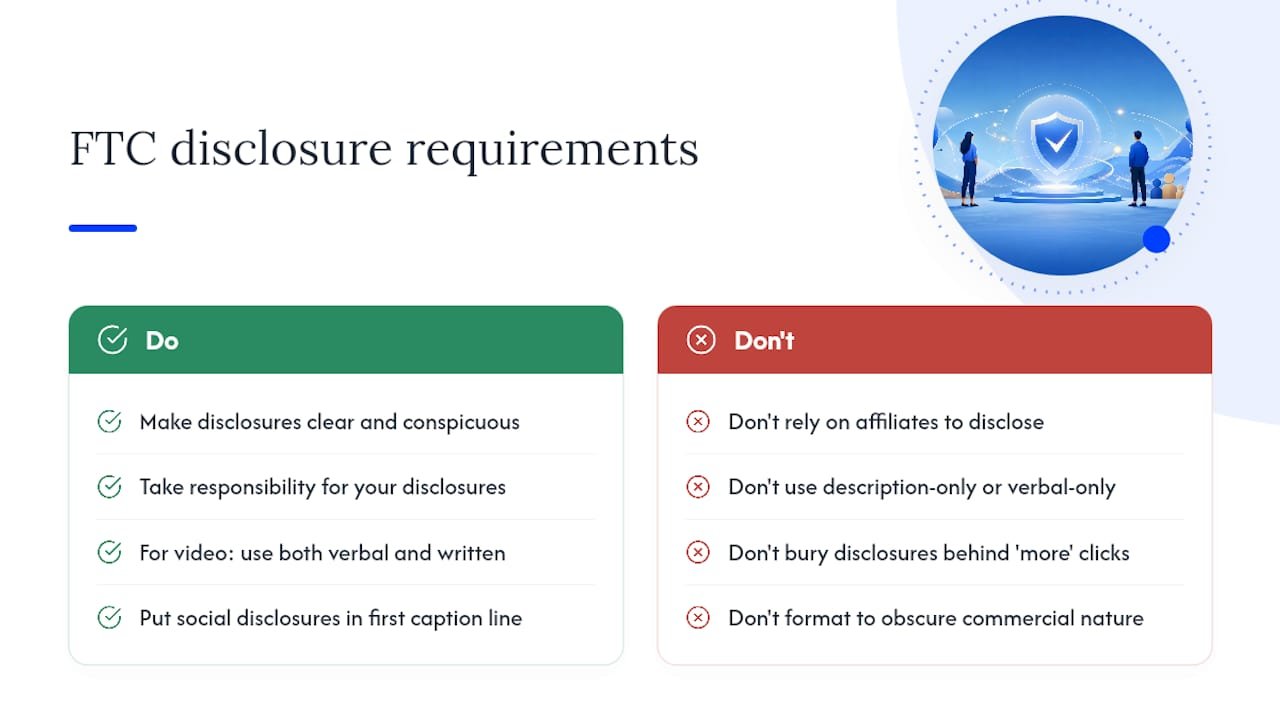
The FTC’s standard for affiliate disclosures is “clear and conspicuous.” That phrase has a specific meaning: the disclosure must be presented in a way that a typical consumer would notice, read, and understand before taking any action based on your recommendation.
The FTC’s Endorsement Guides make clear that the creator bears legal responsibility for the disclosure, not the affiliate network or the brand being promoted. If you participate in five affiliate programs and none of them remind you to disclose, that’s still your problem.
The 16 CFR §255 examples in the Code of Federal Regulations illustrate when compensation or free products create a disclosure obligation. The key test: would knowing about the compensation affect how a consumer evaluates your recommendation? For affiliate links, the answer is almost always yes.
For video content, the FTC expects both a verbal disclosure in the video itself and a written disclosure in the description. A description-only disclosure doesn’t cover viewers who watch without reading the description. A verbal-only disclosure doesn’t cover viewers who watch on mute or read the description before clicking play.
For social media captions, the FTC’s social media guidance is specific: the disclosure must appear where users will see it before tapping “more.” That means the first line of the caption, not the third.
The FTC’s truth-in-advertising resources and enforcement policy statement on deceptively formatted advertisements show that the agency treats disclosure placement as a substantive issue, not a technicality. Formats designed to obscure the commercial nature of content are treated as deceptive regardless of whether a disclosure technically exists somewhere on the page.
Common disclosure mistakes that put you at risk
Most compliance failures aren’t intentional. They’re the result of habits that felt fine at the time. Here’s what to watch for.
- Footer-only disclosures. A link in your site footer that says “Affiliate Disclosure” does not satisfy the FTC’s “clear and conspicuous” standard for individual posts. It’s a useful supplement, not a substitute.
- Vague hashtags used alone. “#sp,” “#partner,” “#collab,” and “#gifted” are not universally understood. The FTC recommends plain terms like “#ad” or “Paid promotion” — and even those work only when they appear at the start of a caption, not buried after several lines of text.
- Ambiguous language. Phrases like “I love this product!” or “Check out my favorite tool” with no disclosure attached are exactly the kind of content the FTC’s endorsement rules target. Enthusiasm without context looks like organic recommendation.
- Relying on platform labels alone. Instagram’s “Paid partnership” label and YouTube’s “Includes paid promotion” banner are useful, but the FTC has noted that platform-native labels may not always be visible or sufficient on their own. Add your own disclosure in the caption or description.
- Disclosures that appear after the links. If your disclosure appears below a product recommendation or after a “Buy Now” button, it fails the pre-click visibility requirement.
- Inconsistent disclosure across a site. Disclosing on some posts but not others creates a pattern that looks deliberate rather than accidental.
Quick audit checklist for existing content:
- Open five of your most-visited affiliate posts.
- Is the disclosure above the first affiliate link on each one?
- Does it use plain language, not abbreviations?
- Is it visible on a mobile screen without scrolling?
- Does it appear in video descriptions and verbally in the video?
Fix any post that fails two or more of these checks first.
Platform-by-platform disclosure instructions
Every platform has its own format constraints. Here’s what “correct” looks like on each one.
Blog posts and articles:
- Add a one-to-two sentence disclosure at the very top of the post, above the first paragraph.
- Repeat a shorter reminder near any section with multiple affiliate links.
- Link to your site-wide disclosure page from the in-content disclosure.
Email newsletters:
- Place the disclosure in the first visible line of the email body, before any product mention.
- Keep it to one sentence. Readers scan emails fast.
YouTube and long-form video:
- Speak a disclosure aloud within the first 30 seconds: “Quick heads up — some links in the description are affiliate links. I may earn a commission if you buy through them.”
- Place the written disclosure in the first three lines of the video description so it’s visible before “Show more.”
- Do not rely on YouTube’s built-in “Includes paid promotion” checkbox alone.
Instagram and TikTok captions:
- Start the caption with “#ad” or “Affiliate link below” before any other text.
- Do not place the disclosure after three or four lines of content — it will be hidden behind the “more” truncation.
- Add on-screen text in the first few seconds of short-form video if you’re directing viewers to a link.
Pinterest:
- Add a short disclosure to the pin description: “Affiliate link — I may earn a commission.”
- Include it in the image alt text where your platform allows.
Podcasts:
- Mention the disclosure verbally in the first 30 seconds of the episode.
- Add a written disclosure to the episode show notes, above the first affiliate link.
Tools and resources that make compliance faster
You don’t need to write every disclosure from scratch or memorize every FTC rule. These resources do a lot of the heavy lifting.
- Termly’s affiliate disclosure generator creates a customizable disclosure page you can embed on your site or link from posts. It covers the main FTC requirements and lets you tailor the language to your specific affiliate programs.
- FTC business center guidance collects the official Q&A and practical tips in one place. Bookmark it and check it when you’re unsure about a specific format or platform.
- FTC Disclosures 101 for Social Media Influencers is the most practical FTC document for bloggers and content creators. It covers captions, video, and the “clear and conspicuous” standard in plain language.
- Grammarly or Hemingway Editor can help you check that your disclosure reads at a clear, accessible level. A disclosure written at a 12th-grade reading level defeats its own purpose.
- A simple spreadsheet tracking every affiliate program you’re enrolled in, the disclosure language each program requires, and the last date you audited your posts for that program. Low-tech but highly effective.
When to use a dedicated disclosure page vs. in-content disclosures:
A dedicated disclosure page (linked in your footer and navigation) is worth creating once you have affiliate links across more than a handful of posts. It gives readers a single place to understand your overall affiliate policy. But it does not replace in-content disclosures. The Shopify affiliate disclosure guide is clear on this: the multi-layer approach (in-content plus a linked policy page) is what satisfies “clear and conspicuous” across different user experiences and devices.
Scaling compliance: workflows, monitoring, and AI-assisted templates
If you publish affiliate content regularly, a one-time disclosure fix isn’t enough. You need a repeatable system.
- Build a template library. Keep a document with your approved disclosure language for each platform (blog, email, YouTube, social). When you create new content, copy from the library rather than rewriting from memory. This prevents drift and keeps your language consistent.
- Add disclosure to your editorial checklist. Before any post goes live, your checklist should include: disclosure present, disclosure above first link, disclosure uses plain language. Make it a non-negotiable step, not an afterthought.
- Run a quarterly audit. Pick 10 to 15 posts at random each quarter and check them against the placement and language checklist from Section 7. Update any that fall short.
- Use AI prompts to generate disclosure variants. A simple prompt like “Write a one-sentence affiliate disclosure for a blog post about [topic], in a friendly tone, that mentions I may earn a commission at no extra cost to the reader” produces a solid draft in seconds. Run it through your template library for consistency before publishing.
- Log your affiliate links. Keep a running list of every affiliate link on your site, the program it belongs to, and the post it appears in. This makes audits faster and helps you spot posts that were updated but never had their disclosures reviewed.
Pro Tip: Use a simple AI prompt to generate five disclosure variants for a new post, then pick the one that best matches your voice. It takes 30 seconds and removes the “I’ll add it later” trap that leads to non-compliant posts.
The FTC’s business center guidance is unambiguous: the creator holds legal responsibility for disclosures, not the affiliate network or the brand. That means your workflow needs to catch gaps before they go live, not after a reader or regulator flags them.
Why plain-language disclosures are the smartest long-term move
There’s a version of this conversation that treats disclosures as a legal burden to minimize. That framing misses the bigger picture.
Readers who discover an undisclosed affiliate relationship don’t just lose trust in that one post. They reassess everything you’ve ever recommended. The damage to your credibility is disproportionate to the disclosure you skipped. A single sentence at the top of a post costs you nothing. Losing a reader’s trust costs you their lifetime value.
Plain-language disclosures also signal confidence. When you say “I may earn a commission, and here’s why I still recommend this,” you’re telling your audience that your recommendation can stand up to scrutiny. That’s a stronger sales signal than a hidden affiliate link with no context. Readers who understand the arrangement and still click are far more likely to convert than readers who feel deceived after the fact.
Long-term, transparent affiliate marketing is simply more sustainable. Audiences grow when they trust you. Revenue compounds when readers return. A disclosure isn’t a warning label. It’s a trust signal.
Ready to build a compliant affiliate content system?
Sorting out your disclosures is one piece of a larger affiliate marketing operation. If you want a done-for-you compliance workflow, including a ready-to-use template pack, an editorial checklist, and coaching on how to integrate AI into your affiliate content process, Willbuckley has you covered.

The coaching and template bundle at Willbuckley gives you the exact disclosure language, placement checklists, and AI prompt workflows covered in this article, packaged so you can implement them across your site in an afternoon rather than piecing it together post by post. You can also explore related affiliate marketing strategies on the Willbuckley blog to keep building from here. Visit the coaching and templates page to see what’s included and get started.
Sources
- Disclosures 101 for Social Media Influencers | Federal Trade Commission
- FTC’s Endorsement Guides: What People Are Asking | Federal Trade Commission
- Business center guidance — Federal Trade Commission
- Affiliate disclosure — Shopify blog
For complex endorsement arrangements, paid brand deals, or cross-border affiliate programs, consult a qualified attorney familiar with FTC regulations. The guidance above covers the standard affiliate link disclosure scenario for US-based publishers.