

AI conversion optimization uses machine learning to read visitor behavior, personalize what each person sees, and run automated experiments that find winners faster than a human team ever could alone. It matters because speed compounds: more tests, run smarter, means more lift banked per quarter. The marketers who benefit most are the ones stuck running one A/B test a month and wondering why their conversion rate hasn’t budged in a year.
TL;DR:
- AI conversion optimization requires a few thousand monthly sessions and multiple variables to outperform manual testing reliably.
- Techniques like multivariate testing, predictive scoring, real-time personalization, and behavioral analytics drive the most significant lift but depend on traffic volume and data quality.
- Integrating AI tools seamlessly with existing analytics and tracking setups is crucial since mismatched data definitions can invalidate results.
- Follow a disciplined implementation process: map goals, instrument properly, run audits, generate and refine variants, set guardrails, and validate with holdout groups.
- Expect ongoing, standing allocation systems to replace one-off tests as AI tools improve, making continuous optimization accessible to small teams.
Table of Contents
- What Is AI Conversion Optimization, Really?
- What AI Techniques Actually Move Conversion Rates?
- Which Tool Categories Should You Actually Shortlist?
- How Do You Implement AI Conversion Optimization Step by Step?
- What KPIs Should You Track to Measure Lift?
- What Are the Biggest Risks in AI-Driven CRO?
- Two Ready-to-Run AI CRO Recipes You Can Copy Today
- Why Do AI CRO Tools Struggle to Fit Existing Marketing Stacks?
- Where Is AI Conversion Optimization Headed Next?
- Author Perspective: Where AI Ends and Judgment Begins
- Want Help Running This Without the Guesswork?
- Sources
- FAQ
What Is AI Conversion Optimization, Really?
Traditional CRO runs on hypothesis, patience, and a calculator. You watch analytics, guess at a fix, split traffic 50/50, and wait two or three weeks for enough data to call a winner. AI conversion optimization keeps the same goal, more conversions from the same traffic, but changes how you get there. Machine learning models process behavioral data continuously, generate variant ideas, and shift traffic toward winners in near real time instead of waiting for a fixed test window to close.
The practical difference shows up in three places. First, speed: an AI audit tool can scan a page and hand you a prioritized list of fixes in minutes, something CROLabs built its entire audit workflow around. Second, personalization depth: instead of one winning variant for everyone, allocation engines can serve different versions to different visitor segments simultaneously, an approach Customfit describes as a winner per visitor rather than a single global winner. Third, scale: you can run far more experiments in parallel because the model, not a human, is doing the traffic math.
That doesn’t make manual CRO obsolete. Heuristic reviews and classic A/B tests still work well when:
- Your traffic is low enough that a bandit algorithm can’t reach statistical confidence quickly.
- You need a clean, defensible test for a single high-stakes page, like a pricing redesign.
- Your team lacks clean event tracking, which makes any AI recommendation only as good as the data feeding it.
AI conversion optimization tends to add the most value once you have meaningful traffic (a few thousand monthly sessions on the page in question) and multiple variables worth testing at once. Below that threshold, a disciplined manual test often beats an AI tool guessing at patterns in thin data.
What AI Techniques Actually Move Conversion Rates?
Four techniques do most of the heavy lifting in AI-driven conversion work, and they solve different problems.
- Automated multivariate testing and allocation engines. Instead of testing one variable at a time, these systems test headline, image, and CTA combinations simultaneously, then use bandit algorithms to shift traffic toward the best-performing combination as data comes in. This beats sequential A/B testing on speed, but it needs enough traffic to avoid chasing noise.
- Predictive analytics and propensity models. These models score visitors on likelihood to convert based on behavior patterns, browser signals, and referral source, letting you prioritize high-intent traffic for more aggressive offers and low-intent traffic for softer nudges. This is where a lot of “AI for lead generation” claims actually live, scoring leads before a human ever touches them.
- Real-time personalization. Rather than picking one global winner, per-visitor allocation serves different page versions to different segments at once, an approach CustomFit.ai built its product around specifically to avoid forcing a single design on every visitor type.
- Behavioral pattern recognition. Session replay, heatmaps, and rage-click detection surface the friction points a spreadsheet never will. UXCam’s documentation on this is a good primer: watching where visitors click repeatedly without result tells you exactly where to aim your next test.
Choosing among these comes down to two questions: how much traffic do you have, and what’s actually broken? If your checkout page has a 40% cart abandonment rate, behavioral analytics will show you where people stall before you spend a dollar on a testing tool. If you’re already converting decently but want incremental lift across a high-traffic landing page, an allocation engine running multivariate tests is the better fit. Predictive scoring earns its keep when you’re running paid traffic and need to route budget toward the leads most likely to close.
Which Tool Categories Should You Actually Shortlist?
Most AI CRO stacks combine four tool types, and each one solves a distinct problem rather than competing head to head.
- Behavioral analytics platforms capture session replays, heatmaps, and click patterns. Microsoft Clarity is a widely used free option that many teams pair with paid CRO tools as their behavioral source of truth.
- Personalization engines decide what each visitor sees based on segment, source, or predicted intent, running the per-visitor allocation model rather than a single fixed design.
- Automated testing and allocation tools run the multivariate math, shifting traffic toward winners without you manually declaring a test complete.
- Landing page optimizers generate ready-to-test variants, sometimes working directly from a live URL. Converto does this without requiring a full rebuild, which matters because it preserves existing SEO equity and tracking setups instead of forcing you to start a page from scratch.
- Chatbots and conversational AI handle on-page questions and objections in real time, often converting hesitant visitors who would otherwise bounce before filling out a form.
When you evaluate any of these, four signals matter more than the feature list. Check whether the tool integrates cleanly with your existing analytics stack, whether it genuinely supports mobile testing or just claims to, how fresh its data refresh cycle is, and how fast you can actually ship a variant once you’ve decided on one.
One distinction trips up a lot of buyers: an optimizer and a builder are not the same thing. A builder wants you to construct a new page inside its system. An optimizer, like the Converto approach described above, works from a page you already have. If your current landing page ranks well and carries tracking history you don’t want to lose, an optimizer is almost always the safer starting point.
How Do You Implement AI Conversion Optimization Step by Step?
Running this well isn’t about buying a tool and hoping. It’s a loop, and skipping steps is how teams end up with data they don’t trust.
- Map your funnel and set real goals. Identify every critical conversion event, add to cart, email signup, checkout, and decide which one actually moves revenue. Don’t optimize a vanity metric.
- Instrument before you automate. Behavioral analytics need clean event tracking on both desktop and mobile. Since more than half of global web traffic now comes from mobile devices, a tool that only tracks desktop sessions well is giving you half a picture at best.
- Run an AI audit. Let a tool scan your page for friction points and get a prioritized list of fixes. This is fast, but treat the output as a hypothesis list, not a guaranteed lift, a distinction CROLabs itself recommends validating through actual testing.
- Generate variants, then edit them. Use AI to draft headline, CTA, and layout options quickly, then edit for your actual audience and voice. Generic AI output rarely converts as well as a version you’ve sharpened with real specifics.
- Set allocation guardrails before launch. Decide your minimum sample size and confidence threshold up front, not after you see early results trending your way.
- Validate with a holdout. Keep a fixed slice of traffic on the original experience throughout the test so you have a clean control to measure against, not just a before-and-after comparison that could be explained by seasonality.
- Scale what works, then repeat the loop. Once a variant proves out, roll it to 100% of traffic and move to the next funnel stage. AI CRO isn’t a one-time project; it’s a standing process.
Pro Tip: When you feed an AI tool a prompt for a new headline or CTA, include three specificity tokens: an exact numeric result, a named feature, and a target segment. “Increase conversions” produces bland output. “Help freelance designers close 3 extra clients a month using our proposal templates” produces something you can actually ship.
Teams worried this sounds like a lot of overhead should know that generative AI tools are already measurably increasing worker productivity, which is exactly why a two-person marketing team can now run a testing cadence that used to require a dedicated CRO analyst.
What KPIs Should You Track to Measure Lift?
Conversion rate is the headline number, but it’s not the only one that matters, and treating it as the only signal is how teams misread results.
- Conversion rate and lift range, reported as a range rather than a single point estimate, since early results almost always overstate the eventual steady-state lift.
- Average order value and downstream LTV, because a variant that boosts conversion but attracts lower-value customers isn’t actually a win.
- Segmented performance by device, campaign source, and cohort, since a winner on desktop paid traffic can lose on organic mobile traffic, and averaging the two hides the truth.
- Sample size and statistical validity, particularly for multivariate and allocation-based tests, which need more traffic than a simple two-variant test to reach reliable confidence.
- Holdout comparison, keeping a control group untouched by continuous allocation so you can periodically confirm the model is still outperforming the baseline, not drifting.
A dashboard broken out by these segments tells a very different story than a single blended conversion rate. If you’re reporting results upward, show the range and the sample size alongside the headline lift number. That’s the difference between a credible report and a number that gets challenged in the next meeting.
What Are the Biggest Risks in AI-Driven CRO?
The most common failure mode isn’t a bad algorithm. It’s a team that stops asking why a recommendation was made. AI audits are excellent at surfacing patterns, but a human still needs to decide whether a suggested fix makes sense for the business, not just the data.
Data quality breaks AI recommendations faster than anything else. If your event tracking misfires on mobile, or double-counts pageviews, the model is optimizing against noise. UXCam’s own guidance flags instrumentation and behavioral event quality as the most common operational blocker teams hit before AI recommendations become trustworthy. Test your tracking before you trust your dashboard.

Personalization also carries bias and privacy risk. Segmenting visitors by inferred intent can drift into showing different prices or offers based on characteristics that raise fairness or compliance concerns, so review what signals your personalization engine actually uses. And on the testing side, the classic mistakes still apply: calling a test early, ignoring minimum effect sizes, and skipping the holdout group. Keep those guardrails non-negotiable, regardless of how confident the dashboard looks.
Two Ready-to-Run AI CRO Recipes You Can Copy Today
Here are two workflows built for affiliate marketers and solo operators facing common constraints such as limited time, limited traffic, or no dedicated CRO team.
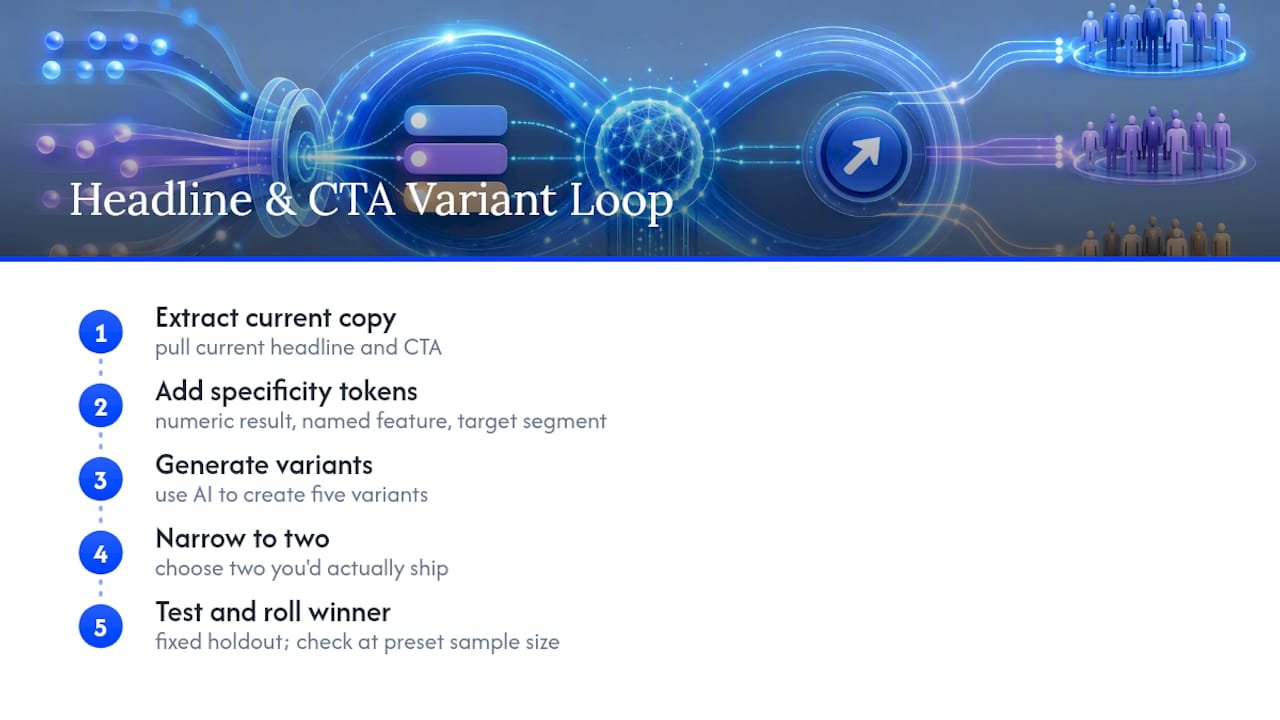
Recipe 1: Headline and CTA variant loop. Pull your current headline and CTA, feed an AI tool a prompt with your specificity tokens (numeric result, named feature, target segment), generate five variants, then cut it to two you’d actually be comfortable shipping. Run them with a fixed holdout, check results at your pre-set sample size, and roll the winner. This pairs well with structured AI brief templates if you want a repeatable format instead of starting from a blank prompt every time.
Recipe 2: Mobile checkout friction fix. Instrument mobile checkout events specifically (not just desktop), watch session replays for rage clicks near the payment field, generate two or three layout variants targeting that exact friction point, and validate with a small holdout before rolling wide.
Both recipes lean on the same principle: AI drafts fast, but specificity is what separates a variant that converts from one that just looks different. For a broader set of tested sequences, the ready-to-run affiliate workflows built around this exact constraint are worth adapting to your own funnel.
Why Do AI CRO Tools Struggle to Fit Existing Marketing Stacks?
Most friction in AI CRO rollouts isn’t the AI itself. It’s the seams between tools that were never designed to talk to each other. A behavioral analytics platform, an email service provider, an ad platform, and a testing tool each define “conversion” slightly differently, and reconciling those definitions is where projects stall.
The fix is sequencing, not more software. Get one source of truth for conversion events before layering in AI recommendations, otherwise you’re asking a model to optimize against three conflicting numbers. Shopify’s own guidance on AI-driven CRO makes a similar point: platform-suggested fixes are a useful starting point, but they still need a human to check them against the store’s actual analytics before rolling them out store-wide.
Practically, that means auditing your tracking setup before you add a new AI tool, not after. Confirm your analytics platform and your testing tool count “conversion” the same way. Check that your CRM or email platform can receive segment data from your personalization engine, otherwise you’re personalizing on-site while emailing everyone the same generic message. Integration problems compound quietly, so catching them early saves you from debugging a “failed” test that was actually a tracking mismatch all along.
Where Is AI Conversion Optimization Headed Next?
The clearest trend is the shift from single-winner testing toward continuous, per-visitor allocation as the default rather than the exception. Fewer teams will run a test, declare a winner, and freeze the page. More will run standing allocation systems that keep adjusting as visitor behavior shifts across seasons and campaigns.
Expect AI audit tools to get better at explaining their reasoning, not just handing you a recommendation list. That matters for trust: a marketer is far more likely to act on a suggestion when the tool shows the specific behavioral pattern behind it. Chatbots and conversational interfaces will also take on more of the mid-funnel objection-handling work, converting hesitant visitors in real time instead of losing them to a bounce.
The bigger shift, though, is accessibility. As generative AI keeps compressing the time needed to draft variants, audit pages, and analyze results, AI conversion optimization stops being a large-team advantage and becomes something a two-person operation can run competently. That’s the part worth watching over the next few years.
Author Perspective: Where AI Ends and Judgment Begins
AI conversion optimization is an accelerant, not a replacement for strategy. The tools will draft variants and crunch allocation math faster than any human, but they don’t know your audience, your margins, or which fix actually matters this quarter. Expect realistic, incremental gains from disciplined testing, not a single dramatic overnight lift. Adopt the workflows above, measure honestly against a holdout, and let the results, not the hype, decide what scales.
— Will
Want Help Running This Without the Guesswork?
If you’ve read this far wondering where to actually start, the ready-to-run AI affiliate workflows on this site are built for exactly that gap. They pair the framework above with templates, prompt structures, and coaching drawn from real affiliate campaigns instead of generic marketing advice.

This resource is designed for solo marketers and small teams seeking a disciplined testing process, offering prompt templates for variant generation, a rollout checklist aligned with an implementation framework, and workflow recipes tailored for affiliate funnels rather than generic ecommerce examples. If you’d rather see the numbers first, the affiliate marketing case study data walks through what a real campaign looked like end to end. Either way, the next step is the same: pick one funnel stage, run the recipe, and measure it against a holdout before you scale it.
Sources
A handful of sources are worth keeping open in a tab if you want to verify claims or go deeper than this framework covers.
- Share of website traffic coming from mobile devices | Statista
- The impact of generative AI on worker productivity | St. Louis Fed
- AI Conversion Rate Optimization & A/B Tool | CROLabs
FAQ
Is a 12% Conversion Rate Good?
It depends heavily on industry and traffic source, but 12% is well above average for most ecommerce and lead-gen benchmarks, where single-digit rates are far more typical. Context matters more than the raw number: a 12% rate on high-intent branded search traffic is expected, while the same rate on cold display traffic would be exceptional.
Which AI Is Best for Conversion?
There’s no single best tool because AI CRO tools solve different problems: behavioral analytics platforms like Microsoft Clarity surface friction, allocation engines handle traffic distribution, and optimizers like Converto generate testable variants from existing pages. The right choice depends on whether your bottleneck is diagnosis, testing speed, or variant generation.
What Are the Stages of a Conversion Funnel?
Most funnels move through awareness, interest, consideration, intent, evaluation, purchase, and loyalty, though the exact labels vary by framework. AI conversion optimization tools typically focus on the middle and later stages, intent through purchase, since that’s where behavioral data and testing produce the clearest, fastest signal.
Is a 2.5% Conversion Rate Good?
Whether it counts as “good” depends on your traffic quality and average order value, which is why segmented KPI tracking matters more than judging one blended number in isolation.
How Long Should an AI-Driven CRO Test Run?
Run it until you hit your pre-set minimum sample size and confidence threshold, not until you see a result you like. Multivariate and allocation-based tests generally need more traffic and time than a simple two-variant test to reach reliable statistical validity.