

Google does not penalize content for being written with AI. It penalizes content published to game rankings without adding real value, and AI just happens to make that kind of publishing faster and cheaper to produce at scale. The qualifier matters more than the tool. If you understand that one distinction, the rest of this article is just the operating manual.
TL;DR:
- Google’s quality signals focus on content value and user engagement, not whether the content was written by AI or a person.
- Rapid publishing spikes, templated pages, lack of author expertise, and poor user signals can trigger algorithmic ranking drops without any manual penalty.
- Using human oversight to fact-check, adding original information, and avoiding mass-recipe templates help prevent AI-assisted content from being penalized.
- Traffic declines without manual action notices are often caused by a site’s declining topical authority or engagement, not an outright Google ban on AI content.
- Prioritizing small-scale, human-reviewed AI content production and monitoring engagement metrics is the best practice for maintaining rankings.
Table of Contents
- What Google Officially Says About AI Content and Scaled Abuse
- Penalty vs. Algorithmic Suppression: They’re Not the Same Thing
- The Patterns That Actually Trigger a Demotion
- The Checklist That Keeps AI-Assisted Content Safe
- How to Audit a Traffic Drop and Recover
- A Real Editorial Workflow for Scaling AI Content Safely
- What the Data Actually Tells You to Prioritize
- Get a Content Audit Before You Scale Further
- Sources
- FAQ
What Google Officially Says About AI Content and Scaled Abuse
Google’s own guidance on AI-generated content says quality matters, not the production method. Automated content that helps people, whether it’s written by a person, an AI model, or some blend of both, is fine. Automated content whose primary purpose is manipulating search rankings is a spam policy violation, full stop.
That’s where “scaled content abuse” comes in. Google defines it as generating large volumes of pages, with any mix of automation, humans, or AI, where the main goal is manipulating rankings rather than helping a reader. The test isn’t “did a machine touch this,” it’s “why does this page exist.”
Google draws a clear line between acceptable and abusive automation:
- Acceptable: auto-generated sports scores, weather updates, transcripts, or financial data feeds that a person genuinely wants
- Abusive: thousands of near-identical city or product pages built to catch long-tail searches with nothing new to say
- The Search Quality Rater Guidelines treat both cases the same way raters treat any low-effort page, regardless of how it was made
Penalty vs. Algorithmic Suppression: They’re Not the Same Thing
A manual action is a human reviewer at Google flagging your site for a policy violation. It shows up explicitly in Search Console under “Manual Actions,” with a stated reason and a path to fix it. That’s a real penalty, and it’s rare.
Algorithmic suppression is different. It’s your rankings quietly dropping because Google’s automated systems, including its helpful content classification, decided your pages weren’t worth surfacing as highly. No notice, no message in Search Console, just fewer clicks.
Here’s the statistic that matters: in the 16-month AI content experiment run by Search Engine Land, AI-generated pages indexed quickly but lost rankings over time once the pages lacked backlinks, topical authority, or anything genuinely new to say.
Most people who claim they got hit with an “AI penalty” actually experienced this second thing:
- No manual action notice in Search Console
- A gradual, multi-week decline rather than a sudden cliff
- Traffic loss concentrated in thin or templated sections of the site
The Patterns That Actually Trigger a Demotion
Google’s systems don’t scan a single article and flag it as “written by AI.” They look at patterns across a site or a network of sites, according to CMSWire’s reporting on Google’s spam-detection approach. A few signals show up again and again in sites that lose visibility:
- Publishing velocity spikes. Jumping from 5 posts a month to 200 reads as a red flag, not a growth strategy.
- Templated, near-duplicate pages. Swap the city name or the product name and the rest of the page is identical. That’s the definition of low information gain.
- Missing E-E-A-T signals. No named author, no credentials, no sourcing, especially risky on money or health topics (YMYL).
- Weak engagement. High bounce rates and short time-on-page tell Google’s systems the content didn’t satisfy the search.
- Network-level clustering. SpamBrain and related systems look at whether a whole cluster of sites shares the same templated structure, not whether one page used AI.
None of these require Google to “detect AI.” They require Google to notice that a page doesn’t hold anyone’s attention or say anything new.
The Checklist That Keeps AI-Assisted Content Safe
If you’re producing content with AI assistance, here’s the sequence that actually protects rankings, based on how Google’s own quality signals behave.
- Put a human in the loop on every draft. No AI output goes live without a person reading it, correcting it, and fact-checking every claim, number, and named source.
- Run the information gain test. Before publishing, ask what this page says that the top 5 competing pages don’t. If the honest answer is “nothing,” don’t publish it. First-party data, original screenshots, and direct experience all pass this test; a rewritten summary of someone else’s post doesn’t.
- Cap your publishing velocity. Scaling from a handful of posts a week to dozens overnight is the single fastest way to trip a site-level suspicion flag. Grow in small, monitored batches instead.
- Add real E-E-A-T signals. Byline the author, list credentials where relevant, cite primary sources, and disclose AI assistance if your niche calls for it on YMYL topics.
- Kill the mass-template habit. If your “content strategy” is one prompt with a find-and-replace city list, that’s scaled content abuse waiting to happen. Give every page its own reason to exist.
Tools like Willbuckley’s guide on how to humanize AI content walk through exactly how to layer a human editorial pass on top of an AI draft without slowing your production down to a crawl.
Pro Tip: Before you publish a batch of AI-assisted pages, read three of them back to back. If they feel interchangeable, a reader will notice before Google does.
How to Audit a Traffic Drop and Recover
Don’t guess. Work through this in order:
- Check Search Console first. Look under Manual Actions and Coverage. If there’s a manual action, that’s your answer and your fix path is spelled out for you.
- If there’s no manual action, look at your worst pages. Improving or removing your lowest-quality content raises what amounts to your site’s overall quality density, which protects the pages that were already performing.
- Test in small batches. Rewrite or prune 10 to 20 pages, then watch impressions and rankings for several weeks before touching the rest of the site. Mass reindexing everything at once just repeats the original mistake.
- Only file a reconsideration request after a confirmed manual action is actually fixed. Filing one for algorithmic suppression does nothing, since there’s no violation to reconsider.
A Real Editorial Workflow for Scaling AI Content Safely
An approach to scaling AI-assisted content leans on a 90-day rollout rather than a weekend sprint, and it’s built around checks that catch problems before they compound:
- Draft with AI, then run every piece through a human “humanize” pass that adds voice, examples, and a real point of view
- Fact-check every claim and number against a primary source before it ever gets scheduled
- Detect AI fingerprints before publishing, using the same kind of checks outlined in Will’s guide on AI content detection
- Follow a fixed cadence rather than a burst, detailed in the full 90-day AI content strategy rollout
What the Data Actually Tells You to Prioritize
Most of the AI panic in marketing circles is aimed at the wrong target. People ask “will Google know I used AI,” when the better question is “does this page teach anyone anything.” The Search Engine Journal analysis of AI content as thin content backs this up: the sites getting hurt are the ones treating AI as a volume lever instead of an editing partner.
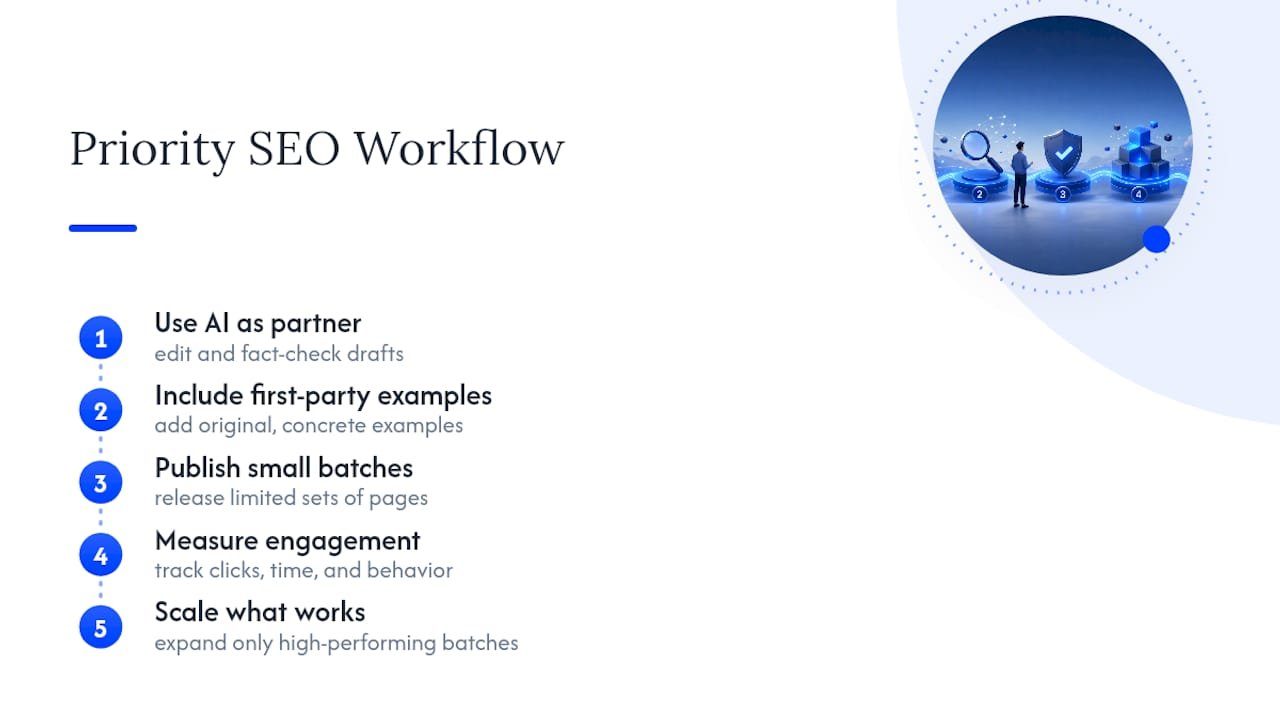
The conventional advice, “just add a disclaimer” or “just run it through a paraphraser,” misses the point entirely. Google’s systems increasingly reward information gain, not stylistic disguise. A heavily edited, fact-checked AI draft with a genuine first-party example will usually outperform a “100% human” article that says nothing new.
If you’re prioritizing one thing this quarter, prioritize velocity discipline by learning more from AI-Driven Content Creation for Maximum SEO Growth. Publish in small batches, measure engagement, then scale. That single habit, more than any prompt engineering trick, is what separates sites that survive core updates from the ones quietly bleeding traffic without a single manual action in sight.
— Will
Get a Content Audit Before You Scale Further
An edge for affiliate marketers involves a practical, coaching-backed process built from real workflows for people who need their AI-assisted content to actually convert, not just publish.

If you’re already publishing at volume and you’re not sure whether your last traffic dip was a manual action or algorithmic suppression, that’s exactly the kind of question a fast audit answers before you waste another month guessing. Pair that audit with the YouTube Automation Affiliate Marketing launch playbook if your content strategy includes video, since the same information gain and velocity rules apply there too. Start by requesting a review of your current publishing cadence and editorial checks, then build your next 90 days around what it turns up.
Sources
- Google Search’s guidance about AI-generated content
- Google may be penalizing AI-generated content as thin content
- Google’s new AI spam detector judges networks not pages
- How AI-generated content performs in Google Search: A 16-month experiment
FAQ
Does Google Penalize AI-Written Content?
No, not for being AI-written. Google’s own guidance penalizes content whose primary purpose is manipulating rankings, whether a human or an AI produced it.
What Is Google’s 20% Rule for AI Content?
There is no official Google “20% rule” governing how much of a page can be AI-generated. That figure isn’t part of Google’s published spam policies or Search Central documentation, so treat any claim citing a specific AI-content percentage threshold as unverified.
Who Is the Biggest Enemy of Google Search Quality?
Scaled, low-value content built primarily to manipulate rankings is the real threat Google’s systems target, according to its spam policy guidance. That includes thin AI pages, templated affiliate pages, and manipulative link schemes alike, not any single tool or company.
Does Google Ban AI Content Outright?
No. Google explicitly allows AI-assisted content when it’s created to help readers, and its documentation on using generative AI content treats helpfulness, not authorship, as the deciding factor.
How Can I Tell if My Traffic Drop Was a Manual Action or Suppression?
Check Search Console’s Manual Actions report first. If it’s empty, you’re almost certainly dealing with algorithmic suppression tied to content quality or site-wide engagement signals, not a formal penalty.