

Instagram affiliate marketing means promoting a brand’s product to your followers and earning a commission when someone buys through your unique link or code. You can start today with a free account, an affiliate program that fits your niche, and honest content that shows the product in use. Instagram’s own affiliate tools add a few extra requirements, and we’ll cover those below.
If you’ve ever wondered whether you need thousands of followers, where a clickable link can even go, or how to stay on the right side of the rules, you’re in the right place. We’ll go step by step, and we’ll keep it practical.
TL;DR
- Affiliates earn a commission on sales or clicks tracked through a unique link or code shared in Stories, Reels, the bio link and captions.
- Instagram’s native affiliate partnerships require a public professional account and more than 1,000 followers, but other affiliate programs have no official follower minimum.
- Captions don’t hold clickable links, so you send people to your bio link, Story link stickers, DMs or broadcast channels.
- In the US, you must clearly disclose every affiliate relationship, right next to the link or claim.
- Track clicks, conversions and earnings by placement, so you know which posts actually pay.
Table of Contents
- How Instagram affiliate marketing works
- What you need to qualify
- Set up your profile and pick a niche
- Choose affiliate programs that fit your audience
- Where to put your affiliate links
- Disclose every affiliate link
- Create content that earns trust and clicks
- Track what actually earns
- Our perspective
- Get help building your workflow
- FAQ
- Sources
How Instagram affiliate marketing works
The model is simple. A business pays a creator a commission for sending customers its way, and the sale is tracked through a unique code or URL. HubSpot describes it as a commission-based exchange where creators earn when followers buy through their link or code in Stories, Reels, bio links or discount codes.
There are two common payment structures. With pay per click, you earn a small amount for each click. With cost per acquisition, you’re paid only when a sale happens. For most beginners, the second is easier to find and easier to understand, because you can see exactly which sale produced which payout.
One detail surprises many people. For Instagram’s native affiliate partnerships, commissions are paid by the affiliate partner, not Meta, and rates and payment terms come from each partner’s program. So the first question is never “what does Instagram pay?” It’s “what does this brand’s program pay, and when?”
Native program or outside programs?
You have two routes, and you can use both.
The native route is Instagram’s own affiliate feature. It was relaunched in late March 2026, letting creators tag up to 30 affiliate products in Reels through an Add Products option on the share screen, with Meta taking no commission cut. The rollout started in the US, Brazil, India, Indonesia and Thailand, with expansion planned toward all 22 Instagram commerce markets.
The outside route is any affiliate program you already join, whether through a brand directly or through a network. You share its tracked links on your profile and in Stories. This route has no Instagram-specific gate, so it’s where most beginners begin.
What you need to qualify
Here’s the honest answer to the question everyone asks: how many followers do you need?
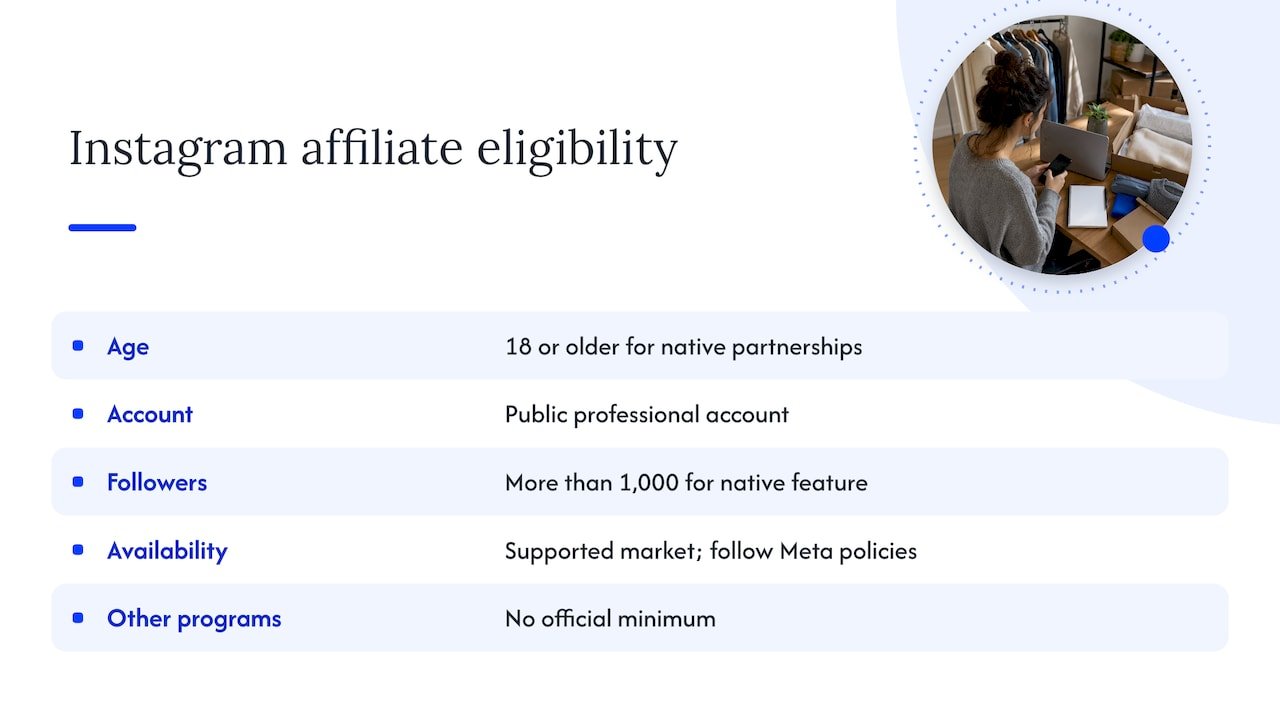
For Instagram’s native affiliate partnerships, creators must be 18 or older, have a public professional account, have more than 1,000 followers, be in a supported market, and follow Meta’s monetization policies. The feature is rolling out gradually, so you may not see it in your account right away.
For everything else, there’s no official minimum. The old 10,000-follower requirement for Story swipe-up links was removed in 2021. Link stickers are available to most accounts, except new accounts and those that repeatedly share content against Community Guidelines.
Even where it’s not strictly required, switching to a creator or business account is worth doing. HubSpot notes that it helps establish legitimacy and trust with your audience and the businesses you work with. It also gives you the Professional Dashboard, which you’ll use for tracking later.
If you’re starting with a small audience, don’t let the 1,000 mark discourage you. A small account with a focused niche and real conversations in the comments can earn from outside programs while it grows toward the native feature.
Set up your profile and pick a niche
Your profile has one job: help the right visitor understand, in a few seconds, who you help and why they should trust you. Use a clear name, a bio that states your topic, and one link slot that leads to everything else.
Choose a niche where you can talk about products from real experience. That could be home workouts, budget travel gear, skincare routines, or the AI tools that save marketers time. When you actually use what you recommend, your content has details that can’t be faked, and followers can feel the difference.
A useful test is whether you could create thirty posts about the topic without running dry. If you can, you’ve probably found a workable niche. If you can’t, narrow it or widen it until you can.
Choose affiliate programs that fit your audience
Once your niche is clear, look for brands your followers already buy from. Shopify advises finding opportunities by partnering with brands directly, and notes that affiliate networks aggregate opportunities so you can generate custom links, track commissions and get paid from one dashboard.
Commission rates vary a lot by category, so compare before you commit. HubSpot gives the example of Amazon Associates, which pays between 1% and 10% depending on product category. Amazon’s Influencer Program accepts Instagram accounts, requires a business account for Instagram and names no follower minimum, with rates from 10% on Luxury Beauty to 1% on Grocery, paid about 60 days after the month earned.
On Instagram’s own program, Ecommerce Times reports creator commission rates between 5% and 15%, and a 5% Meta selling fee (minimum $0.40 per order) on transactions using native checkout.
A few things to weigh beyond the headline rate:
Rate versus fit
A 3% commission on something your followers buy every month can beat 20% on something they never need. Think about price, how often people reorder, and whether the product solves a problem your audience talks about openly.
Payment timing
Many programs hold commissions for a while to allow for returns and exchanges. Before you promote anything, read the payout terms, so a delayed first payment doesn’t catch you off guard.
Negotiating later
Once you’re sending steady sales, you have something to bargain with. Our guide on how to negotiate a higher commission with a 90-day pilot gives you a copyable approach.
Where to put your affiliate links
This is where Instagram differs from a blog. Awin points out that Instagram captions don’t support clickable links, so your content has to point somewhere else. Here are the placements that work.
Bio link
Awin recommends using up to five bio links or a multi-link page and referring to them in your posts. Say “link in bio” in the caption or on screen, and keep the page tidy, with your best offer first.
Story link stickers
Stories let you add a link sticker that opens a page in one tap. Stories feel casual, so they suit quick demos, “what I’m using this week” moments, and answers to questions followers send you.
Reels with product tags
If you have access to the native program, tagging products in Reels puts the product right under your video. If you don’t yet, a Reel that shows the product in use and sends people to your bio link still works well.
Promo codes
Shopify notes creators can share trackable links and discount codes through Stories, Reels and bio links. Codes are easy to say out loud, easy to paste into a caption, and work even when someone doesn’t click your link.
DMs and broadcast channels
Awin also lists direct messages and broadcast channels as ways to share affiliate links. If a follower asks “where did you get that?”, a DM with your link is one of the warmest moments in affiliate marketing. Broadcast channels work for one-way announcements to people who have opted in.
Disclose every affiliate link
In the US, this part isn’t optional. Shopify says the FTC requires creators to disclose affiliate relationships, and gives the example “I earn a commission for purchases made through links in this post”. It adds that Instagram’s paid partnership label can help you meet FTC endorsement requirements.
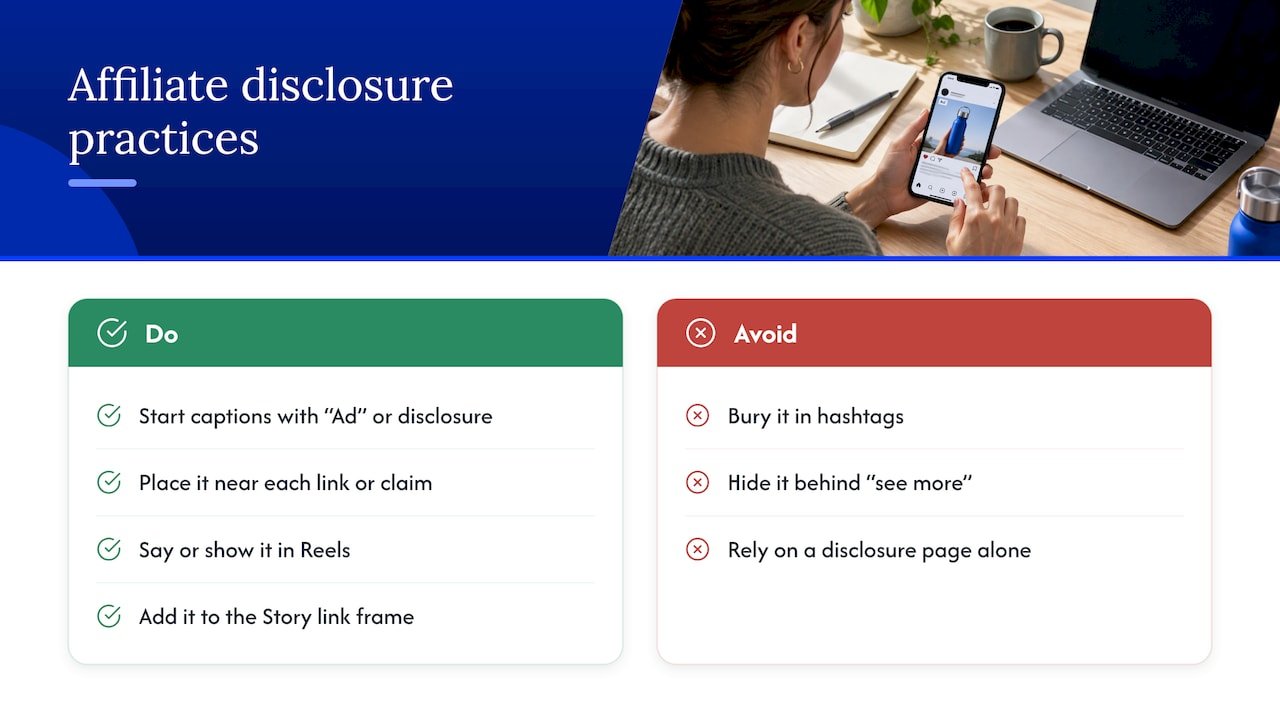
The details matter. The FTC’s Endorsement Guides, revised in June 2023, require any material connection, including affiliate commissions, to be disclosed clearly and conspicuously in plain language, such as “ad” or “sponsored,” placed where it’s hard to miss and not buried in hashtags or behind a “see more” button.
Another source on the same rules says disclosures should be positioned as close as possible to the link or claim, and that a disclosure page alone isn’t enough. When in doubt, disclose.
In practice, that means putting “Ad” or a one-line disclosure at the start of your caption, saying it out loud or showing it on screen in a Reel, and adding it to the Story frame that holds the link sticker. If you want ready-made wording, we’ve collected affiliate disclosure examples you can adapt, and our EEAT and FTC steps for affiliate sites cover the wider trust picture.
If you’re outside the US, your own country’s rules may differ, so check your local advertising regulator.
Create content that earns trust and clicks
People don’t follow an account to be sold to. They follow it because it helps them. Shopify’s advice for affiliates is to focus on relationship signals like comments, DMs and saves, give value beyond promotions (product demos are a good example), and post consistently with a mix of promotional and non-promotional content.
That same guidance says consistency beats sporadic high-engagement posts. If you can post three times a week for six months, you’ll likely beat the person who posts daily for two weeks and disappears.
Here’s a simple rhythm that many beginners find manageable. Share one helpful tip or tutorial, one honest product demo, and one personal story or behind-the-scenes post each week, then use Stories on the other days to answer questions. Notice that only one of those is a pitch. The rest builds the trust that makes the pitch work.
If you’re wondering how to keep that pace without burning out, this is where AI can take work off your plate: drafting captions, outlining Reels, repurposing one idea into five formats. We’ve put together AI affiliate workflows that show how.
Track what actually earns
Posting without tracking is guessing. Awin recommends reviewing audience demographics and engagement in Instagram’s Professional Dashboard, then using the program’s reporting tools to track clicks, conversions and sales, and adjusting based on what brings the most engagement and commissions.
The numbers worth watching are clicks, conversion rate, earnings per click and total earnings. One source points out that without an attribution layer, you only get the network’s final numbers and can’t tell which post, Story or link sent the click that led to a sale.
There’s an easy fix: give each placement its own tagged link or code. One for your bio, one for a specific Reel, one for Stories. The same logic applies offline, and the idea behind tracking QR code scans to prove ROI is a good model for connecting each touchpoint to a result.
A simple weekly check looks like this: note your top three placements by clicks, then compare them by sales. A post with lots of clicks and no sales may be sending the wrong audience, or the landing page may not match the promise. A post with fewer clicks and several sales is telling you what your audience really wants more of.
For a deeper setup, our guides on cookieless affiliate link tracking and Google Tag Manager for affiliates walk through it step by step.
Our perspective
Most people come to Instagram affiliate marketing hoping for a shortcut, and they leave frustrated when the first month brings three clicks and no sales. We’ve seen that story many times, and it almost never means you picked the wrong platform. It usually means the work was scattered.
Our view is that you win by being a guide, not a billboard. Teaching has shaped everything we do: you explain one thing clearly, you stay patient, and you let people decide for themselves. On Instagram, that looks like showing how you use a tool, being straightforward about the commission, and answering the DM that comes in two days later.
This is also where AI earns its place. It isn’t there to replace your voice. It’s there to take the repetitive drafting, repurposing and reporting off your plate, so you have more time for the human parts that build trust. That balance of practical AI and real coaching is what we aim to help you reach.
Will
Get help building your workflow
If you’d rather not piece this together alone, we’ve built resources for affiliate marketers who want to use AI to save time without losing their voice. A good place to begin is our AI affiliate workflows, a set of ready-to-run recipes for planning content, drafting posts and organizing your links.

You can also explore everything else we share, including coaching, tips, video tutorials and our newsletter, at willbuckley.com. If you want to take what you learn here to other platforms, we have guides for Pinterest, TikTok and YouTube too.
FAQ
How many followers do you need for Instagram affiliate marketing?
There’s no official minimum for sharing links from outside affiliate programs. For Instagram’s native affiliate partnerships, you need a public professional account and more than 1,000 followers, and you must be 18 or older. The feature is also rolling out gradually by market.
Can you put affiliate links in Instagram captions?
Not as clickable links, since captions don’t support them. Instead, put your link in your bio or a multi-link page, use Story link stickers, or share it in a DM or broadcast channel. Then tell people where to find it in your caption or video.
Do you have to disclose affiliate links on Instagram?
Yes, in the US. The FTC requires clear and conspicuous disclosure of any material connection, including affiliate commissions, placed close to the link or claim and in plain words like “ad” or “sponsored.” Don’t bury it in hashtags or behind “see more.”
How much can you earn per sale?
It depends entirely on the program and category. Examples from the sources above range from 1% on groceries to 10% on luxury beauty through one large retail program, and 5% to 15% on Instagram’s own program. Always read each program’s rates and payout terms before you promote.
What’s the best way to start as a beginner?
Switch to a professional account, pick a niche you know, join one or two programs your audience already buys from, and post consistently with a mix of helpful and promotional content. Give each link its own tag so you can see what works.
Sources
- HubSpot: How to do affiliate marketing on Instagram
- Ecommerce Times: TikTok Shop vs. Instagram Shopping in 2026
- Outfeed: Instagram affiliate program eligibility and how it works
- Favly: Affiliate marketing on Instagram with programs and links
- Post Affiliate Pro: Instagram affiliate marketing follower requirements
- Shopify: Instagram affiliate marketing, how to start
- Shopify: Instagram affiliate marketing best practices
- inDM: Affiliate programs for Instagram, compared
- Awin: How can I use Instagram for affiliate marketing?
- Ballard Spahr: What Instagram’s new affiliate Reels mean for retailers
- Firm of the Future: Affiliate disclosures, a quick guide
- Kicksta: Instagram affiliate marketing for creators