

CPS (cost per sale) pays you only when a person you referred buys something. CPA (cost per action) pays when that person completes any action the advertiser has defined, and that action may be a purchase, but it may also be a free trial, a signup or a form. So every CPS deal is a kind of sale-based deal, while a CPA deal can be much broader. The difference sounds small. In practice it changes how you choose offers, what traffic you send, and how reliably you get paid.
Have you ever opened an affiliate dashboard, seen “CPA” next to an offer, and wondered whether you were being paid for sales or for something else? You’re not alone. The terms get used loosely, and the fine print decides everything. This guide walks you through both models in plain language, with a worked example, the questions to ask before you promote anything, and a simple way to choose.
TL;DR
- CPS pays a fixed amount or a percentage of the order, but only after a referred customer completes a purchase.
- CPA pays for a specific, predefined action. That action can be a sale, a trial, a signup, a quote request or something else the advertiser names.
- CPS ties your income to real revenue, so it is easy to understand. CPA can be easier to convert, but the definition of a qualifying action varies by program.
- Before you promote either, read the terms for cookie length, refund handling, approval rules and payout thresholds.
- Many marketers mix both: CPS for products with a clear price, CPA for software trials and lead-style offers.
Table of Contents
- What CPS means in affiliate marketing
- What CPA means in affiliate marketing
- CPS vs CPA at a glance
- Conversion requirements and payout risk
- A worked example with hypothetical numbers
- When CPS suits your campaign
- When CPA suits your campaign
- Terms to check before you promote anything
- Our perspective
- Put it into practice with us
- FAQ
- Sources
What CPS means in affiliate marketing
CPS stands for cost per sale. It is the classic commission model: an affiliate earns commission only when a customer they referred makes a purchase, either as a fixed amount or as a percentage of the order value, as Tapfiliate’s help center describes it. Clicks don’t pay. Signups don’t pay. A confirmed sale does.
That is why this model is common in e-commerce. Daisycon notes that CPS is typical in e-commerce programs and rewards affiliates for actual sales. If you’ve ever earned a percentage of a product someone bought after reading your review, you’ve been paid on CPS.
How a CPS sale gets verified
The workflow matters more than most beginners expect. A visitor clicks your link, the purchase is tracked, and then the advertiser checks that the sale is valid. According to Involve Asia’s glossary, the advertiser confirms the sale was not returned or cancelled before it counts. In other words, the money you see on day one is often “pending” until the order clears.
This is also where tracking comes in. If your links don’t record the click properly, a real sale can go unpaid. If you want to get that foundation right, our guide on building a cookieless affiliate link tracking setup walks you through it step by step.
How CPS commission is calculated
When the commission is a percentage, the math usually isn’t “order total times rate.” Tracknow explains that commission is typically the eligible net sale value multiplied by the commission rate, and that commissionable order value is gross order value minus things like taxes, shipping, discounts, excluded products and refunds. That means a $100 order may only produce commission on $82 or so, depending on the program’s rules.
Software programs add another twist. Some SaaS companies pay on subscriptions for as long as the customer stays, which is how a recurring commission affiliate program can turn one referral into months of income. That is still a CPS-style payout, because it rests on a paid subscription rather than a free signup.
What CPA means in affiliate marketing
CPA stands for cost per action, and sometimes cost per acquisition. Mobidea notes both meanings are in use, but functionally it means you earn when someone completes a desired action through your promotion. The advertiser decides what that action is.
Shopify lists purchasing a product, visiting a landing page, signing up for an email newsletter and registering an account as examples. Search Engine Land adds filling out a form, getting a quote and signing up for a trial. Daisycon gives examples such as opening a bank account or subscribing to a service.
Here is the catch that trips people up. Tapfiliate points out that CPA does not automatically mean purchases, unless the advertiser defines the sale as the action. So when you see CPA on an offer page, your first job is to find the exact definition of the action. A “lead” that requires a verified phone number is a very different job from one that needs only an email address.
Where CPL fits
You’ll also hear CPL, cost per lead. It pays when a visitor completes a lead-generating action, such as joining a newsletter or filling out a contact form, according to Daisycon. Think of CPL as a narrower cousin of CPA. CPA is the umbrella for any defined action, and a lead is one kind of action.
CPS vs CPA at a glance
The table below puts the two side by side on the points that affect your income.
| Point | CPS (cost per sale) | CPA (cost per action) |
|---|---|---|
| What triggers payment | A completed purchase | A predefined action the advertiser sets |
| Payout type | Fixed amount or percentage of order value | Usually a fixed amount per action |
| Does it have to be a sale? | Yes | No, though it can be |
| Typical examples | E-commerce orders, courses, travel bookings | Free trials, demos, signups, quote requests |
| Refund and cancellation exposure | Higher, since order value and returns affect payout | Depends on how the action is validated |
| Biggest thing to check | Commissionable items, cookie length, refund rules | The exact definition of a qualifying action |
The core distinction, as Tracknow puts it, is that CPA pays for a specific action that need not be a sale, while CPS pays only when a referred customer purchases. Tracknow also notes that the two are usually separated because order value, products, refunds and margin affect the CPS calculation.
Conversion requirements and payout risk
Neither model is automatically “safer” for you. The risk just shows up in different places.
Where CPS can let you down
With CPS, you only get paid on a finished purchase, so a visitor who loves your review but never buys earns you nothing. Offer18 stresses that signups and form submissions won’t earn income under a pure sale model. Returns and cancellations can also reduce or reverse a commission. On the plus side, the advertiser carries little risk, which is why they are often generous with percentages on products that have a clear sale value. CloudBlue describes it as low risk and high reward for the business because payment occurs when a sale occurs.
Where CPA can let you down
With CPA, the question is whether your action actually qualifies. Payment depends on validation rules inside the program. As an example, AlterCPA’s documentation shows that a conversion can sit in wait, hold or cancel statuses until it reaches the stage the program treats as approved. So a signup that happened is not necessarily a signup that pays.
The other side of CPA is that an action can be easier to complete than a purchase. Affroom notes that a specific action is typically harder to produce than a click, which is why payouts reflect it. For you, a free trial is a smaller ask than a credit card purchase, so more visitors may complete it, even if each action pays less than a full sale.
Who carries the risk
A useful way to think about it comes from Tracknow: the earlier in the funnel the payment happens, the more risk the advertiser carries, because they pay before they see revenue. Payment after a sale lines up with revenue. This is why advertisers often pay a flat, modest amount for early actions and a larger one for sales. When you understand that, offer payouts start making sense.
A worked example with hypothetical numbers
Let’s make it concrete. These figures are made up to show the math, not taken from any real program.
Imagine you review a $60 online course. Program A pays 30% CPS on the net sale. Program B pays a flat $12 CPA for each free-trial signup.
Under Program A, one sale pays you $18 (30% of $60), assuming no discounts or refunds. If the buyer uses a $10 coupon, the net sale is $50 and you get $15. If they request a refund, you may get nothing.
Under Program B, you earn $12 per trial. Now suppose 100 of your readers click through. If 10 start a trial, you make $120. If only 3 buy under Program A, you make about $54. The CPA program looks better on those numbers. But if the trials are low quality and the advertiser rejects half of them, your $120 becomes $60. And if your audience is ready to buy and 8 of 100 purchase, CPS pays about $144.
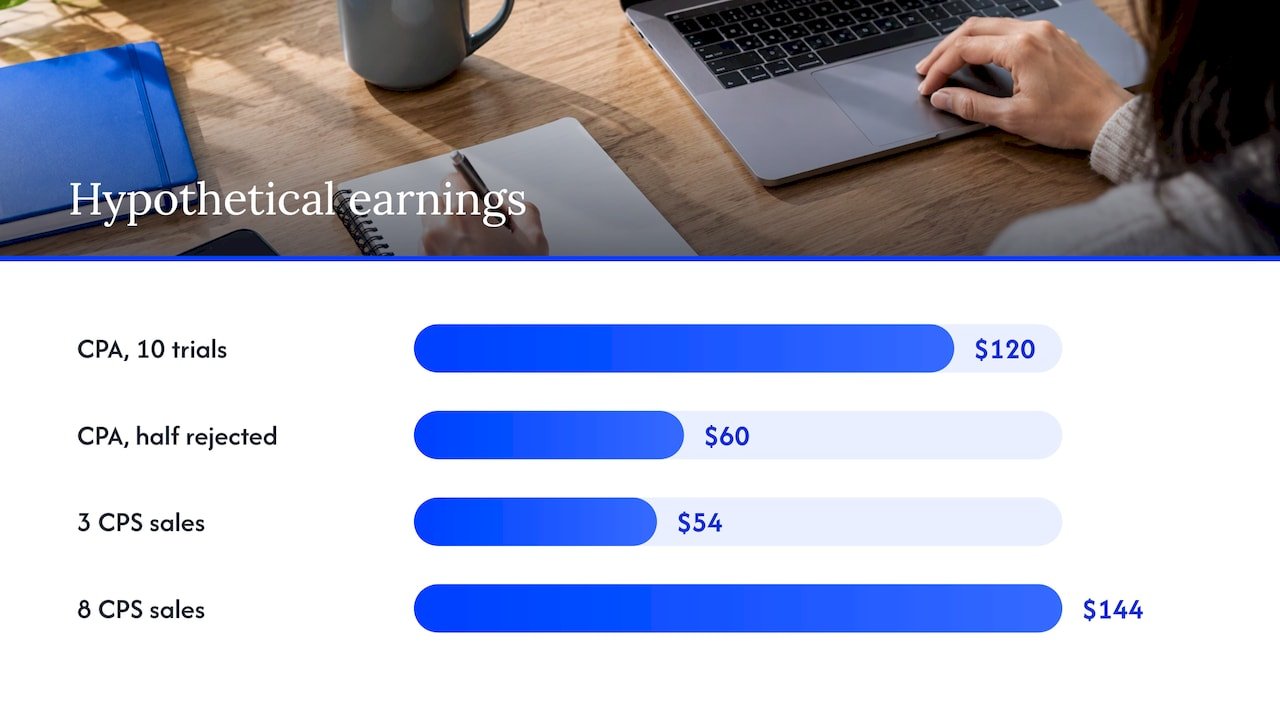
The lesson is simple. Neither model wins on paper. Your audience’s buying readiness, the approval rate and the program’s rules decide it. That is why tracking your own numbers matters. If you want to see which pieces of your content actually drive sales, our piece on affiliate attribution models shows how to match roles to results and test what works.
When CPS suits your campaign
Tapfiliate recommends CPS when you run a traditional e-commerce store and want to drive direct sales. From the affiliate’s seat, that translates to a few good fits.
CPS works well when your content is review or comparison driven, because readers who reach the end of a review are often close to buying. It also suits products with a clear price, which Tracknow lists as e-commerce, travel, courses and digital products. And it suits you if you care about long-term trust, since you are paid only when the reader got something they wanted enough to buy.
When the product is software, CloudBlue points out that CPS is especially suitable for businesses that want marketing spend tied to results. That is good news for you as well, because an advertiser who pays only on results tends to want affiliates who send serious buyers.
When CPA suits your campaign
Tapfiliate says CPA is best when you want to pay for specific results beyond sales, such as free trials or demos. Offer18 adds form fills, app downloads, newsletter signups and quote requests to the list of actions advertisers predetermine.
CPA tends to suit you when your traffic is earlier in the buying journey, for example readers who are researching and not yet ready to pay. It also fits you when the product has a long sales cycle, like a service that needs a demo first, and when the advertiser’s real value sits in a lead or an account rather than a single order.
Choosing between the two models
If you are weighing the two as a business decision, it helps to think about whether payment should follow a sale or a broader set of actions. A performance marketing agency approaches that same question from the advertiser’s side, which is useful to know when you are negotiating, because you can see why the other party prefers one structure over the other.
A simple rule of thumb: ask where your readers are in their decision. If they arrive ready to buy, lean toward CPS. If they arrive curious, CPA offers on trials and signups may match them better. And if you can’t decide, test both on a small scale and compare earnings per click after approvals, not before.
Terms to check before you promote anything
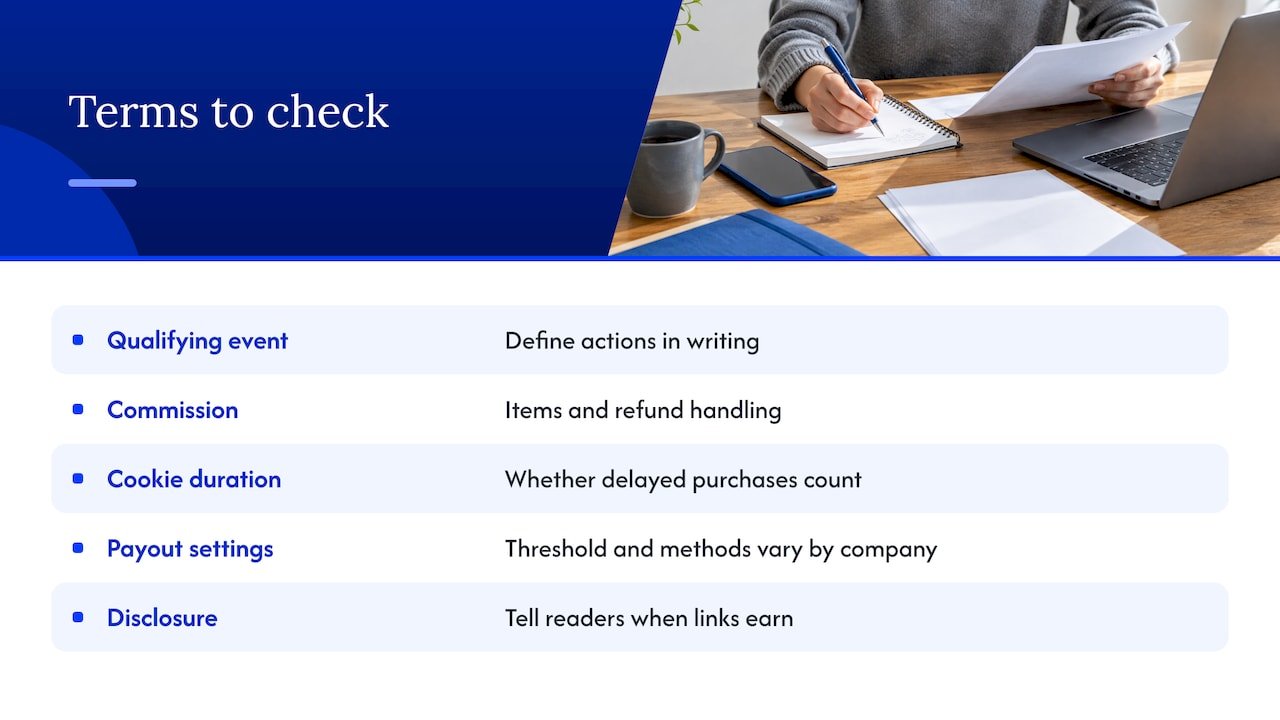
The label, whether CPS or CPA, is only the start. The program terms decide what you earn. Before you put a link on your site, read for these items.
First, the definition of the qualifying event. For CPA, Shopify advises that advertisers define the qualifying actions and the terms when launching a program, so the actions should be spelled out in writing. If they aren’t, ask.
Second, what counts toward commission. For CPS, Tracknow says program terms should define commissionable items and refund handling, because refunds and margin variation are the main risks.
Third, the operational settings. Flowlu highlights cookie duration, which decides whether delayed purchases still count, the payout threshold, which is the minimum balance before withdrawal, and the payout methods. These are set per company, so they can differ widely from one program to the next.
Fourth, your disclosure duties. Whichever model you use, readers should know when you earn from a link. Our examples of affiliate disclosures every blogger needs give you wording you can adapt.
Once you have a program you like, you can also ask for better terms. Our 90-day pilot for negotiating higher commission shows how to make that case with your own data.
Our perspective
When I coach affiliates, the CPS versus CPA question comes up early, and it usually hides a different one: “How do I stop wasting effort?” We think the honest answer is that the model matters less than knowing your audience and your numbers.
If you’re new, we’d start with CPS on a product you understand well. It’s easy to follow, because a sale is a sale, and it teaches you what makes your readers actually buy. Once you have some data, add a CPA offer or two for readers who aren’t ready yet, such as a free trial, and watch how they behave.
This is where AI earns its place in our approach. We use it to speed up the tedious parts: comparing program terms, sorting results, and drafting content, so you spend your time on decisions rather than spreadsheets. Our aim is practical, time-saving workflows you can run yourself, and we’re building them around real affiliate work.
And if the numbers feel confusing at first, that’s normal. Everyone starts there. Take it one offer at a time.
Will
Put it into practice with us
If you’d like a clear path from “I understand the models” to “I have a working funnel,” we’ve put together beginner-friendly guidance on exactly that. Our 30-day AI affiliate marketing launch guide takes you through choosing offers, setting up tracking and building content with AI support, at a pace you can keep up with.

If you’re further along and want ready-made processes, our collection of AI affiliate workflows gives you recipes to copy and adapt. You can also browse everything on our blog.
FAQ
What is the difference between CPA and CPS?
CPS pays only when a referred customer completes a purchase, as a fixed amount or a percentage of the sale. CPA pays when the customer completes a specific action the advertiser defines, which can be a sale but doesn’t have to be. In short, all CPS is tied to sales, while CPA covers a wider set of actions.
Is CPA marketing the same as CPS?
Not exactly. CPA is the broader category, and a sale can be one of its actions, so some CPA offers behave like CPS. But many CPA offers pay for trials, signups or leads. Always read the offer’s definition of the qualifying action before you assume you’re paid on purchases.
What is the difference between CPA and CPL?
CPL pays when a visitor completes a lead-generating action, such as joining a newsletter or filling out a contact form. CPA pays for any action the advertiser defines. A lead is one type of action, so CPL sits inside the wider CPA idea.
Which model pays more?
It depends on the program. CPS can pay more per conversion because it rests on a larger sale, but fewer people convert. CPA often pays less per action, though more people complete it. Compare earnings per click after approvals, using your own traffic, to see which fits.
How long do I wait to get paid on CPS?
That is set by each advertiser. Sales usually stay pending while the advertiser checks that the order was not returned or cancelled, and programs also set a minimum payout balance. Check the cookie duration, approval period and threshold in the program terms before you promote.
Sources
- Tapfiliate help center: choosing the right affiliate payable action
- Daisycon: understanding affiliate marketing commission models
- Involve Asia: cost per sale (CPS)
- Tracknow: affiliate program commission options
- Mobidea: what is CPA affiliate marketing
- Shopify: CPA marketing
- Search Engine Land: CPA marketing guide
- Offer18: CPA vs. CPS
- CloudBlue: cost per sale (CPS)
- AlterCPA: offer status models
- Affroom: understanding payout models
- Flowlu: best affiliate programs