

Buyer intent keywords are the searches people type when they are close to spending money: “best,” “review,” “vs,” “buy,” “discount,” or a specific product name. For an affiliate marketer, they are the difference between traffic that reads and traffic that clicks your link and buys. This guide shows you how to recognize them, sort them into commercial and transactional groups, find them with simple tools and AI, and give each one the right kind of page.
Have you ever published a post that pulled in thousands of visitors and not one sale? It is frustrating, and it usually has nothing to do with your writing. It has to do with what those visitors were looking for when they arrived.
TL;DR
- Buyer intent keywords are searches from people who are ready, or nearly ready, to buy. They often include words like “best,” “review,” “vs,” “buy,” “price,” or “coupon.”
- Commercial intent means comparing options. Transactional intent means ready to act. Affiliates need both, but they need different pages.
- Check intent by reading the query and the search results together. The pages Google ranks tell you what searchers want.
- Match each keyword to a page type: roundups for “best,” single reviews for product names, deals pages for discount searches.
- Judge keywords by your own conversion data, not by assumptions about the words.
Table of Contents
- What buyer intent keywords actually are
- Commercial vs. transactional: two kinds of ready
- A starter list of modifiers to watch for
- How to tell what a searcher really wants
- Finding buyer intent keywords without drowning in data
- Using AI without outsourcing your judgment
- Scoring your shortlist
- Match each keyword to the right page and call to action
- Perspective
- Common mistakes to avoid
- Put it to work with our workflows
- FAQ
- Sources
What buyer intent keywords actually are
Buyer-intent keywords are search terms that suggest a person is ready to purchase soon and is looking for the last piece of information needed to decide, according to Ahrefs. Another way to say it: these are queries where the searcher is already thinking about buying, and how strongly depends on where they sit in the buying journey, as Search Engine Journal explains.
It helps to zoom out one step. Search intent is the goal behind a query, such as learning, finding a particular site, comparing options or taking an action. Shopify’s guide to search intent names four broad types: informational, navigational, commercial and transactional. Buyer intent lives mostly in the last two.
So “what are chia seeds” is someone learning, and “buy chia seeds” is someone ready to purchase, which is the example Semrush uses to separate the two. Same topic, completely different person on the other side of the screen.
You may also see these called commercial intent keywords, high-intent keywords or transactional keywords. They overlap, and the labels matter less than the habit of asking one question before you write anything: what does this person want to do next?
Commercial vs. transactional: two kinds of ready
This is where most beginners get tangled, so let’s make it simple. Semrush sorts buyer keywords into lower-intent commercial searches and higher-intent transactional searches. Commercial searchers are weighing a purchase or evaluating options. Transactional searchers lean strongly toward buying.
The wording tends to give them away. Commercial searches often include “review,” “best” or “top.” Transactional searches are more direct and often include “buy,” “deal,” “discount” or “coupon,” per the same Semrush guide. Shopify’s examples of transactional modifiers add “order” and “price,” with queries such as “sonicare coupon code.”
The line is blurry, and that is normal. WordStream notes that commercial keywords can come from people ready to buy or from people still educating themselves first. Don’t worry about perfect labels. Worry about whether your page helps that person take the next step.
Examples you can recognize at a glance
Commercial examples from Ahrefs include “best running shoes” and “top eco-friendly cars.” Transactional examples include “order pizza” and “buy concert tickets.” In software, NetLine’s examples include comparing tools side by side on the commercial side, and “sign up for” a named product on the transactional side.
For affiliate sites, the commercial group is often the sweet spot. Ahrefs points out that comparison-style queries like “best garden hose” are valuable for affiliate content precisely because people are still evaluating options and are open to guidance. The same source says transactional queries such as “buy garden hose online” convert well but draw heavy organic and paid competition.
That tradeoff is useful. Commercial searches give you a way in, because a helpful comparison can win the click. Transactional searches are crowded because everyone sees the money in them.
A starter list of modifiers to watch for
You don’t need a giant spreadsheet to begin. Start by learning the words that signal buying behavior. Semrush recommends looking for modifiers like “buy,” “best,” “cheap,” “discount,” “coupon,” “deal,” “offer” and “free shipping,” plus specific brands, models, features, ratings and comparisons.
Here is how that sorts for a typical affiliate niche, using a made-up tool category so you can see the pattern.
| Searcher mindset | Example query pattern | What they want | Best page type |
|---|---|---|---|
| Researching | “how to choose an email tool” | To understand the problem | Tutorial or guide |
| Comparing | “best email tools for bloggers” | A shortlist | Roundup |
| Comparing | “Tool A vs Tool B” | A verdict between two options | Head-to-head comparison |
| Evaluating | “Tool A review” | An honest look at one product | Single-product review |
| Ready to act | “Tool A pricing” or “Tool A coupon” | The price or a deal | Pricing or deals page |
Notice that the keyword does half the work of telling you what to write. Once you see the pattern, a list of a hundred queries starts sorting itself.
How to tell what a searcher really wants
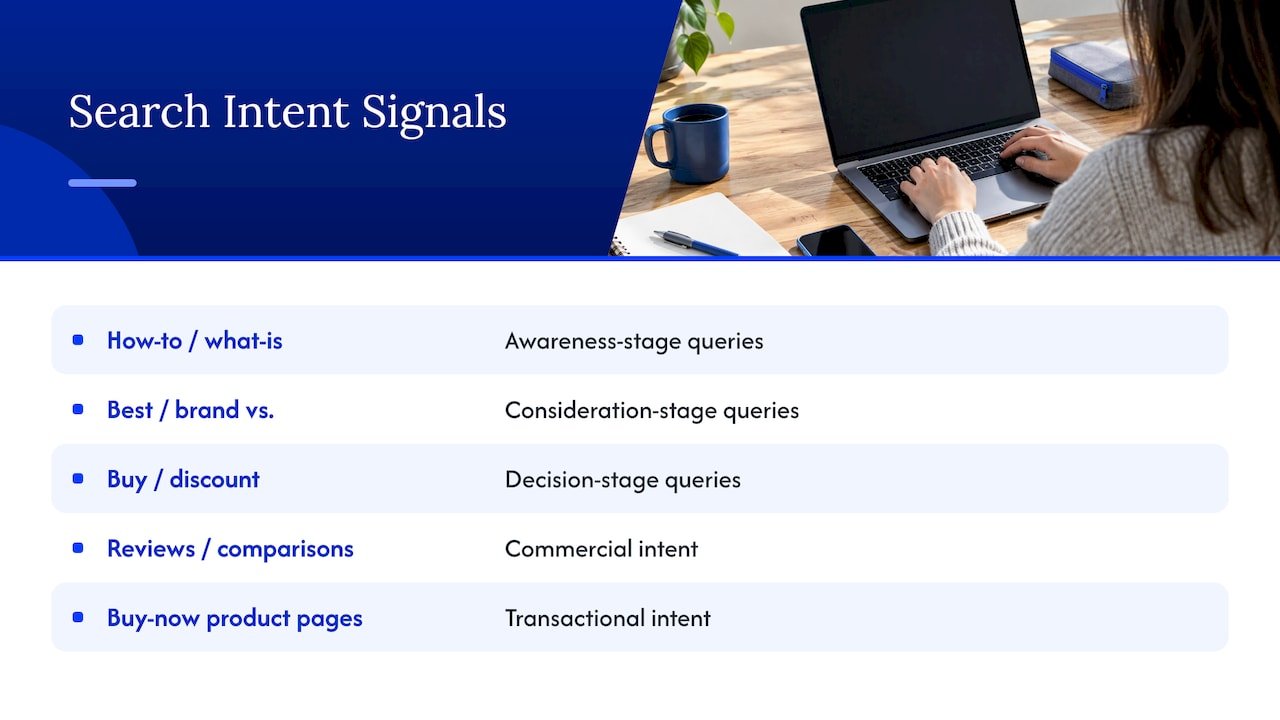
Words are only a clue. The real test is what Google shows. Search Engine Journal suggests checking suggested queries and the search results themselves. It gives “how to” and “what is” queries as awareness-stage examples, “best [product]” and “[brand] vs. [competitor]” as consideration-stage examples, and “buy now” or “discount” as decision-stage examples.
The results page backs this up. Semrush explains that product pages where people can buy immediately suggest transactional intent, while reviews and comparisons suggest commercial intent. PipeRocket agrees: read the query and the results together, because the results are the final test.
Here is a quick routine. Type the keyword into Google in a private window. Look at the first page. If you see listicles and review sites, the search is commercial and a roundup or review can compete. If you see only brand pricing and signup pages, the search is transactional and the merchant will likely be hard to beat. If you see a mix of tutorials and tool pages, the intent is mixed and you may be better off with a hybrid page.
This takes about two minutes per keyword. It will save you weeks of writing for searches you can’t win.
Finding buyer intent keywords without drowning in data
You have a few good places to start, and none of them requires an expensive setup.
Start with your buyer’s own words
For affiliate research, Surnex recommends beginning with the language real buyers use, drawn from category pages, product reviews and communities, and only then using a keyword tool to expand and validate. The point is not to let a tool define your niche. Read what customers complain about and what they compare, and those phrases become your seed list.
Use autocomplete and question tools
Geniuslink suggests filtering keyword tools for “best,” “review,” “vs” and price modifiers, using Google autosuggest for “[product] for” ideas, and using a question tool to see what people ask about a product. These are free or cheap and surprisingly rich.
Filter by what the results page looks like
The most reliable method, says Ahrefs, is using an SEO tool to filter for results-page features such as ads and product carousels, since those appear when Google believes people want to buy. The same source says AI can suggest broad terms related to your business, and that you should confirm intent by reviewing the results.
If you want a broader tour of tactics, these keyword discovery methods cover ways to find and prioritize terms that can be matched to buying intent.
Mine the People Also Ask box
Earnetics recommends scoring People Also Ask questions with a volume proxy, a commercial-intent score, a CPC estimate and a competition estimate, then favoring the questions that fit a merchant or category you can promote. It is a small, tidy way to find long-tail questions the big sites skip.
Using AI without outsourcing your judgment
AI is wonderful at the boring parts: grouping a few hundred phrases by intent, suggesting modifiers you hadn’t thought of, and drafting the first pass of a brief. It is not wonderful at knowing what your audience will actually buy. That part is still yours.
A simple way to work: paste your raw keyword list into an AI assistant and ask it to sort each phrase into researching, comparing, evaluating or ready to act, with a one-line reason. Then spot-check ten of its calls against the real search results. If it gets eight or nine right, you can trust it for the rest of the list. If it gets five right, tighten your instructions and try again.
If you want the full process, our AI keyword research workflow walks through it step by step, and our five-step affiliate keyword research guide shows how to find searches that bring buyers rather than just visitors.
Scoring your shortlist
Once you have candidates, you need to choose. Ahrefs suggests weighing traffic potential, conversion potential, keyword difficulty and CPC together. CPC is worth a moment of attention. It is the price advertisers pay per click, so a higher number often means advertisers think the click is worth money. Treat it as a hint about commercial value, not a promise.
Here is a practical way to score. Give each keyword a 1 to 3 rating on four questions: Is the intent clearly commercial or transactional? Can a small site realistically rank for it? Is there a merchant with an affiliate program I would be proud to recommend? Do I know enough to say something useful and honest? Add the numbers, and write for the highest scores first.
One caution, and it is an encouraging one. PropSaaS Growth argues that conversion history should outweigh your assumptions: a keyword you think is informational may still convert, and one that looks high-intent may bring traffic that never turns into results. Your own data beats any rule of thumb, including the ones in this article.
That is why we like short tests. Our piece on a 2 to 4 week revenue test explains how to put a few keywords live, watch what happens, and decide with evidence rather than hope.
Match each keyword to the right page and call to action
Finding a great keyword and then sending it to the wrong page is one of the most common ways affiliates lose sales. The fix is to match the page to the stage.
Passionfruit’s funnel guide maps awareness searches to educational content with gentle calls to action, consideration searches to comparisons and buyer’s guides with moderate ones, and decision searches to product, pricing or trial pages with direct ones.

For affiliates, Geniuslink gives a clear example: a search like “best robot vacuum for pet hair” fits a roundup, “Roomba i7 review” fits a single-product review, and a Black Friday deals search fits a time-sensitive deals page. Surnex describes a similar framework in its affiliate keyword guide, pairing problem-aware queries with tutorials and decision-validation queries with versus or objection-handling pages.
In practice, that means a few habits. On a roundup, lead with your top pick and say who it is for. On a review, show what you actually saw and used, and be honest about who it suits. On a deals page, keep it current and make the link easy to find. On a tutorial, teach first and place your recommendation where it solves the problem the reader just learned about.
If your content pipeline uses AI to draft these pages, we recommend building an evidence pack first, so every claim has something real behind it. We cover that in why the evidence pack comes first.
Perspective
Here is what we have noticed after years of teaching and coaching: most affiliates don’t have a traffic problem. They have a mismatch problem. They write for a person who is browsing and hope that person buys.
Buyer intent keywords fix that, but only if you treat them as a conversation rather than a list. Every query is someone telling you where they are. “How to” says they are curious. “Best” says they want help choosing. “Pricing” says they are nearly there. Your job is to meet them exactly where they stand, honestly and kindly.
This is where AI earns its place in our approach. It saves you the hours you would spend sorting and drafting, so you can spend them on what only you can do: using the product, telling the truth about it, and explaining it the way a good teacher would. We built our workflows around that idea, practical, time-saving and human, because a smarter process should make you more trustworthy, not less.
If you feel overwhelmed by all this, start small. Pick five keywords, match each one to the right page, and see what happens. Progress beats perfection every time.
Will
Common mistakes to avoid
The first is chasing only the most obvious transactional terms. They look like gold, but they are crowded, and the merchant’s own pages usually hold the top spots. Mix in commercial searches where you can add real value.
The second is ignoring the results page. A keyword can sound like a purchase and still show tutorials, which tells you Google thinks people want to learn. Write what the results reward.
The third is treating every keyword the same. A “vs” search deserves a verdict. A “review” search deserves first-hand detail. A “coupon” search deserves a working, current offer. Using one template for all of them quietly drains conversions.
The fourth is never going back. Search behavior shifts, merchants change programs, and prices move. Revisit your top pages every few months, and let your own click and sales data tell you which keywords deserve more attention. Understanding how credit is split between pages helps here, which is why we wrote about affiliate attribution models.
Put it to work with our workflows
If you would like help turning a keyword list into pages that actually earn, our practical resources are built for exactly that. We share ready-to-use AI affiliate workflow recipes that cut the sorting and drafting time, along with coaching, tips and tutorials for affiliate marketers learning to use AI well.

Start with one recipe, run it on five keywords this week, and see how much time you get back. You can also explore everything else we offer on the Will Buckley homepage.
FAQ
What are buyer intent keywords?
They are search terms that suggest the person is ready, or getting close, to buy. Ahrefs describes them as searches where the user wants final information to make a buying decision. Common examples include “best,” “review,” “vs,” “buy” and “discount.”
What is the difference between commercial and transactional keywords?
Commercial keywords come from people comparing options before they buy, often with words like “best” or “review.” Transactional keywords come from people ready to act, often with “buy,” “coupon” or “deal,” as Semrush explains. The two overlap, so check the search results to confirm.
How do I know if a keyword has buyer intent?
Look at the wording, then look at the results page. Listicles, comparisons and reviews point to commercial intent, while pricing and signup pages point to transactional intent, according to PipeRocket. The results page is the final test.
Which buyer intent keywords are best for a new affiliate site?
Most beginners do well starting with commercial searches such as “best,” “vs” and “review” queries for specific products. They are less crowded than pure buying terms and let you add real value by helping people choose. Test a handful, then follow your own conversion data.
Can AI find buyer intent keywords for me?
AI can suggest broad terms and sort a list by intent quickly, and Ahrefs notes that you should still check intent by reviewing the results. Use it to save time on sorting, and keep the final choices for yourself.
Sources
- Buyer Intent Keywords Convert Better. Here’s How to Find Them (Ahrefs)
- Keyword Intent: What It Is and How to Use It (Ahrefs)
- Understanding Buyer Intent Keywords (Search Engine Journal)
- Search Intent: What It Is and How to Optimize for It (Shopify)
- How to find buyer intent keywords for organic and AI search (Semrush)
- What Is Keyword Intent? (Semrush)
- 4 types of keywords in SEO (Semrush)
- Commercial Intent: How to Find Your Most Valuable Keywords (WordStream)
- Finding and Using Buyer Intent Keywords (NetLine)
- What Is a Commercial Keyword? (PipeRocket)
- Amazon Affiliate Website SEO (Geniuslink)
- Affiliate Marketing Keyword Research: A Modern Guide (Surnex)
- People Also Ask Mining for Affiliate Keywords (Earnetics)
- SEO Funnel Strategy (Passionfruit)
- Buyer Intent Keywords for B2B SaaS (PropSaaS Growth)