

CPA pays you a fixed amount once, when a referred person completes an action. RevShare pays you a percentage of the revenue that person generates, usually every month, for as long as the deal says. Neither is better in the abstract. CPA is the better fit when you need cash back quickly and the product is a one-time buy. RevShare is the better fit when your audience sticks around and the product renews.
If you’ve ever stared at two affiliate offers for the same product, one paying $50 flat and the other paying 30% monthly, and felt stuck, this guide is for you. We’ll define both terms in plain English, walk through a worked example, and show you which terms in the fine print decide what you actually earn.
TL;DR
- CPA (cost per action) is a flat, one-time payout for a defined action such as a signup, a lead or a first sale.
- RevShare (revenue share) is a percentage of what each referred customer spends, paid period after period.
- CPA gives faster, more predictable cash. RevShare gives upside if customers stay and the product renews.
- The fine print matters more than the label: the revenue base, refund rules, duration caps and negative balances can change a deal’s value dramatically.
- Compare both over the same 60 to 90 day window with your own traffic numbers before you commit.
Table of Contents
- What CPA and RevShare actually mean
- How the money actually moves
- A worked example with your own numbers
- Where each model goes wrong
- The fine print that changes the math
- Which model fits which kind of marketer
- How CPA and RevShare sit among other commission models
- How to test both before you commit
- Perspective
- Put the choice into a workflow
- FAQ
- Sources
What CPA and RevShare actually mean
CPA stands for cost per action. The IAB Affiliate Marketing Handbook treats it as the basic payment metric of affiliate marketing, where an action is usually a sale but can also be a lead, a registration, a call or a download. The same handbook describes two ways of setting it: a flat rate per action, typical for registrations, and a revenue share, a percentage of the price of what was bought, favored by advertisers selling goods at varying prices.
That last detail clears up a lot of confusion. In everyday talk, “CPA” means the flat fee and “RevShare” means the percentage. But a percentage of a one-time sale is technically also a form of CPA. So when someone says RevShare in the affiliate world, they usually mean a percentage that keeps coming back, month after month, from the same customer.
Here is the simplest picture:
- CPA: a software company pays you $20 whenever someone signs up for a free trial. One signup, one payment, done.
- RevShare: the same company pays you 30% of a customer’s $100 monthly subscription. You earn $30 every month that customer stays.
A third option, the hybrid, mixes the two: a smaller upfront payment plus a smaller ongoing percentage. A typical example is $50 upfront plus 10% of ongoing subscription payments.
How the money actually moves
Understanding the cash flow is half the decision, so it helps to see how a commission travels from a click to your bank account.
A commission is first accrued, meaning it is recorded when the qualifying event happens. It then sits through a hold period while the merchant checks for refunds, fraud or cancellations. After that it is approved and paid out on a schedule. Terms vary by program, but you can see the pattern in one program’s published rules: RevenueLab explains that it pays CPA earnings twice a month after conversions are verified, while RevShare and hybrid earnings are paid once a month for the previous month. Some conversions may be declined at the verification stage.
The practical lesson: CPA tends to land in your account sooner after the action. RevShare trickles in and, early on, can look disappointing. A RevShare deal that pays nothing visible in week two may be paying handsomely by month ten, but only if you can afford to wait.
A worked example with your own numbers
Let’s make this concrete with an illustration (the figures are invented for the example, not a real program). Say you send 1,000 visitors a month to a software tool.
- 3% of them start a trial, so 30 trials.
- 40% of trials become paying customers, so 12 customers.
- The tool costs $40 a month, and customers stay about 10 months on average.
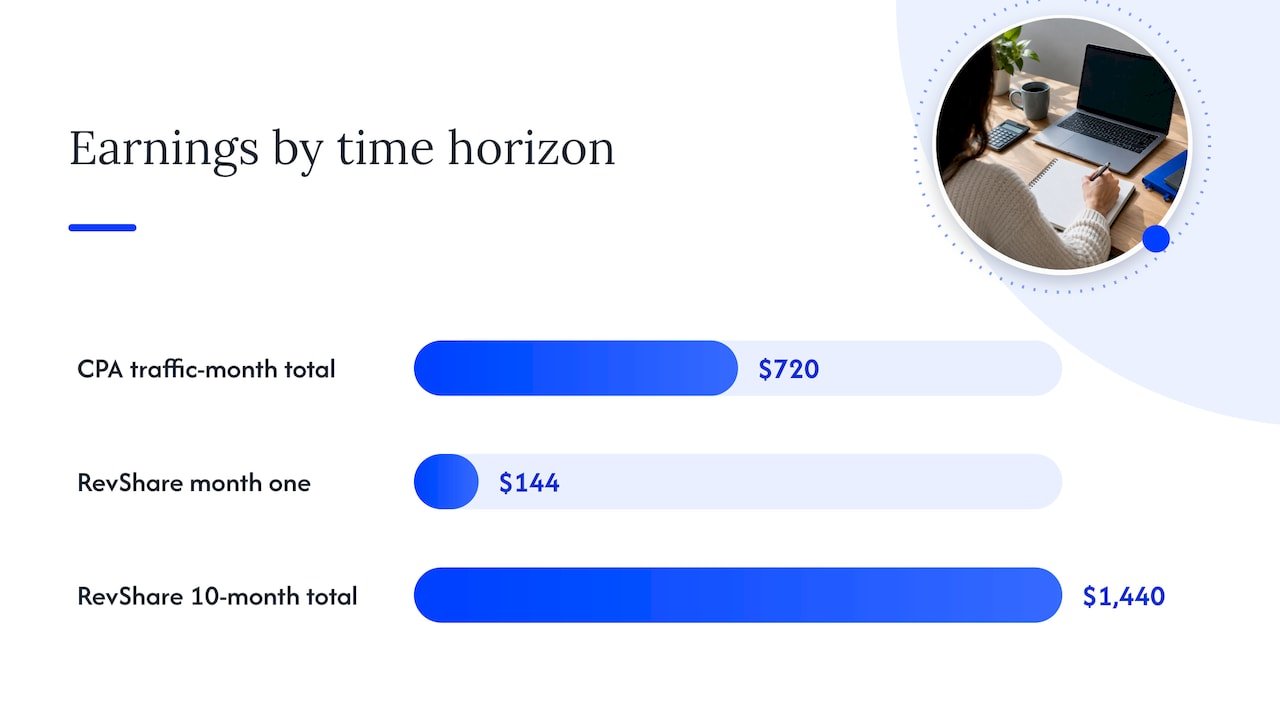
Offer A is CPA at $60 per paying customer. You earn 12 x $60 = $720 for that month’s traffic, and that is the end of it.
Offer B is RevShare at 30%. Each customer is worth $12 a month to you. For the same 12 customers, you earn $144 in month one. Over a 10-month average life, each customer is worth $120 to you, so that month’s traffic eventually produces $1,440.
On paper RevShare wins by a wide margin. But look at the conditions hiding in the example. It assumes customers really stay 10 months, that the program is still running and honest in month ten, and that you can keep creating content for ten months before the full payoff arrives. If your customers cancel after two months, CPA wins. If you are paying for traffic, the gap between your ad spend now and your commissions later is a real cost.
That is why the question is never just “which pays more.” It is “which pays more for my traffic, over a time horizon I can sustain.” If you want to work out what each click is worth to you under either model, our guide to EPC meaning in affiliate marketing shows the formula and examples.
Where each model goes wrong
Every commission model has a failure mode. Knowing it in advance is how you avoid unpleasant surprises.
The risks of CPA
CPA is predictable, but it pays on one event only. One affiliate platform’s support documentation states that CPA pays only on the initial sale, not on upsells or rebills of subscriptions, though CPA commissions there are not liable for refunds or chargebacks. They can still be voided for fraud.
The other CPA trap is the definition of the “action.” A signup, a verified account and a funded account are very different bars. Before you promote anything, find out exactly what counts, how long the approval window is, and whether there is a minimum threshold the customer must reach first.
The risks of RevShare
RevShare puts some of the merchant’s risk on you. On that same platform, the documentation says affiliates on RevShare are liable for refunds and chargebacks, meaning you lose the commission on that sale. Your income also moves with retention, customer behavior and product quality, none of which you control.
There is also the matter of how long it lasts. Some programs pay for the lifetime of the customer. Others stop after a set number of months. A 60% commission for 12 months can be worth less than 25% for life, depending on how long your customers actually stay.
The fine print that changes the math
Two RevShare offers with the same headline percentage can be worth wildly different amounts. These are the terms to read before you say yes.
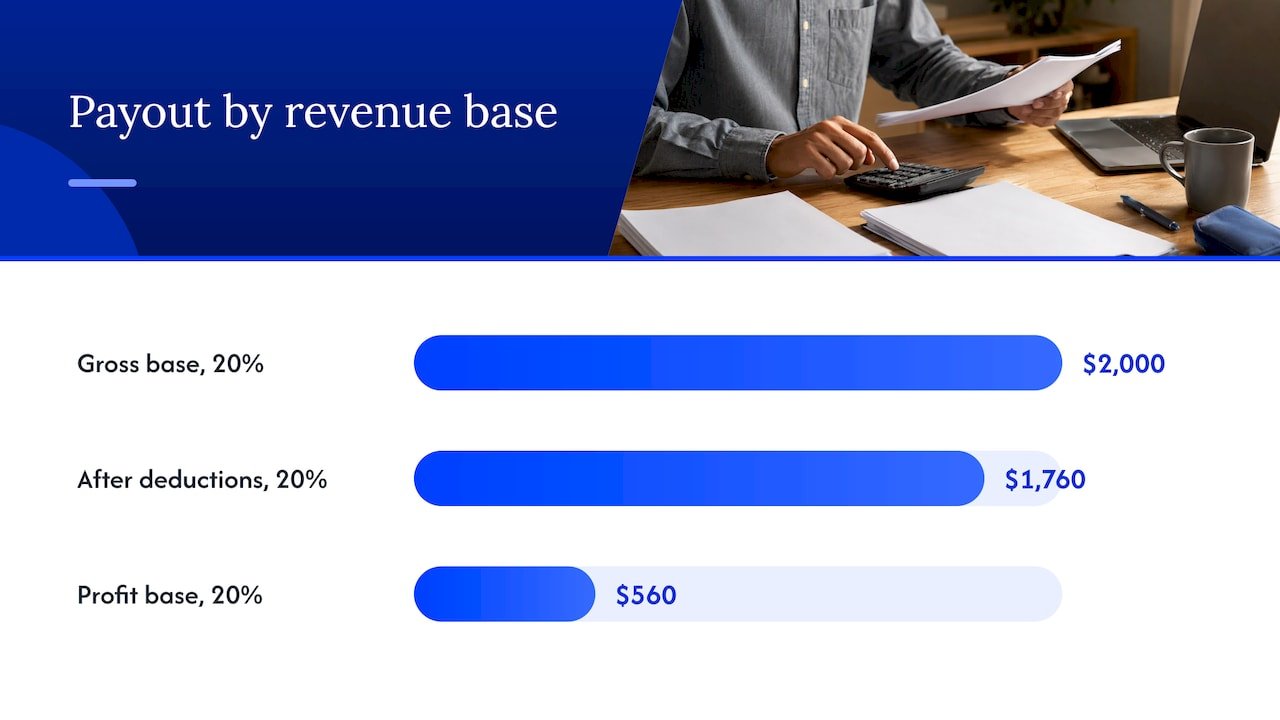
The revenue base. A percentage of what, exactly? Creem’s revenue-share guide gives a clean illustration: on a $10,000 period at 20%, a gross revenue base pays $2,000. If $1,200 of agreed tax, fee and refund deductions come off first, the same 20% pays $1,760. If the base is profit after $6,000 of agreed costs, it pays only $560. Same percentage, very different paycheck. Settle the definition before you celebrate the rate.
Negative balances. Some programs let a bad month dig a hole that must be filled before you earn again. A review of eight published iGaming programs by BOTH’s negotiation guide found five carry negative balances forward by default, while three reset monthly with exceptions. Ask whether a negative month carries over, and whether it can reduce the upfront part of a hybrid deal.
Duration. Lifetime, 24 months, 12 months? This single clause often matters more than the percentage.
Changes and closure. Can the rate change with notice? What happens to accrued earnings if the program closes? You want these answers in writing.
Reporting. If the merchant’s dashboard is your only evidence, a lifetime RevShare is only worth as much as that merchant’s honesty and longevity. Look for transparent, transaction-level reporting.
A useful habit is to write each definition down before comparing rates: for CPA, the qualifying action and the approval window; for RevShare, the revenue base, the allowed deductions and how negative balances are handled. Then the numbers you compare are actually comparable.
Which model fits which kind of marketer
Here’s the honest shortcut. Match the model to how your traffic behaves.
Choose CPA when:
- You buy traffic (paid ads, for example) and need money back quickly to keep scaling.
- Your visitors are comparison shoppers or one-time buyers.
- The product has a single conversion event, or prices vary little. If a thousand phone cases all sell for $30 to $35, a flat $5 per sale is simpler than a percentage.
- You want to know your numbers with confidence in the first few weeks.
Choose RevShare when:
- Your traffic is evergreen, like search content, a YouTube library or an email list, so one piece of work keeps sending buyers.
- The product is a subscription with a long customer life. A recurring commission program on a software subscription is the classic example, where the percentage keeps paying for as long as the customer stays subscribed.
- Your audience is loyal and trusts you, so the people you send tend to stay.
- You can wait for the payoff without it hurting your finances.
Choose a hybrid when you want a bit of cash now and a share of the long game, which is common when a brand is new and wants to attract strong publishers quickly.
If you’re comparing CPA with a pay-per-sale deal rather than a revenue share, our breakdown of CPS vs CPA covers that choice directly.
How CPA and RevShare sit among other commission models
The affiliate world has a long alphabet soup, and it helps to see where our two terms fit. CPL pays for a lead or registration, CPS for a completed sale, CPI for an app install, CPC for a click and CPM for every thousand impressions. Shopify’s guide to CPA marketing lists CPL, CPC, CPS, CPI and CPV as types of CPA marketing, and notes that CPA differs from revenue-sharing programs that provide ongoing percentages.
How common is CPA? In an impact.com survey of its own users from 2021, 83% of organizations said they use cost per action as a payment method for commerce content. For most beginners, the practical takeaway is that you’ll meet CPA-style offers first, and RevShare mostly when you promote subscriptions, software and certain regulated industries.
One caution for regulated verticals such as gambling or finance: some markets restrict revenue-share compensation for affiliates. Always check what the rules in your country allow before you sign.
How to test both before you commit
Here’s a simple way to stop guessing. Take 60 to 90 days of real data, and score each model on four things: how fast you recover your costs, how predictable the income is, how much you participate in long-term customer value, and how much effort it takes to verify what you were paid.
Compare models on the same horizon and the same group of customers. Label 30-day data as 30-day data, not as a lifetime forecast. And match the model to the traffic source rather than copying a deal that worked on one channel. Something that suits an SEO article may not suit paid social.
If you already have a deal and think it is underpriced, a time-boxed pilot is a friendly way to ask for better terms. We lay out a copyable approach in how to negotiate higher affiliate commission. And if you’re unsure which of your channels actually drives sales, affiliate attribution models will help you decide where each model belongs.
Perspective
When we coach affiliate marketers, the most common mistake isn’t picking the wrong model. It’s picking a model without knowing their own numbers. Someone sees “lifetime recurring” and imagines a pile of passive income, or sees a big flat payout and ignores that nothing comes after it.
Our view is simple. Start with your traffic, not the offer. Know your conversion rate, know how long you can afford to wait, and then let those facts choose the deal. If you’re new and need proof that your content converts, a CPA offer gives you a clean signal fast. Once you have steady, evergreen traffic and a product people keep paying for, a RevShare deal can turn the same work into income that builds.
This is also where AI earns its keep. Modeling both deals over a 90-day window, tracking cohorts and flagging when a program’s reporting looks off are exactly the repetitive jobs that tools do well, leaving your time free for the creative work only you can do. You don’t have to be a spreadsheet person to make a smart commission decision. You just need a method and a bit of patience with yourself.
Will
Put the choice into a workflow
If you’d like to turn this comparison into a repeatable routine, start with our AI affiliate workflows, which walk through ready-to-run recipes for the work that eats your week. If you’re just getting going and want a clear path, launching in 30 days with AI is the place to begin.

Our coaching, tips, tutorials and newsletter are built for affiliate marketers and entrepreneurs learning to use AI to improve their strategy. Browse everything on willbuckley.com and pick the guide that matches where you are right now.
FAQ
What does RevShare mean?
RevShare is short for revenue share. The program pays you a percentage of the revenue your referred customers generate, usually monthly, for the life of the deal or until a stated cap. A common example is 30% of a customer’s $100 monthly subscription, which is $30 a month while they remain a customer.
Is CPA or RevShare better for beginners?
CPA is often the easier starting point because you see results quickly and the numbers are simple to track. That fast feedback tells you whether your content converts. Once you have steady traffic and a product with recurring payments, you can test a RevShare or hybrid deal alongside it.
What is a reasonable revenue-share percentage?
It depends heavily on the industry and on how revenue is defined. Published starting rates in iGaming run from 15% to 40% of net revenue, according to BOTH’s October 2026 review of eight programs. Because the base and deductions change what you receive, compare the definition first and the percentage second.
What is a hybrid commission model?
A hybrid pays a reduced upfront CPA plus a reduced ongoing RevShare. It gives you some cash now and some long-term upside, and it is a common way for newer programs to attract publishers. Read how negative balances are handled, since in some terms they can reduce the CPA part.
Sources
- IAB Affiliate Marketing Handbook
- RevenueLab: how earnings are calculated and paid
- Explodely support: commission type and amount
- Creem: revenue share agreement
- BOTH: negotiating affiliate deals
- Shopify: CPA marketing
- impact.com Commerce Content Research Report
- BabyLoveGrowth affiliate program