

Have you ever looked at a list of email subscribers or form submissions and wondered which ones are actually worth your time? That question is exactly what AI lead scoring answers. It uses a model trained on your own past results to give each lead a probability of converting, so you follow up with the right people first. For affiliate marketers and solo marketers, the real win is not the algorithm. It is a clear, simple routine for what you do with the score, built on tidy data and checked against real outcomes.
TL;DR
- AI lead scoring learns from your past wins and losses, then gives each new lead a conversion probability instead of a hand-picked point total.
- It needs clean data and enough closed outcomes to learn from. If you have only a few hundred, start with simple rules.
- Judge a model by whether top-ranked leads really convert more than middle and bottom ones, not by a technical accuracy number.
- A score only pays off when it changes what you do next: who gets a call, who gets a nurture sequence, who gets left alone.
- Retrain and recheck on a schedule, because buyer behavior and traffic sources drift.
Table of Contents
- What AI lead scoring actually is
- Why it matters when you are small
- How a scoring model works, step by step
- What you need before it will work
- Scoring affiliate leads and traffic
- Build a simple version in four steps
- Measure it like a marketer, not a data scientist
- Where AI lead scoring goes wrong
- The follow-up matters as much as the score
- Connect the score to the rest of your stack
- Perspective
- Put it into practice
- FAQ
- Sources
What AI lead scoring actually is
Traditional lead scoring is a points system you write yourself. A pricing-page visit earns 20 points, an email open earns 1, an unsubscribe costs you 30. It works, but you are guessing at the weights, and you have to keep revisiting them as things change.
AI lead scoring flips that. You hand a model your history of leads who bought and leads who did not, and it finds the patterns itself. Academic researchers reviewing the field note that traditional scoring struggles to capture nonlinear effects and interactions between signals, and leans heavily on behavior while neglecting who the person is. A model can notice that a certain traffic source plus two visits to a comparison page plus a certain kind of email address tends to convert, even though none of those alone would have earned many points.
The output is usually a number between 0 and 100 percent, often grouped into hot, warm and cold tiers. Oracle’s documentation describes this kind of score as built from patterns in historical converted and lost leads, and says the model is retrained monthly and recalculated every 12 hours.
Why it matters when you are small
Most leads never buy. The same review reports that only 1 to 6 percent of leads ultimately become customers, and that scoring can lift the share of prospects who become qualified leads to 15 to 20 percent. It also finds predictive models are especially helpful to small and medium businesses, which can pass fewer leads to sales and still see higher conversion rates.
That is good news if you are a one-person operation. Your time is the scarcest thing you own. If a score tells you which 20 people on a list of 500 deserve a personal reply, a webinar invite or a call, you spend your energy where it counts.
How a scoring model works, step by step
You do not need to build the math yourself, since most email platforms and CRMs now offer scoring. But understanding the moving parts helps you judge what any tool tells you.
1. It collects signals
Typical signals fall into a few groups: who the lead is (job title, company size, location), what they did (page visits, email clicks, form submissions, how long they stayed), and where they came from (campaign, channel, affiliate or partner ID). A common and sensible habit is to keep fit, intent and engagement as separate ideas rather than blending them too early, so you can see why a lead looks good.
2. It learns from outcomes
The model looks at who became a customer and who did not. One detail matters more than it sounds: a lead who has not bought yet might still buy. Salesforce’s engineers describe this as right-censored outcomes, and handle it by treating only leads older than a set time window as true negatives. The same write-up explains that recent activity can be weighted more than old activity, so an email click today counts for far more than one from nine months ago.
3. It scores and routes
Each lead gets a probability, and you set thresholds that trigger actions. Hot leads get a personal message. Warm leads get a nurture sequence. Cold leads stay on the newsletter and cost you nothing extra.
What you need before it will work
This is where most people stumble, and the research is blunt about it. A survey of B2B marketers found that 57.7 percent estimate between 10 and 50 percent of leads in their CRM are incomplete, inaccurate or duplicated, and inaccurate data was the top challenge for AI performance. Another 2026 survey reported by PPC Land found sales teams estimate about 32 percent of their CRM data is flawed.
In practice that means a short checklist before you turn anything on:
- Pick one outcome. A sale, a booked call, a qualified signup. One model, one definition of success.
- Clean your records. Merge duplicates, fix blank fields and make sure outcomes are recorded the same way every time.
- Have enough history. Oracle’s documentation lists minimums for its own model, including 1,000 closed leads and 100 converted ones. Salesforce’s behavior scoring asks for six months of engagement history. Your tool will have its own floor, so read it.
- Track the outcome, not just the signup. For affiliates, that often means a completed purchase or a first payment, not an email address.
If you are below those numbers, a spreadsheet and a handful of rules is a perfectly respectable start. You can fill in a short scorecard, check it against your last 90 days of buyers and non-buyers, and only then think about automation.
Scoring affiliate leads and traffic
Affiliate marketers have a twist. You may be scoring your own subscribers, or you may be judging the quality of traffic coming from different sources. Useful signals include:
- How the lead engaged: opens, clicks on offer links, return visits.
- Whether the contact details look real: disposable email domains, mismatched phone and location, forms filled in suspiciously fast.
- Which source sent them, and how that source has performed before.
Treat negative signals as seriously as positive ones. An unsubscribe, 90 days of silence or a throwaway email address should pull a score down. And never apply one threshold to every source. A cutoff that suits your newsletter may be far too strict or too loose for paid traffic.
If your lead flow starts with a free download, a strong AI lead magnet gives you cleaner, more intentional signals to score in the first place, because the people who opt in are telling you what they care about.
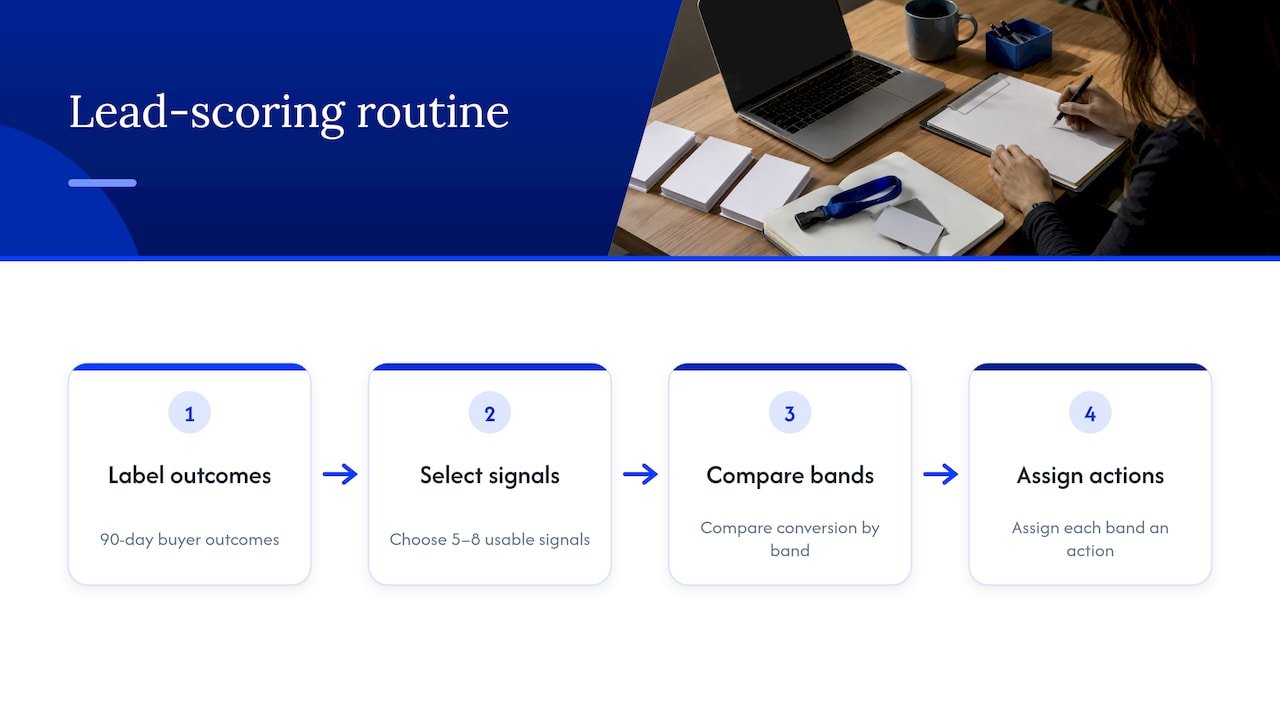
Build a simple version in four steps
This routine works whether you use a built-in tool or a spreadsheet.
Step one: list your last 90 days of leads and mark the result. Buyer or not. This is your training set, and it forces you to confront how messy your records are.
Step two: choose five to eight signals you can actually capture. Source, number of site visits, link clicks, a key page viewed, email type, and one or two negative flags. Leave out anything that only appears after a deal is already moving, such as a note a rep adds once the buyer replies. Experts call that leakage, and it makes a model look brilliant on past data and useless on new leads.
Step three: turn on your platform’s AI scoring, or compare your own rules against the outcomes. Then look at conversion by band. A useful model shows a clear gap between the top, middle and bottom groups. In one field test at a B2B energy retailer, 6.4 percent of top-quartile leads converted to a quote versus 2.8 percent of middle-quartile leads. That kind of spread is what you are looking for.
Step four: attach an action to every band. If a hot score does not change what you do, the score is decoration.
Measure it like a marketer, not a data scientist
Technical measures like AUC (a number that summarizes how well a model separates buyers from non-buyers) are fine for specialists. For you, three questions matter more.
First, do top-ranked leads convert at a meaningfully higher rate than the rest? Second, does the score change your behavior and your revenue? A model can rank well on old data and still do nothing for you if you do not act on it. Third, does it keep working over time?
Be realistic about what a good model looks like. In a large 2026 study from a Chinese automaker summarized by a revenue-operations newsletter, even the best top-1 percent queue converted at only about 13 percent, at a base conversion rate of 1.33 percent. That is a huge improvement over random, yet most of the priority list still did not buy. A score is a better way to spend attention, not a promise.
If you test a change, do it gently. Keep your current method running on most leads and try the new model on a smaller slice before you commit.
Where AI lead scoring goes wrong
A 2026 narrative review in a management journal concludes that machine learning improves standardization and ranking but does not remove the need for qualification, explanation and human judgment. It also notes that engagement alone can overstate readiness, since someone can click a lot and still never buy, and that models trained on one company’s data often do not transfer well elsewhere.
So the common failure points are predictable. Too little history. Messy data. Training on signups instead of buyers, which teaches a model to find clickers. A model left alone for months while your audience and traffic mix change. The fix is dull but effective: recheck the score bands against real outcomes on a regular schedule, and retrain when the gap between bands narrows.
The follow-up matters as much as the score
The same review argues that the commercial value of a score depends on the response it triggers: how quickly you follow up, who owns the lead and how feedback flows back. A perfect ranking that sits unread is worth nothing.
That is where your nurture routine comes in. Warm leads need patient, useful contact, and lead nurturing strategies show how to keep them moving without pushing too hard. If you work with a team or partners, agreeing in advance on what counts as a qualified lead and who acts on it keeps everyone honest, which is what a sales and marketing SLA is for.
For the email side of that follow-up, our guide to AI email sequences walks through setting up the messages a warm lead should receive.
Connect the score to the rest of your stack
Lead scoring does not live alone. It works best next to clear attribution, so you know which channels really drive sales, and next to clean tracking so the outcomes feeding your model are right. Two pieces worth reading alongside this one: affiliate attribution models and AI marketing analytics. If you are working with personal data, it also pays to think through fairness and transparency early, which our piece on ethical AI marketing covers.
Perspective
Here is how I see it after years of teaching and coaching. People get excited about the tool and forget the habit. A score is only a sentence your data is saying out loud: this person looks like the folks who bought before.
The marketers who get value from it do three simple things. They keep their records honest. They decide in advance what each score band means for their week. And they come back every few months to see whether the score still earns its place.
That is the practical, time-saving approach we take with AI in affiliate marketing: start small, automate the repetitive parts, keep your own judgment in the loop. You do not need a data science team. You need a clear process and the patience to check it.
Will
Put it into practice
If you want to go from reading to doing, our AI affiliate workflows give you ready-to-run recipes, and the guide to AI workflow automation for affiliate marketers shows how to hand the repetitive work to AI so you can spend your time on the leads that matter.

Start with one list, one outcome and one simple rule for each score band. You can always add sophistication later.
FAQ
Is AI lead scoring worth it for a small affiliate business?
It can be, once you have enough recorded outcomes for a model to learn from. Research suggests predictive models are especially useful for smaller businesses because they let you send fewer, better leads forward. If your history is thin, begin with a simple rules-based scorecard and move to AI as your data grows.
How much data do I need?
It depends on the tool. Oracle’s model asks for at least 1,000 closed leads and 100 converted ones, while Salesforce’s behavior scoring wants six months of engagement history. Check the minimums in your platform’s documentation, and begin with rules if you are under them.
How often should I retrain or recheck the model?
Plan on a regular review, such as every few months, and sooner if your offers, audience or traffic sources change. Compare conversion across score bands each time. If the top band no longer converts clearly better than the rest, it is time to retrain.
What is the difference between lead scoring and lead qualification?
Scoring ranks leads by likelihood to convert. Qualification is the decision about whether a lead is a real fit and ready to talk. Research shows scoring improves ranking but does not replace human judgment, so use the score to decide who to look at first, then qualify.
Sources
- The state of lead scoring models and their impact on sales performance (PMC)
- How does the AI Lead Score get calculated? (Oracle documentation)
- Machine Learning Driven Sales and Marketing: Einstein Behavior Scoring (Salesforce Engineering)
- AI and Revenue Decisions report (b2bmarketing.net)
- B2B sales teams estimate 32% of their CRM data is flawed (PPC Land)
- AI-enabled lead temperature: a narrative review (XIMB Journal of Management)
- 186 Lead Scoring Statistics (Marketsplash)
- The lead score that learned the funnel’s own ladder (Programmable Revenue)