

Yes, you can promote affiliate offers with Bing Ads, now called Microsoft Advertising, as long as your ads, landing pages and tracking follow Microsoft’s rules. The auction is smaller than Google’s, so clicks often cost less, but the payoff depends on three things: a page Microsoft will approve, tracking that connects commissions back to keywords, and judging results on commission rather than clicks. We will walk through each, in plain language, so you can decide whether this channel deserves a small test budget.
If you have ever looked at a Google Ads dashboard and wondered whether there is a quieter corner of paid search where your budget stretches further, this is that corner. It just asks a bit more of you up front.
TL;DR
- Microsoft Ads is a pay-per-click auction: you pay only when someone clicks, never more than your bid, and position depends on bid, relevance and performance.
- Affiliates are responsible for their own keywords, destinations and disclosures, so a thin redirect-only page is the fastest way to a rejected ad.
- Direct linking can work when the content complies with policy and the ad URL matches the landing page, but a clean, useful page of your own is the safer start.
- Pass the Microsoft click ID into your network’s sub-ID field so you can see which keywords earn commissions, then judge results by profit per sale.
- Give the test a few weeks and a capped budget before deciding.
Table of Contents
- How Microsoft Ads works for an affiliate
- What Microsoft expects from affiliates
- Can you direct link to an affiliate offer?
- Setting up your first campaign
- What results to expect, and how to judge them
- Who tends to do well on Microsoft Ads
- How this compares with TikTok, native and YouTube ads
- Our approach to paid search as an affiliate
- Put AI to work on your campaigns
- FAQ
- Sources
How Microsoft Ads works for an affiliate
Microsoft Ads puts your text ads in front of people searching on Bing and its partner sites. According to Microsoft’s own documentation, your keywords (exact or broad match) can trigger an ad, an auction decides your position based on your bid, competition, ad relevance and performance, and you pay only when an eligible ad is clicked, never more than your bid.
For an affiliate, that means the same basic loop you may know from other search platforms: pick keywords that show buying intent, write an ad that promises what the page delivers, send the click somewhere useful, and earn a commission when the visitor buys. The twist is that you are paying for every click before you know whether the commission will arrive, so the whole game is about keeping the cost per sale below the commission you earn.
If you are newer to paid traffic, our guide to Google Ads affiliate marketing covers the same mechanics on the larger platform, and most of it carries over.
What Microsoft expects from affiliates
There is no special “affiliate account.” You use a standard advertiser account and agree to the advertising terms. Microsoft’s Advertising Agreement (July 2025) makes you responsible for your keywords, targeting, destinations and the products you advertise. It prohibits fraudulent or invalid clicks and conversions, requires a prominent privacy-policy link on each destination, and requires consent before you activate the Universal Event Tracking tag (UET, Microsoft’s conversion tracking code) wherever privacy laws demand it.
In practice, that translates to a few habits that keep accounts healthy:
Give every destination real substance. A page that only bounces people to a merchant adds nothing, and it is the classic reason affiliate ads get disapproved. Add your own comparison, your own testing notes, your own explanation of who the product is for.
Make your relationship clear. Say plainly that you may earn a commission. Our affiliate disclosure examples show wording you can adapt so it reads naturally instead of like fine print.
Keep the ad and the page consistent. The ad’s promise, the display URL and the page the visitor lands on should all tell the same story. Policies also differ by region and by industry, and sensitive categories such as health, finance and earnings claims draw closer review, so read the current editorial policies in your account before you build anything.
We also like to remind readers that the page you send traffic to is a search-quality asset too. If you want help thinking about how search-focused pages are structured, a resource on local SEO and search marketing shows how a site can be organized so visitors and search engines both understand it.
Can you direct link to an affiliate offer?
This is the question behind “bing ads direct linking,” and the honest answer is: sometimes. A Microsoft Advertising support specialist explained in a 2021 Q&A thread that direct linking is available if the promoted content complies with Microsoft policies, that the ad URL needs to match the landing page URL, and that tracking should run through a tracking template.
Two more things decide whether direct linking is even on the table. First, the merchant or network. Affiliate agreements can spell out whether you may send paid traffic straight to the advertiser’s site, whether you must use your own page in between, and whether using the advertiser’s URL as your display URL is allowed. The Performance Marketing Association’s 2023 guide to retailer affiliate agreements recommends that agreements state all of this explicitly, so read your program’s terms before you spend a dollar.
Second, the platform trend. Affiliate Times reported in June 2026 that after TikTok tightened destination matching, several top media buyers found direct-link performance on e-commerce and SaaS offers stronger than expected once pre-lander clutter was removed. That is a different platform, but it shows the old rule that you always need a pre-lander is no longer automatic.
Our take: start with a short, honest page of your own that adds real value, then test a direct link against it once you have data. If you are unsure which format fits your offer, our breakdown of a bridge page vs landing page will help you choose.
Setting up your first campaign
Here is a simple order of operations that keeps you from burning budget on guesses.
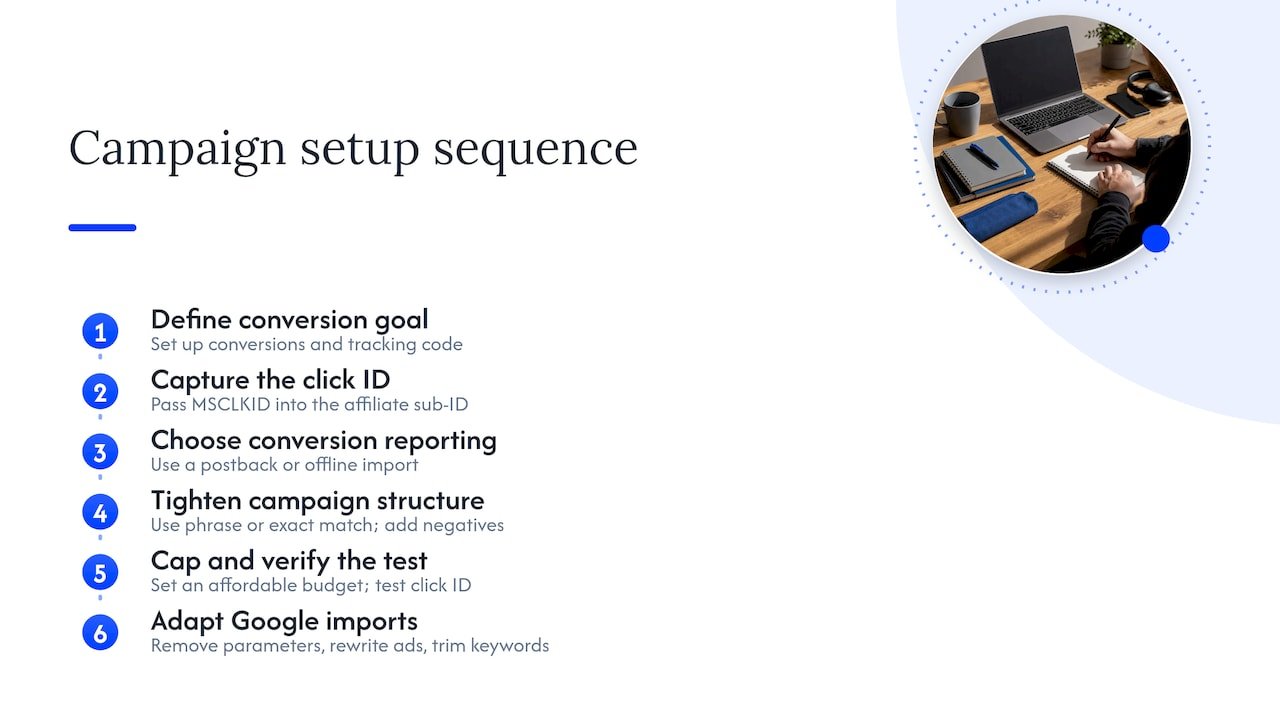
Start with the goal, not the ad. Microsoft describes a conversion as a meaningful action such as a purchase, lead-form submission or phone call, and says you should set up conversions in your account and install tracking code so it can measure which campaigns, keywords and ads drive results. Before you launch, decide what counts as a win for your page. For an affiliate, the real sale happens on the merchant’s site, which brings us to the tricky part.
Solve tracking before spending. You usually cannot place your UET tag on the merchant’s checkout, so you need another way to tell Microsoft which clicks led to commissions. The most reliable route is to capture the Microsoft click ID (called MSCLKID) on your page and pass it into the sub-ID field of your affiliate link. Your network can then report which click produced each sale. From there, the cleanest options are a server-to-server postback from the network or an offline conversion import that matches on the click ID. Counting an outbound click on your own page as a conversion is a last resort, because a click is not a commission. Our guide to cookieless affiliate link tracking walks through building this kind of setup step by step.
Keep the structure tight. Because Microsoft’s audience is smaller, a few closely related keywords per ad group is plenty. Start with phrase or exact match so you are not paying for loosely related searches, then review the search terms report and add negatives for the queries that waste money.
Cap the test. Set a daily budget you can afford to lose, since Microsoft lets you set one and you will not spend more than it. Run a small purchase yourself to confirm the click ID travels all the way into the network report. Finding a broken tracking link after a month of spend is a painful lesson.
Importing from Google? Microsoft’s import tool is a handy shortcut, but treat the imported campaign as a draft. Remove any Google-specific tracking parameters, rewrite ad copy with Microsoft’s audience in mind, and trim the keyword list, because lower search volume means a long list spreads your budget too thin.
What results to expect, and how to judge them
It helps to hold benchmarks loosely. Microsoft’s reporting guide gives reference points of about a $0.84 average cost per click, a 2% click-through rate and a 2% to 3% conversion rate, and says that if your conversion rate stays consistently lower, the landing page’s organization, relevance and usability are the first things to improve. Other industry roundups publish different averages, which is a good reminder that your niche, your offer and your audience matter more than any average.
What should you actually watch? Spend, conversions, cost per acquisition, return on ad spend and impression share make a solid top row. Click-through rate, cost per click and quality score are diagnostic: they tell you why something is happening rather than whether you are profitable.
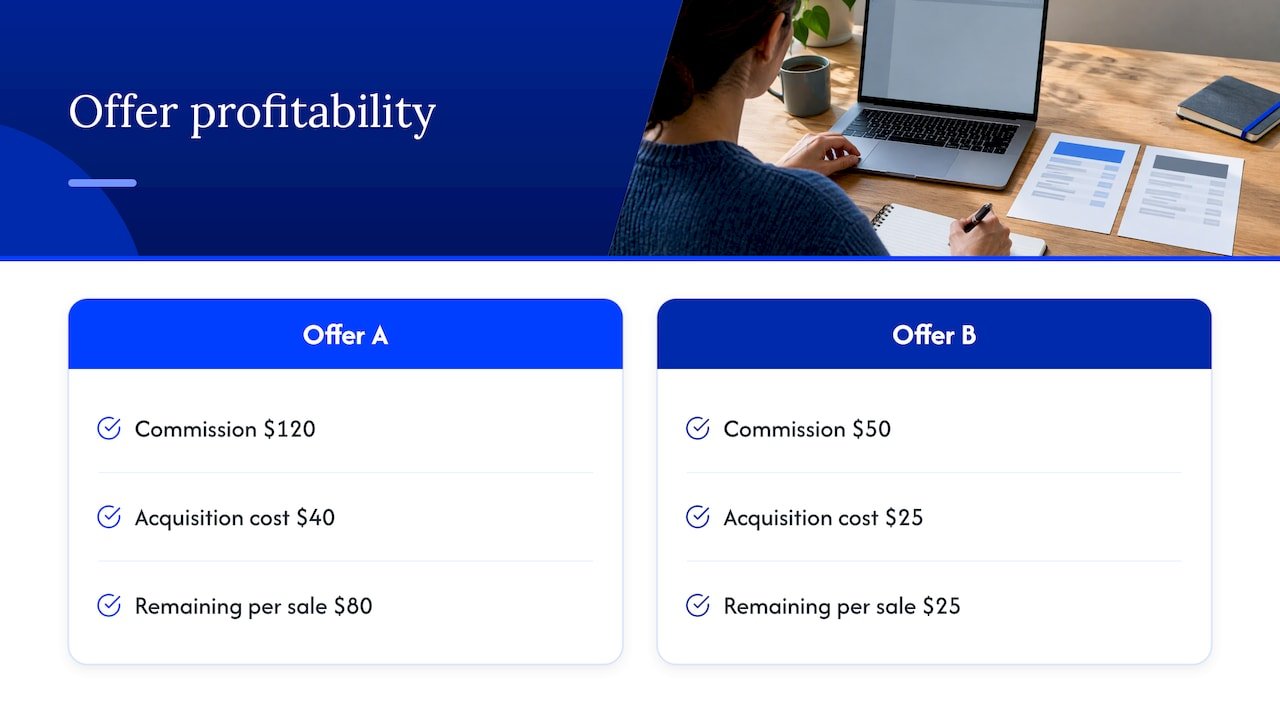
The number that matters most for you is commission-adjusted margin. A simple example makes it concrete. Say Offer A pays a $120 commission and you acquire sales at $40 each. You keep $80 per sale. Offer B pays $50 and you acquire sales at $25 each, so you keep $25. The cheaper cost per sale on Offer B looks better in the dashboard, yet Offer A is far more profitable. Always subtract your acquisition cost from the commission before you celebrate.
Timing matters too. Microsoft Learn notes that changes can take up to a couple of weeks to show, and recommends running performance reports every two to four weeks. Affiliate commissions often arrive with a delay, so give the test a few weeks and compare Microsoft’s reported conversions against your network’s dashboard before you make big decisions. If numbers do not match, the cause is usually tracking, not traffic.
When you are ready to dig deeper into the numbers, what AI marketing analytics means for your campaigns shows how to spot patterns faster without drowning in spreadsheets.
Who tends to do well on Microsoft Ads
Microsoft’s audience tends to skew toward desktop and workplace searching, so offers aimed at professionals, such as software, business services and productivity tools, are natural candidates to test. Impulse-driven, mobile-first offers may fit other platforms better. This is a pattern, not a promise, so let your own data decide.
When you negotiate with a program, your paid-traffic results are also a bargaining chip. A steady stream of profitable sales is exactly the kind of evidence we cover in our post on how to negotiate a higher affiliate commission.
How this compares with TikTok, native and YouTube ads
People searching this topic often ask about affiliate policies on other ad platforms, so here is the short version.
TikTok reviews every ad creative and landing page for compliance with its advertising policies and local laws, per its Ads Manager User Guide (March 2026). According to the Affiliate Times report above, its June 2026 update requires the ad’s domain to match the final destination and flags advertorial-style pre-landers at review. For creators who sell inside the app, TikTok Shop’s affiliate model works differently: creators tag products in videos and earn a seller-set commission on purchases they directly drive.
Native ad networks have their own landing-page rules, and our native ads affiliate marketing starter guide covers what to expect. YouTube is a video-first channel, and our YouTube affiliate marketing beginner’s guide explains how to approach it. The common thread across every platform is the same: useful pages, honest disclosure and a destination that matches the ad.
Our approach to paid search as an affiliate
We built Willbuckley around one idea: affiliates do better when they spend less time on busywork and more time on decisions. Paid search is a good example. The hard part is rarely creating an ad. It is setting up tracking you trust, knowing which numbers to believe, and not panicking in week one.
That is where we like to bring a teacher’s patience. Start small, write down what you expect to happen, run the test long enough to learn something, and let the commission math, not the click count, tell you whether to continue. If a campaign fails, you still walk away with cleaner tracking and a better page.
AI helps with the repetitive parts, such as drafting ad variations, sorting search terms and summarizing reports, so you keep your energy for judgment. Used that way, Microsoft Ads can be a calm, measurable place to learn paid traffic without the pressure of a crowded auction.
Will
Put AI to work on your campaigns
If you want to save time on the repetitive side of paid search, our AI affiliate workflows give you ready-to-run recipes for drafting, organizing and reviewing your marketing tasks. You can also explore the full library of coaching, tips and video tutorials at willbuckley.com.

Pick one recipe, apply it to your first Microsoft Ads test, and see how much time you get back.
FAQ
Does Microsoft Ads allow affiliate marketing?
Yes, affiliates can advertise on Microsoft Ads when their ads, landing pages and tracking comply with Microsoft’s policies. You are responsible for your keywords, destinations and the products you promote, and each destination needs a prominent privacy-policy link, per the Microsoft Advertising Agreement. Check the current editorial policies in your account for your category.
Is Microsoft Ads the same as Bing Ads?
Yes. Bing Ads was renamed Microsoft Advertising, and people still use both names. The platform places your ads on Bing search results and partner sites, and uses the same pay-per-click auction described in Microsoft’s documentation.
Can I send Microsoft Ads traffic straight to an affiliate link?
It can be possible when the content complies with policy, the ad URL matches the landing page and your program’s agreement permits it. Read your affiliate terms first, and consider starting with your own helpful page so you control the experience and the tracking.
How long should I run a test before judging it?
Give it at least a few weeks. Microsoft notes that changes can take up to a couple of weeks to show in results, and affiliate commissions often post with a delay. Judge the campaign on commission-adjusted margin, not on clicks alone.
Sources
- Learn how Microsoft Advertising works
- Microsoft Advertising Agreement, July 2025
- Direct Linking to an affiliate webpage, Microsoft Q&A
- Guide to Retailer Affiliate Agreements, PMA 2023
- TikTok Ads’ New Affiliate Policy, Affiliate Times
- Frequently Asked Questions for new Microsoft Advertisers
- What the numbers mean in performance reports, Microsoft Learn
- How do I improve my ad campaign performance? Microsoft Learn
- TikTok Ads Manager User Guide, March 2026
- TikTok Shop Partner Center affiliate overview