

SGE changes how the top of the search results page gets built, and the right response is to keep the fundamentals that already work while adding short, extractable, well-sourced passages that AI systems can pull from with confidence. If you take one action today, make it this: check indexability in Search Console, add tight factual passages to your best pages, and give yourself a measurement window before you judge the results.
TL;DR:
- Pages must be crawlable and indexed before AI systems can retrieve or cite them, so verify rendering, robots.txt, and canonicals in Search Console.
- Add a standalone 40 to 80 word answer beneath a relevant heading on priority pages, using semantic HTML and text equivalents for media.
- Prioritize proprietary data, real expertise, and practical walkthroughs; consolidate thin near duplicate pages, while avoiding unsupported tactics such as llms.txt or guaranteed placement claims.
- AI Overviews can reduce clicks by close to half on affected queries, so raw traffic losses do not necessarily mean rankings or content have failed.
- Test one change at a time across paired two to four week windows, comparing AI impressions, clicks, and qualified conversions before judging results.
Table of Contents
- What SGE Is and Why It Changes Search Visibility
- How SGE Works: The Technical Primitives Worth Understanding
- Practical Content Tactics to Adapt Your SEO Strategy for SGE
- Technical and Indexability Checklist for SGE Readiness
- Measurement, KPIs, and Experiment Templates for the SGE Era
- Risks, Myths, and Vendor Claims to Treat With Suspicion
- Practitioner Workflows and Quick Wins
- Author Perspective: Priorities for the Next Two Quarters
- A Practical Way to Put This Playbook Into Action
- FAQ
- Sources
- Primary Sources Worth Your Own Review
What SGE Is and Why It Changes Search Visibility
Google’s Search Generative Experience, now largely rolled out as AI Overviews and AI Mode, inserts a generated summary above the traditional blue links. Instead of ten results and some featured snippets, you get a synthesized answer pulled from multiple sources, with citations tucked below or beside it. That’s a structural shift, not a cosmetic one. The old SERP rewarded a single page that ranked well. The new one rewards a page that can be lifted, quoted, and cited alongside several competitors in the same answer.
We’ve watched this shift show up most on longer, question-style searches, the kind someone types when they want a real explanation rather than a single fact. That pattern tracks with reporting on how AI Overviews have expanded to more queries, with a strong tilt toward longer, conversational phrasing.
For SEO professionals, this matters because click behavior has changed. A user who gets a satisfying summary may never scroll to the links. That doesn’t mean organic traffic becomes worthless, but it does mean your content has two jobs now: rank well enough to be considered, and be structured well enough to get cited when it is.
A few shifts worth tracking as you plan your strategy:
- AI Overviews appear disproportionately on informational and question-based queries rather than transactional ones.
- Citations below the summary still drive some clicks, often from users who want to verify or go deeper.
- Pages built around clear, standalone facts are more likely to get pulled into the generated answer than pages that bury their point in narrative.
- Authoritative, specific content, the kind with real numbers, named methods, or direct answers, becomes more valuable as grounding material, not less.
None of this replaces classic SEO. It adds a layer on top of it: write for people, structure for machines.
How SGE Works: The Technical Primitives Worth Understanding
You don’t need to be a machine learning engineer to optimize for SGE, but a basic mental model helps you make better decisions than guesswork or vendor hype.
Generative AI features on Google Search rely on retrieval-augmented generation, commonly called RAG. Instead of the model inventing an answer from memory, it retrieves relevant web pages at query time and grounds its response in that retrieved content. This is why indexing still matters enormously: a page that isn’t crawled and indexed cannot be retrieved, and a page that can’t be retrieved cannot be cited.
Related to retrieval is query fan-out. Rather than running a single search, the system can break a user’s question into several related sub-queries, fetch supporting pages for each, and then synthesize them into one answer. A single search for “best budget laptops for video editing” might trigger fetches for separate sub-questions about specs, price ranges, and brand reliability. That’s part of why niche, specific pages sometimes outperform broad ones: they answer one sub-query cleanly.
Indexing eligibility is the gate before any of this happens. Google’s own guidance is direct about this: foundational SEO best practices still apply to generative features, with an emphasis on helpful, reliable, people-first content rather than any new trick.
What determines whether a page becomes machine-readable and extractable comes down to a short list:
- Clean, semantic HTML with headings that match the content below them.
- Facts and definitions stated in self-contained sentences that don’t depend on three paragraphs of setup to make sense.
- No reliance on JavaScript rendering that blocks crawlers from seeing the actual text.
- Proper canonicalization so the system isn’t confused about which version of a page is authoritative.
Grounding rewards clarity. A page that states its point plainly, high up, in plain HTML, is simply easier for a retrieval system to use than one that wraps its answer in branding copy before getting to the point.
Practical Content Tactics to Adapt Your SEO Strategy for SGE
This is where strategy turns into edits you can actually make this week.
Start with extractable passages. These are compact, 40 to 80 word blocks that answer one specific question completely, without needing the rest of the page for context. Think of them as mini answers planted at the top of a section, right after the heading, before you get into nuance or examples. A passage like “A canonical tag tells search engines which version of a duplicate page should be indexed, preventing split ranking signals across near-identical URLs” works as a standalone unit. A paragraph that starts with “Now, as we discussed earlier…” does not.
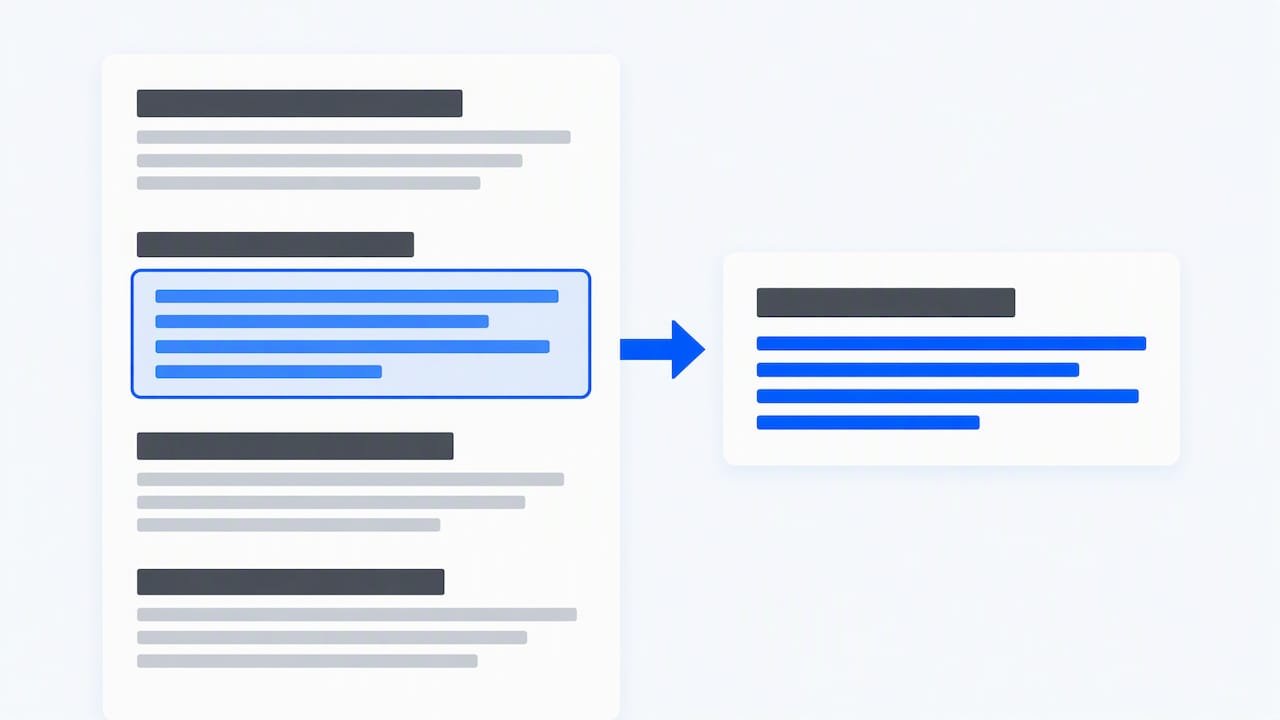
Google’s guidance supports this directly: models prefer clearly structured, factual passages that can be parsed in isolation, placed high on the page in semantic HTML, covering definitions, step lists, comparisons, or specific metrics.
Here’s a practical sequence for applying this across a content library; for detailed, actionable tactics, see how to optimize content for AI search.
- Pull your top 20 pages by organic impressions and sort them by topic type.
- For each page, identify the one question it answers best and write a 40 to 80 word passage that answers it completely on its own.
- Place that passage directly under the relevant heading, ahead of supporting detail.
- Check that the surrounding HTML uses real heading tags, not styled paragraph text.
- Add a caption or short transcript to any image, video, or chart so the information isn’t locked inside media alone.
Pro Tip: Write your extractable passage like you’re answering a text message from a smart friend who needs the fact now, not the backstory.
Beyond passage-level edits, prioritize the content types that hold up under this new pressure. Unique expertise, proprietary data, and step-by-step walkthroughs from real use cases carry weight that generic “what is X” pages don’t. If your site has ten thin variations of the same comparison page targeting slightly different keyword phrasings, consolidate them. Scaled, near-duplicate content doesn’t just waste crawl budget, it risks classification as spam under Google’s own quality guidance, and it gives an AI system no clear reason to prefer your version over a competitor’s.
Structural housekeeping matters here too. Use headings that describe what’s actually in the section below them. Keep semantic HTML consistent, so a heading tag is a heading tag, not a bolded paragraph pretending to be one. Give every image a real caption, and every video a transcript, since text equivalents are what retrieval systems can actually use. If you’re running keyword research to find new angles worth covering, a structured workflow like the one in our AI keyword research guide helps you spot the specific sub-questions worth answering rather than guessing at broad terms.
Technical and Indexability Checklist for SGE Readiness
None of the content work above matters if the page underneath it isn’t crawlable, indexed, and clean. Run this checklist as part of any SGE-focused audit.
Start in Search Console. Confirm the property is verified, then review the Generative AI performance report, which Google folds into standard Search Console performance reporting rather than a separate tool. This report is the closest thing you have to real visibility into how your pages perform inside AI features, and it’s the one data source that doesn’t require trusting a third-party vendor’s claims.
One figure worth sitting with: research shows AI Overviews can reduce website clicks by close to half on affected queries, which means your traffic baseline may shift even when rankings hold steady. That’s a measurement problem, not necessarily a content failure.
From there, work through the standard crawlability checks that still decide whether any of this is possible:
- Confirm robots.txt isn’t blocking resources the page needs to render correctly.
- Check that your CDN isn’t serving cached, outdated, or geo-restricted versions to Googlebot.
- Verify JavaScript-rendered content actually appears in the rendered HTML Google sees, not just in the browser.
- Audit canonical tags for consistency, especially on pages with URL parameters or tracking strings.
On snippet controls: Google offers nosnippet and related meta tags for site owners who want to opt specific content out of appearing in AI-generated summaries or regular snippets. Use noindex only when you genuinely don’t want a page discoverable at all, since it removes the page from both regular results and any AI grounding. These are judgment calls between visibility and control, not settings to apply automatically.
Structured data, including Article, Organization, and HowTo schema, remains supportive rather than required. It helps with standard rich results and gives search systems cleaner signals about page type, but it won’t force inclusion in an AI Overview on its own.
Measurement, KPIs, and Experiment Templates for the SGE Era
Raw click totals alone will mislead you now. A page can lose clicks while gaining better-qualified visitors, or hold steady on impressions while converting worse. Build measurement around a few specific signals.
- Pull the Generative AI performance view inside Search Console’s standard performance report and compare impressions, clicks, and average position for pages that show AI feature appearances against those that don’t.
- Track AI-source impressions separately from your overall impression count, since a page can be cited inside a summary without registering a traditional click.
- Watch intent-qualified conversions rather than raw conversion rate. A smaller number of highly motivated clicks from an AI citation can outperform a larger number of casual visits.
- Monitor dwell time and long-session rate as a proxy for whether the traffic you do get is actually engaged, not just passing through.
For experiments, run paired windows: measure a page’s baseline for two to four weeks, insert an extractable passage or structural edit, then measure another two to four weeks before drawing conclusions. Keep the change isolated. If you edit five pages at once with different tactics, you won’t know which one moved the needle. Attribution here is inherently noisier than classic rank tracking, since AI Overview appearance can vary by session, location, and query phrasing even for the same core search.
Risks, Myths, and Vendor Claims to Treat With Suspicion
A lot of noise has filled the gap left by uncertainty about how SGE actually ranks and cites content. Some of it is harmless confusion. Some of it is paid advice built on nothing.
Google has been explicit that gimmicks like adding an llms.txt file or artificially “chunking” content into fragments don’t help and aren’t part of how these systems evaluate pages. The official guidance on generative AI features points back to the same foundational SEO practices that have mattered for years: helpful content, real expertise, and technical cleanliness.
Be skeptical of any tool or consultant promising guaranteed AI Overview placement. Google’s own guidance on third-party SEO advice notes that outside tools don’t have access to internal ranking or AI systems, so any claim of precise control over SGE citation should be checked against official documentation before you believe it, let alone pay for it.
A few practical guardrails:
- Treat any “guaranteed SGE ranking” pitch as a red flag, since no external party has that level of access.
- Avoid restructuring content purely to game a perceived AI preference rather than to serve a reader’s actual question.
- Reserve
noindexor aggressive snippet blocking for genuinely sensitive content, since both reduce your chance of being cited at all.
Pro Tip: If a vendor can’t point you to Google’s own documentation to support a claim, treat the claim as marketing, not method.
Practitioner Workflows and Quick Wins
Here’s a workflow we run in two to four week cycles, built for teams without unlimited audit time.
- Identify your 15 to 20 highest-value pages by organic impressions or affiliate revenue contribution.
- Add one extractable passage per page, placed under the most relevant heading, and verify indexability for each in Search Console.
- Run a two to four week measurement window before making a second round of edits.
- Compare AI-source impressions against click-through to spot whether visibility is translating into qualified visits.
- Iterate on the pages that show impression growth without click growth, since that gap usually means the passage is being cited but not compelling enough to earn a click.
For cleaning up transcripts or drafting passage candidates quickly, a structured audit process like the one in our AI SEO audit workflow speeds up the repetitive parts without skipping the verification step.
Pro Tip: Watch AI impressions and click conversions separately for at least one full cycle before deciding a passage “isn’t working.”
Author Perspective: Priorities for the Next Two Quarters
If you’re planning Q1 and Q2 work, order it this way: audit first, extractable content second, measurement third. Skipping the audit means you’re editing pages that were never going to be indexed cleanly in the first place.
Small teams should phase this by value, not by volume: fix your ten best pages properly before touching your next fifty. Larger teams can parallelize, but should still enforce the same two to four week measurement discipline per batch, or you’ll lose the ability to tell which edit caused which change.
SGE keeps shifting shape. We’d rather you move deliberately and measure honestly than chase every new rumor about what’s “working now.”
— Will
A Practical Way to Put This Playbook Into Action
We provide coaching and playbooks for affiliate marketers and solopreneurs who need to apply changes like these without hiring a full SEO team. The focus stays practical: specific edits, specific measurement windows, and workflows you can run yourself between other work.

If you’re ready to put a structured plan behind your content instead of reacting to every algorithm headline, these resources are a good next step:
- Our affiliate marketing case study walks through real numbers from campaigns built around exactly this kind of audit and measurement cycle.
- Our AI content strategy rollout lays out a 90-day plan for teams who want the full sequence rather than piecing it together.
- Our prompt engineering workflows cut the drafting time needed to produce extractable passages at scale.
Start with the affiliate marketing case study if you want to see what a measurement-driven approach actually looks like before committing to the full plan.
FAQ
What are the top 5 SEO strategies for the SGE era?
Prioritize people-first content with clear expertise, add extractable factual passages near the top of key sections, keep technical crawlability clean, consolidate duplicate or thin pages, and measure through Search Console’s generative AI performance data rather than click counts alone. Each of these reflects guidance from Google’s own documentation on generative AI features rather than speculative tactics.
What is the 80/20 rule in SEO?
The 80/20 rule in SEO generally refers to focusing the bulk of your effort on the small share of pages or keywords that drive most of your traffic or revenue, rather than spreading effort evenly across your whole site. Definitions vary across practitioners, but the core idea, concentrate audits and edits on your highest-value pages first, lines up with the phased workflow approach covered above.
Is SEO dead now with AI?
No. Google’s guidance is explicit that foundational SEO best practices still apply to generative AI features, and indexing remains a prerequisite for any page to be retrieved or cited. What’s changed is the format of the result, not the underlying need to be crawlable, relevant, and trustworthy.
Is SEO still worth it in 2026?
Yes, though the return now depends more on qualified visits than raw click volume. Research indicates AI Overviews can reduce clicks by close to half on affected queries, but pages that earn citations still capture visitors who are further along and more likely to convert.
Sources
- Google Search Central — Optimizing for generative AI features on Google Search
- Research shows Google AI overviews reduce website clicks by almost half — Ars Technica
Primary Sources Worth Your Own Review
For deeper review beyond this playbook, start with Google’s own documentation on generative AI features and third-party tool guidance, independent reporting on AI Overview click impact, and practitioner analysis of SGE traffic effects. These sources back the specific claims made throughout this article.