

Pick your attribution approach by matching each partner type to its role in the funnel. Discovery partners (creators, content sites) need first-click or position-based credit, closers (coupon and loyalty sites) need last-click or time decay, and data-driven models stay reserved for programs with enough conversion volume to make the math reliable. Start by mapping every partner to a funnel role this week.
TL;DR:
- A seven day lookback misses early touches in a 30 day sales cycle, making multi touch attribution resemble last click.
- Freeze baseline reporting for days 1 to 7, run parallel reports through day 30 without payout changes, and flag shifts above 20% before rollout.
- Ask your top 10 revenue partners how they understand their roles, explain payout effects before switching, and set a clear process for disputed credit.
- Linear attribution divides credit evenly, including low impact touches; position based weighting favors first and last touches but can rely on arbitrary shares.
Table of Contents
- What each affiliate attribution model actually credits
- Comparing the models side by side
- How to choose and segment attribution models for your program
- Lookback windows, tracking timing, and privacy limits
- When to pilot data-driven and causal attribution
- Copyable checklist and partner communication templates
- Integration of AI in affiliate attribution models
- AI-driven models versus traditional attribution models
- What AI-enhanced attribution changes in practice
- Why partner-role segmentation beats chasing the “perfect” model
- Where Will’s coaching fits into attribution decisions
- Get hands-on help implementing your attribution pilot
- FAQ
- Sources
What each affiliate attribution model actually credits
Every attribution model answers the same question differently: when a sale happens after five touchpoints, who gets paid? Here’s what each one does with that question, and what it quietly tells your partners about their worth to your program.
Last-click gives 100% of the credit to the final touchpoint before conversion. A shopper clicks a coupon link right before checkout, and that coupon site gets the whole commission, even if a creator’s review sparked the purchase three days earlier.
First-click flips that entirely: whoever earns the first touchpoint gets full credit. A YouTube review that introduces a product gets paid even if the customer bought two weeks later through a different link.
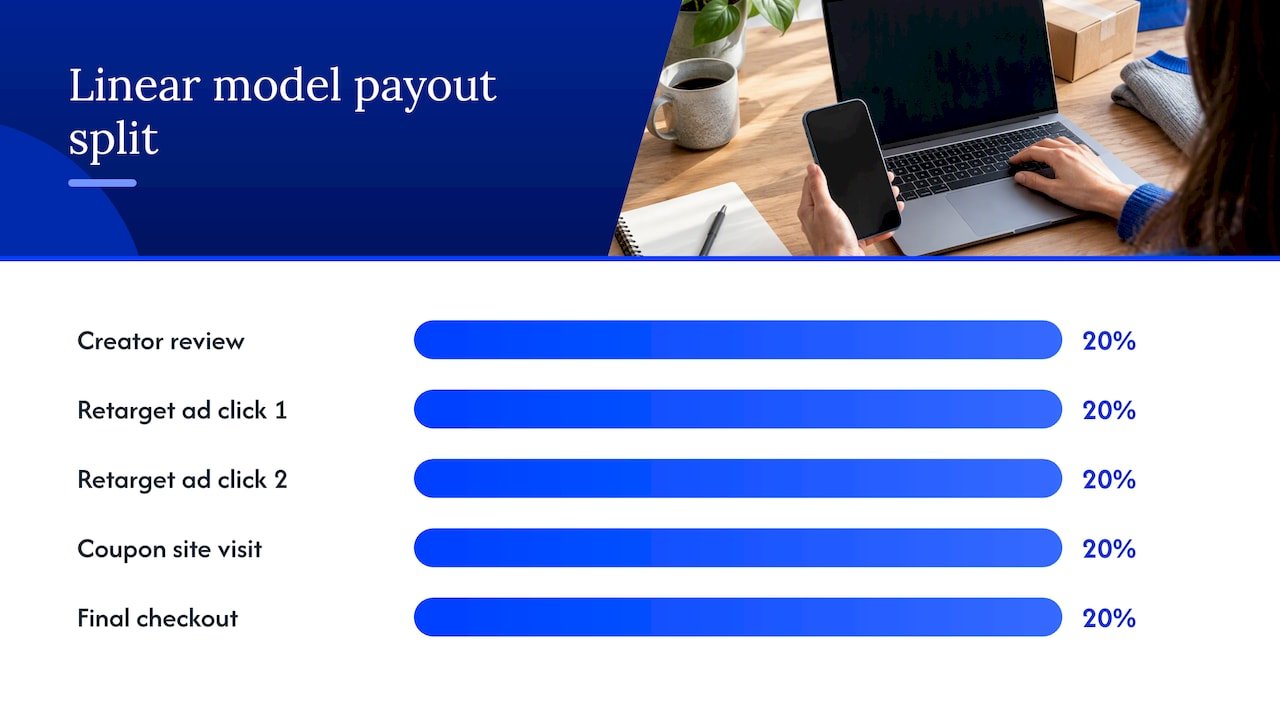
Linear splits credit evenly across every touchpoint in the path.
This rewards the partner who found the customer and the one who closed the sale, while still acknowledging the middle of the journey.
Time decay gives more credit to touchpoints closer to conversion, with influence fading the further back in time a click occurred. It’s a middle ground between last-click’s bluntness and linear’s blind fairness.
Algorithmic (data-driven) uses statistical modeling to assign credit based on actual incremental contribution, learned from your own conversion patterns rather than a fixed rule.
A few variants matter for affiliate-specific programs:
- Paid-only models exclude organic or direct touches entirely, crediting only tracked affiliate clicks.
- Participation models credit any partner who touched the path at all, often used for engagement bonuses rather than core commission.
- Engagement-weighted models adjust credit based on the partner’s historical conversion quality, not just click position.
For creators and publishers who build awareness, first-click or position-based models validate their contribution. For coupon and deal sites, last-click or time decay reflects their actual role: capturing intent that already exists. Network-level partners often sit somewhere in between, depending on whether they drive discovery or closing.
Comparing the models side by side
Each model trades off simplicity against fairness against data requirements. The right choice depends less on which model is “best” and more on which partner type you’re trying to measure honestly.
- Last-click: credit logic is 100% to final touch; best for coupon, loyalty, and cashback partners; primary risk is systematically underpaying the partners who created demand earlier in the funnel.
- First-click: credit logic is 100% to initial touch; best for content creators and awareness-stage influencers; primary risk is overpaying discovery while ignoring the partner who actually closed the sale.
- Linear: credit logic splits evenly across all touches; best for simple funnels with few partners per path; primary risk is treating a minor touch the same as a decisive one.
- Position-based: credit logic weights first and last touch heavily, middle touches lightly; best for programs with mixed discovery and closing partners; primary risk is arbitrary weighting that doesn’t match actual influence.
- Time decay: credit logic favors touches closer to conversion; best for longer sales cycles with repeated touchpoints; primary risk is still undervaluing early discovery in long-cycle purchases.
- Algorithmic: credit logic is statistically derived from historical data; best for high-volume programs with complex, multi-partner paths; primary risk is requiring conversion volume and transparency most mid-size programs don’t have yet.
Picture a program with a five-touch path: a creator review, two retargeting ad clicks, a coupon site visit, and a final direct checkout. Under last-click, the coupon site takes the entire commission. Under linear, every touch, including the ad clicks that likely added little incremental value, gets an equal fifth.
Switching models doesn’t just change a report. It changes who gets paid, by how much, and that shift ripples through partner relationships fast. A creator-heavy program moving from last-click to position-based can see creator payouts jump while coupon-site payouts drop, which is exactly the kind of change that needs a heads-up before it hits anyone’s statement.
How to choose and segment attribution models for your program
Start by mapping your actual partner mix against your actual sales cycle, not against whatever model your platform defaults to. Programs with short sales cycles for lower-priced items behave differently from those with long consideration phases for high-value services, and the models that fit each are rarely the same.
- Map partner roles. List every active partner type (creators, coupon sites, loyalty programs, networks, comparison sites) and tag each with its primary funnel function: discovery, consideration, or close.
- Quantify your sales cycle. Pull average days-to-conversion and touchpoint count per path. A 1-day cycle with one touch doesn’t need time decay; a 30-day cycle with five touches does.
- Draft segmentation rules. Assign position-based or first-click credit to discovery partners, last-click or time decay to closing partners, and document why each assignment makes sense for that partner type.
- Ask partners what they expect. Before switching anything, ask your top 10 partners by revenue how they currently understand their own role, and whether a model change would materially change their payout.
- Run parallel reporting. Report under both the old and new model for a defined window before cutting over live payouts, so you can see the delta before it hits anyone’s check.
- Set an arbitration process. Decide in advance how disputes over credit allocation get resolved, including who has final say when two partners both claim a touchpoint.
Industry guidance consistently points the same direction here: match models to partner roles and sales-cycle length rather than forcing every partner into one measurement framework. Programs that segment by partner type tend to avoid the most common complaint in affiliate attribution: top-of-funnel partners feeling systematically underpaid relative to their actual contribution.
Pro Tip: *Run your segmentation rules past your highest-volume partner before launch.
Lookback windows, tracking timing, and privacy limits
Your lookback window decides how far back a touchpoint can reach and still claim credit. A 7-day window on a 30-day sales cycle will systematically miss the early touches that actually started the journey, which quietly turns any multi-touch model you’ve chosen back into something close to last-click by default.
Click-time versus conversion-time attribution changes something more practical: when a sale gets recorded and paid. Click-time attribution assigns credit based on when the referring click happened, which can create a lag between a sale and its payout appearing in reports. Conversion-time attribution ties credit to when the sale itself completes, which lines up more naturally with your accounting periods but can obscure which campaign or season actually drove the click.
Privacy-safe measurement has reshaped what’s even possible to track. The W3C’s Private Attribution API and the IAB Tech Lab’s ADMAP specification both describe aggregated, differentially private attribution that works without exposing individual user identifiers, using matching services, noise injection, and data clean room patterns instead of third-party cookies.
Several hundred monthly conversions is the practical floor many platforms cite before algorithmic attribution becomes statistically meaningful, with Google Ads noting that data-driven attribution needs enough volume to distinguish real patterns from noise. Below that threshold, the model is guessing with extra steps.
What to watch after any tracking change:
- Sudden drops in credited conversions that likely reflect lost touchpoints, not lost sales.
- Partner complaints clustering around one segment, which often signals a lookback window that’s too short for that partner’s typical cycle.
- Reporting gaps between click-time and conversion-time totals that widen instead of staying stable.
For a practical build, our cookieless affiliate link tracking guide walks through a setup publishers can have running within an hour, and partners handling offline or phone-based conversions often need call tracking and attribution tools layered on top of standard click tracking to avoid losing credit for calls that never touch a web link.
When to pilot data-driven and causal attribution
Algorithmic attribution earns its keep only once you have the data to feed it. Google’s own guidance on data-driven attribution points to a practical range: programs typically need somewhere between several hundred and several thousand monthly conversions before the model has enough signal to outperform a fixed rule. Four hundred conversions a month is a reasonable floor to start testing; several thousand gives you a model worth trusting for payout decisions.
One of the more credible paths to get there combines experiments with machine learning rather than relying on either alone. The Predicted Incrementality by Experimentation (PIE) approach uses randomized controlled trial samples to train a model that predicts incremental lift across campaigns the RCT never directly touched, which scales causal measurement beyond what you could test manually. Amazon’s multi-touch attribution work follows a similar hybrid logic, calibrating model-based credit against holdout experiments to keep predictions grounded in actual causal effect rather than correlation alone.
Attribution is fundamentally a causal question: which touchpoint actually caused the conversion, not just which one happened to be present.
Causal-driven attribution (CDA) offers a privacy-friendly variant worth watching. It operates on aggregated impression-level data rather than individual user trails, which fits naturally with the privacy-safe architectures ADMAP and the Private Attribution API are built around.
Before piloting any of this:
- Confirm you clear the conversion volume floor for at least two consecutive months.
- Reserve a holdout group or RCT sample if your platform supports it, so you have a causal benchmark to calibrate against.
- Write a one-page transparency note for partners explaining what inputs the model uses and what variance they should expect.
Copyable checklist and partner communication templates
Changing attribution models without a plan is how programs lose partner trust fast. Running a defined pilot window with parallel reporting protects both sides while you figure out if the new model actually works better.
- Days 1 to 7: freeze current model reporting as your baseline and document every partner’s current average payout.
- Days 8 to 30: run the new model in parallel, reporting both sets of numbers without changing actual payouts yet.
- Days 31 to 45: compare credit distribution deltas by partner segment and flag any partner whose payout would shift more than 20%.
- Days 46 to 60: cut over live payouts to the new model for segments that tested cleanly, and extend the pilot for segments still showing volatility.
Sample segmentation rules by program type: a creator-heavy program typically runs position-based for creators and last-click for everyone else; a coupon-heavy program often keeps last-click across the board but adds a small first-click bonus pool for partners who drove documented first touches; a network-heavy program tends to benefit from time decay applied uniformly, since network partners rarely occupy a single clear funnel role.
For partner emails, a line like “we’re piloting a new credit model for 30 days alongside our current one, and your payout won’t change until the pilot confirms it’s fair” does more to prevent disputes than any amount of technical explanation. Dispute clauses should specify who adjudicates contested credit and within what timeframe.
Pro Tip: Track three numbers during any pilot: the credit distribution delta per partner, partner churn in the segment you’re changing, and results from any incremental lift test you can run. If churn rises while lift stays flat, pause the rollout.
Our real affiliate marketing case study data includes sample datasets you can copy directly into this kind of pilot structure.
Integration of AI in affiliate attribution models
AI has moved from a reporting add-on to a working part of how attribution gets calculated. Instead of applying one fixed rule to every path, machine learning models can weigh dozens of path characteristics at once: time between touches, partner type, device, even content format, and adjust credit accordingly.
The practical gain is speed as much as accuracy. Where a manual review of attribution anomalies used to take days, AI-assisted monitoring can flag unusual credit shifts within hours, which matters most during a pilot window when you’re watching for partner complaints before they escalate. Pattern detection also catches things humans tend to miss, like a coupon partner whose share of credit climbs steadily over months even as their actual influence on new-customer acquisition stays flat.
None of this replaces the groundwork. AI models still need the same conversion volume floor as any data-driven approach, and they still need clean, well-tagged tracking data to learn from. What changes is how fast you can test a hypothesis once that foundation exists. Our AI affiliate workflows guide covers specific recipes for applying this kind of monitoring without building a data science team from scratch.
AI-driven models versus traditional attribution models
Traditional models apply the same rule to every conversion path, regardless of context. Last-click treats a five-touch enterprise sale the same way it treats a single-click impulse buy. That consistency is also the weakness: a fixed rule can’t adapt to the fact that different partner mixes and different sales cycles behave in genuinely different ways.
AI-driven models adjust credit based on patterns learned from your own historical conversions, which means two paths that look identical on the surface can receive different credit splits if the model has learned that one path type converts at a meaningfully different rate. That flexibility is valuable, but it comes with a cost traditional model don’t have: you need enough data for the model to learn from, and you need to be able to explain its decisions to partners who will ask why their payout changed.
Traditional models win on transparency. Anyone can look at a position-based rule and understand exactly why a payout landed where it did. AI-driven models require more trust, since the reasoning is statistical rather than explicit. The practical answer for most programs isn’t choosing one over the other outright. It’s using fixed, explainable rules for lower-volume partner segments and piloting algorithmic credit only where conversion volume supports it and where you’re prepared to document how the model works for partners who ask.
What AI-enhanced attribution changes in practice
The clearest pattern in programs that move toward AI-enhanced attribution isn’t a single dramatic shift. It’s a steady narrowing of the gap between what partners feel they contributed and what they actually get paid for.
Programs running a creator-heavy mix tend to see the biggest adjustment when they move from last-click toward a model, AI-assisted or rules-based, that credits earlier touchpoints. Creators who were previously getting paid only when a customer happened to click their link last start seeing payouts that reflect their actual role in starting the purchase journey, which tends to improve retention among exactly the partners a program most wants to keep.
The hybrid experiment-plus-ML approach used in PIE-style measurement and reflected in Amazon’s multi-touch attribution work shows a similar pattern: calibrating model predictions against randomized controlled trial outcomes consistently improves how closely credited attribution matches actual incremental lift, compared to relying on either experiments or modeling alone. That calibration step is also what makes the resulting credit splits defensible to partners who ask how the numbers were calculated.
The honest takeaway is that AI-enhanced attribution performs best as a refinement layer on top of sound segmentation, not a replacement for thinking through partner roles first. A program that skips straight to algorithmic credit without first understanding its partner mix tends to get a more sophisticated version of the same underpayment problem it started with.
Why partner-role segmentation beats chasing the “perfect” model
Most of the debate around attribution models treats this like a search for the one correct answer, as if there’s a single model sitting out there that fairly credits every partner in every program. There isn’t, and chasing that idea wastes time that’s better spent on segmentation.
The conventional wisdom says bigger programs should graduate to algorithmic attribution as soon as they can afford the data volume. We’d push back on the urgency behind that. A program with a clean, well-documented segmentation rule set, position-based for creators, last-click for closers, time decay where cycles run long, often produces fairer, more explainable outcomes than an early, undercooked algorithmic rollout that nobody on the partner side can interpret. The sophistication of the model matters less than whether its logic matches how your partners actually behave in the funnel.
What gets underestimated is how much a model change is really a trust transaction. Every time you shift credit logic, you’re asking partners to accept that the new math represents their contribution more fairly than the old math did, and that’s a harder sell than most programs plan for. Parallel reporting and clear partner communication aren’t bureaucratic overhead. They’re the difference between a model change that sticks and one that triggers a wave of partner churn right when you need stability most.
— Will
Where Will’s coaching fits into attribution decisions
Attribution work tends to stall for the same reason most data projects stall: the analysis takes longer than the decision deserves. Pairing an attribution pilot with AI-assisted monitoring tools shortens the review cycle from weeks to days, which matters most during a parallel-reporting window when partners are watching for payout changes.
A typical approach: run the 30 to 60 day pilot checklist outlined earlier, feed the parallel reports into an AI workflow that flags credit-distribution anomalies automatically, and use the real affiliate marketing case study data as a benchmark for what a healthy pilot curve looks like. Our AI workflows guide covers the specific recipes we walk coaching clients through for this kind of monitoring.
Get hands-on help implementing your attribution pilot
Reading about segmentation rules is one thing. Building the pilot, writing the partner emails, and watching the credit-distribution numbers without losing a week to spreadsheet wrangling is another. That’s where our templates and AI-enabled workflows come in.

A few resources that pair directly with what’s in this article:
- Our case study data pack gives you sample datasets to benchmark your own pilot numbers against instead of guessing whether a 15% payout swing is normal.
- Our AI affiliate workflows recipes cut the manual review time out of parallel reporting, so you can spot a problematic credit shift in hours instead of days.
Start with our YouTube automation affiliate marketing playbook for a guided path through setting up tracking and scaling workflows that support whatever attribution model you land on.
FAQ
What are examples of attribution models?
The canonical examples are last-click, first-click, linear, position-based (U-shaped), time decay, and algorithmic (data-driven) attribution. Each assigns credit for a conversion differently, from giving everything to one touchpoint to splitting it statistically across the whole path.
What are the three main types of affiliates?
Affiliate partners generally fall into three functional roles: discovery partners like content creators and reviewers who introduce products, consideration-stage partners like comparison and coupon sites, and closing partners who capture a sale right before checkout. Matching attribution logic to these roles is the core of fair payout design.
What are the different types of affiliate business models?
Affiliate business models vary by how partners earn, including pay-per-sale, pay-per-lead, and pay-per-click arrangements, plus structural variants like coupon and cashback sites, content and review sites, and network aggregators. The attribution model a program chooses often depends on which of these business models its partner mix leans toward.
How much conversion volume do I need for data-driven attribution?
Data-driven attribution generally needs several hundred to several thousand monthly conversions to be statistically reliable. Programs below that threshold typically get more consistent, explainable results from a segmented rules-based approach instead.
How does a lookback window affect attribution results?
A lookback window sets the maximum time between a click and a conversion that still counts for credit, so a window shorter than your actual sales cycle will miss real early touchpoints. Widening the window or layering in privacy-safe aggregated measurement, such as approaches described in ADMAP, helps capture a more complete path without relying on individual user tracking.
Sources
- Google Ads help — About data-driven attribution
- Impact
- Predicted Incrementality by Experimentation (PIE) for Ad Measurement
- W3C Working Draft — Privacy-preserving attribution
- ADMAP — Attribution Data Matching Protocol (IAB Tech Lab)