

If you run an affiliate site, you have probably felt a knot in your stomach when someone mentions Google’s AI answers. That is understandable. The short version: SGE, the Search Generative Experience, is the name Google used during testing, and the features now live in search are called AI Overviews and AI Mode. They hit broad review and “best of” content hardest, they do not require any special markup, and the sites that hold up are the ones that show real, first-hand use of what they recommend.
This guide walks through what is actually known, how to measure your own exposure, and what we would change first if we were in your seat.
TL;DR
- SGE became AI Overviews and AI Mode. Google says standard SEO best practices still apply and there are no extra requirements to appear in them.
- Review content and buyers’ guides take the biggest hit. One affiliate specialist reports traffic losses of up to 50% on that kind of page.
- Measure before you panic. Search Console now has dedicated Generative AI performance reports.
- Your best defense is depth: first-hand testing, original evidence and narrow topics beat generic top-10 lists.
- Do not mass-produce a page for every AI-style question. That invites a spam problem on top of a traffic problem.
Table of Contents
- SGE, AI Overviews and AI Mode: the naming mess, cleared up
- Why affiliate sites feel it first
- Measure first: find out what is really happening to your site
- What holds up: depth, experience and narrow focus
- The trap: a page for every AI question
- Protect your revenue, not just your rankings
- Trust signals still matter, and so does disclosure
- Our perspective: stop fighting the summary, become the source
- A 30-day plan you can start today
- Want help turning this into a system?
- FAQ
- Sources
SGE, AI Overviews and AI Mode: the naming mess, cleared up
When people search “SGE for affiliate sites,” they are usually asking one question: will Google’s AI answers eat my traffic and my commissions?
SGE was the experimental label. What reached everyday searchers is AI Overviews (a summary at the top of results) and AI Mode (a more conversational search experience). Google’s documentation on AI features and your website covers both under one roof, and it is the page we would bookmark. Its core message is reassuring in a plain way: the SEO basics you already know remain relevant, and there are no additional requirements or special optimizations needed to be included.
That means you can stop hunting for an “AI schema” or a secret file. Google’s own guide to optimizing for generative AI features asks whether SEO still matters for generative AI search, and answers with a firm yes. The work is crawlable pages, helpful content, accurate structured data and a good experience.
So why does it still feel so threatening? Because the thing that changed is not the rules for getting in. It is the number of searchers who get their answer without clicking.
Why affiliate sites feel it first
Affiliate sites live on a very specific kind of query: “best X,” “X vs Y,” “is X worth it.” Those are exactly the questions an AI summary is happy to answer in a few lines.
Press Gazette spoke with affiliate specialist Paul Cunliffe, who works with publishers on their affiliate channels. In its report, AI Overviews are reducing traffic to review content and buyers’ guides by up to 50%, and the headline figure is an affiliate revenue drop of 20 to 40% at some publishers. Notice the wording: “some publishers,” “up to.” This is one specialist’s view of the publishers he works with, not a law of nature, and your own numbers may be better or worse.
There is a second effect that rarely gets discussed. Fewer referrals do not just mean fewer sales today. They can also mean lower commission tiers and thinner performance data for the retailers and networks you work with, which makes your account less valuable to them over time. The same Press Gazette piece is the place to start if you want to see how publishers describe it. The practical lesson: protect the pages where your conversion data is strongest, because that data is your leverage later.
If you want to see how we think about negotiating from that position, our 90-day commission negotiation pilot lays out a copyable plan.
Measure first: find out what is really happening to your site
It is tempting to look at a dip in revenue and blame the AI. Sometimes that is right. Sometimes it is a seasonal slump, a lost ranking, or a broken link. Before you rebuild anything, get facts.
Google announced Search Generative AI performance reports in Search Console in June 2026, with dedicated reports for Search and Discover. They are designed to show how your site appears within generative AI features, including impressions and page-level performance. Google also states that its Search generative AI control was rolled out to all websites worldwide as of August 31, 2026, which lets you manage whether your site is included in those features.
Here is a simple way to use all this without drowning in data.
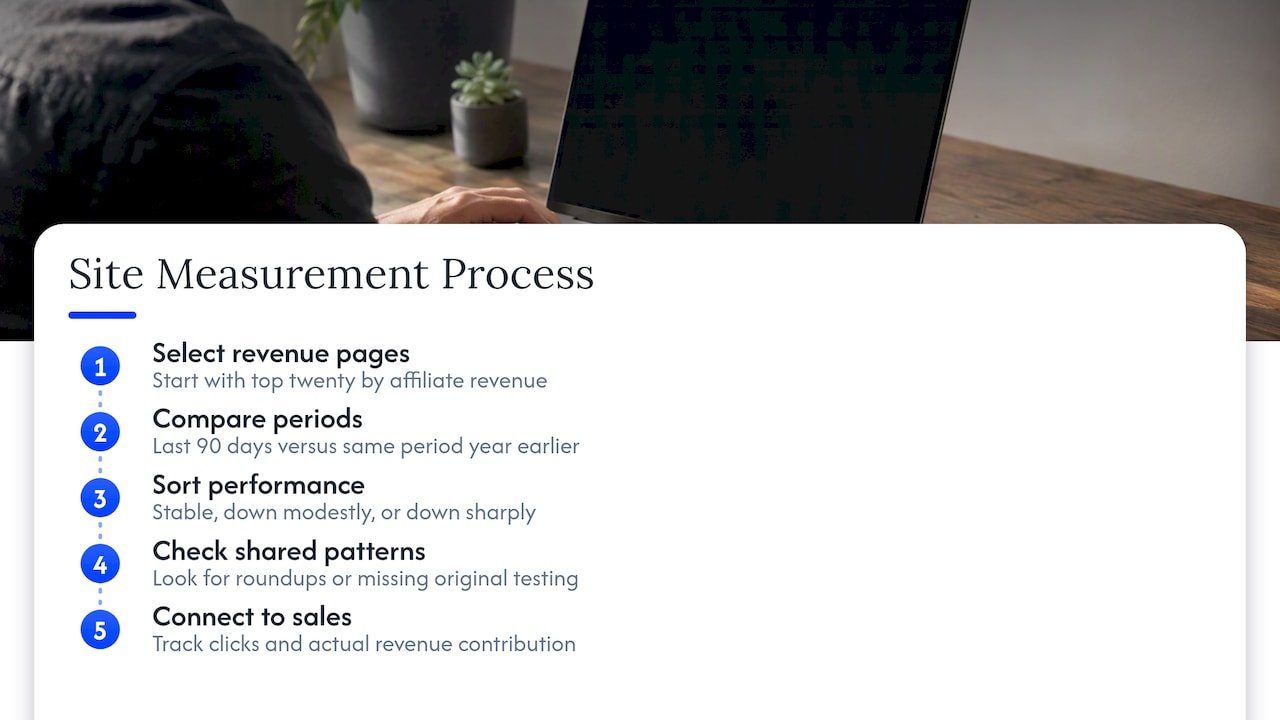
Start with your top twenty pages by affiliate revenue, not by traffic. Traffic is a vanity number if the visitors never buy. Then compare the last 90 days to the same 90 days a year earlier, page by page, and sort them into three buckets: stable, down modestly, down sharply. Most sites find the damage is concentrated in a handful of pages, usually the broad comparison posts.
Next, check the pages that fell for patterns. Are they all “best [category]” roundups? Are they all written without original photos or testing? If so, you have found your real problem, and it is more fixable than “AI is killing affiliate.”
Finally, tie it back to money. If you only track clicks, you will optimize for the wrong thing. Our guide to affiliate attribution models shows how to match each page’s role to what it actually contributes to sales.
What holds up: depth, experience and narrow focus
Here is the encouraging part. Practitioners keep noticing the same split. Broad, commodity-style lists suffer the most volatility, while content built on firsthand testing, detailed benchmarking and a distinct personal perspective stays more resilient. A 2025 German university thesis, analyzing the effect of AI on search results, examines how AI tools like Google’s AI Overviews affect search and whether SEO business models still have a future, and it is a good academic starting point if you want to go deeper.
Google’s own advice points the same direction. In its post on succeeding in AI search, the company says the fundamentals it has long advised carry across to these new experiences. Unique, helpful content is still the center of that.
What does “unique” look like for an affiliate? Think about what an AI summary cannot do. It cannot use the product for three weeks. It cannot photograph the broken zipper, time the setup, or tell you the support team answered in four minutes. It cannot say “I switched to this after the other one failed me.” That is the content a summary has to point to rather than replace.
Swap the top-10 list for a decision page
A generic “10 best project management tools” page is the easiest thing in the world for an AI to summarize. A page titled around one decision, such as which tool suits a two-person agency that bills hourly, is harder to summarize and more useful to a buyer. It also tends to convert better, because the reader arrives with a specific problem.
You do not need to abandon your big comparison pages. Instead, add what only you have: your test notes, your screenshots, your scoring method, your honest “who should skip this.” Our 7-part affiliate review template gives you a structure for exactly that.
Build the evidence before you write
The most common mistake we see with AI-assisted affiliate content is starting with the draft. Start with the evidence pack: your notes, screenshots, test results, pricing screenshots with dates, and a few honest quotes from your own use. Then let AI help you organize and polish. We explain the whole approach in why the evidence pack comes first.
If you do use AI to draft, keep a human editing pass. Our post on avoiding a Google AI content demotion walks through five steps to keep that pass honest.
Go deep on a topic, not wide on a category
Topical depth is the other lever. A site that covers one niche from every angle, from beginner questions to troubleshooting to long-term ownership, gives both readers and search systems a reason to trust it. If that is the direction you want to take, see our seven steps to topical authority for affiliate marketers.
One more note on planning: new AI-powered SEO platforms can help with keyword discovery, content planning and technical audits, and some also cover how your content shows up in AI search tools. This overview of AI content for SEO is useful reading if you are weighing how much of your planning to automate. Whatever you pick, keep your own testing at the center.
The trap: a page for every AI question
When traffic drops, the instinct is to publish more. Someone suggests creating a page for every long-tail question an AI answer might surface. We would not.
Google’s optimization guide cautions against content produced at scale mainly to capture search traffic. Churning out hundreds of thin pages can run into its scaled content abuse policies, which means you risk trading a traffic dip for a bigger problem. A better approach is fewer, richer pages that answer complex, multi-part questions where your first-hand experience actually matters.
The same guide has a quiet but important point on structured data. If you use Product schema or similar markup, it must be accurate and match what a visitor sees on the page. Mismatched prices, ratings that do not appear anywhere on the page, or review stars you cannot back up can cost you rich result eligibility. Check your markup against the visible page before you change anything else.
Protect your revenue, not just your rankings
Traffic is only half the equation. Even in a world with fewer clicks, you can raise what each visit is worth.
Choose programs for lifetime value
High upfront payouts are seductive, but experts at CB-Stats note that verticals with big payout structures, such as adult and finance, also tend to come with tougher customer acquisition. Favor programs with strong conversion quality and recurring or lifetime value. If a program pays well on paper but your readers rarely complete the purchase, it is costing you page space.
Respect the 80/20 pattern
In most affiliate portfolios, a small share of partners produces most of the money. Find yours. Then point your AI-assisted optimization, whether that is testing headlines, refreshing comparison tables or checking link placement, at the pages that feed those partners. Our AI link placement audit is a ten-page pilot that fits this approach well.
Run small revenue tests
Rather than overhauling your whole site, change a few pages and watch the outcome for two to four weeks. We describe how in AI SEO for affiliates needs a revenue test. It keeps you calm, because every decision comes from your own data instead of the latest scary headline.
Trust signals still matter, and so does disclosure
When readers are suspicious of generic content, trust becomes a competitive edge. Clear author information, honest pros and cons, and plain disclosures all help. In the United States, the FTC’s Guides Concerning Use of Endorsements and Testimonials in Advertising apply to affiliate relationships, so your disclosure should be clear and placed where readers will actually see it, not buried in a footer. If you publish for readers in other countries, check the rules there too, since they differ.
We cover practical wording and placement in our guide to EEAT for affiliate sites.
Our perspective: stop fighting the summary, become the source
We have coached a lot of people through changes in search, and the pattern is always the same. First comes fear, then a rush of tactics, then a quieter realization that the fundamentals were the answer all along.
Here is what we believe about AI search and affiliate sites. The summary is not your enemy, but it is a mirror. It reflects whatever is generic on the web back at the searcher, and it has very little to say about what is specific, lived and tested. If your pages are generic, you are competing with a machine that is faster than you. If your pages carry real experience, you are offering something the machine has to borrow.
So our advice is not to chase every new feature. Pick one niche you genuinely care about. Test the products. Write down what really happened, including the disappointing parts. Use AI to save hours on research, outlines, formatting and repurposing, never to replace the testing itself. And measure honestly, a few pages at a time.
It is also fine to feel rattled. Procrastination loves a crisis, and “I’ll wait and see what Google does” is the most comfortable form of it. Pick one page this week and improve it with real evidence. That small step is worth more than a month of worrying.
— Will
A 30-day plan you can start today
Week one is for measuring. Pull your top twenty revenue pages, compare periods, and check the Generative AI reports in Search Console. Write down which pages are stable and which dropped.
Week two is for choosing. Pick the three pages with the most revenue at risk. For each, list the first-hand material you already have and the material you still need to gather, such as fresh screenshots, test results or a short video.
Week three is for rebuilding. Add the evidence, a clear “who this is for and who should skip it,” an honest scoring method, and accurate structured data. If you need a faster drafting workflow, our prompt engineering workflows can cut draft time without cutting the human parts.
Week four is for reviewing. Compare clicks, conversions and revenue on those three pages against the pages you left alone. If the rebuilt pages hold up better, you have a repeatable method. If not, you have learned something cheaply.
Want help turning this into a system?
If you would rather not do this alone, we built our content around exactly this challenge: using AI to save time while keeping the human, tested perspective that search and readers reward. Start with our AI content strategy 90-day rollout for a full plan, or browse the rest of what we share at willbuckley.com, including tips, tutorials and our newsletter for affiliate marketers.
FAQ
Is SGE still a thing, or is it called something else now?
SGE was Google’s experimental name. The features you see in search today are AI Overviews and AI Mode, and Google documents them together on its AI features page. People still search for “SGE,” so the term lives on in conversation even though the product name has changed.
Do I need special schema or a special file to appear in AI Overviews?
No. Google says there are no additional requirements or special optimizations needed, and that standard SEO best practices still apply. What you should do is keep any structured data you already use accurate and consistent with what is visible on the page.
How much traffic will my affiliate site lose?
Nobody can tell you that without your data. One specialist quoted by Press Gazette described drops of up to 50% on review content and buyers’ guides, but results vary by niche and by page type. Use Search Console’s Generative AI reports and your own revenue numbers to see where you stand.
Should I publish a page for every question AI answers show?
We would not. Publishing large numbers of thin pages to catch long-tail queries can run afoul of Google’s scaled content abuse policies. Fewer, deeper pages that rely on first-hand experience are safer and tend to serve readers better.
What is the 80/20 rule in affiliate marketing?
It is the common pattern where roughly 80% of your revenue comes from a small fraction of your partners or pages. The useful move is to identify that top group and focus your testing and optimization there, rather than spreading effort evenly.
Sources
- AI features and your website, Google Search Central
- Google’s guide to optimizing for generative AI features on Google Search
- Top ways to ensure your content performs well in Google’s AI experiences
- Introducing Search Generative AI performance reports in Search Console
- Search generative AI control, Search Console Help
- Google AI Overviews leading to affiliate revenue drop at some publishers, Press Gazette
- Auswirkung von KI auf Suchmaschinenergebnisse, Hochschule Mittweida
- Use of Endorsements and Testimonials in Advertising, Federal Trade Commission