

Have you ever looked at your best-performing affiliate page and wondered how many buyers you are missing because they search in Spanish, German or Portuguese? AI has made it cheap to translate a whole site. But translation is not SEO. Multilingual SEO with AI works when you pair machine speed with three things the machine will not do for you: indexable URLs for every language, local keyword research, and a human who reads the result before it goes live.
This guide walks through that process in the order we would do it, with the mistakes we see most often.
TL;DR
- AI is a strong first-pass translator, but it does not understand search intent, so you still need keyword research in each target language.
- Every language needs its own crawlable URL, plus hreflang annotations, so Google can serve the right version to the right person.
- Translated sites have been shown to earn more citations in AI answers, in new languages and in the original one, as long as the pages are real and indexable.
- Layer your workflow: translate, check terminology, adapt tone, then have a human edit your money pages.
- Start with two or three pages in one language, measure, then scale.
Table of Contents
- Why translation alone does not rank
- What the data says about AI visibility and translation
- Step 1: Pick your first language and your first pages
- Step 2: Do keyword research in the target language
- Step 3: Translate with a layered workflow, not a single pass
- Step 4: Set up the technical layer
- Step 5: Fix internal links in every language
- Step 6: Localize more than the words
- Our perspective: speed is the gift, judgment is the job
- A simple workflow you can copy this month
- Where to go next
- FAQ
- Sources
Why translation alone does not rank
Most affiliate marketers figure out that they need translated pages. Fewer figure out that a translated page can still be invisible. If a plugin swaps the text in the visitor’s browser with JavaScript, your reader sees Spanish, but Google may only ever see English. There is no separate URL to crawl, so there is nothing to rank.
What you want instead is a setup that creates a real, server-rendered URL for each language, such as a subdirectory like /es/ or /de/. Google’s own documentation on localized versions of pages recommends consistent URL structures and clear signals so it can tell which page belongs to which audience. If you are choosing a structure today and have no strong reason otherwise, subdirectories are the simplest to manage because everything stays under one domain.
We covered the tool side in our guide to AI translation for websites. Here we will focus on the SEO layer sitting on top of it.
What the data says about AI visibility and translation
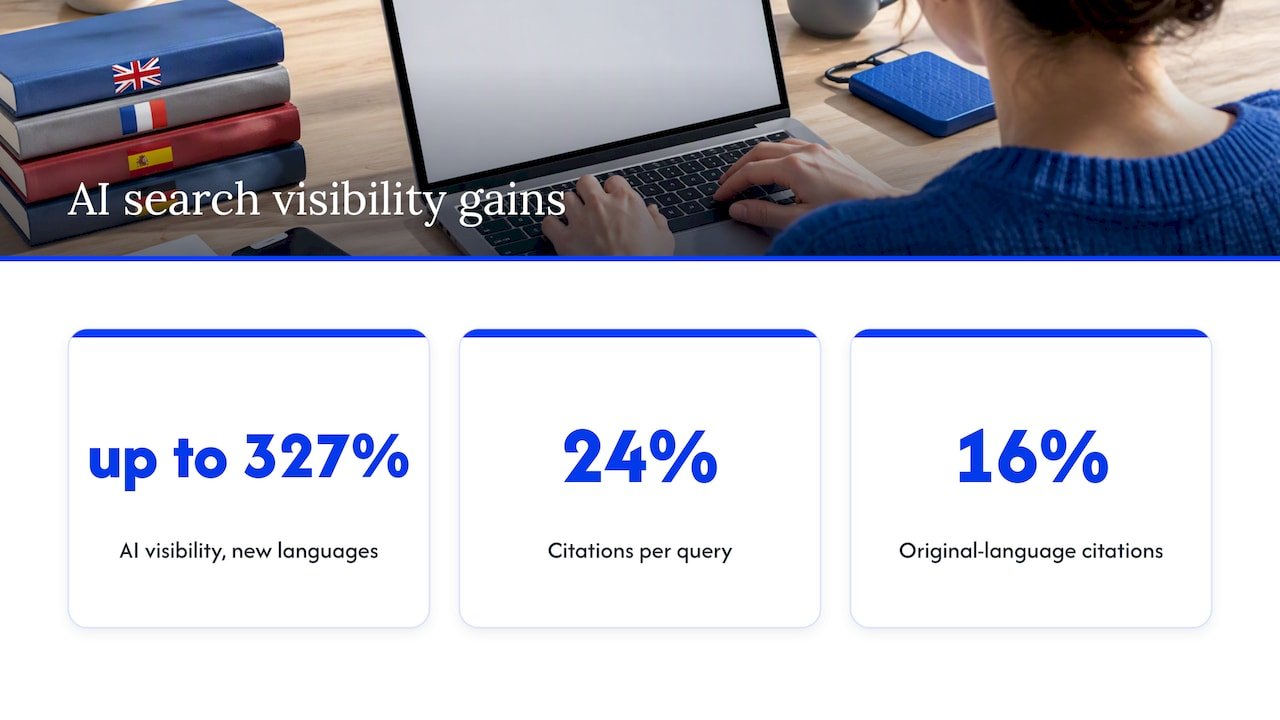
There is a real upside here, and it is bigger than classic search traffic. Research from Ellipsis and Weglot, which analyzed more than 1.3 million citations, found that translated websites gained up to 327% more visibility in AI-driven search for queries in languages the site did not previously support. The same research reported 24% more citations per query across all languages, and 16% more citations even for content in the original language.
Two cautions. First, the research was published by a translation vendor and a research firm, so treat the numbers as a strong signal rather than a guarantee for your niche. Second, those gains belong to sites that were translated properly. They do not promise that dumping raw machine output on your blog will do the same.
If you are interested in how AI answers pick their sources more generally, our GEO playbook for ranking in AI answers is the companion read. For a broader look at how search visibility now spans Google and AI assistants, this overview of multi-platform SEO and AI search visibility is also worth a skim.
Step 1: Pick your first language and your first pages
It is tempting to launch in ten languages because the tools allow it. Resist that. Pick one language, and pick it with data.
Look at your analytics for countries where you already get visitors who bounce quickly, and look at your affiliate programs. Do they ship to, or accept customers from, those countries? A translated review of a product your reader cannot buy is traffic that earns nothing. Check the program terms before you spend a single hour on translation.
Then choose two or three pages, not the whole site. Your best converting review and your most linked guide are good candidates. This keeps the experiment small enough to measure, which matters, because the revenue question is the one that decides whether you keep going. Our piece on AI SEO for affiliates and the 2 to 4 week revenue test shows how to set that up.
Step 2: Do keyword research in the target language
This is the step almost everyone skips, and it is where rankings are won or lost. SEO professional Veruska Anconitano has pointed out in Search Engine Land that AI tools and translation systems are efficient but rarely understand search intent or local keyword nuance. A literal translation of your English keyword is often not what people type.
Here is a simple example of the idea. A phrase you use in English might be searched with a completely different, shorter or more casual term in Mexico than in Spain. If you translate your title word for word, you may end up with a perfectly grammatical page that nobody searches for.
Use AI to help, but ask it the right question. Instead of “translate this keyword,” try asking it to list how a native speaker in a specific country would search for the same problem, then verify each suggestion in a keyword tool or by looking at what actually ranks on Google in that country. Our AI keyword research workflow walks through the verification part, and it works the same in any language.
Once you have a target phrase, write down the search intent in one sentence. Is this person comparing, looking for a how-to, or ready to buy? If the intent differs from your English page, adjust the structure of the translated page rather than mirroring it.
Step 3: Translate with a layered workflow, not a single pass
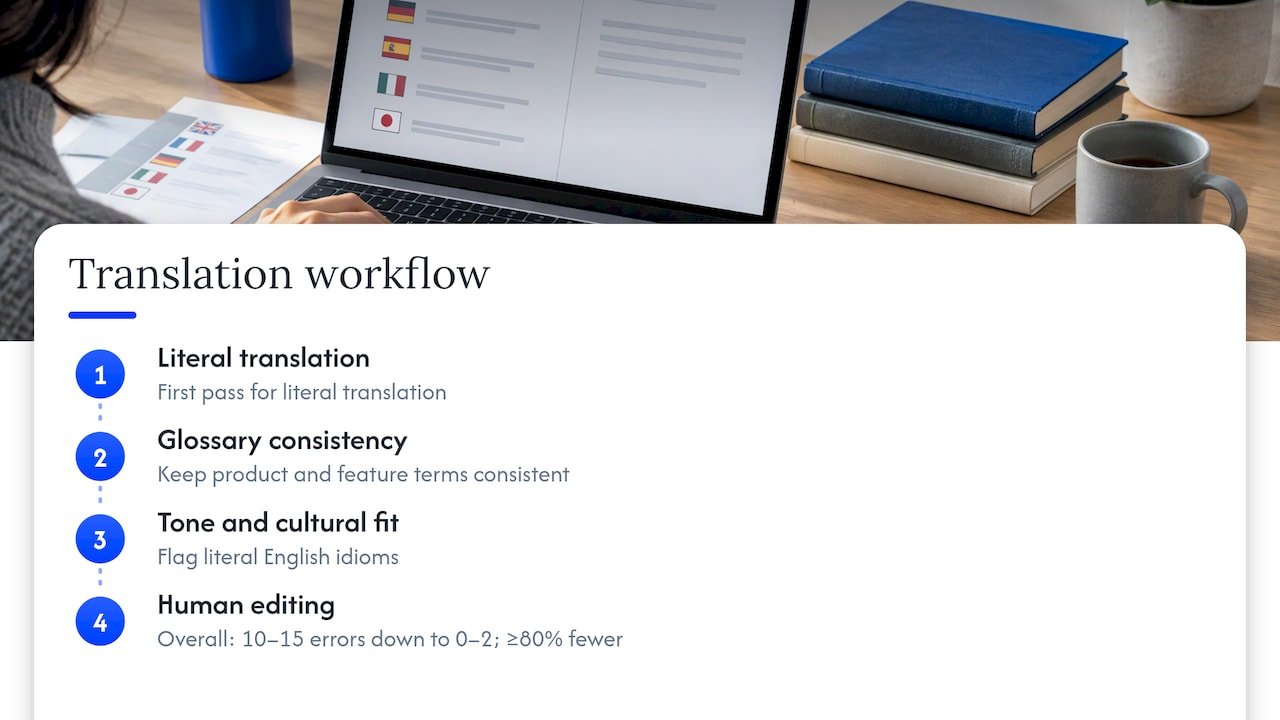
A single engine, run once, is the weakest way to use AI. The 2025 State of Translation Automation report from Intento found that multi-agent workflows can cut translation errors by at least 80%, often taking 10 to 15 errors per text down to 0 to 2. The idea is to separate jobs instead of asking one model to do everything.
In practice, you can mimic this on a small budget. Run a first pass for literal translation. Run a second pass with your glossary, so product names, feature names and the terms you want left in English stay consistent. Run a third pass that checks tone and cultural fit, asking the model to flag anything that sounds like a literal English idiom. Then a human reads it.
That last step is not optional for pages that earn money. Research on machine translation quality keeps showing that even strong models struggle with figurative language, puns and cultural nuance, and the authors of one recent study frame AI output as a first draft that high-stakes marketing text still needs people to refine. If you do not speak the language, hire a native speaker to edit your two or three test pages. It is a small cost compared with publishing something that makes your recommendation sound off.
If you want to make the text read less robotic before the human pass, our guide on how to humanize AI content has a quick workflow that works on translated drafts too.
Is AI-translated content a spam risk?
The worry is understandable. Google’s spam policy targets scaled content with little or no value to users, not translation as such. Search analyst Glenn Gabe has reviewed the policy and Google’s statements and concluded that it does not say AI-translated content is spam, while the focus stays on whether the content is helpful. The practical takeaway is simple: translate pages that are already good, and do not mass-produce thin pages in languages you have not checked.
Step 4: Set up the technical layer
This is the part that feels intimidating, but the checklist is short.
First, give every language version its own URL. Second, add hreflang annotations so each page points to its alternates, and to itself. Google’s documentation is clear that hreflang is not a ranking signal on its own. It is a way to help Google show the correct localized page to the right user. It also does not guarantee that every version gets indexed, so check indexing in Search Console after launch.
Third, make sure each translated page has its own localized title tag and meta description, not the English ones. Those are what people see in the results, and they are often forgotten. Fourth, submit your sitemap with all language versions. Google’s guidance on managing multilingual and multi-regional sites is the best reference for the details.
How you achieve this depends on your site. If you run a standard WordPress site, an integrated localization plugin or wrapper that creates real URLs and handles hreflang and metadata automatically will save you from a lot of implementation mistakes. If your site is custom or headless, you will likely work with a translation API directly and build those signals yourself. One comparison of translation tools for live websites makes the same point: pick the tool based on your architecture first and raw translation quality second.
Step 5: Fix internal links in every language
This is a quiet killer. When a tool translates a page, it often keeps the original links, or auto-maps them to pages that do not exist in the new language. Your Spanish reader clicks a link and lands on an English article, or on a 404.
Audit each translated page by hand. Link to the localized version of each related page when it exists. When it does not, either leave the link out or point to a page that really helps a reader in that language. Also check anchor text: it should use the natural phrase in the target language, ideally your researched keyword, not a stiff translation of the English anchor.
If you already use AI for site checks, our guide to AI SEO audits for affiliate marketers can be extended to crawl each language folder and list broken or mismatched links.
Step 6: Localize more than the words
Affiliate pages carry more than text. Currency symbols, prices, date formats, units and even product availability change by market. A review that lists a price in dollars to a reader in Germany feels foreign, and a link that sends them to a store that will not ship there loses the sale.
Check your affiliate links and disclosures too. Rules on disclosure vary by country, and what satisfies one market may not satisfy another. If you serve US readers, our EEAT and FTC disclosure steps are a good baseline, but look up the rules for each country you add before you publish.
And think about images and video. Screenshots in English inside a Spanish page undermine trust. If you make video, translated titles, descriptions and transcripts matter too, which we touched on in our AI YouTube SEO article.
Our perspective: speed is the gift, judgment is the job
We have coached and taught for a long time, and the pattern we see with AI is always the same. The tool saves you hours, and then people use the saved hours to publish more instead of to check more. In multilingual SEO, that is the wrong trade.
Here is how we think about it. AI should take the heavy, repetitive work: first-pass translation, glossary checks, drafting alternative titles, flagging inconsistent terms. You keep the decisions that need a human: which market to enter, which keywords match real intent, whether a sentence sounds like a person wrote it, whether a recommendation is honest for that reader.
We also think affiliates should be patient with themselves. You do not need ten languages. You need one language where a handful of pages earn something, and a process you trust. Once you have that, adding the next language is mostly repetition. If it does not earn after a fair test, you have lost a few weeks and a small editing fee, not a quarter.
And if you are feeling overwhelmed by all of this, that is normal. Start with one page this week.
— Will
A simple workflow you can copy this month
In week one, choose your language and your two or three pages, and confirm that your affiliate programs serve that market. In week two, research local keywords and write a short glossary. In week three, run your layered translation, send the pages to a native editor, and set up URLs, hreflang, localized titles and internal links. In week four, publish, submit the sitemap, and check indexing.
Then give it time. Track impressions and clicks by language folder in Search Console, and watch affiliate clicks and sales for those pages separately. Also try asking a few AI assistants questions in the new language and see whether your pages are cited. Keep a small log so you can compare what you did with what happened. If you want a way to organize the whole effort across your content calendar, our AI content strategy 90-day rollout is built for exactly that.
Where to go next
If you want practical help turning AI into a repeatable system, start with our AI workflow automation guide for affiliate marketers. It shows how to build the kind of layered process described above without adding hours to your week. And if you want updates as we publish new tutorials, you can find the newsletter and everything else on willbuckley.com.
FAQ
Can I just use a browser translation widget for multilingual SEO?
Usually not. A widget that translates text in the visitor’s browser does not give search engines a separate URL to crawl, so the translated version cannot rank. You need a setup that serves a real, indexable page for each language.
Do I need hreflang tags for every translated page?
If you have multiple versions of a page, Google recommends telling it about them. Hreflang is not a direct ranking signal, but it helps Google serve the right version to the right user. Add it on every page that has an alternate, including a reference to itself.
Is AI translation good enough without a human editor?
For low-stakes pages, a layered AI workflow can be a decent start. For pages that earn commission, we recommend a native-speaking editor, because models still struggle with idioms, tone and cultural nuance. Even a quick edit pass catches the awkward lines that cost trust.
How many languages should I start with?
One. Choose the market where your affiliate programs actually sell and where you already see some traffic, and translate two or three strong pages. Measure for a few weeks before you add more.
Sources
- Localized Versions of your Pages, Google Search Central
- Managing Multi-Regional and Multilingual Sites, Google Search Central
- Ellipsis research finds translated websites gain 327% more AI visibility
- Intento State of Translation Automation 2025 report
- Machine translation and cultural nuance study (arXiv)
- Search Engine Land
- Auto-translated content and Google’s scaled content abuse policy, GSQi
- Translation tools for live websites compared